Scientific Infrastructure or Expensive Theatre? AI Discovery’s Reckoning in Asia
02 June 2026 | Tuesday | Analysis
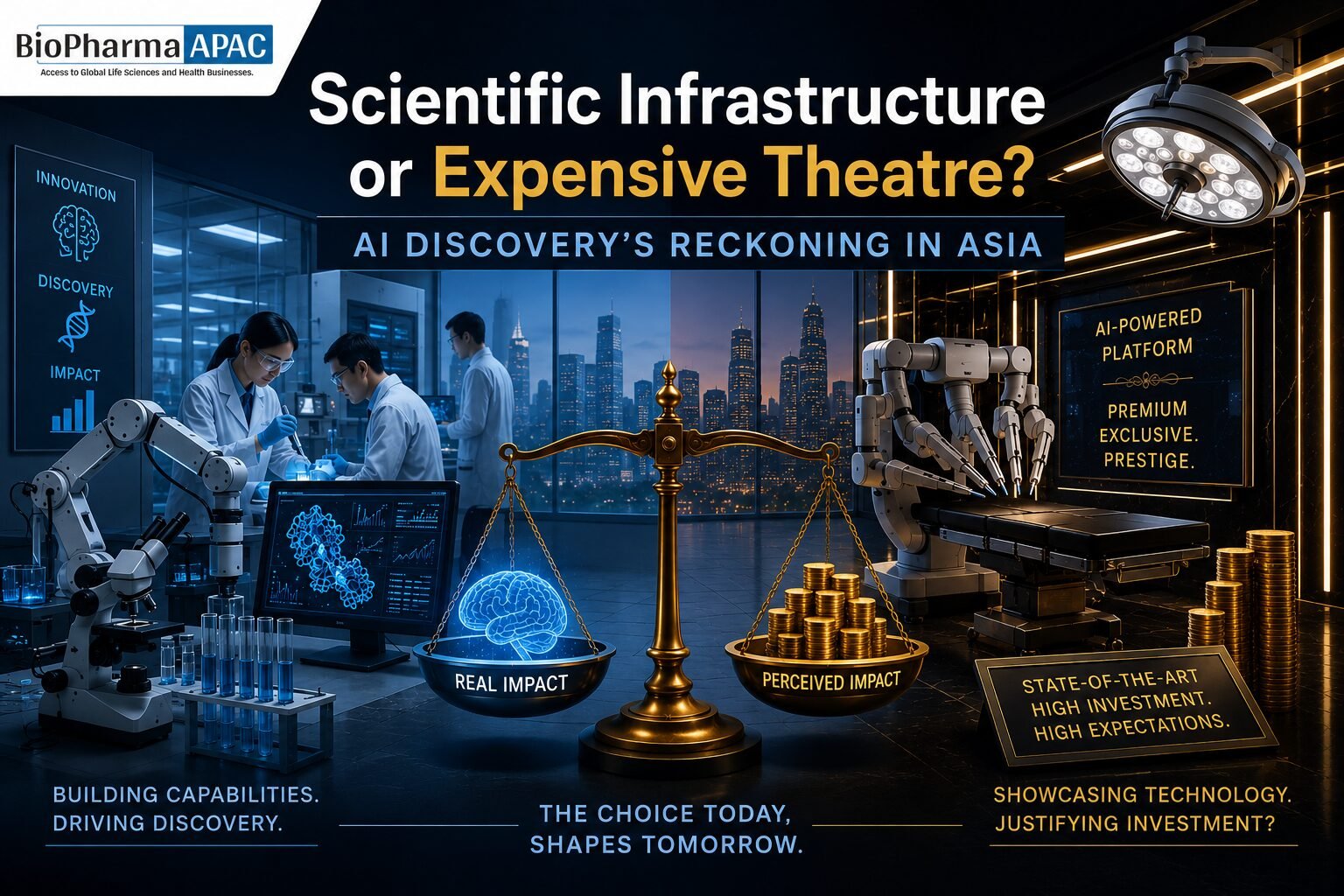
In October 2025, Eli Lilly announced it would build the most powerful supercomputer ever owned by a drug company. By February 2026, “LillyPod” was online — more than 1,000 NVIDIA Blackwell Ultra GPUs delivering over 9,000 petaflops, assembled in roughly four months, with high-bandwidth access to some 700 terabytes of genomics data. It is the most vivid symbol yet of a conviction that has hardened across the industry: that artificial intelligence is no longer a research curiosity but core scientific infrastructure, as fundamental as a wet lab or a clinical-operations team.
And yet, buried in the same announcements was an admission that should give every buyer pause. Lilly’s own chief information and digital officer said the benefits of all this power would not really arrive until 2030. No drug designed by AI has yet been approved by any regulator, anywhere. The most advanced AI-originated candidates are still working through mid-stage trials. The gap between the scale of the infrastructure and the thinness of the clinical proof is the central tension of the field — and nowhere is it more consequential, or more complicated, than in Asia.
How deep the embedding goes
Start with how thoroughly AI has been absorbed into the industry’s self-image. In ZS’s survey of pharma and biotech technology executives, roughly 85 percent said they planned to invest in data, digital and AI across R&D for the year, and the overwhelming majority expected to increase that spending rather than hold it flat. Deloitte found that around 60 percent of life-sciences executives named generative AI or broader digital transformation as the emerging trend they were watching most closely. McKinsey put pharma’s AI spending on a path from roughly $4 billion in 2025 toward $25.7 billion by 2030.
But the most revealing figure is a confession dressed as optimism. In ZS’s 2026 outlook, only about 17 percent of technology leaders reported measurable payoff from their AI investments in research and discovery, and 29 percent in clinical development — yet nearly half expected those investments to start delivering measurable value in the year ahead. Read that twice. The industry has overwhelmingly committed to AI as infrastructure while, by its own accounting, most of it has not yet paid off. Belief is running well ahead of audited return. That is not necessarily irrational — infrastructure takes time to compound — but it is precisely the condition in which theatre flourishes alongside substance, and in which a buyer needs a sharper test than vendor enthusiasm.
The validation gap
The honest scoreboard looks like this. By mid-2025, more than 29 publicly reported AI-driven therapeutic programs had advanced to human studies by one count; by early 2026, a broader tally put over 173 AI-originated programs in clinical development, up from around two dozen in late 2023. The pipeline is real and growing fast. The question is what happens once these molecules meet patients.
Here the data cuts both ways, and reading it carefully is the whole game. AI-discovered molecules show Phase I success rates of 80 to 90 percent, far above the historical industry average of roughly 50 to 65 percent. That is a genuine and encouraging signal — it suggests AI is good at designing molecules with drug-like properties that behave safely in early testing. But Phase I is mostly a safety gate. By Phase II, where efficacy is actually tested, AI-discovered molecules drop to around a 40 percent success rate — statistically indistinguishable from the traditional industry norm, and on a small sample at that. In other words, AI has measurably improved the early, mechanical part of discovery and has not yet demonstrably moved the needle on the hard part: whether a drug actually works in humans. The roughly 90 percent overall clinical failure rate of the pharmaceutical industry remains stubbornly intact.
The single most important validation event to date is also an Asian one. Insilico Medicine, a Hong Kong-headquartered biotech, took rentosertib (formerly ISM001-055) — a TNIK inhibitor for idiopathic pulmonary fibrosis in which both the target and the molecule were AI-generated — from concept to Phase IIa proof-of-concept. In June 2025, Nature Medicine published results from a 71-patient trial across 22 sites in China showing a meaningful improvement in lung function versus placebo. It is the closest thing the field has to a flagship: the first drug with an AI-designed target and compound to produce a credible mid-stage human readout. Notably, it was done in conjunction with traditional medicinal chemistry, not in place of it.
The cautionary tale arrived in the same period. Recursion Pharmaceuticals — which merged with Exscientia in 2024 to form one of the most prominent AI-native platforms — discontinued its lead AI-discovered candidate, REC-994, in May 2025 after longer-term data failed to confirm earlier efficacy signals. Multiple other AI-designed drugs were shelved or deprioritised after Phase II during the year. The lesson is not that AI failed; it is that AI is subject to the same brutal attrition as everything else in drug development. A molecule that looks brilliant on a model can still be silent in a patient.
The Asia overlay: data, compute, and talent
If the global picture is “deep belief, thin proof,” Asia adds three structural complications that make the infrastructure-versus-theatre question harder still.
The first is data sovereignty. AI models are only as good as the data they train on, and in Asia that data does not move freely. China treats human genetic data as a strategic national resource and has, since 1998, restricted its transfer to foreign parties — a regime now anchored by the 2019 Human Genetic Resources Regulation, its 2023 Implementation Rules, and the 2020 Biosecurity Law. Cross-border transfer of genomic data requires administrative review by the science ministry and, separately, a security assessment by the cyberspace regulator; the two run in parallel and can take months. Enforcement is real — BGI and AstraZeneca have both faced sanctions in the past for unauthorised handling of genetic samples. The effect on AI is direct: a multinational cannot simply pool its Chinese patient data into a global training set, and a Chinese biotech cannot freely export the very data that would make its models attractive abroad. A 2026 draft revision may narrow the definition of restricted data to nucleic-acid sequences — excluding pure clinical, imaging and protein data — but the localisation principle is nearly a decade entrenched and unlikely to vanish.
The wall runs both ways. The United States’ Executive Order 14117 now restricts bulk transfers of Americans’ genomic data to “countries of concern,” and BIOSECURE-era policy has pushed to curtail cross-border trials and CRO work that move U.S. genetic data to China. The practical upshot for AI discovery is a fragmenting of the world’s health data into national silos at exactly the moment when the technology’s appetite for large, diverse datasets is greatest. Federated approaches — training models where the data lives rather than moving it, as Lilly’s TuneLab attempts — are one workaround, but they are harder, slower, and less complete than a single pooled corpus.
The second constraint is compute. The LillyPod story is a Western one for a reason: it runs on more than a thousand cutting-edge NVIDIA GPUs. U.S. export controls on advanced AI chips mean Chinese and some other Asian players cannot reliably buy frontier accelerators at the scale a “LillyPod” requires. That forces a different model — smaller clusters, domestic chips, more algorithmic efficiency per FLOP — and it means the headline “pharma supercomputer” arms race is, for now, geographically lopsided. An Asian AI-biotech’s sophistication cannot be inferred from its raw compute; it has to be inferred from what it does with constrained compute.
The third is talent. The scarcest resource in AI drug discovery is the person who understands both transformer architectures and protein folding — and that person is being bid for simultaneously by big tech, big pharma, and well-funded startups. Industry surveys repeatedly flag the skills gap as a primary barrier: by various counts, talent shortages in data science affect the majority of pharma digital strategies. Across Asia, the crunch is acute. Singapore and Japan compete for a thin global pool; India produces strong software and computational talent but fewer with deep wet-lab biology; China has built genuine depth but faces brain-drain pressure and, increasingly, restricted collaboration with U.S. institutions. A buyer evaluating an Asian AI-biotech should weigh the founding team’s genuine dual fluency far more heavily than the size of its server room.
Real platforms versus rebadged services
All of which leads to the question that actually matters to anyone writing a cheque: how do you tell an AI platform that is scientific infrastructure from one that is expensive theatre? The funding data shows why the question is urgent. AI drug discovery has absorbed roughly $9.7 billion over the past decade, with about $2.1 billion in 2025 alone, and AI-biotechs now command premium valuations — Chai Discovery raised a $130 million round at a $1.2 billion valuation in late 2025. But the same investors are sobering up. As one Lux Capital partner put it, investor expectations “might have been too large,” and more than $17 billion has gone into the space since 2019 without a single candidate yet reaching large-scale clinical trials from the most-hyped names. PitchBook bluntly titled one analysis: AI drug discovery isn’t the layup VCs expected.
Academic researchers studying VC flows have given the phenomenon a name — “AI-washing” — the practice of a company invoking AI as a marketing label without it being a core scientific capability. The tell is usually structural rather than rhetorical. The most durable signal in 2025–26 financing was the shift from “AI service providers” to “AI-native” companies that build proprietary pipelines and advance their own therapeutic programs, carrying real clinical risk rather than selling algorithms at a markup. Investors increasingly require at least one asset in IND-enabling studies or the clinic before they’ll believe the platform claim. The strongest rounds went to companies pairing AI with experimental execution — closed-loop, wet-lab, physics-and-chemistry systems that shorten the design-make-test cycle — because, as Genesis Molecular AI’s founder put it, taking an off-the-shelf large language model and asking it to predict 3D drug-protein structures is “kind of a futile exercise.”
The aspiration, the validation, and the cautionary contrast now have clear avatars. The aspiration is the Lilly–NVIDIA supercomputer build — genuine infrastructure, but a bet whose payoff its own builders place at the end of the decade. The validation is Insilico’s rentosertib — an Asian, clinical-stage, AI-designed molecule with a real readout, built alongside traditional chemistry rather than instead of it. And the cautionary contrast is the long tail of startups that wrap public-database predictions in proprietary language, generate no data of their own, advance no asset of their own, and call it a platform. The distance between the three is the distance between infrastructure and theatre.
A buyer’s-eye test
So here is the sober framework the field has earned. AI is now real R&D infrastructure — the embedding is too deep, the early-phase signal too consistent, and the first credible mid-stage readouts too concrete to dismiss it as a bubble. But the clinical validation is still thin, the productivity claims are still largely unaudited, and in Asia the data walls, compute asymmetry and talent crunch mean that raw spend and big hardware are especially poor proxies for genuine capability.
The seven tests below are the questions a buyer — a pharma partner, an investor, an acquirer — should put to any AI-discovery company before believing the platform story. Each one separates a company that has built scientific infrastructure from one that has staged a performance. None of them is about how impressive the AI sounds. All of them are about whether the science is real, the data is owned, the risk is shared, and the molecule has met a patient. In a field where belief has run a decade ahead of proof, those are the only questions that survive contact with the clinic.
The Buyer’s-Eye Test: Infrastructure or Theatre?
Seven questions that separate a real AI-discovery platform from a rebadged service.
|
The test |
Infrastructure (substance) |
Theatre (froth) |
|
Clinical evidence |
At least one asset in the clinic with a real human readout; an OS or hard endpoint, not just a press release |
Everything is “preclinical” or “IND-enabling” in perpetuity; milestones always one year out |
|
The wet lab |
Closed-loop: AI design feeds its own experiments and learns from the results |
Predictions only; the company buys data it never generates and cannot correct its models |
|
Proprietary data |
Owns or generates differentiated training data others can’t replicate |
Trains on public databases anyone can access, then calls the output proprietary |
|
What it sells |
Advances its own therapeutic programs and carries the risk |
Sells “AI-enabled” services at a markup with no skin in the clinical game |
|
The model |
Purpose-built for biology/chemistry; understands why a molecule binds |
An off-the-shelf LLM asked to predict 3D protein structures — “a futile exercise” |
|
Honesty about limits |
Concedes AI compresses discovery but hasn’t beaten the ~90% clinical failure rate |
Claims AI “solves” drug discovery or will deliver approvals imminently |
(arcill.fran@biopharmaapac.com)
Most Read
- Can APAC Biomanufacturing Decarbonise Without Pricing Itself Out?
- The Algorithm on the GMP Floor: AI Promises a Smarter Plant. Regulators Demand the Audit Trail.
- APAC's Peptide-Capacity Gamble
- After the Rush: APAC's mRNA and Vaccine Capacity Hangover
- The Biosimilar Race: Factory to the World — or Stuck in the Copycat Economy?
- The Vein-to-Vein Problem: Can APAC's Cold Chain Carry Advanced Therapies?
- Vectors, Plasmids and the CGT Trap: APAC's Cell and Gene Therapy Ambitions Face an Upstream Bottleneck
- Can APAC Build Radioligand Therapy Before the Atoms Decay?
- The Great Biopharma Reset: 50 Developments That Changed Everything in H1 2026
- Beyond the Trial: Can Real-World Evidence Earn Regulatory Trust in APAC?
- Beyond the Obvious Giant: Where APAC's Clinical Trials Go Next
- The Frontier That Won’t Quite Arrive
Bio Jobs
- Sanofi Turns The Page As Belén Garijo Steps In And Paul Hudson Steps Out
- Global Survey Reveals Nearly 40% of Employees Facing Fertility Challenges Consider Leaving Their Jobs
- BioMed X and AbbVie Begin Global Search for Bold Neuroscience Talent To Decode the Biology of Anhedonia
- Thermo Fisher Expands Bengaluru R&D Centre to Advance Antibody Innovation and Strengthen India’s Life Sciences Ecosystem
- Accord Plasma (Intas Group) Acquires Prothya Biosolutions to Expand Global Plasma Capabilities
- ACG Announces $200 Million Investment to Establish First U.S. Capsule Manufacturing Facility in Atlanta
- AstraZeneca Invests $4.5 Billion to Build Advanced Manufacturing Facility in Virginia, Expanding U.S. Medicine Production
News