Two Chairs, 11,000 Kilometres Apart: The Human Cost of Asia’s Plasma Dependence
17 July 2026 | Friday | Analysis
REPORTAGE / PLASMA SUPPLY
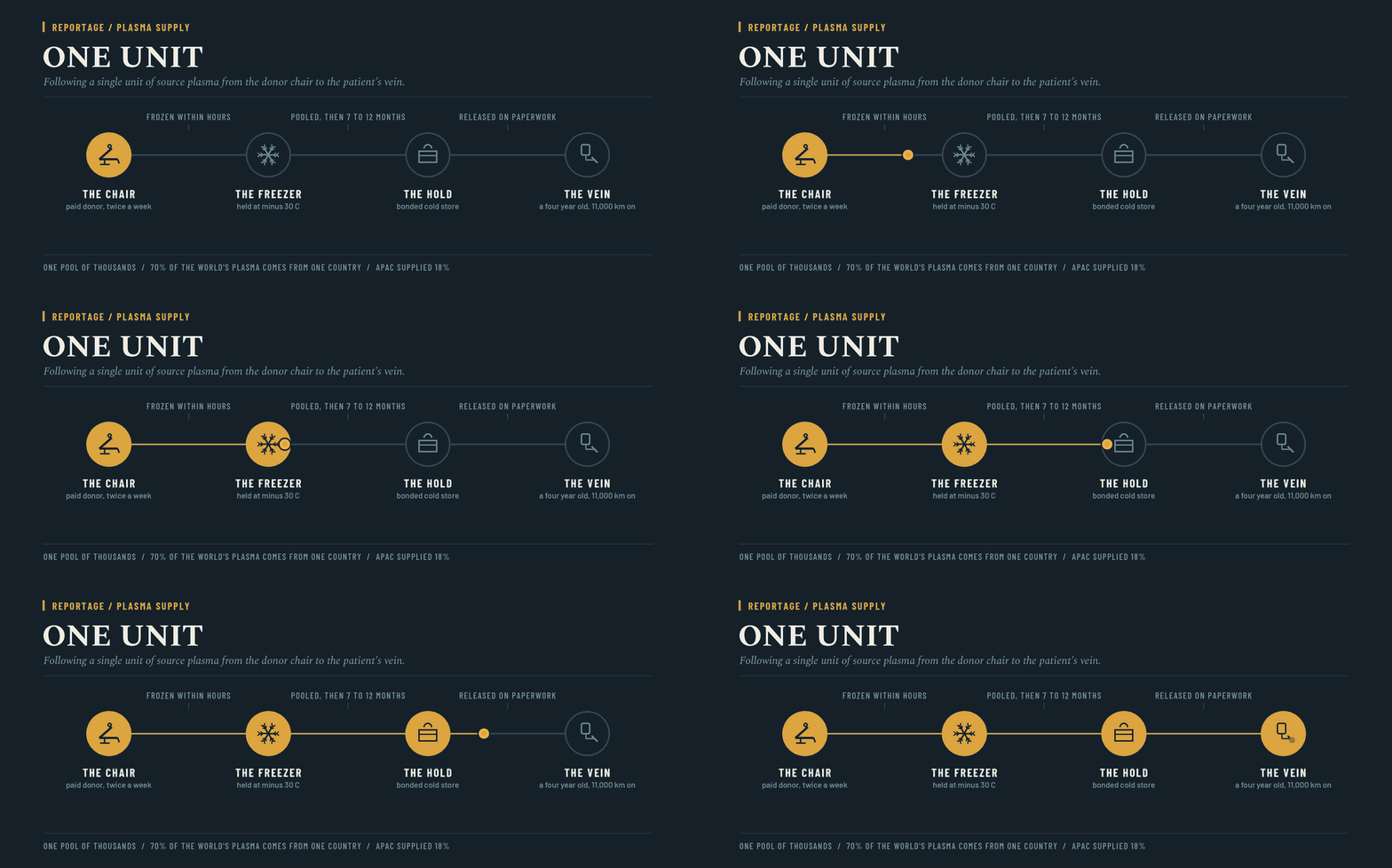
THE CHAIR
The chair reclines. That is the first thing you notice, walking into a plasma centre in a strip mall on the east side of a mid-sized American city, next to a nail salon and a payday lender. The chairs are the good kind, wide and vinyl, the kind that tilt back so a person can lie almost flat for an hour without their arm going to sleep. There are forty of them in two long rows under fluorescent light, and on a Tuesday afternoon in the corridor that runs along the southern border of the United States, most of them are full.
Marcus is in chair nineteen. He is thirty-one, he drives a forklift on the night shift at a distribution warehouse, and he is here for the eighty dollars. He says this plainly, without apology, because there is no reason to apologise for it. The eighty dollars is not abstract. It is his mother's insulin for the month, and the co-pay on a brake job he has been putting off since the noise started, and the difference between making rent on the first and making it on the fifth with a late fee attached. He comes twice a week, which is the legal maximum in this country, and he has been coming for two years. The needle no longer bothers him. What bothers him, a little, is the small talk, so he keeps his earbuds in.
This is the thing to understand about the chair, and it is the whole story compressed into one seat: the chair is full because of Marcus's reasons, and Marcus's reasons are entirely his own. Two chairs down, a woman in scrubs is donating on her lunch break because her daughter's soccer team needs new uniforms and the fundraiser fell short. Across the aisle, a retired postal worker comes because the routine gives his week a shape it lost when he stopped working, and the money buys his grandchildren things his pension will not stretch to. A collection culture is not a policy. It is a room full of individual reasons, and this room is full because in this country those reasons are allowed to be paid.
Ask enough people in a room like this why they came, and you stop hearing a single answer and start hearing a portrait of a place. Nobody in chair nineteen or twenty or twenty-one describes themselves as part of a supply chain. Nobody says the word plasma the way the industry says it, as a raw material, a feedstock, a commodity measured in litres and shipped in reefers. They say rent. They say tuition. They say my kid needs and I'm short and it's easy money and I've got the time. The abstraction that policy people argue over, national self-sufficiency, security of supply, the ethics of compensation, does not exist inside this building. What exists is a set of household budgets that happen, twice a week, to route through a needle. That is what a collection culture actually is. Not a strategy. An accumulation of small, private necessities in a country that decided those necessities could be met with plasma, and that the people meeting them could be paid. Take the payment away and most of these chairs empty, and the argument that seems so theoretical in a conference room becomes a physical absence, a room that used to be full and now is not.
A phlebotomist named Denise swabs the crook of Marcus's left arm, finds the vein she has found a hundred times before, and slides the needle in. The machine beside the chair begins its cycle. This is not a whole-blood donation. It is apheresis, which means the machine draws Marcus's blood, spins it in a centrifuge to separate the straw-coloured plasma from the red cells, keeps the plasma, and returns the red cells to his arm along with a little saline. He will feel a brief cold where the saline goes back in. The cycle repeats several times over the next forty minutes. At the end of it, a plastic bottle on the machine holds roughly 800 millilitres of plasma, warm, faintly gold, and belonging, for a few more minutes, to Marcus.
That bottle is our unit. Everything that follows happens to it.
THE LABEL
Before the bottle leaves the collection floor, it acquires an identity. A barcode is printed and fixed to its side, tying it to Marcus's donation record, his last physical, the protein screen from his most recent visit, and the two forms of identification he showed at the door. In an adjacent room, tubes of his blood are already on their way to a testing laboratory that may be in another state, where they will be checked for hepatitis B and C, for HIV, for anything that would disqualify the unit. Nothing about the unit is casual. Everything about it is documented, because the entire industry downstream depends on being able to say, months from now and thousands of miles away, exactly where this fluid came from and that it was safe.
The unit is carried to the back of the centre, and here it meets the first machine that could kill it.
THE FREEZER
Plasma is a living inventory of proteins, and some of those proteins are impatient. The most delicate is a clotting factor called Factor VIII, and it begins to degrade the moment it leaves the body and the temperature is wrong. To hold the plasma still, to stop time inside the bottle, the unit must be frozen hard, and it must be frozen fast, within hours of collection. Not chilled. Frozen, down to roughly thirty degrees below zero and held there.
There is a blast freezer at the back of the centre for exactly this, and a walk-in freezer beyond it where the day's units wait in stacked trays until a refrigerated truck comes for them. The unit goes into the blast freezer first. Somewhere on the wall there is a temperature logger with an alarm, and the alarm is the quiet hero of this entire story, because everyone in the building understands what it protects against.
Consider what a temperature excursion would mean at this exact moment. Say the freezer's compressor fails overnight and no one is there to hear the alarm. Say the units climb from thirty below to something merely cold, and hover there for six hours before a technician arrives at opening and sees the reading. The proteins do not announce their own ruin. The unit still looks like plasma. But the labile factors inside it may be gone, and because no one can prove they are intact, the unit cannot be trusted, and a unit that cannot be trusted is a unit that is thrown away. Not sold at a discount. Destroyed. Marcus's forty minutes, Denise's steady hand, the money that was going to be insulin and a brake job: all of it survives, because the eighty dollars was already his. What does not survive is the medicine that this bottle was going to become for someone who has not yet been born into this story. A temperature excursion here is not a spoiled product. It is a dose that a patient somewhere will simply never receive, subtracted from a supply that was already too small, and no one will ever know their name.
The alarm does not sound tonight. The compressor holds. In the morning the truck comes, and the unit, now a frozen brick in a labelled bag, is loaded into a reefer trailer alongside several hundred others and driven to a consolidation warehouse, and then, still frozen, toward a fractionation plant.
THE POOL
Here is where the story has to be honest about arithmetic, because here is where the unit stops being a unit.
A fractionation plant does not treat one bottle of plasma as one anything. It works in oceans. Thousands of frozen donations are received, thawed under controlled conditions, and combined into a single manufacturing pool. Marcus's 800 millilitres are emptied into a tank alongside the plasma of several thousand strangers, and in that moment the barcode that made the unit a unit becomes a line in a batch record rather than a thing you can point to. You could no longer find Marcus's plasma in the tank if you tried. It is now a fraction of a fraction, a few drops of gold dissolved into a reservoir the size of a small swimming pool.
This is the fact that makes the whole subject so hard to feel. Argued in the aggregate, plasma dependency is a shrug. It is a percentage in a report, a bar on a chart, a sentence in a market forecast. And the reason it refuses to land is precisely this pooling: the individual donation vanishes into the collective almost immediately, and the individual patient receives something that has no single origin. The chair and the vein are real and specific. Everything between them is a blur of thousands.
But the blur has a direction, and the direction is the argument. That reservoir is fed, overwhelmingly, by chairs like the one Marcus sat in, in a country that pays its donors and lets them come twice a week. It is not fed, in any meaningful quantity, by chairs in the region where our unit is going. The pool is American because the chairs are American, and the chairs are American because the reasons are allowed to be paid.
From the pool, over a process that takes not days but the better part of a year, the plant separates the plasma into its valuable proteins by a method of cold and alcohol and patience that has changed less than you would think since it was invented in the 1940s. Albumin settles out. Clotting factors are captured. And the fraction that matters most to our story, the immunoglobulin, the concentrated antibodies that a certain kind of patient cannot live without, is purified, tested exhaustively, and filled into small glass vials. One of those vials, carrying within it the statistical ghost of Marcus's donation and thousands of others, is boxed, labelled with a lot number and an expiry date, and enters the part of the journey where borders start to cost money.
THE HOLD
The vial does not walk into Asia. It is imported into Asia, and importing is a verb with paperwork.
Follow it to the air cargo terminal of a major Indian airport, arriving in the belly of a freighter inside an insulated shipper packed with dry ice and a temperature logger of its own, the same quiet hero from the collection centre freezer, riding the whole way to prove the cold never broke. The shipment does not clear on landing. It goes into a bonded cold store, a chilled cage inside the customs zone, and it waits.
It waits for documents. An import licence for a plasma-derived medicine is not a form you fill in at the counter. It is a file that has been building for months: the manufacturer's certificates, the batch's test records, the proof that this specific lot was released by the regulators in the country where it was made, the registration that permits this product to be sold in this country at all. A customs officer does not evaluate medicine. She evaluates whether the file is complete and whether it matches the box, and if a single certificate is missing or a number on one page does not agree with a number on another, the box stays in the cage while emails cross oceans and time zones, and the clock that matters is not the customs clock but the expiry clock printed on the vial.
Stand in front of the cold store long enough and the abstraction of a border resolves into something physical and slightly absurd. The medicine is here. You could point at it through the mesh of the cage. A child who needs it is across the city. And between the two of them stands not a wall or a distance but a stack of paper that has to agree with itself. The lot number on the vial must match the lot number on the release certificate must match the number on the invoice must match the number on the import licence. When they agree, the box moves in minutes. When one of them does not, the box does not move at all, and a discrepancy that a clerk could resolve in a sentence instead waits on a reply from an office that is asleep because it is on the other side of the world. The reefer's generator hums. The dry ice sublimates and has to be topped up. The logger keeps writing its patient line of temperatures, proving the cold has held, while the one thing the cold cannot stop, the calendar, keeps moving toward the date printed on the label.
There is a specific reason this vial had to make this journey, and it is written into the law of the country receiving it. India does not permit the collection of source plasma by apheresis for fractionation. The chair that Marcus sat in cannot legally exist here. Whatever plasma India recovers comes as a byproduct of ordinary blood donation, componentised when it is componentised at all, and it is nowhere near enough. For the specialised immunoglobulins in particular, the country is almost wholly dependent on exactly this box, in exactly this cage, waiting for exactly this paperwork. The dependency is not an accident of the market. It is, in part, a matter of statute meeting a supply that only one part of the world produces at scale.
Every hour in the hold is a cost, and the cost is not only money, though it is also money, layered on at every handoff from the pool onward until the finished dose is many times more expensive than the plasma that seeded it. The deeper cost is time subtracted from a product that was always going to expire, and shipped halfway around a planet because it could not be made where it was needed. Eventually the file is complete. The certificate that was missing is found. The box is released, moves to a licensed importer's cold chain, then to a distributor, then to a hospital pharmacy's refrigerator, where it sits on a shelf beside other boxes and waits for a name to be assigned to it.
The name, when it comes, is Aarav.
THE VEIN
Aarav is four. He is in a bed on the paediatric floor of a large hospital, in a gown printed with cartoon elephants, and he is watching a video on his mother's phone with the total absorption of a child who has learned that hospitals are boring and phones are not. He has an immune deficiency, one of the primary immunodeficiencies, which means his body does not make the antibodies that are supposed to stand between him and the ordinary microbial world. For most children a cold is a cold. For Aarav, before the diagnosis, a cold was a pneumonia was a week on oxygen was a set of parents who learned to read his breathing at three in the morning.
The treatment is antibodies from other people. He receives an infusion of immunoglobulin every three to four weeks, and he will receive it, in one form or another, for the rest of his life. A nurse spikes the vial, our vial, into a line, checks the label against his chart twice, and starts the drip slow to watch for a reaction. The pale liquid moves down the tube and into the cannula taped to the back of Aarav's small hand, and into his vein, and into the bloodstream that could not defend him on its own. Somewhere in that fluid, immeasurably diluted, are antibodies that a forklift driver's body made on a Tuesday afternoon in a strip mall eleven thousand kilometres away.
Aarav does not know this. Why would he. He knows the infusion takes a couple of hours and that afterward he gets to choose the restaurant. His mother knows more. She knows the brand name, and she knows it is imported, and she knows that in the bad months a few years ago there were shortages, weeks when the pharmacy could not promise the next dose and she sat in the corridor doing a kind of arithmetic no parent should have to do. She does not know the word fractionation. She does not know that her son's medicine begins in strangers' arms in another hemisphere, that it is pooled from thousands of them, that it took most of a year to make and days to clear a customs cage, that the reason it could not simply be made down the road is a tangle of law and economics and the plain fact that not enough people here sit in the chair. She knows only that it comes, and that when it comes he is well, and that this is the arrangement her family's life now depends on.
The infusion finishes. The nurse flushes the line. Aarav chooses the restaurant.
TWO CHAIRS
There are two chairs in this story, and the whole argument lives in the distance between them.
The first is the wide vinyl recliner that tilts back, in a room that is full because a man needed eighty dollars and a country lets him earn it with his plasma. The second is a hospital bed with a cartoon-elephant gown, in a country where the first chair is not permitted to exist, holding a child whose ordinary life is on loan from the first room's abundance. The bag left one and, transformed almost beyond recognition, arrived at the other, and at no point along the way did the fluid ever belong to the place that needed it most.
You can argue about plasma self-sufficiency for a decade, and many people have, in conference rooms and policy papers and the footnotes of market forecasts. You can debate donation models and pricing and whether paying donors is a market solution or a moral hazard or both at once. But the debate keeps failing to land, because it is conducted in the aggregate, and the aggregate is a blur, a reservoir the size of a swimming pool with no faces in it.
So set the aggregate down for a moment and picture the chair instead. Picture it full, and picture it empty, and picture the eleven thousand kilometres and the freezer alarm and the customs cage and the expiry clock that connect the full one to the empty one. A collection deficit is not a statistic. It is a room with too few chairs in it, and a child at the far end of a very long supply chain, watching a video, waiting for the drip to finish, with no idea that the antibodies keeping him alive were made by a stranger who will never know his name.
The argument, in numbers
The dependency is real, and it is concentrated in one country.
The United States supplies roughly 70 percent of the plasma used worldwide, and holds about 80 percent of the world's plasma collection centres. On any given day, around 200,000 Americans donate plasma across more than 1,200 centres, drawn largely by compensation of roughly 50 to 120 US dollars a visit and by rules that permit donation up to twice a week. US collections reached an estimated 62.5 million litres in 2025. Few other countries permit paid donation at this scale, and none matches the output.
Sources: PPTA and industry data via Georgetown Blood and Plasma Research Group (2026); Haemonetics FY2025 annual report; Vox Sanguinis (Belmonte et al., 2025).
Asia Pacific consumes far more than it collects.
In 2020 the Asia Pacific region supplied about 18 percent of the global plasma supply, and roughly three-quarters of that came from China alone. The rest of the region collects little relative to its need. Asia Pacific is now the fastest-growing plasma fractionation market, forecast at close to a 9 percent compound annual growth rate through the early 2030s, which widens rather than closes the gap between demand and domestic supply.
Sources: Vox Sanguinis (Belmonte et al., 2025); Mordor Intelligence, plasma fractionation market (2026).
Demand is growing faster than collection can follow.
Immunoglobulins now account for roughly half of the global plasma-protein market and the majority of fractionation revenue. The global immunoglobulin market is projected to expand from about 13.4 billion US dollars in 2023 to roughly 25 billion by 2032. Manufacturing is slow: producing immunoglobulin from plasma takes about 7 to 12 months, against 2 to 3 months for many other biologics, so a shortfall today cannot be corrected quickly.
Sources: Vox Sanguinis (Belmonte et al., 2025); Marketing Research Bureau (2026).
India is a study in structural dependence.
Indian law does not permit source (apheresis) plasma collection for fractionation, so the country relies on recovered plasma from whole-blood donation, of which only a fraction is componentised and made available for fractionation. India fractionates on the order of 500,000 litres a year and produces mainly albumin and immunoglobulins, while specialised hyperimmune globulins are essentially fully imported, as finished product or as bulk. The national blood donation rate sits below 1 percent of the population, and access is deeply uneven: in parts of northern India, a majority of residents lack timely access to transfusion services at all.
Sources: Annals of Blood (Ajmani et al., 2018; Ramesh et al., 2025); Invest India; Mordor Intelligence, India plasma fractionation market (2026).
Other advanced economies face the same slope.
Even wealthy, voluntary-donation systems import heavily. Australia sources less than half of its immunoglobulin domestically and is on track to import as much as 70 percent by 2030 as an ageing population drives demand. Canada, one of the highest per-capita users of immunoglobulin in the world, covers under 20 percent of its own requirement. The pattern is consistent: where donation is unpaid, collection rarely keeps pace with need, and the shortfall is met from the one supply that does.
Sources: BioPharma APAC (2026); Vox Sanguinis (Belmonte et al., 2025).
(arcilla.fran@biopharmaapac.com)
Note: figures are drawn from industry, regulatory and peer-reviewed sources dated 2018 to 2026 and are indicative rather than audited. Where a range exists in the literature, the most commonly cited figure has been used.
About this story: the supply chain, the regulations and every figure in the article and footerbar come from the published industry, regulatory and peer-reviewed sources cited alongside. The journey of the single unit is a reconstruction assembled from those sources rather than an account of one documented donation, and Marcus, Denise and Aarav are composites. No person, collection centre, fractionator or hospital in this article is a real individual or institution. We have written it this way because the chain described is real, routine and largely closed to observation, and because a dependency argued only in aggregate has failed for a decade to land.
Most Read
- Can APAC Biomanufacturing Decarbonise Without Pricing Itself Out?
- The Algorithm on the GMP Floor: AI Promises a Smarter Plant. Regulators Demand the Audit Trail.
- APAC's Peptide-Capacity Gamble
- After the Rush: APAC's mRNA and Vaccine Capacity Hangover
- The Biosimilar Race: Factory to the World — or Stuck in the Copycat Economy?
- The Vein-to-Vein Problem: Can APAC's Cold Chain Carry Advanced Therapies?
- Vectors, Plasmids and the CGT Trap: APAC's Cell and Gene Therapy Ambitions Face an Upstream Bottleneck
- Can APAC Build Radioligand Therapy Before the Atoms Decay?
- The Great Biopharma Reset: 50 Developments That Changed Everything in H1 2026
- Beyond the Trial: Can Real-World Evidence Earn Regulatory Trust in APAC?
- Beyond the Obvious Giant: Where APAC's Clinical Trials Go Next
- The Frontier That Won’t Quite Arrive
Bio Jobs
- Sanofi Turns The Page As Belén Garijo Steps In And Paul Hudson Steps Out
- Global Survey Reveals Nearly 40% of Employees Facing Fertility Challenges Consider Leaving Their Jobs
- BioMed X and AbbVie Begin Global Search for Bold Neuroscience Talent To Decode the Biology of Anhedonia
- Thermo Fisher Expands Bengaluru R&D Centre to Advance Antibody Innovation and Strengthen India’s Life Sciences Ecosystem
- Accord Plasma (Intas Group) Acquires Prothya Biosolutions to Expand Global Plasma Capabilities
- ACG Announces $200 Million Investment to Establish First U.S. Capsule Manufacturing Facility in Atlanta
- AstraZeneca Invests $4.5 Billion to Build Advanced Manufacturing Facility in Virginia, Expanding U.S. Medicine Production
News