Biotech Failures 2026: What Did Not Happen in APAC Biopharma
02 October 2026 | Friday | Analysis
Approvals get counted, deals get ranked, listings get priced. The other half of the year, the programmes that stopped, the applications that came back, the partnerships that ended quietly in a footnote, rarely gets the same treatment. When it is covered at all, it arrives as a list of headlines with no common standard behind them.
This piece applies to the negative record the same discipline this series applies to approvals. An entry qualifies only if the sponsor disclosed it, a partner disclosed it in a filing, or a regulator or registry recorded it with a date. Analyst notes, unnamed sources and market chatter do not qualify. Each entry carries what was expected, what was disclosed and when, the reason the company gave, and the reference a reader can open.
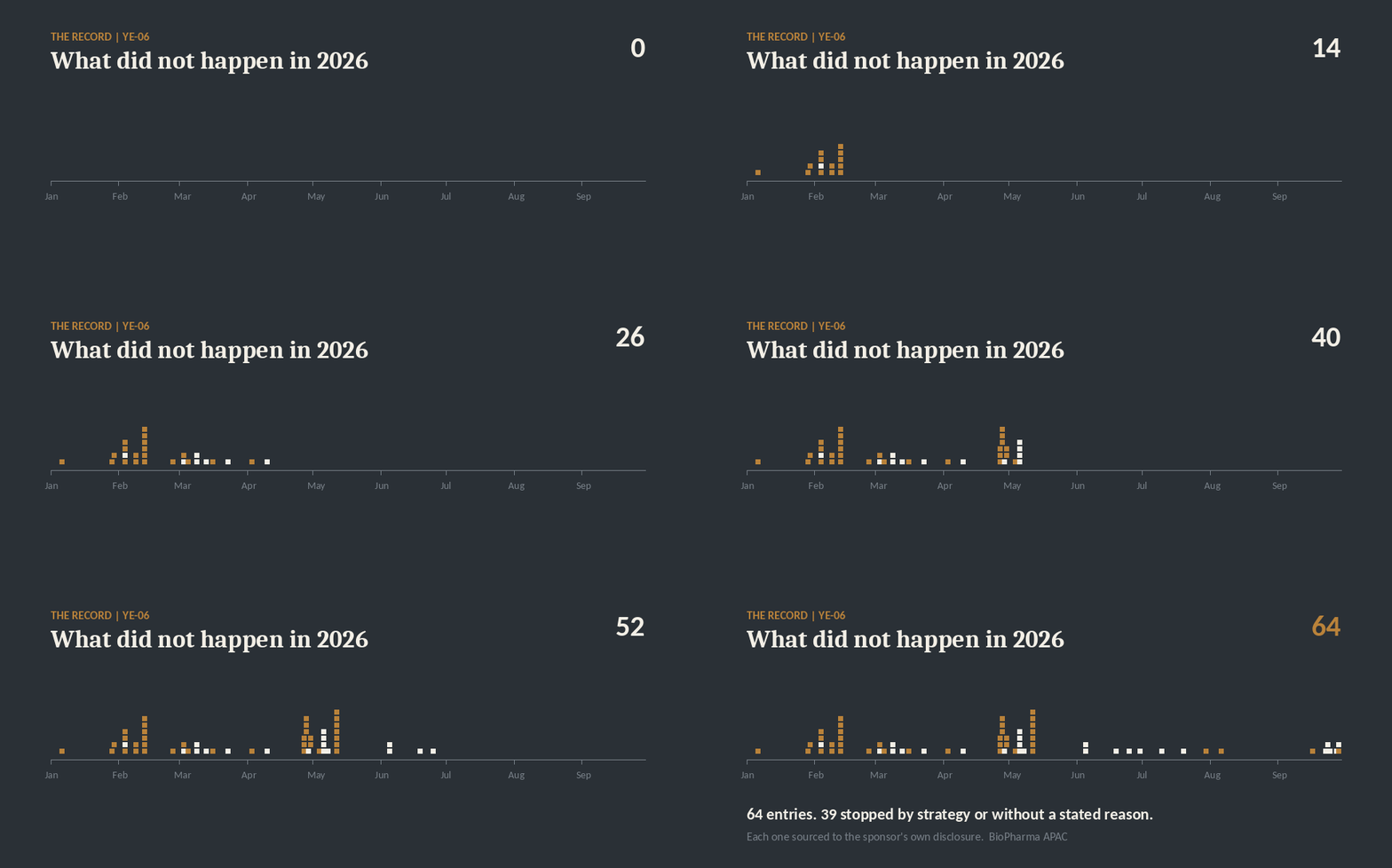
The count at our cut is 64. Read across the whole year, the record says something the individual headlines do not: the most common reason an Asia-Pacific programme stopped in 2026 was a portfolio decision, and the second most common was no stated reason at all. Data killed fewer programmes than strategy did.
|
METHOD Scope. Discontinuations, terminations, market withdrawals, withdrawn or refused marketing applications, ended licensing and collaboration deals, and publicly guided dates that were missed, where at least one party is headquartered in Asia-Pacific. Window: disclosures dated 1 January to 30 September 2026 in this edition; October to December entries are added in place before the year closes, each with a dated revision note. Inclusion. The sponsor's own disclosure (press release, results presentation, pipeline table, exchange filing) or a registry or regulator status change with a date. Press speculation does not qualify. Where a partner disclosed and the sponsor did not, the partner's filing is the reference and that is stated. Reasons. We report the reason as stated and sort it into one of six categories: efficacy or data, safety, strategy or portfolio, regulatory or CMC, money or market, and no reason stated. Where no reason was given, the entry says so. No entry is a verdict on a company. Counting. One entry per programme, per indication cluster, or per deal. A programme stopped in two separate disclosures counts twice only if the two decisions were distinct. Boundaries. Company-by-company depth on trials stopped since 2020 sits in the group's discontinued-trials investigation; this is the calendar-year record. Any contested reading of a failure belongs to Fault Lines. |
The count
Sixty-four entries from 32 Asia-Pacific companies and their partners, across five markets. By record type, 43 are programme discontinuations, 11 are ended deals, five are application setbacks, four are missed public dates and one is a market withdrawal.
By stated reason, strategy or portfolio accounts for 22 entries and no reason stated for 17. Efficacy or data accounts for 13. Regulatory or CMC accounts for seven, money or market for three, and safety for two. Put the first two together and 39 of 64 entries, 61%, were stopped for reasons that the company either framed as a choice or did not explain.
By phase at stop, Phase 1 leads with 19, then Phase 2 with 14 and Phase 3 with nine. Six entries were at the filing stage, two were marketed products, two were corporate events and one was preclinical. Eleven disclosures did not state a phase, which is itself a finding about how much the market is told.

Figure 1 sets out both cuts.
Figure 1. Discontinuations by stated reason and by phase, APAC sponsors, 1 January to 30 September 2026. Source: BioPharma APAC analysis of sponsor disclosures.
One caution sits above everything else in this count. Forty of the 64 entries come from Japanese companies. That is not because Japanese pipelines failed more often. It is because Japan's large pharma companies publish a pipeline-changes table every quarter, often with a reason column, and they file it on the exchange. Chinese biotechs, which run some of the region's largest early-stage pipelines, contribute eight entries, half of them from one company's earnings slides. The negative record is shaped by who discloses, and readers should treat the national split as a map of transparency, not of performance.
I. The data said no
Thirteen entries cite efficacy or a failure to meet internal criteria. Five of them were Phase 3.
Gilteritinib, PASHA (HOVON 156). Astellas with HOVON. Expected: a Phase 3 overall survival benefit over midostaurin in newly diagnosed FLT3-mutated AML fit for intensive chemotherapy. Disclosed: topline on 9 March 2026; listed as discontinued in the Q1 FY2026 pipeline update. Reason: primary endpoint of overall survival not met. Reference: Astellas and HOVON release, 9 March 2026.
Eftilagimod alfa, TACTI-004. Immutep. Expected: full enrolment of the Phase 3 first-line NSCLC study with pembrolizumab and chemotherapy, guided for Q3 2026. Disclosed: 13 March 2026, discontinuation on the independent data monitoring committee's recommendation after the planned interim futility analysis. Reason: futility. The company described itself as disappointed and surprised given the agent's earlier results. Reference: Immutep release, 13 March 2026.
Avacincaptad pegol, Stargardt disease. Astellas. Expected: a Phase 2b result supporting expansion of the complement C5 aptamer beyond geographic atrophy. Disclosed: 4 February 2026, Q3 FY2025 pipeline slides. Reason: primary endpoint not met. Reference: Astellas Q3 FY2025 presentation.
Emugrobart, spinal muscular atrophy and FSHD. Chugai with Roche. Expected: progression of the anti-latent-myostatin antibody into Phase 3 in SMA (MANATEE) and FSHD (MANOEUVRE). Disclosed: 23 March 2026. Reason: muscle effects did not translate into the intended functional outcomes consistently or robustly enough to justify Phase 3. Reference: Chugai release, 23 March 2026.
Emugrobart, obesity. Chugai with Roche. Expected: Phase 2 GYMINDA to show clinically meaningful weight loss with muscle preservation in combination with incretin therapy. Disclosed: 28 September 2026. Reason: an interim analysis found the pre-specified weight-loss objectives unlikely to be met; the drug was well tolerated with no new safety findings. Roche returns all rights, and Chugai says it is preparing to restart SMA work and seek a licensee. Reference: Chugai release, 28 September 2026.
Imeroprubart (IMVT-1402), cutaneous lupus. HanAll Biopharma with Immunovant. Expected: a Phase 2b proof of concept for the anti-FcRn antibody. Disclosed: 23 September by Immunovant, 24 September by HanAll. Reason: the week-12 CLASI-A primary endpoint was missed, with the competitive treatment landscape also cited. Reference: NCT06980805; Immunovant and HanAll disclosures.
Four oncology programmes. BeOne Medicines. BG-60366 (EGFR), BGB-53038 (pan-KRAS), BG-89894 (MAT2A) and BG-68501 (CDK2), all Phase 1. Disclosed: 6 May 2026 in the Q1 earnings presentation, not in the accompanying press release. Reason: did not meet internal development criteria. A CCR8 antibody was paused and a Phase 2 IRAK4 degrader study in rheumatoid arthritis halted pending data review; neither is counted as a discontinuation. Reference: BeOne Q1 2026 presentation.
The remaining three efficacy entries, all in knee osteoarthritis, are taken together in Section VI because what happened after the data is the more important part of their record.
II. The safety signal
Two entries, both involving secondary malignancy, and both ending programmes that had shown efficacy.
Rocatinlimab, all indications. Kyowa Kirin. Expected: filings from the Phase 3 ROCKET programme in atopic dermatitis, with asthma and prurigo nodularis behind it. Disclosed: on 30 January 2026 Amgen ended the partnership, citing strategic portfolio prioritisation, and Kyowa Kirin regained global rights. On 3 March 2026 Kyowa Kirin stopped all ongoing trials. Reason: emerging data on malignancies, including Kaposi sarcoma, with possible links to OX40 pathway modulation; the company concluded the potential risks may outweigh the benefits for the populations studied. Reference: Kyowa Kirin releases of 30 January and 3 March 2026.
Tazemetostat, China, Hong Kong and Macau. HUTCHMED, licensed from Ipsen. Expected: continued commercial supply and China trials of the EZH2 inhibitor. Disclosed: 9 March 2026, withdrawal and recall, with all active China trials stopped and SYMPHONY-1 open for safety follow-up only. Reason: Ipsen's US withdrawal after the SYMPHONY-1 data monitoring committee found that secondary haematological malignancies meant risks may outweigh benefits. HUTCHMED said 2025 sales were US$2.5 million and guidance was unaffected. Reference: HUTCHMED HKEX announcement, 9 March 2026.
III. The portfolio decided
Twenty-two entries cite strategy or portfolio priorities. Most come in batches, from the quarterly pipeline tables that Japanese companies publish with their results.
Ulotaront and eight further programmes. Otsuka. On 13 February 2026, with full-year results, Otsuka listed ulotaront in schizophrenia in Japan and China (Phase 2/3, partnered with Sumitomo Pharma), centanafadine in major depressive disorder, brexpiprazole in PTSD, TAS-115 across several oncology and fibrosis indications, TAS-303 in stress urinary incontinence and OPS-2071 in irritable bowel syndrome as discontinued. On 28 April it added OPC-214870 in epilepsy, ulotaront in major depressive disorder and TAS1553 in AML. Reason, for all nine: discontinued for strategic reasons. Phases were not given for eight of the nine. Reference: Otsuka Holdings results materials, 13 February and 28 April 2026.
Four programmes. Astellas. ASP4396, a KRAS G12D degrader in Phase 1, was terminated on 4 February to focus on its sister asset ASP3082. On 27 April, with full-year results, Astellas halted AT132, its AAV gene therapy for X-linked myotubular myopathy, stating the impairment was not due to safety and did not reflect a change in scientific rationale; a next-generation candidate replaces it. ASP1570 in oncology and ASP5502 in Sjögren's syndrome, both Phase 1, were stopped as business decisions unrelated to safety. Reference: Astellas Q3 FY2025 and FY2025 presentations.
DS-9606. Daiichi Sankyo. Expected: progression of the CLDN6-directed ADC in germ cell and other CLDN6-positive tumours. Disclosed: 30 January 2026. Reason: internal development discontinued following a strategic portfolio review. Reference: Daiichi Sankyo Q3 FY2025 presentation.
ONO-4578, ONO-7913 and DCC-3084. Ono Pharmaceutical. The EP4 antagonist ONO-4578 was stopped in breast cancer in March 2026 while continuing in gastric, colorectal and lung cancer; ONO-7913, the anti-CD47 antibody magrolimab, was stopped in pancreatic and colorectal cancer in April. Both were reported on 30 April as discontinued for strategic reasons. Ono's US subsidiary Deciphera stopped DCC-3084, a pan-RAF inhibitor in Phase 1, in early March for reasons it said were unrelated to safety or efficacy. References: Ono FY2025 supplementary materials; Deciphera disclosure.
Five partnership exits also fall in this category, because the departing partner gave strategy as the reason.
DSP-0187. Sumitomo Pharma and Jazz. Disclosed 26 February 2026: rights to the oral orexin-2 agonist revert to Sumitomo Pharma after Jazz's decision based on its own business strategy. Reference: Sumitomo Pharma release.
HRS-1167 (M9466) and the SHR-A1904 option. Jiangsu Hengrui and Merck KGaA. Expected: global development of the PARP1 inhibitor licensed in October 2023 for €160 million upfront. Disclosed: early March 2026 in Merck KGaA's pipeline update and statements; rights return to Hengrui, which keeps the upfront. Reason: pipeline prioritisation. Reference: Merck KGaA disclosure. We located no Hengrui exchange filing on the termination; the partner's disclosure is the reference.
Masked T-cell engager alliance. CytomX and Astellas. Disclosed 16 March 2026 in CytomX's annual results: Astellas chose not to advance the remaining preclinical programmes. Reference: CytomX release.
DNL593. Denali and Takeda. Expected: co-development of the progranulin replacement in frontotemporal dementia with GRN mutations. Disclosed: 3 April 2026, termination effective after 60 days, with all rights reverting to Denali. Reason: strategic considerations, not related to efficacy or safety data. Reference: Denali 8-K, 3 April 2026.
APB-R5. AprilBio and Yuhan. Disclosed 4 May 2026: the 2022 licence and joint research agreement ended. Reason: changes in R&D strategy and priorities in a fast-moving market. Reference: AprilBio disclosure filing.
IV. The partner walked away, without saying why
Seventeen entries carry no stated reason. Nine of them are from companies that published a list of removed programmes without a reason column, and four are deals where the departing partner, or the filing, did not explain itself.
Seven programmes. Shionogi. With FY2025 results on 12 May 2026, Shionogi's pipeline no longer carried resiniferatoxin for knee osteoarthritis pain (Phase 3, licensed from Grünenthal), the MGAT2 inhibitor S-309309 in obesity (Phase 2), epertinib, the mesenchymal stem cell product ADR-001 in decompensated cirrhosis, the Nav1.7 inhibitor S-151128, the urinary tract infection candidate S-743229 and the peptide vaccine S-588410. Reason: none stated. Reference: Shionogi FY2025 materials and the 30 January pipeline supplement.
E7130 and E8001. Eisai. Disclosed 9 February 2026: development of E7130 in solid tumours has finished, and the Japan Phase 1 study of E8001 in transplant rejection was finished. Reason: none stated. Reference: Eisai Q3 FY2025 filing.
TAK-101. Takeda. Expected: a path forward for the gliadin-loaded nanoparticle in celiac disease after its Phase 2 completed in January. Disclosed: 30 July 2026 in Q1 FY2026 materials, with a JPY 3.1 billion impairment for a terminated celiac programme. Reason: an assessment of the programme and available information; no specific finding stated. Reference: Takeda 6-K, 30 July 2026.
BRY10. Chugai. The company's only antibody designed with its MALEXA AI platform, in Phase 1 for an unnamed chronic disease, was removed on 29 January 2026 after what a spokesperson called a comprehensive review of the data. Reason: none specified beyond the review. Reference: Chugai FY2025 results.
Enfortumab vedotin, EV-104 and EV-202. Astellas with Pfizer. Disclosed 4 February 2026: the NMIBC study and the multi-tumour study were removed from the pipeline. Reason: none stated. Reference: Astellas Q3 FY2025 presentation.
IMM2510 and IMM27M. ImmuneOnco and Axion Bio. Expected: ex-China development of the PD-L1xVEGF bispecific under a 2024 licence worth up to about US$2 billion. Disclosed: 6 January 2026, development discontinued and licence terminated; ImmuneOnco keeps US$35 million received. Reason: none stated. Reference: Instil Bio release, 6 January 2026.
Kostaive and the sa-mRNA collaboration. CSL Seqirus and Arcturus. Expected: commercialisation of the self-amplifying mRNA COVID-19 vaccine under a December 2022 deal with headline value of about US$4.3 billion. Disclosed: 6 August 2026 in Arcturus's 8-K, termination and settlement, with Arcturus regaining global rights; CSL's FY2026 results on 18 August listed the end of the collaboration and a US$590 million impairment. Reason: none stated in either filing. Reference: Arcturus 8-K; CSL FY2026 results presentation.
ORM-6151. Orum Therapeutics and Bristol Myers Squibb. Expected: development of the GSPT1 degrader-antibody conjugate in AML and high-risk MDS, bought for US$100 million upfront in 2023. Disclosed: 17 September 2026; BMS halted development after reviewing clinical data. Orum keeps the upfront and forgoes up to US$80 million in milestones. Reason: the disclosure does not say whether safety or efficacy drove it, and Orum said it was notified unexpectedly. Reference: Orum KRX disclosure.
Belvarafenib. Hanmi and Genentech. Disclosed 29 September 2026: Genentech's licence of the pan-RAF inhibitor ends effective 27 December 2026. Hanmi keeps the US$80 million upfront from 2016 and said Genentech had stopped pursuing development years ago. Reason: none stated in the notice. Reference: Hanmi DART filing, 29 September 2026.
V. The regulator said not yet
Seven entries record an application withdrawn, refused, returned or delayed. Three of the five application setbacks cite manufacturing, not efficacy.
Ifinatamab deruxtecan, ES-SCLC. Daiichi Sankyo with Merck. Expected: US accelerated approval for the B7-H3 ADC on Phase 2 data. Disclosed: 25 September 2026, BLA voluntarily withdrawn. Reason: data including IDeate-Lung01 did not satisfy the requirements for accelerated approval. The companies will assess a future filing on the Phase 3 IDeate-Lung02, which they describe as near completion. Reference: Daiichi Sankyo and Merck release, 25 September 2026.
Rivoceranib with camrelizumab, first-line HCC. HLB's Elevar Therapeutics and Jiangsu Hengrui. Expected: FDA action ahead of a 23 July 2026 goal date. Disclosed: 10 July 2026, a third complete response letter. Reason: deficiencies from a cGMP inspection of a manufacturing site listed on the NDA; no efficacy or safety issues were raised. Reference: Elevar release; NDA 216586 and BLA 761308.
TX05, trastuzumab biosimilar. Tanvex BioPharma. Expected: US approval. Disclosed: late June 2026, a third complete response letter. Reason: manufacturing issues at a third-party downstream manufacturer. Reference: Tanvex exchange disclosure. Published reports place the letter between 23 and 26 June; the desk carries the filing date.
Efepoetin alfa (Efesa). Genexine. Expected: Korean approval in anaemia of chronic kidney disease. Disclosed: 5 June 2026, MFDS did not approve. Reason: additional CMC and risk management plan data required, which the company called addressable; it plans to resubmit. Reference: Genexine disclosure.
Zircaix (TLX250-CDx). Telix Pharmaceuticals. Expected: US approval of the kidney cancer PET agent on resubmission. Disclosed: a corrected complete response letter dated 10 April 2026, recorded in Telix's half-year results in August with an extended resubmission deadline. Reason: none stated beyond outstanding CRL items. Reference: Telix H1 2026 results; BLA 761401.
Leqembi Iqlik. Eisai with Biogen. Expected: an FDA decision by 24 May 2026. Disclosed: in early May, the goal date moved to 24 August after the FDA classed Eisai's response to an information request as a major amendment. Reason: regulatory process. Reference: Eisai and BioArctic disclosures.
Tovecimig, biliary tract cancer. ABL Bio with Compass Therapeutics. Expected: a BLA for the DLL4/VEGF-A bispecific after its Phase 2/3. Disclosed: on 29 April 2026 overall survival did not reach significance; on 22 September Compass said the FDA recommends a survival trial before a BLA. Compass disputes that reading; how to interpret the result is for Fault Lines. Reference: Compass release, 22 September 2026.
VI. The money, and the knee
Three entries are classed as money or market, but this is where the year's most consequential failures sit, because for single-asset companies a Phase 3 result is also a balance sheet event.
Zilosul, PARA_OA_012, knee osteoarthritis. Paradigm Biopharmaceuticals. Expected: a Phase 3 interim analysis in September 2026. Disclosed: trading halt on 21 September; on 23 September the trial fell below its continuation threshold, with missing data from operational problems affecting the analysis; on 30 September the company appointed administrators from FTI Consulting. Reason for administration: time needed to resolve a mismatch between short-term liabilities and the long-term value of its intellectual property. Reference: ASX announcements, 21 to 30 September 2026.
CYP-004, SCUlpTOR, knee osteoarthritis. Cynata Therapeutics. Expected: Phase 3 readout in mid-2026. Disclosed: on 17 June a Phase 2 study of CYP-001 was halted; on 19 June the Phase 3 missed both co-primary endpoints; on 6 July all roles including the chief executive were made redundant; the FY2026 report on 31 August flagged a going-concern emphasis of matter. Reason for the trial stop: efficacy. Reference: Cynata ASX announcements.
TG-C, ACTiVION-II, knee osteoarthritis. Kolon TissueGene. Expected: Phase 3 data in July and a BLA on this year's results, as the company told Korean press in June. Disclosed: 20 July 2026, both co-primary endpoints missed, with the company pointing to placebo response; no BLA timeline was given and next steps await ACTiVION-I in October. Reference: Kolon TissueGene release, 20 July 2026.
FC303. FutureChem and Curium. Disclosed 4 to 5 June 2026: FutureChem terminated the European licence of its PSMA PET agent itself. Reason: development in Europe was progressing more slowly than planned and would delay launch significantly. Reference: FutureChem KRX disclosure.
AriBio merger. AriBio and AriBio Holdings. Expected: completion of a merger agreed in August 2024 that was to give the AR1001 developer its listed route. Disclosed: 29 September 2026, merger abandoned. Reason: the merged entity's reference share price sat far below the appraisal price, risking large appraisal-rights claims. Reference: AriBio Holdings regulatory filing.
H-share listing. Northland Bio. Disclosed 30 June 2026: the Hong Kong listing plan filed in October 2025 was terminated in favour of a domestic placement. Reason: the external macro environment, capital market conditions and strategic plans. Reference: Northland Bio exchange announcement.
What the failures cluster around
The brief for this piece asked whether the year's failures cluster around a modality, a mechanism, a market or money. The record supports four findings, each narrower than a headline would make it.
Market: the knee. Four of the nine Phase 3 entries are knee osteoarthritis: Paradigm, Cynata, Kolon TissueGene and Shionogi's resiniferatoxin. They span a small molecule, an iPSC-derived cell therapy, a cell and gene therapy and an intra-articular TRPV1 agonist. Different modalities, one indication, and a recurring company explanation in placebo response and missing data. No other indication appears more than twice in the late-stage record.
Mechanism: two pairs and one signal. Two pan-RAF inhibitors left pipelines (DCC-3084 and belvarafenib) and two KRAS-directed programmes did too (ASP4396 and BGB-53038). The two safety entries, OX40 modulation and EZH2 inhibition, are unrelated mechanisms that ended on the same finding: secondary malignancy.
Modality: the conjugates. Five entries are conjugates: DS-9606, the two enfortumab vedotin studies, ifinatamab deruxtecan's US filing and ORM-6151. None of these is a verdict on the class, which also produced many of the year's approvals and largest deals. The point is narrower: when a modality fills pipelines, it also fills the discontinuation table.
Money: the upfront stays. In four ended deals, the APAC licensor keeps cash already received: Orum US$100 million, Hanmi US$80 million, ImmuneOnco US$35 million and Hengrui its €160 million. For licensors the downside of a returned asset in 2026 was the lost milestones, not a clawback. For the three listed single-asset companies in Section VI, there was no partner cushion, and the trial result became the corporate result.
The absences
The most consistent feature of the 2026 record is what it does not say. Seventeen entries carry no stated reason. Eleven do not state the phase at which the programme stopped. Several of the year's most significant removals surfaced only in slide decks and supplementary tables, not in press releases, which means anyone tracking the region through announcements alone would have missed them.
There is also a structural absence. Japanese companies filed 40 of the 64 entries because their disclosure format forces the question every quarter. Chinese, Korean, Australian and Indian sponsors report stopped programmes less systematically, and no Indian sponsor produced a qualifying entry in the window. A region whose pipeline is increasingly the source of global licensing deals, as this series has documented, does not yet publish a negative record of matching depth.
That is the case for keeping this list annually and to the same standard every year. The approvals record shows what the region can do. This one shows what it chose to stop, and how much it chose to say.
References, by entry
- 2026-01-06, ImmuneOnco / Axion Bio (Instil Bio): IMM2510 and IMM27M licence. https://www.globenewswire.com/news-release/2026/01/06/3213459/0/en/
- 2026-01-29, Chugai: BRY10 (MALEXA-designed antibody). https://www.fiercebiotech.com/biotech/chugai-drops-only-ai-assisted-antibody-pipeline-still-has-high-hopes-technology
- 2026-01-30, Daiichi Sankyo: DS-9606 CLDN6 ADC. https://www.daiichisankyo.com/files/investors/library/quarterly_result/2025/Q3/FY2025Q3_Financial_Results_Presentation_E.pdf
- 2026-02-04, Astellas: ASP4396 KRAS G12D degrader. https://www.astellas.com/content/dam/astellas-com/global/en/confidential-documents/financial-results/3q2025_pre_en.pdf
- 2026-02-04, Astellas: Avacincaptad pegol, Stargardt disease. https://www.astellas.com/content/dam/astellas-com/global/en/confidential-documents/financial-results/3q2025_pre_en.pdf
- 2026-02-04, Astellas / Pfizer: Enfortumab vedotin EV-104 (NMIBC). https://www.astellas.com/content/dam/astellas-com/global/en/confidential-documents/financial-results/3q2025_pre_en.pdf
- 2026-02-04, Astellas / Pfizer: Enfortumab vedotin EV-202. https://www.astellas.com/content/dam/astellas-com/global/en/confidential-documents/financial-results/3q2025_pre_en.pdf
- 2026-02-09, Eisai: E7130, solid tumours. https://post.tokyoipo.com/tdnet/20260209/202602091530/20260209551192/140120260209551192.pdf
- 2026-02-09, Eisai: E8001, transplant rejection. https://post.tokyoipo.com/tdnet/20260209/202602091530/20260209551192/140120260209551192.pdf
- 2026-02-13, Otsuka / Sumitomo Pharma: Ulotaront, schizophrenia (Japan, China). https://fs2.magicalir.net/tdnet/2026/4578/20260213559778.pdf
- 2026-02-13, Otsuka: Centanafadine, MDD. https://fs2.magicalir.net/tdnet/2026/4578/20260213559778.pdf
- 2026-02-13, Otsuka: Brexpiprazole, PTSD. https://fs2.magicalir.net/tdnet/2026/4578/20260213559778.pdf
- 2026-02-13, Otsuka / Taiho: TAS-115 (pamufetinib), several indications. https://fs2.magicalir.net/tdnet/2026/4578/20260213559778.pdf
- 2026-02-13, Otsuka / Taiho: TAS-303, stress urinary incontinence. https://fs2.magicalir.net/tdnet/2026/4578/20260213559778.pdf
- 2026-02-13, Otsuka: OPS-2071, IBS. https://fs2.magicalir.net/tdnet/2026/4578/20260213559778.pdf
- 2026-02-26, Sumitomo Pharma / Jazz: DSP-0187 orexin-2 agonist licence. https://www.sumitomo-pharma.com/news/20260226-1.html
- 2026-03-03, Kyowa Kirin (Amgen exit 30 Jan): Rocatinlimab, all trials. https://www.kyowakirin.com/media_center/news_releases/2026/e20260303_01.html
- 2026-03-03, Ono (Deciphera): DCC-3084 pan-RAF inhibitor. https://www.fiercebiotech.com/biotech/onos-deciphera-drops-early-candidate-advanced-solid-tumors-pipeline
- 2026-03-05, Hengrui / Merck KGaA: HRS-1167 (M9466) licence and SHR-A1904 option. https://www.fiercebiotech.com/biotech/merck-kgaa-ending-pursuit-remaining-assets-39b-springworks-buyout
- 2026-03-09, HUTCHMED (licensed from Ipsen): Tazemetostat, China, HK, Macau. https://www.globenewswire.com/news-release/2026/03/09/3251601/0/en/HUTCHMED-Announces-Update-on-Licensed-Oncology-Product-TAZVERIK-in-China.html
- 2026-03-09, Astellas / HOVON: Gilteritinib PASHA, newly diagnosed FLT3m AML. https://newsroom.astellas.com/2026-03-09-astellas-and-hovon-confirm-phase-3-study-did-not-meet-its-primary-endpoint-of-overall-survival-in-patients-with-newly-diagnosed-flt3m-aml
- 2026-03-13, Immutep: TACTI-004 eftilagimod alfa, 1L NSCLC. https://www.globenewswire.com/news-release/2026/03/13/3255426/0/en/TACTI-004-Phase-III-Study-in-First-Line-NSCLC-to-be-discontinued-following-Futility-Analysis.html
- 2026-03-16, CytomX / Astellas: Masked T-cell engager alliance. https://www.globenewswire.com/news-release/2026/03/16/3256146/0/en/
- 2026-03-23, Chugai / Roche: Emugrobart, SMA and FSHD. https://www.chugai-pharm.co.jp/english/news/detail/20260323083000_1236.html
- 2026-04-03, Denali / Takeda: DNL593 co-development. https://www.globenewswire.com/news-release/2026/04/03/3268105/0/en/
- 2026-04-10, Telix: Zircaix (TLX250-CDx) BLA. https://ir.telixpharma.com/news-releases/news-release-details/telix-2026-half-year-results-strong-commercial-execution-and
- 2026-04-27, Astellas: AT132 resamirigene bilparvovec. https://www.astellas.com/content/dam/astellas-com/global/en/confidential-documents/financial-results/4q2025_pre_en.pdf
- 2026-04-27, Astellas: ASP1570, oncology. https://www.astellas.com/content/dam/astellas-com/global/en/confidential-documents/financial-results/4q2025_pre_en.pdf
- 2026-04-27, Astellas: ASP5502, Sjogren's. https://www.astellas.com/content/dam/astellas-com/global/en/confidential-documents/financial-results/4q2025_pre_en.pdf
- 2026-04-28, Otsuka: OPC-214870, epilepsy. https://finance-frontend-pc-dist.west.edge.storage-yahoo.jp/disclosure/20260428/20260427511401.pdf
- 2026-04-28, Otsuka / Sumitomo Pharma: Ulotaront, MDD (US). https://finance-frontend-pc-dist.west.edge.storage-yahoo.jp/disclosure/20260428/20260427511401.pdf
- 2026-04-28, Otsuka / Taiho: TAS1553, AML. https://finance-frontend-pc-dist.west.edge.storage-yahoo.jp/disclosure/20260428/20260427511401.pdf
- 2026-04-29, ABL Bio / Compass: Tovecimig BLA path, biliary tract cancer. https://www.stocktitan.net/news/CMPX/compass-therapeutics-provides-regulatory-update-on-tovecimig-in-yfx5q0vg64h6.html
- 2026-04-30, Ono: ONO-4578 EP4 antagonist, breast cancer. https://finance.biggo.com/news/jpx_tdnet_140120260430515731
- 2026-04-30, Ono: ONO-7913 (magrolimab), GI cancers. https://finance.biggo.com/news/jpx_tdnet_140120260430515731
- 2026-05-04, AprilBio / Yuhan: APB-R5 licence and joint R&D. https://v.daum.net/v/20260504164932200
- 2026-05-06, BeOne Medicines: BG-60366 (EGFR). https://www.fiercebiotech.com/biotech/beone-shelves-5-cancer-programs-halts-phase-2-rheumatoid-arthritis-trial
- 2026-05-06, BeOne Medicines: BGB-53038 (pan-KRAS). https://www.fiercebiotech.com/biotech/beone-shelves-5-cancer-programs-halts-phase-2-rheumatoid-arthritis-trial
- 2026-05-06, BeOne Medicines: BG-89894 (MAT2A). https://www.fiercebiotech.com/biotech/beone-shelves-5-cancer-programs-halts-phase-2-rheumatoid-arthritis-trial
- 2026-05-06, BeOne Medicines: BG-68501 (CDK2). https://www.fiercebiotech.com/biotech/beone-shelves-5-cancer-programs-halts-phase-2-rheumatoid-arthritis-trial
- 2026-05-08, Eisai / Biogen: Leqembi Iqlik PDUFA date (24 May). https://grafa.com/en/news/united-states/bioarctic-b-leqembi-iqlik-fda-pdufa-extension-august-2026
- 2026-05-12, Shionogi: Resiniferatoxin, knee OA pain. https://finance-frontend-pc-dist.west.edge.storage-yahoo.jp/disclosure/20260512/20260512525748.pdf
- 2026-05-12, Shionogi: S-309309 MGAT2 inhibitor, obesity. https://finance-frontend-pc-dist.west.edge.storage-yahoo.jp/disclosure/20260512/20260512525748.pdf
- 2026-05-12, Shionogi: Epertinib (S-222611). https://finance-frontend-pc-dist.west.edge.storage-yahoo.jp/disclosure/20260512/20260512525748.pdf
- 2026-05-12, Shionogi: ADR-001 MSCs, decompensated cirrhosis. https://finance-frontend-pc-dist.west.edge.storage-yahoo.jp/disclosure/20260512/20260512525748.pdf
- 2026-05-12, Shionogi: S-151128 Nav1.7 inhibitor. https://finance-frontend-pc-dist.west.edge.storage-yahoo.jp/disclosure/20260512/20260512525748.pdf
- 2026-05-12, Shionogi: S-743229, complicated UTI. https://finance-frontend-pc-dist.west.edge.storage-yahoo.jp/disclosure/20260512/20260512525748.pdf
- 2026-05-12, Shionogi: S-588410 peptide vaccine, oesophageal cancer. https://finance-frontend-pc-dist.west.edge.storage-yahoo.jp/disclosure/20260512/20260512525748.pdf
- 2026-06-05, FutureChem / Curium: FC303 Europe licence. https://www.koreabiomed.com/news/articleView.html?idxno=31909
- 2026-06-05, Genexine: Efepoetin alfa (Efesa) MFDS application. https://www.koreabiomed.com/news/articleView.html?idxno=31914
- 2026-06-19, Cynata Therapeutics: CYP-004 SCUlpTOR, knee OA. https://kalkinemedia.com/au/news/announcements/cynata-therapeutics-reports-phase-2-and-3-trial-failures-announces-major-restructuring-in-fy2026-annual-report
- 2026-06-25, Tanvex BioPharma: TX05 trastuzumab biosimilar BLA. https://insights.citeline.com/generics-bulletin/products/biosimilars/tanvex-hits-strike-three-on-us-trastuzumab-biosimilar-RAVJ6OXFB5AGXDJHAIA65PHSPA/
- 2026-06-30, Northland Bio: Hong Kong H-share listing. https://www.mrjjxw.com/articles/2026-07-01/4444138.html
- 2026-07-10, HLB (Elevar) / Hengrui: Rivoceranib plus camrelizumab, 1L HCC. https://www.drugs.com/nda/rivoceranib_260710.html
- 2026-07-20, Kolon TissueGene: TG-C ACTiVION-II, knee OA. https://www.globenewswire.com/news-release/2026/07/20/3329671/0/en/Kolon-TissueGene-Reports-Topline-ACTiVION-II-Phase-3-Clinical-Trial-Results-for-TissueGene-C-TG-C-Targeting-Osteoarthritis-OA-of-the-Knee.html
- 2026-07-30, Takeda: TAK-101, celiac disease. https://www.sec.gov/Archives/edgar/data/1395064/000139506426000327/form6k_073026.htm
- 2026-08-06, CSL Seqirus / Arcturus: sa-mRNA vaccine collaboration (Kostaive). https://www.stocktitan.net/sec-filings/ARCT/8-k-arcturus-therapeutics-holdings-inc-reports-material-event-8b0dfb2db184.html
- 2026-09-17, Orum Therapeutics / BMS: ORM-6151 (BMS-986497). https://www.koreabiomed.com/news/articleView.html?idxno=33237
- 2026-09-23, Paradigm Biopharmaceuticals: Zilosul PARA_OA_012, knee OA. https://biotechdispatch.com.au/news/disappointment-for-paradigm-as-phase-3-knee-osteoarthritis-trial-fails-futility-test
- 2026-09-24, HanAll Biopharma / Immunovant: Imeroprubart, cutaneous lupus. https://www.dermatologytimes.com/view/imvt-1402-misses-primary-endpoint-in-cutaneous-lupus-proof-of-concept-trial
- 2026-09-25, Daiichi Sankyo / Merck: Ifinatamab deruxtecan BLA, ES-SCLC. https://www.financialcontent.com/article/bizwire-2026-9-25-ifinatamab-deruxtecan-biologics-license-application-for-certain-patients-with-previously-treated-extensive-stage-small-cell-lung-cancer-voluntarily-withdrawn
- 2026-09-28, Chugai / Roche: Emugrobart, obesity; rights returned. https://www.chugai-pharm.co.jp/english/news/detail/20260928160000_1289.html
- 2026-09-29, Hanmi / Genentech: Belvarafenib licence. https://en.sedaily.com/finance/2026/09/30/hanmi-regains-rights-to-cancer-drug-belvarafenib-from
- 2026-09-29, AriBio / AriBio Holdings: Merger and listing route. https://en.sedaily.com/finance/2026/09/30/aribio-holdings-shares-plunge-20-percent-after-merger
Most Read
- Can APAC Biomanufacturing Decarbonise Without Pricing Itself Out?
- The Algorithm on the GMP Floor: AI Promises a Smarter Plant. Regulators Demand the Audit Trail.
- APAC's Peptide-Capacity Gamble
- After the Rush: APAC's mRNA and Vaccine Capacity Hangover
- The Biosimilar Race: Factory to the World — or Stuck in the Copycat Economy?
- The Vein-to-Vein Problem: Can APAC's Cold Chain Carry Advanced Therapies?
- Vectors, Plasmids and the CGT Trap: APAC's Cell and Gene Therapy Ambitions Face an Upstream Bottleneck
- Can APAC Build Radioligand Therapy Before the Atoms Decay?
- The Great Biopharma Reset: 50 Developments That Changed Everything in H1 2026
- Beyond the Trial: Can Real-World Evidence Earn Regulatory Trust in APAC?
- Beyond the Obvious Giant: Where APAC's Clinical Trials Go Next
- The Frontier That Won’t Quite Arrive
Bio Jobs
- Sanofi Turns The Page As Belén Garijo Steps In And Paul Hudson Steps Out
- Global Survey Reveals Nearly 40% of Employees Facing Fertility Challenges Consider Leaving Their Jobs
- BioMed X and AbbVie Begin Global Search for Bold Neuroscience Talent To Decode the Biology of Anhedonia
- Thermo Fisher Expands Bengaluru R&D Centre to Advance Antibody Innovation and Strengthen India’s Life Sciences Ecosystem
- Accord Plasma (Intas Group) Acquires Prothya Biosolutions to Expand Global Plasma Capabilities
- ACG Announces $200 Million Investment to Establish First U.S. Capsule Manufacturing Facility in Atlanta
- AstraZeneca Invests $4.5 Billion to Build Advanced Manufacturing Facility in Virginia, Expanding U.S. Medicine Production
News