The Technology Is Ready. Are APAC’s Regulators?
15 July 2026 | Wednesday | Regulatory
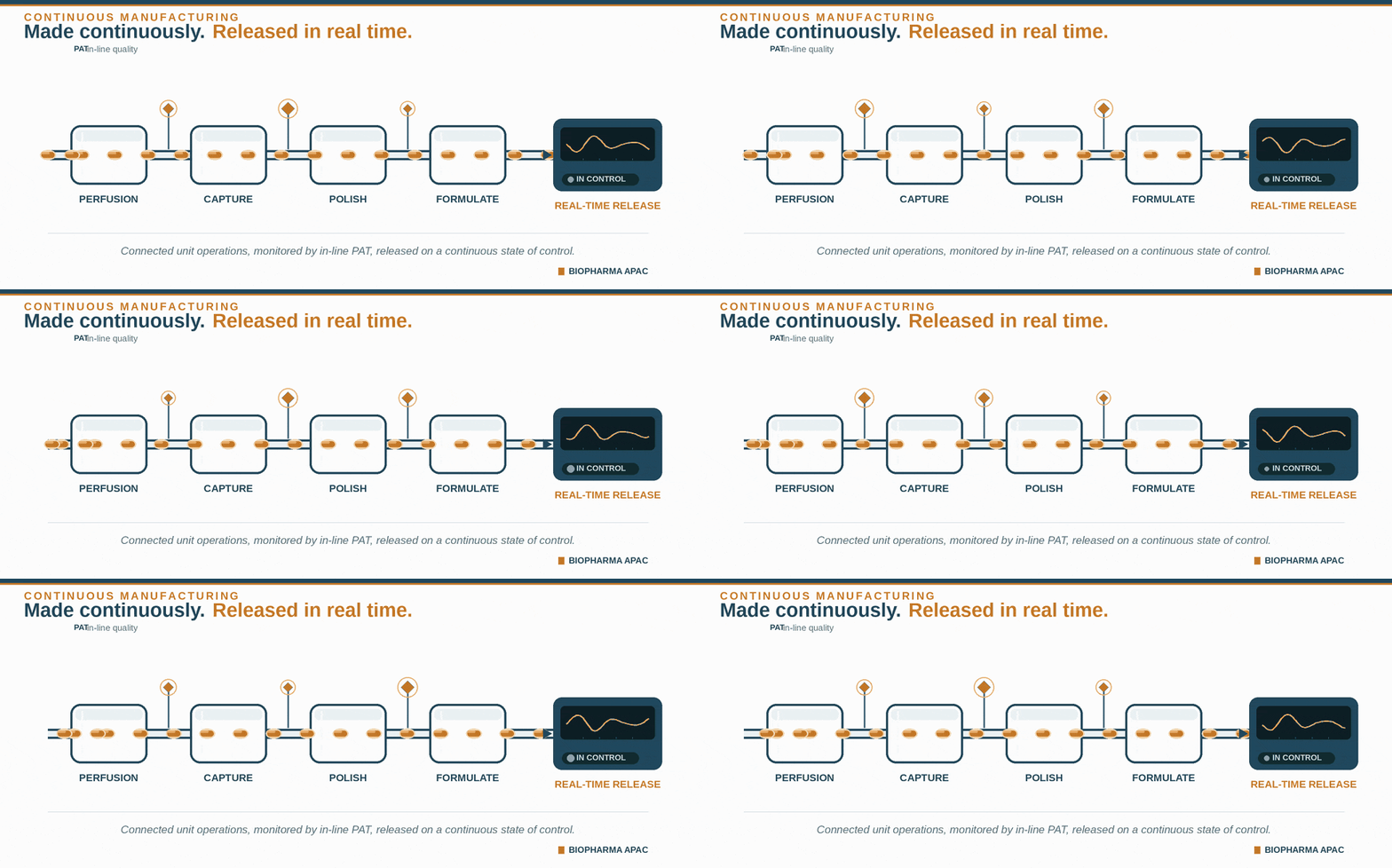
In a process-development suite in Singapore, or Hyderabad, or Songdo, a perfusion bioreactor can now run for weeks, its output feeding straight into a connected capture step, with spectroscopic probes reading product quality in real time. The hardware works. The software works. What stalls the capital request that would turn that pilot line into a commercial one is rarely an engineering question. It is a regulatory one: will the national authority accept a batch that was never a batch in the old sense, released not by a certificate of analysis at the end but by a continuous demonstration of control throughout?
That question sits at the centre of a standoff that has defined continuous manufacturing in Asia Pacific for a decade. Continuous and intensified processing, now backed by a dedicated international guideline in ICH Q13, promises smaller plants, faster campaigns and lower cost per gram. Yet the promise carries an uncomfortable dependency. Manufacturers will not commit the capital until the approval pathway is predictable. Regulators, in turn, are reluctant to publish detailed expectations, or to staff up specialist review teams, until they see real dossiers moving through their systems. Each side is waiting for the other to move first.
It is a classic chicken-and-egg problem, and in APAC it has a particular edge. The region holds some of the world’s fastest-growing biomanufacturing capacity, much of it still on the drawing board rather than locked into legacy batch plants. That makes the prize unusually large: a chance to leapfrog straight to continuous, intensified facilities without the cost of retrofitting. It also raises the stakes of hesitation. The question for the next few years is not whether the technology is ready. It plainly is. The question is who, among the region’s manufacturers and regulators, breaks the standoff first.
The value case: why continuous is worth the fight
Strip continuous manufacturing back to its economics and the appeal is straightforward. A traditional batch process makes medicine in discrete steps, with material sitting in hold tanks and quarantine between each one while samples are pulled and tested. A continuous process connects two or more of those steps so that material flows through without the stop-start. The result is less idle inventory, smaller equipment running for longer, and a dramatically smaller building to house it all.
The headline numbers are striking. Analyses of continuously manufactured products point to production-time reductions on the order of ninety percent against equivalent batch routes, and by 2025 more than fifteen products made using continuous processes had cleared the US FDA (industry analyses, 2025). The best-known small-molecule examples, Vertex’s cystic fibrosis therapies and Johnson & Johnson’s Prezista among them, showed that hybrid and fully continuous lines could win approval and hold up commercially.
For biologics the logic runs deeper still. Perfusion upstream, paired with connected downstream capture and polishing, lets a small bioreactor match the output of a far larger fed-batch tank by running continuously and harvesting constantly. Single-use assemblies, now present in an estimated forty to fifty percent of new biologic production lines, slot naturally into that model because they remove cleaning and changeover time between campaigns (equipment-market analyses, 2025 to 2026). The combined effect is a facility that is smaller, cheaper to build, quicker to bring online and easier to reconfigure for the next product.
Footprint is not just a cost line, it is a strategic asset. A plant that occupies a fraction of the floor space can be sited closer to demand, replicated across markets, or stood up quickly in response to a shortage. Intensified processing, whether that means high-density perfusion, connected unit operations or simply running a fed-batch harder with better analytics, gives manufacturers a lever on both capital and resilience at once. For an APAC sector under pressure to serve domestic demand, export to regulated markets and weather supply shocks, that combination is exactly the pitch that should make continuous manufacturing an easy yes.
There is a demand story layered on top of the cost story. APAC is simultaneously the world’s fastest-growing market for biologics and a rising force in supplying them, from monoclonal antibodies and biosimilars to newer modalities. Meeting that demand with conventional batch capacity means very large, very expensive plants and long build times. Continuous and intensified processing offers a way to add capacity in smaller, faster, more capital-efficient increments, which is exactly the profile a fast-scaling region needs. Market forecasts reflect this: continuous bioprocessing is widely projected to grow faster in Asia Pacific than in any other region (continuous bioprocessing market forecasts, 2026). The pull is there. What is missing is the regulatory certainty to convert it into signed capital-expenditure approvals.
And yet it is not an easy yes. The economics that look so clean on a spreadsheet collide with a harder reality the moment a company asks how the output will be tested, released and inspected. That is where the second half of the continuous manufacturing story begins, and where the real friction lives.
The control-strategy shift: proving quality a different way
The reason continuous manufacturing is a regulatory question and not merely an engineering one comes down to how quality is demonstrated. In a batch world, control is largely retrospective. You make the batch, you pull samples, you test against specification, and a qualified person signs a release. Continuous manufacturing cannot work that way, because there is no discrete batch sitting in quarantine waiting for a certificate. Quality has to be assured as the material flows.
That inverts the logic of validation. Instead of proving quality after the fact, a continuous line must demonstrate a continuous state of control, monitored in real time and backed by the ability to detect and divert any material that drifts out of specification. The enabling toolkit is process analytical technology, or PAT: spectroscopic probes, in-line sensors and soft-sensor models that read critical quality attributes as the process runs rather than in a lab hours later. Real-time release testing, where the decision to release rests on process and in-line data rather than end-product testing alone, is the destination that PAT makes possible.
ICH Q13, adopted by the International Council for Harmonisation at Step 4 in November 2022, is the document that codifies this thinking for continuous manufacturing specifically (ICH; EMA records). It is deliberately technology-neutral, describing concepts, scientific approaches and regulatory considerations rather than prescribing hardware, and it leans heavily on the quality-by-design and lifecycle principles laid down across ICH Q8 through Q12. Its Annex III addresses therapeutic proteins directly, acknowledging the added complexity of living systems: variable cell performance, intricate downstream purification, and the need to hold product quality steady across a long continuous run.
What this asks of a manufacturer is a far deeper level of process understanding than a batch filing typically demands. Material traceability becomes central, because in a connected line you must be able to track how a transient disturbance propagates and prove you removed the affected material. Continuous process verification replaces the old idea of validating three set-piece batches. The control strategy, not the batch record, becomes the core of the submission.
“The hardest shift is not the equipment, it is the mindset. Assessors trained on batch records have to get comfortable releasing on a state of control they cannot read off a single number.”
For regulators, that is precisely the challenge. Assessing a continuous dossier requires reviewers fluent in PAT, chemometric models, control engineering and diversion logic, not just analytical chemistry. It requires inspectors who can walk a continuous line and interrogate its control system rather than its batch paperwork. Building that capability takes time and specialist hiring, and no agency wants to invest heavily in it speculatively. This is the supply side of the standoff: the expertise gap that keeps pathways vague until volume justifies filling it.
The regulatory state: reading the ICH Q13 map across APAC
Because Q13 is an ICH guideline, its reach across Asia Pacific tracks closely with each authority’s relationship to ICH. That relationship, more than any single policy, is the best first indicator of how ready a given regulator is to receive a continuous manufacturing dossier.
Japan’s PMDA sits at the front of the pack. As a founding regulatory member of ICH, it implemented Q13 in step with the guideline’s international timetable, publishing the adopted text in 2023, and it had already developed its own thinking on continuous manufacturing for both small molecules and biologics ahead of that. Japanese industry has live continuous manufacturing experience, and the agency has shown willingness to engage early through its innovation-focused review schemes. Of the APAC authorities, PMDA is the one a manufacturer can approach today with the least uncertainty.
China’s NMPA has moved on the structural barriers rather than issuing a signature rulebook. An ICH member since 2017, its October 2024 pilot allowing non-end-to-end, or segmented, manufacturing of biologics matters because it loosens a longstanding requirement that drug substance and drug product be made at a single site, a rule that sat awkwardly with distributed and continuous models (NMPA pilot plan, October 2024). The agency also offers expedited review for products using innovative manufacturing technology that show clear patient benefit, and it has widened priority-review eligibility to include innovative production methods. The direction of travel is unmistakably toward accommodating advanced manufacturing, even if the detailed CM playbook is still emerging.
India’s CDSCO is the region’s paradox. As the world’s largest supplier of generic medicines, India has more to gain from continuous manufacturing’s cost advantage than almost anyone, and yet its regulator has moved cautiously. CDSCO participates in ICH as an observer and has engaged with advanced manufacturing through joint workshops alongside the US FDA, PMDA and TGA, a signal that the topic is on its radar (DIA advanced-manufacturing workshop; CDSCO). Its recent draft legislation on manufacturing-change approvals shows an agency modernising its post-approval framework. The latent opportunity is enormous; the open question is whether policy will move fast enough to let Indian manufacturers act on it.
Singapore’s HSA plays a different game. It regulates a small domestic market but carries outsized credibility, having been recognised by the WHO at the highest tier of regulatory maturity. HSA is unlikely to author a pioneering continuous manufacturing framework of its own, but its sophisticated, reliance-based approach means it can accept innovation validated by trusted reference regulators quickly. For a company running a continuous line in Singapore’s substantial biomanufacturing cluster and exporting globally, HSA’s posture is an accelerant rather than a brake.
Australia’s TGA rounds out the group. As an ICH member it adopts ICH guidance including Q13, and it leans on comparable-overseas-regulator pathways that let it rely on assessments from peer agencies. Its domestic manufacturing base is modest, so it is more likely to be an acceptor of continuous manufacturing filings than an originator, but its reliance mechanisms make it a low-friction destination once a dossier has cleared a major market.
Lined up side by side, the pattern is clear. No APAC regulator is hostile to continuous manufacturing, but they occupy very different positions on two separate axes: how ready their framework and expertise are to assess a CM dossier, and how much actual manufacturer adoption is pulling them forward. The matrix below maps that landscape.
ADOPTION VERSUS REGULATORY READINESS: APAC AT A GLANCE
|
Regulator |
ICH Q13 status |
RTRT / PAT posture |
CM pilot & policy activity |
Manufacturer pull |
Readiness |
|
PMDA (Japan) |
Adopted 2023; ICH founding member |
Established, experienced |
Own CM guidance; innovation review schemes |
Live domestic CM lines |
High |
|
NMPA (China) |
Adopted; ICH member since 2017 |
Building via pilots |
Segmented-manufacturing pilot; expedited review for innovative tech |
Fast-growing CDMO capacity |
Med-High |
|
CDSCO (India) |
ICH observer; aligns to ICH |
Developing |
Advanced-mfg workshops; post-approval change reform |
Large latent (generics), early |
Emerging |
|
HSA (Singapore) |
Aligns to ICH; reliance-based |
Capable via reliance |
Reliance on reference regulators; top WHO maturity tier |
Cluster present, export-led |
Acceptor |
|
TGA (Australia) |
ICH member; adopts Q13 |
Adopts via ICH |
Comparable-overseas-regulator reliance |
Modest domestic base |
Acceptor |
Readiness key: High = framework and expertise in place; Med-High = strong policy momentum; Emerging = engaged but early; Acceptor = reliance-based, moves once a reference market approves. Indicative, for verification.
The split the matrix exposes is the crux of the standoff. PMDA has readiness and adoption pulling in the same direction. NMPA has strong policy momentum meeting fast-building industry capacity. But for CDSCO, HSA and TGA, readiness and adoption sit out of balance: the frameworks are workable, or the reliance mechanisms are strong, yet the domestic pipeline of continuous manufacturing dossiers is thin. Frameworks without filings do not mature, and filings without frameworks do not get made.
The standoff, and the first movers who break it
If the problem is that each side waits for the other, the solution is a mechanism that lets one side move without betting the whole business on the other. Three are already visible in APAC, and together they suggest how the deadlock breaks.
The first is the regulator-run pilot. Rather than publishing an exhaustive rulebook up front, an agency invites a small number of real continuous manufacturing programmes into a structured, closely supervised channel and learns by doing. NMPA’s segmented-manufacturing pilot is one version of this. Internationally, the US FDA’s Advanced Manufacturing Technologies designation, finalised in early 2025 and first awarded that April, offers a template APAC agencies can borrow: a formal designation that grants innovative manufacturing approaches earlier and more intensive engagement with reviewers (US FDA AMT program, 2025). A visible pilot with a dedicated review team does more to unlock capital than any quantity of draft guidance, because it converts an abstract pathway into a named contact and a timeline.
The second is the contract manufacturer. A CDMO that builds continuous, single-use, intensified capacity spreads that capital across many clients, which changes the investment maths entirely. CDMOs in China and Korea are already establishing continuous and turnkey single-use capabilities, and that is strategically important (continuous bioprocessing market analyses, 2026). An individual drug owner may hesitate to build a continuous plant for one product; a CDMO can build the platform once and offer it to dozens, becoming the wedge that gets the first APAC continuous dossiers written.
The third is the reference dossier. Every continuous manufacturing filing that clears a credible regulator lowers the barrier for the next, both by teaching the agency and by giving reliance-based authorities something to rely on. This is where APAC’s reliance frameworks become a genuine advantage. Once a continuous product is approved by a reference regulator, HSA and TGA can move quickly, and even more conservative agencies gain a worked example to benchmark against. The first mover does not just win for itself; it de-risks the pathway for everyone behind it.
Underpinning all three is ICH itself. Shared membership means shared expectations for what a Q13 dossier should contain, which lets a manufacturer design one control strategy and one submission structure for multiple APAC markets rather than reinventing it agency by agency. Harmonisation is what turns a single reference dossier into a regional key rather than a one-country win.
The design details matter more than the label. What manufacturers consistently say moves the needle is not a glossy policy announcement but concrete machinery: a named review team with continuous manufacturing expertise, structured pre-submission meetings where a control strategy can be pressure-tested before a filing is locked, and inspectors trained to audit a control system rather than a stack of batch records. Agencies that put those in place, even for a handful of pilot products, send a credible signal that a dossier will get a fair and competent hearing. That credibility, more than any incentive on paper, is what unlocks the capital request.
“The technology stopped being the bottleneck a while ago. The real question is which regulator will let it into a filing.”
Put together, the picture is of a standoff that does not need every party to move at once. It needs a coalition: one manufacturer willing to file, one CDMO willing to build the platform, and one regulator willing to run a visible pilot with people who understand the technology. Where those three align, the chicken-and-egg dissolves.
Leapfrog, or stuck?
So does APAC leapfrog to continuous manufacturing, or stay trapped in the investment-and-approval standoff? The honest answer is that both futures are live, and the region will probably see both at once.
The case for leapfrogging is real. Much of APAC’s biomanufacturing capacity is still being planned rather than defended, which means there is less legacy batch infrastructure to write off and more appetite for building right the first time. The region’s reliance frameworks let smaller agencies accept innovation proven elsewhere without having to originate it. And the commercial pressure, to serve vast domestic populations, to compete in export markets and to withstand supply shocks, points hard toward the smaller, cheaper, more flexible facilities that continuous manufacturing delivers. Where a capable regulator, an ambitious CDMO and a committed manufacturer come together, APAC has every ingredient to move faster than incumbents burdened with old plants.
The case for staying stuck is equally real, and it is mostly about coordination rather than capability. If manufacturers keep waiting for fully detailed pathways, and regulators keep waiting for dossiers before they build those pathways, the standoff simply persists, and the capacity gets built as conventional batch because that is the known quantity. Nothing about the technology forces a resolution. Only decisions do.
What the evidence suggests is that the break will not come from a grand regional policy. It will come from specific pairings: PMDA with a Japanese continuous line already in operation, NMPA with a segmented-manufacturing pilot participant, a Singapore or Korean CDMO with a flagship client willing to file first. Each of those is a small crack in the standoff. Enough of them, and the chicken-and-egg stops being a question at all. The technology is ready. Whether APAC’s regulators and manufacturers stop waiting for each other is the only variable left.
|
By the numbers ~90% reported reduction in production time for continuous versus equivalent batch processes. 15+ continuously manufactured products approved by the US FDA as of 2025. 40 to 50% share of new biologic production lines using single-use systems. Nov 2022 ICH Q13 adopted at Step 4; FDA March 2023, EMA effective July 2023, PMDA 2023. Oct 2024 NMPA pilot allowing non-end-to-end (segmented) manufacturing of biologics. |
|
The bottom line Continuous manufacturing’s bottleneck in APAC is no longer the technology, it is coordination. The standoff breaks not through a single regional policy but through specific coalitions of a willing manufacturer, an ambitious CDMO and a regulator prepared to run a visible pilot with a competent, dedicated team. APAC’s greenfield capacity and reliance frameworks give it a genuine shot at leapfrogging, if the first movers act. |
(arcilla.fran@biopharmaapac.com)
Disclaimer: This feature is an editorial analysis prepared by BioPharma APAC using publicly available information current as of July 2026. Regulatory positions, pilot programmes and adoption figures change over time; specific details should be verified against primary regulatory sources before any commercial or compliance decision. Company and product references are illustrative of industry practice and do not constitute endorsement or advice.
Most Read
- Can APAC Biomanufacturing Decarbonise Without Pricing Itself Out?
- The Algorithm on the GMP Floor: AI Promises a Smarter Plant. Regulators Demand the Audit Trail.
- APAC's Peptide-Capacity Gamble
- After the Rush: APAC's mRNA and Vaccine Capacity Hangover
- The Biosimilar Race: Factory to the World — or Stuck in the Copycat Economy?
- The Vein-to-Vein Problem: Can APAC's Cold Chain Carry Advanced Therapies?
- Vectors, Plasmids and the CGT Trap: APAC's Cell and Gene Therapy Ambitions Face an Upstream Bottleneck
- Can APAC Build Radioligand Therapy Before the Atoms Decay?
- The Great Biopharma Reset: 50 Developments That Changed Everything in H1 2026
- Beyond the Trial: Can Real-World Evidence Earn Regulatory Trust in APAC?
- Beyond the Obvious Giant: Where APAC's Clinical Trials Go Next
- The Frontier That Won’t Quite Arrive
Bio Jobs
- Sanofi Turns The Page As Belén Garijo Steps In And Paul Hudson Steps Out
- Global Survey Reveals Nearly 40% of Employees Facing Fertility Challenges Consider Leaving Their Jobs
- BioMed X and AbbVie Begin Global Search for Bold Neuroscience Talent To Decode the Biology of Anhedonia
- Thermo Fisher Expands Bengaluru R&D Centre to Advance Antibody Innovation and Strengthen India’s Life Sciences Ecosystem
- Accord Plasma (Intas Group) Acquires Prothya Biosolutions to Expand Global Plasma Capabilities
- ACG Announces $200 Million Investment to Establish First U.S. Capsule Manufacturing Facility in Atlanta
- AstraZeneca Invests $4.5 Billion to Build Advanced Manufacturing Facility in Virginia, Expanding U.S. Medicine Production
News