Korea Fujitsu Completes MasterControl's Quality, Manufacturing and Asset Trio in Korea with Ax Launch
06 October 2026 | Tuesday | News
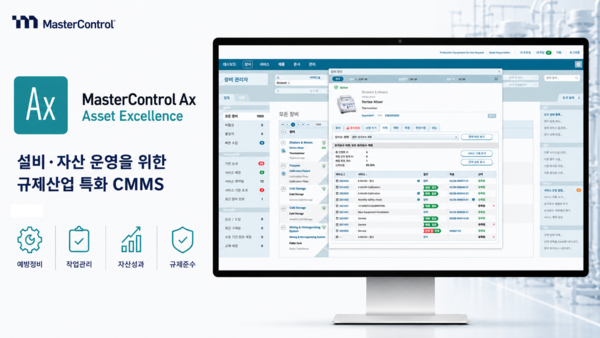
Korea Fujitsu has announced the South Korean launch of MasterControl Ax (Asset Excellence), a cloud-based asset management platform developed by US quality software company MasterControl for the pharmaceutical, biotechnology and medical device sectors. The move marks a notable step in the country's push toward fully digital, inspection-ready manufacturing, extending structured digital control beyond quality and production systems into the facilities, instruments and laboratory equipment that sit underneath them.
Why this matters
In regulated life sciences manufacturing, equipment is not simply a production asset. Facilities and instruments are core GMP control points, because their condition directly shapes product quality and the integrity of the records that prove it. A missed calibration or a late preventive maintenance task can ripple outward, calling test results into question, disrupting batch schedules, widening deviation investigations and complicating responses to regulators.
Yet this is precisely the area many manufacturers have left behind in their digital transition. Korea Fujitsu notes that even companies running computerised QMS (Quality Management System) and MES (Manufacturing Execution System) platforms frequently still track equipment maintenance and calibration histories in spreadsheets, paper documents or standalone tools. The result is a fragmented record at the exact point where inspectors expect a clean, traceable audit trail.
What the platform does
MasterControl Ax is a computerised maintenance management system (CMMS) built specifically for life sciences, rather than adapted from general industrial software. It brings the entire asset lifecycle into a single environment, covering:
- Asset visibility: equipment status and location viewable in one place.
- Calibration control: calibration schedules managed and tracked against due dates.
- Preventive maintenance: plans set on either a time basis or actual usage.
- Work execution: work orders raised, assigned and closed within the system.
- Service history: a consolidated, traceable record of all maintenance and service activity.
By replacing scattered logs with a unified record, the platform is designed to reduce the risk of overdue tasks, shorten the time needed to assemble evidence for audits, and give quality teams a reliable view of asset readiness before batches are released.
Completing the digital stack
The launch also signals a broader strategy. With Ax, Korea Fujitsu now offers three pillars of the MasterControl platform in Korea: Qx for quality, Mx for manufacturing and Ax for assets. Together they allow life sciences companies to connect quality events, production records and equipment data on a common platform, closing a gap that has historically forced teams to reconcile information across disconnected systems during investigations and inspections.
Leadership view
Kyung-joo Park, CEO of Korea Fujitsu, said the launch is significant because it widens the scope of digital operations for life sciences companies from quality and manufacturing into facilities and asset management.
“Korea Fujitsu will strengthen digital operating systems across quality, manufacturing and asset areas based on the MasterControl platform expanding to Qx, Mx and Ax,” Park said, adding that the company will continue to support customers in responding more effectively to regulatory inspections while using accumulated data for analysis and AI-based decision-making.
What to watch
For Korean manufacturers scaling biologics, biosimilars and contract manufacturing capacity for global markets, the ability to demonstrate equipment control under international GMP scrutiny is becoming a competitive requirement rather than an operational nicety. The key questions now are how quickly early adopters move asset records off spreadsheets, and whether a single connected data layer across quality, manufacturing and assets translates into faster inspections and fewer equipment-linked deviations. The stated ambition to apply that accumulated data to analytics and AI-driven decisions points to where the next phase of competition in Korean GMP operations is likely to play out.
Most Read
- Can APAC Biomanufacturing Decarbonise Without Pricing Itself Out?
- The Algorithm on the GMP Floor: AI Promises a Smarter Plant. Regulators Demand the Audit Trail.
- APAC's Peptide-Capacity Gamble
- After the Rush: APAC's mRNA and Vaccine Capacity Hangover
- The Biosimilar Race: Factory to the World — or Stuck in the Copycat Economy?
- The Vein-to-Vein Problem: Can APAC's Cold Chain Carry Advanced Therapies?
- Vectors, Plasmids and the CGT Trap: APAC's Cell and Gene Therapy Ambitions Face an Upstream Bottleneck
- Can APAC Build Radioligand Therapy Before the Atoms Decay?
- The Great Biopharma Reset: 50 Developments That Changed Everything in H1 2026
- Beyond the Trial: Can Real-World Evidence Earn Regulatory Trust in APAC?
- Beyond the Obvious Giant: Where APAC's Clinical Trials Go Next
- The Frontier That Won’t Quite Arrive
Bio Jobs
- Sanofi Turns The Page As Belén Garijo Steps In And Paul Hudson Steps Out
- Global Survey Reveals Nearly 40% of Employees Facing Fertility Challenges Consider Leaving Their Jobs
- BioMed X and AbbVie Begin Global Search for Bold Neuroscience Talent To Decode the Biology of Anhedonia
- Thermo Fisher Expands Bengaluru R&D Centre to Advance Antibody Innovation and Strengthen India’s Life Sciences Ecosystem
- Accord Plasma (Intas Group) Acquires Prothya Biosolutions to Expand Global Plasma Capabilities
- ACG Announces $200 Million Investment to Establish First U.S. Capsule Manufacturing Facility in Atlanta
- AstraZeneca Invests $4.5 Billion to Build Advanced Manufacturing Facility in Virginia, Expanding U.S. Medicine Production
News