Can APAC Build Radioligand Therapy Before the Atoms Decay?
02 July 2026 | Thursday | Analysis
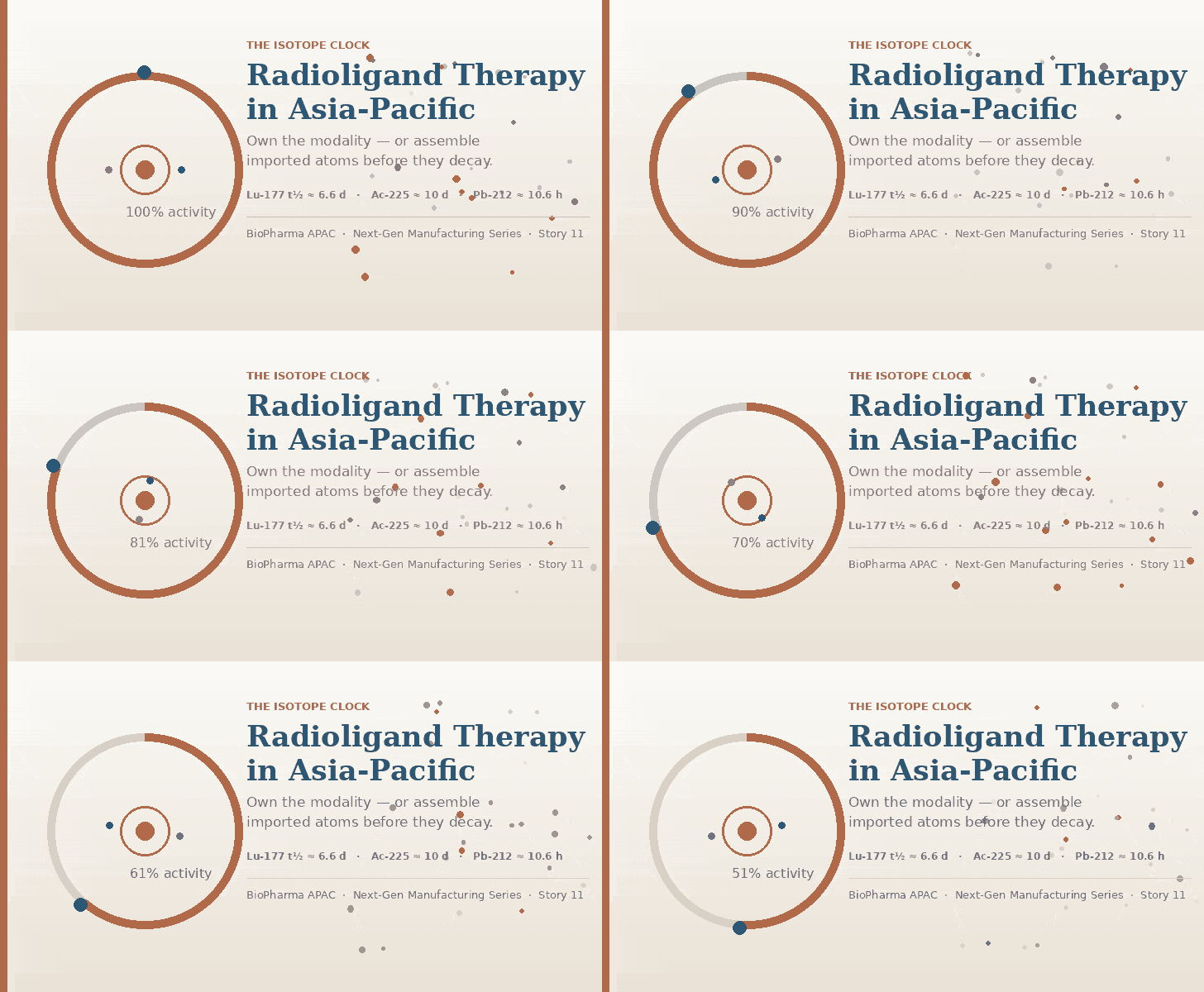
Every dose of radioligand therapy is a countdown. The moment a batch of lutetium-177 leaves the reactor, it begins to fade — roughly half its therapeutic punch gone in under seven days. By the time those atoms are purified, shipped, bound to a tumour-seeking molecule, cleared by quality control and infused into a named patient, a measurable fraction of the payload has already decayed into inert matter. It is a manufacturing problem unlike any other in medicine: the product destroys itself from the instant it is made, and no amount of capital, automation or clever chemistry can slow the physics.
That countdown is the defining constraint on Asia-Pacific’s ambition to build a domestic radioligand industry. Across Sydney, Tokyo, Seoul and Chengdu, governments and companies are pouring money into radiochemistry — the GMP “kitchens” that bind isotope to ligand and fill the vial. But the scarce, strategic layer sits upstream and in transit: the reactors and accelerators that make the atoms, and the time-critical distribution that delivers them before they die. The distinction that will decide winners is stark. A region can master the chemistry and still be nothing more than a downstream assembler of imported atoms, its treatment calendar hostage to a foreign reactor’s maintenance schedule and an export-control signature.
|
The Isotope Clock: Supply & Decay at a Glance Lutetium-177 (beta emitter) Half-life ~6.6 days. Made by irradiating ytterbium-176 targets in high-flux research reactors, then chemically separated into high-purity “no-carrier-added” material over several days. The workhorse behind Lutathera and Pluvicto; roughly 29% of radiopharmaceutical CDMO revenue in 2025. Actinium-225 (alpha emitter) Half-life ~10 days. Historically “milked” from thorium-229 left over from Cold War–era nuclear programs at Oak Ridge, a fixed and finite trickle. One industry estimate puts global output below 10 curies against clinical demand exceeding 1,000 curies — a roughly 100-fold gap. A 2024 shortage forced a Phase 3 trial pause. Lead-212 (alpha emitter) Half-life 10.6 hours. Near-daily production is required, forcing ultra-local, generator-based logistics. Central to Australia’s AdvanCell–Lilly alpha-therapy work. Molybdenum-99 / Iodine-131 Reactor-made diagnostic and therapeutic staples. Repeated global shortages have followed unplanned reactor outages, including Petten in 2022 — the cautionary tale driving regional self-sufficiency. The decay window Each Pluvicto dose has roughly a five-day window to reach the patient after manufacture. Miss the slot — a delayed flight, a customs hold — and the dose is rescheduled, cascading to every patient booked behind it. The distribution radius A production site can serve only the geography its couriers can reach before decay erodes the dose: a few days by air for Lu-177, mere hours for Pb-212. Proximity is not a convenience; it is dosimetry. Estimates compiled from ANSTO, BioSpace, KIRAMS, VCBeat, AuntMinnie and Journal of Nuclear Medicine reporting; figures vary by source and year. |
1. The demand pull: a modality that hospitals want close to home
Radioligand therapy — RLT, also called targeted radionuclide therapy — pairs a tumour-seeking molecule with a radioactive isotope that delivers a lethal dose of radiation directly to cancer cells while largely sparing healthy tissue. Two Novartis drugs turned the concept from academic promise into a commercial category. Lutathera (lutetium-177 dotatate), approved by the US FDA in 2018 for gastroenteropancreatic neuroendocrine tumours, was the proof point; Pluvicto (lutetium-177 vipivotide tetraxetan), approved in 2022 for PSMA-positive metastatic castration-resistant prostate cancer, became the first blockbuster. Together, BioSpace reports, the two generated about US$2.8 billion for Novartis in 2025.
Approvals have since spread across APAC. Australia’s Therapeutic Goods Administration registered Pluvicto for PSMA-positive mCRPC on the strength of the pivotal VISION trial. And the eligible population keeps widening: in March 2025 the FDA expanded Pluvicto into earlier, pre-chemotherapy patients — a move Novartis says roughly triples the pool — while 2025 data from the Phase III PSMAddition study push toward hormone-sensitive disease, potentially doubling eligibility again. Each label expansion multiplies the number of doses that must be manufactured, timed and delivered.
The growth numbers are extraordinary. Analysts at Mordor Intelligence size the nuclear-medicine therapeutics market at about US$4.33 billion in 2025, rising toward US$10.67 billion by 2030 — with Asia-Pacific the fastest-growing region at more than 22% a year. The radiopharmaceutical CDMO market, valued near US$3.27 billion in 2025 by SNS Insider, is forecast to more than double by 2035, with lutetium-177 alone accounting for roughly 29% of 2025 revenue.
What makes RLT different from any other oncology drug is why hospitals want it made nearby: shelf life. A therapy that loses half its potency in a week cannot be warehoused or stockpiled. Every course is manufactured to order for a specific patient on a scheduled infusion date, then raced to the clinic. As Telix Pharmaceuticals’ Simone Leyden has put it, radiopharmaceuticals “must be administered shortly after manufacture, making local production essential.” For a region defined by vast distances, customs borders and variable air freight, a supply chain anchored in Europe or North America means doses that arrive late, weakened, or not at all.
There is a clinical reason the demand is sticky. Radioligand therapy is the treatment half of “theranostics” — a see-and-treat model in which the same molecular target is first imaged with a diagnostic tracer (a gallium-68 or copper-64 PSMA scan, say) and then treated with a therapeutic isotope bound to the same targeting molecule. A patient whose tumour “lights up” on the scan is one whose cancer will also bind the therapy. That tight coupling of imaging and treatment builds durable institutional demand: once a hospital stands up a PSMA imaging service and a nuclear-medicine therapy suite, it needs a dependable, repeatable flow of both diagnostic and therapeutic isotopes — six infusions per prostate patient, dosed weeks apart, each one manufactured to a calendar. Interrupt the isotope and you interrupt an entire treatment protocol mid-course.
Demand is also broadening beyond lutetium. The sector’s next frontier is the alpha emitters — led by actinium-225, with lead-212, copper-67 and astatine-211 close behind — which deliver higher-energy radiation over a shorter range and are thought to cause more double-strand DNA breaks with less collateral damage. Big pharma has validated the shift with its cheque-book: Bristol Myers Squibb bought RayzeBio for about US$4.1 billion, AstraZeneca acquired Fusion Pharmaceuticals for up to US$2.4 billion, and Eli Lilly took Point Biopharma for roughly US$1.4 billion. The modality is proven and the money has arrived. The question for APAC is whether the atoms will.
2. The isotope supply chain: who controls the atoms
The therapy’s Achilles heel is not the chemistry; it is the isotope. Lutetium-177 is produced by irradiating enriched ytterbium-176 targets in a high-flux nuclear reactor and then chemically separating the lutetium — a multi-day process that yields the high-purity “no-carrier-added” material clinicians prefer. The catch is that only a handful of research reactors worldwide can do it, and many are ageing. When the High Flux Reactor at Petten in the Netherlands went offline unexpectedly in early 2022, global supplies of both lutetium-177 and molybdenum-99 dipped and hospital shipments were cut. European authorities have warned that the continent’s research reactors are nearing the end of their working lives.
Upstream, supply is concentrated in a few Western hands — ITM in Munich, Curium, SHINE Technologies, NRG PALLAS, South Africa’s NTP and Israel’s Isotopia among them — and APAC clinics largely buy from them. Even China, which fabricates finished radiopharmaceuticals domestically, long had to import the lutetium-177 itself; a review in the Journal of Nuclear Medicine noted that the gallium-68 / lutetium-177 theranostic pair still depended on purchasing the therapeutic isotope from an international supplier.
“The short half-life of imported isotopes puts us at a competitive disadvantage.” — Sun-Kwan Hwang, SK Biopharmaceuticals
Actinium-225 is scarcer still, and its scarcity is structural. For nearly three decades the main global source has been Oak Ridge National Laboratory, which milks the isotope from thorium-229 left over from nuclear programs of the 1940s and 1950s — a fixed, finite trickle. Demand has now vastly outrun it. A Chinese industry analysis estimates global annual production below 10 curies against clinical demand exceeding 1,000 curies, a roughly hundred-fold gap; South Korean figures frame the same shortfall differently but no less starkly. This is not a theoretical constraint: in 2024, BioSpace reported, Bristol Myers Squibb’s RayzeBio paused a Phase 3 trial for want of actinium.
The economics of that race are unforgiving, and they favour the deep-pocketed. NorthStar chief executive Frank Scholz told BioSpace that his company chose electron-accelerator technology only after calculating it would otherwise need to buy ten to fifteen cyclotrons — a fleet of failure-prone, maintenance-hungry machines — to meet its supply targets. The decision, he said, was as much a holistic business case as a technical one. For APAC newcomers the lesson is sobering: standing up sovereign actinium supply is not a single reactor or accelerator but a capital-intensive network with redundancy built in, and the established suppliers already have a multi-year head start on contracts and know-how.
A race is now on to manufacture the alpha emitter by other means — cyclotrons and linear accelerators bombarding radium-226, electron accelerators, and the recovery of thorium-229 from legacy uranium-233 stockpiles. The suppliers scaling up — NorthStar, Eckert & Ziegler, Ionetix, Niowave, BWXT and ITM’s Actineer joint venture — are almost all outside Asia-Pacific, and drugmakers are locking their output into multi-year contracts. AstraZeneca signed a ten-year actinium deal with Niowave; Bayer has stitched together agreements with BWXT, Ionetix, NorthStar and PanTera. The upstream is being spoken for — and APAC buyers are, for now, mostly at the back of the queue.
3. The decay clock: logistics is the real manufacturing
Because the atoms are perishable, the “factory” in radioligand therapy is less a building than a scheduling engine. Lutetium-177’s half-life is about 6.6 days; actinium-225’s roughly ten; lead-212’s a mere 10.6 hours. Novartis manufactures Pluvicto in batches, with only about a five-day window for each dose to reach the patient, according to reporting in AuntMinnie. Any interruption — a delayed flight, a customs hold, an unplanned manufacturing event — forces a dose to be rescheduled, which then cascades to every patient booked behind it.
That physics dictates a hard geographic limit that no spreadsheet can wish away: the distribution radius. A production site can serve only the territory its couriers can physically reach before too much of the isotope is gone — a few days by air for lutetium, mere hours for lead-212. Proximity, in other words, is not a commercial convenience; it is dosimetry. The closer the hot lab sits to the patient, the more of the prescribed dose survives the journey. This is the physical argument for regional production, and it is the one APAC planners cite most often.
This is why time-critical distribution, not just production, is the discipline that separates a viable network from an aspirational one. A radioligand supply chain needs redundant air lanes, pre-cleared customs pathways, radiation-licensed couriers and dose-tracking systems precise enough to know, hour by hour, how much activity remains in every vial in transit. A single congested airport or a mislaid import permit does not merely delay a shipment — it destroys the product, because the isotope keeps decaying whether or not the paperwork clears. Established originators such as Novartis have built industry-leading logistics infrastructure precisely because the modality lives or dies on it; matching that reliability across APAC’s borders, currencies and regulators is arguably a harder problem than the radiochemistry itself.
“We can only pursue new therapies based on what isotopes are reliably available.” — Jae-Yoon Ji, CEO, FutureChem
The clock also exposes a downstream infrastructure gap. Even where a dose arrives intact, hospitals need shielded “hot labs,” trained nuclear-medicine staff and radiation-safety approvals to handle it. A British Nuclear Medicine Society survey found only four of 45 surveyed centres were “ready to start” Pluvicto — and two of those had never handled a lutetium-177 agent before. In many middle-income APAC health systems that readiness gap is wider still. China illustrates the access side of the ledger: by one published estimate it has only about 0.305 PET/CT and 0.645 SPECT/CT scanners per million people, and fewer than four people per 10,000 receive radionuclide therapy each year — well below United States and European rates. Building the modality means building the clinics, not just the chemistry.
4. The build-out and the make-vs-import call
Australia is the closest thing APAC has to an end-to-end player. ANSTO’s OPAL research reactor at Lucas Heights produces no-carrier-added lutetium-177 under a long-running technology licence with ITM, alongside molybdenum-99 and iodine-131, and distributes between 10,000 and 12,000 potential doses each week; a new nuclear-medicine facility is being built in stages to replace ageing infrastructure. ANSTO chief executive Shaun Jenkinson has argued that local manufacturing matters precisely because targeted radionuclide therapy is a fast-growing regional treatment. Around the reactor sits a genuine industry: Telix Pharmaceuticals (which acquired ARTMS to add actinium-225 and astatine-211 cyclotron capability, and whose Illuccix agent selects patients for PSMA therapy), Clarity Pharmaceuticals (copper-64/67 theranostics), AdvanCell (a lead-212 platform partnered with Eli Lilly) and Radiopharm Theranostics. Australia even holds precursor elements for alpha emitters in mining stockpiles and runs the ARTnet clinical-trials network. It has reactor, radiochemistry and a domestic pipeline — the fullest stack in the region.
Japan is the diagnostic powerhouse. It is the world’s most cyclotron-dense nation and its third-largest pharmaceutical market, and GE HealthCare took full control of Nihon Medi-Physics in 2025 to consolidate a national radiopharmacy network. On the therapeutic side, PeptiDream’s PDRadiopharma partnered with Curium in late 2024 to co-develop a lutetium-177 PSMA-I&T therapy — now in Phase 3 — and a copper-64 companion diagnostic for the Japanese market. Japan’s dense cyclotron fleet is a natural base for short-lived PET isotopes and, potentially, accelerator-made actinium; its reactor-based therapeutic-isotope supply, however, is thinner than Australia’s.
South Korea has the most explicit state strategy. Its Ministry of Science and ICT has published a roadmap to localise isotope supply chains, reach self-sufficiency in key isotopes around 2030, become a net exporter by 2035 and advance at least three novel radiopharmaceuticals within a decade. In May 2025, KIRAMS — the national radiological-sciences institute — won regulatory clearance to produce actinium-225 domestically using a cyclotron to bombard radium-226 with protons, beginning with small batches sufficient for three to four patients and plans to scale output ten- to fifteen-fold; it has also begun iodine-131 production on the HANARO reactor after import disruptions. Korean firms are racing in parallel: SK Biopharmaceuticals (an actinium-focused “RPT roadmap” supplied by TerraPower and PanTera), FutureChem (its lutetium-177 prostate candidate, with n.c.a. lutetium secured from Isotopia), CellBion (a lutetium-177 PSMA therapy nearing launch) and DuChemBio (Korea’s first domestic oxygen-18 recovery line). Officials still remember foreign reactor shutdowns that left Korean patients untreated in 2009, 2016 and 2022; supply security is now framed as a national-strategic goal.
China has scale and a domestic-first push. Chinese groups already fabricate finished radiopharmaceuticals, and the Mianyang Research Reactor operated by the China Academy of Engineering Physics has produced no-carrier-added lutetium-177 on home soil. Companies including Sinotau, Full-Life Technologies, Dongcheng, Hengrui and SmartNuclide are building pipelines; tellingly, Full-Life’s actinium-225 PSMA candidate is one of only two such alpha drugs in Chinese clinical trials, a reminder that the isotope, not the chemistry, is the bottleneck. And in March 2026, Chengdu’s C-Ray Therapeutics signed an exclusive agreement to distribute SHINE Technologies’ no-carrier-added lutetium-177 across mainland China — a signal that even China still reaches abroad for reliable beta-emitter supply.
Building the radiochemistry is now within reach for any well-capitalised APAC player. Securing the atoms — and moving them in time — is not.
The make-versus-import call, distilled, comes down to this: the GMP radiochemistry that binds isotope to ligand is necessary but not sufficient. The scarce, strategic layers are the reactors and accelerators that make the atoms and the time-critical network that moves them. A country can commission a gleaming radiopharmacy and remain a downstream assembler of imported atoms, its treatment calendar dictated by another nation’s reactor schedule. Owning the modality means owning the clock — from irradiation to infusion.
The takeaway
The Isotope Clock measures more than half-life; it measures sovereignty. Asia-Pacific’s demand is real and rising faster than anywhere on earth, and its radiochemistry is catching up quickly. What separates owning radioligand therapy from renting it is whether the region can secure the isotopes at their source and move them at speed. Australia has the reactor and the pipeline; Korea has the plan and the political will; Japan has the cyclotrons; China has the scale. None yet holds the whole clock — and the atoms will not wait for them to figure it out.
KEY SOURCES
Novartis and BioSpace (2025 radioligand sales; actinium-225 supply race; RayzeBio Phase 3 pause); Mordor Intelligence and SNS Insider (market sizing); AuntMinnie (Pluvicto dose window); ANSTO and ITM (OPAL reactor, lutetium-177 licence, weekly dose volume); KIRAMS and Korea’s Ministry of Science and ICT (actinium clearance, national roadmap); VCBeat and the Journal of Nuclear Medicine (China production and access data); Australia’s TGA (Pluvicto registration); BioSpectrum Asia (Telix commentary). Reporting current to mid-2026.
Disclaimer. This analytical feature is provided for editorial and informational purposes only and reflects publicly available information as of publication. It does not constitute investment, medical, or regulatory advice. Market figures are drawn from third-party research and may vary by source and methodology; forward-looking statements are subject to change. BioPharma APAC is an independent publication and has no commercial affiliation with the isotope suppliers or drug originators named herein.
Most Read
- Can APAC Biomanufacturing Decarbonise Without Pricing Itself Out?
- The Algorithm on the GMP Floor: AI Promises a Smarter Plant. Regulators Demand the Audit Trail.
- APAC's Peptide-Capacity Gamble
- After the Rush: APAC's mRNA and Vaccine Capacity Hangover
- The Biosimilar Race: Factory to the World — or Stuck in the Copycat Economy?
- The Vein-to-Vein Problem: Can APAC's Cold Chain Carry Advanced Therapies?
- Vectors, Plasmids and the CGT Trap: APAC's Cell and Gene Therapy Ambitions Face an Upstream Bottleneck
- Can APAC Build Radioligand Therapy Before the Atoms Decay?
- The Great Biopharma Reset: 50 Developments That Changed Everything in H1 2026
- Beyond the Trial: Can Real-World Evidence Earn Regulatory Trust in APAC?
- Beyond the Obvious Giant: Where APAC's Clinical Trials Go Next
- The Frontier That Won’t Quite Arrive
Bio Jobs
- Sanofi Turns The Page As Belén Garijo Steps In And Paul Hudson Steps Out
- Global Survey Reveals Nearly 40% of Employees Facing Fertility Challenges Consider Leaving Their Jobs
- BioMed X and AbbVie Begin Global Search for Bold Neuroscience Talent To Decode the Biology of Anhedonia
- Thermo Fisher Expands Bengaluru R&D Centre to Advance Antibody Innovation and Strengthen India’s Life Sciences Ecosystem
- Accord Plasma (Intas Group) Acquires Prothya Biosolutions to Expand Global Plasma Capabilities
- ACG Announces $200 Million Investment to Establish First U.S. Capsule Manufacturing Facility in Atlanta
- AstraZeneca Invests $4.5 Billion to Build Advanced Manufacturing Facility in Virginia, Expanding U.S. Medicine Production
News