6 Radiopharmaceutical Programmes and Sites to Watch in APAC
18 August 2026 | Tuesday | Analysis
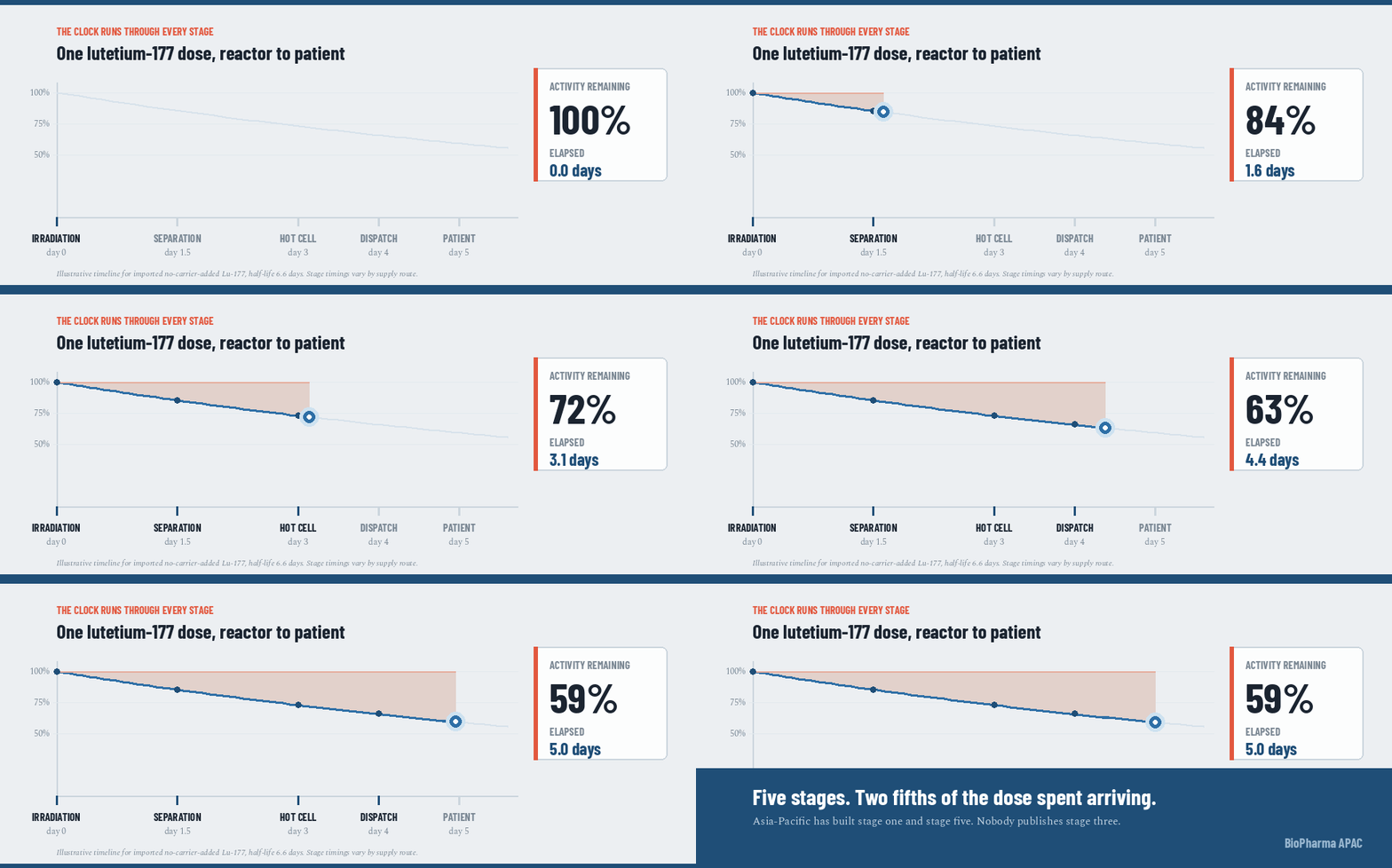
Radioligand therapy is the one modality a region cannot buy its way into late. A vial of lutetium-177 loses half its therapeutic activity in roughly six and a half days. A vial of lead-212 loses half in under eleven hours. The consequence is not commercial, it is geometric: the map of where the atoms are made is also the map of who can be treated, because a production site can only serve the territory a courier can cross before the dose stops being a dose.
That makes this a logistics story wearing an oncology coat, which is why the list looks so unlike a list of clinical assets. A company can hold the best PSMA ligand in the region and still be unable to treat a patient in Manila, while a state reactor with no drug programme at all quietly decides how many patients get scanned next Tuesday.
BioPharma APAC argued in July that the region can master radiochemistry and still end up a downstream assembler of imported atoms. This list is the ledger underneath that argument: the specific sites and programmes where the question actually gets settled, with what exists today held apart from what has been announced.
Assembling it produced three findings, none of them the one we expected.
The region is building both ends of the chain and not the middle. Reactors are running, restarting or newly sanctioned in four countries, and clinics are multiplying across all of them. The licensed hot-cell and GMP radiochemistry capacity that has to sit between the two is the single layer for which no operator in Asia-Pacific publishes a number. We could not find a disclosed hot-cell count for any site on this list, from any source, including the operators' own annual reports. Curies are public. Trial enrolment is public. The bottleneck between them is not.
The most complete radioligand supply chain being built in Asia-Pacific belongs to a Swiss company. Novartis will hold finished-dose plants in Zhejiang and Hyogo before any Asia-Pacific-headquartered company operates one at commercial scale, and the two sites are already the region's most consequential radiopharmaceutical construction projects by a wide margin.
The atoms and the assets are on separate tracks. Every reactor programme in this list supplies a domestic clinical network. Not one has a publicly disclosed supply contract with a regional drug programme. Meanwhile the two most advanced regional assets have both gone outside the region for their starting material. The region is not short of isotopes or short of molecules. It is short of the contracts that would connect them.
- Qinshan Nuclear Power Base, "Hefu No. 1"
Haiyan, Zhejiang, China. Position in the chain: reactor isotope production, beta emitters.
What exists today. China put the world's first commercial power reactor device for online irradiation isotope production into operation at the Qinshan Nuclear Power Base on 26 December 2024, extracting its first batch of lutetium-177 the same day, according to the China Atomic Energy Authority. The technology, branded Hefu No. 1 by China National Nuclear Corporation, uses Qinshan's pressurised heavy water reactors, which can be refuelled without shutting down and therefore irradiate targets continuously rather than in campaign cycles. CNNC reported in mid-2025 that commercial production had begun after three batches of irradiation, purification and trial verification, and put annual irradiation capacity for lutetium-177 at more than 10,000 curies, which it says fully meets national demand. The same platform has since produced yttrium-90 and carbon-14, with a first carbon-14 export reported in September 2025.
The policy behind it is explicit. Eight ministries and commissions including the National Atomic Energy Agency issued the Medical Isotopes Medium and Long-term Development Plan (2021 to 2035) in June 2021, requiring China to establish an independent and stable medical isotope supply system. Hefu No. 1 is that plan's first hard output.
The dependency it has not solved. Whether this output is the material radioligand therapy actually needs. Direct irradiation of a lutetium-176 target yields carrier-added lutetium-177, which carries a long-lived lutetium-177m impurity and is not interchangeable with the no-carrier-added material used in the approved products. CNNC's English-language disclosures do not specify which grade Qinshan produces, and we could not verify it against a primary source. The strongest available counter-indication is commercial: in March 2026 Chengdu's C-Ray Therapeutics signed an exclusive agreement to distribute SHINE Technologies' no-carrier-added lutetium-177 across mainland China. A country producing 10,000 curies a year does not sign an import agreement for the same isotope unless the two products are not the same product.
Next milestone. Publication of a specific activity and radionuclidic purity specification for Qinshan lutetium-177, or its appearance in a Chinese pharmacopoeia monograph. Until one of those lands, capacity figures cannot be compared with anyone else's.
- ANSTO's nuclear medicine precinct
Lucas Heights, New South Wales, Australia. Position in the chain: reactor production, processing and national dispatch.
What exists today. This is the only place in Asia-Pacific where irradiation, radiochemical processing and dose dispatch sit inside one fence. The OPAL research reactor produces molybdenum-99, iodine-131 and no-carrier-added lutetium-177, the last under a long-running technology licence with ITM. ANSTO says the precinct produces radioisotopes enabling 10,000 to 12,000 nuclear medicine procedures a week and supplies roughly 75 to 80 per cent of the nuclear medicine isotopes used in Australia. Around it sits the region's only genuine radiopharmaceutical cluster, and ANSTO supplied the lutetium-177 for the Peter MacCallum work that helped establish lutetium PSMA therapy in the first place.
The dependency it has not solved. Its own building. The third leg of the precinct, the nuclear medicine processing and distribution facility known as Building 23, was constructed in 1959 as a research laboratory and has been modified ever since to keep supply running. Every Gentech generator that leaves Lucas Heights is assembled and tested inside it. ANSTO received its siting licence from ARPANSA for the replacement Nuclear Medicine Manufacturing Facility in late 2025, and expects major construction to begin in 2027 with the facility operational in the mid-2030s. That is a sixty-seven-year-old building carrying the region's most reliable isotope supply for roughly another decade, on a project that has already run from a 2021 design announcement to a 2027 construction start.
There is a second dependency, quieter and more strategic: Australia's stack is deep in beta emitters and thin in alpha. OPAL is a thermal reactor. It does not solve actinium.
Next milestone. Construction start in 2027, and any disclosure of hot-cell capacity in the new design. It is the first real opportunity in half a century for an Asia-Pacific operator to put its processing capacity in the public record.
- BARC's Dhruva reactor and BRIT
Mumbai, India. Position in the chain: reactor production feeding the region's widest therapy distribution network.
What exists today. India treats more patients with lutetium-177 than any other country in the region and does it at a fraction of the price, because the isotope and in many cases the finished radiopharmaceutical come from the state. The Bhabha Atomic Research Centre irradiates targets in the Dhruva reactor on a weekly or fortnightly cycle, and the Board of Radiation and Isotope Technology distributes lutetium-177 as both precursor radiochemical and labelled product to more than fifty nuclear medicine centres nationally.
The numbers, disclosed by the Department of Atomic Energy in August 2026, are the most detailed public production series any Asia-Pacific isotope supplier has released, and they show a programme running hot. Lutetium-177 supply rose from 473 curies in 2021-22 to 976 curies in 2025-26, up 106 per cent in five years, against a stated batch capacity of 50 curies. Molybdenum-99 and iodine-131 each run against 50 curies a week across 52 batches a year.
The dependency it has not solved. A single reactor cannot absorb its own success. The same disclosure shows lutetium-177 imports appearing for the first time in 2024-25 at 10 curies from Russia, then rising more than thirteenfold to 136 curies in 2025-26. Molybdenum-99 imports ran at 516 curies in 2025-26 from Belgium and Russia. Supply shortfalls are equally frank: 13 molybdenum-99 batches short in 2023-24 and 19 in 2024-25 out of 52, with seven lutetium-177 batches missed in 2024-25. BRIT reports meeting about 90 per cent of confirmed orders under normal operation, which is another way of saying that a tenth of India's nuclear medicine calendar is exposed to one reactor's maintenance schedule.
The fix has been sanctioned and it is slow. BARC has obtained administrative and financial sanction for the Engineering and Construction of Isotope Production Reactor project, with production expected to begin around 2035 at a stated capacity of 0.5 million curies.
Next milestone. A construction timetable and site for the new isotope reactor, and whether the import line keeps climbing in 2026-27. If it does, India will spend the next decade as a net importer of the isotope it is best known for producing cheaply.
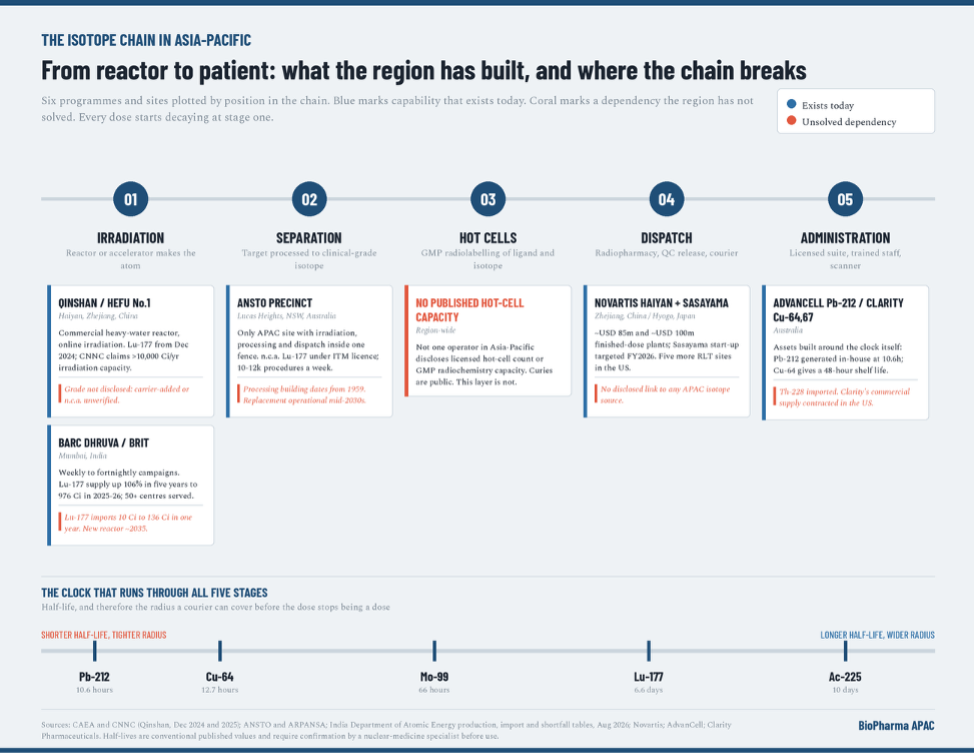
The isotope chain in Asia-Pacific: what the region has built, and where the chain breaks.
- Novartis at Haiyan and Sasayama
Haiyan, Zhejiang, China and Sasayama, Hyogo, Japan. Position in the chain: finished radioligand drug product and the last mile.
What exists today. The originator that created this market is building its Asia-Pacific points of supply directly, rather than waiting for a regional partner to do it. Novartis announced roughly USD 85 million for a radiotherapy facility at Haiyan in Zhejiang to supply Chinese patients, and its Japan unit announced roughly USD 100 million for a plant at Sasayama in Hyogo, with start-up targeted in fiscal 2026. The Japanese demand case is already live: Pluvicto was approved in Japan on 19 September 2025 for PSMA-positive castration-resistant prostate cancer and launched on 12 November 2025 alongside reimbursement listing, the country's first PSMA-targeted radioligand therapy.
The scale comparison is the point. Alongside these two Asia-Pacific sites, Novartis operates or is building five radioligand facilities in the United States, at Millburn, Indianapolis, Carlsbad, Winter Park and Denton, plus Zaragoza and Ivrea in Europe. It reports that more than 99 per cent of doses are administered on the planned day, a figure only a purpose-built scheduling network produces, and the service standard every regional entrant will be measured against.
The dependency it has not solved. Nothing in the public record connects these plants to Asia-Pacific isotope supply. Haiyan is the striking case. Novartis's Chinese radioligand plant and CNNC's Qinshan isotope reactor are in the same county, the only place in the region where a reactor and a finished-dose facility sit that close together, and neither party has disclosed any supply relationship between them. Two of the region's largest radiopharmaceutical investments are being built within sight of each other on separate supply chains.
Next milestone. Start-up at Sasayama in fiscal 2026, first commercial release from Haiyan, and any disclosure of where either site sources its lutetium-177. Regulatory submissions for the hormone-sensitive indication have been filed in China and Japan with first decisions anticipated in the second half of 2026, which would enlarge both sites' demand before either is fully proven.
- AdvanCell's lead-212 platform and ADVC001
Australia, with a growing United States presence. Position in the chain: isotope generation and drug product, deliberately co-located.
What exists today. Lead-212 has a 10.6 hour half-life, which makes it the most demanding logistics problem in the modality and, for exactly that reason, the one that cannot be outsourced. AdvanCell built its company around generating the isotope itself and labelling it in the same operation, and the approach has attracted the market's serious money. The company closed an oversubscribed USD 315 million Series D in July 2026, led by Ally Bridge Group and co-led by Alpha Wave, with Bain Capital Life Sciences, Fidelity and T. Rowe Price-advised funds among new investors, explicitly to expand manufacturing infrastructure and take its lead asset toward Phase 3. Sanofi and Lilly, both already partners, took part.
The asset is real and the data is regional. ADVC001, a lead-212 PSMA-targeted alpha therapy, reported Phase 1b dose escalation results from the TheraPb trial at ESMO in October 2025, the first clinical results for a lead-212 PSMA therapy. The Phase 2 expansion opened in December 2025 and was presented at ASCO GU in February 2026, evaluating 160 and 200 MBq doses across hormone-sensitive and castration-resistant settings, including patients already treated with lutetium PSMA therapy. The trial infrastructure sits in Australia.
The dependency it has not solved. The parent isotope. Lead-212 is milked from thorium-228, and AdvanCell announced its first delivery of high-activity thorium-228 in December 2025, describing the capability to handle it as a differentiator. The supplier was not disclosed, and no Asia-Pacific source of high-activity thorium-228 is publicly identified. A platform built to escape a distribution radius still begins with a shipment from somewhere else. The company's centre of gravity is also shifting: it appointed a chief executive in November 2025 explicitly to lead United States expansion, and now issues from Boston as well as Australia.
Next milestone. Phase 3 initiation, and where the commercial manufacturing infrastructure funded by the Series D actually gets built. That decision, more than the clinical data, determines whether the region keeps this one.
- Clarity Pharmaceuticals' targeted copper theranostic
Eveleigh, New South Wales, Australia. Position in the chain: drug product engineered around the distribution radius.
What exists today. Clarity's answer to the decay clock is not faster logistics but a different isotope. Its SAR technology pairs copper-64 for imaging with copper-67 for therapy on the same targeting molecule, and copper-64's half-life supports a 48-hour product shelf life. That single number changes the geometry. Where gallium-68 and fluorine-18 diagnostics need a dense local network of cyclotrons, generators and radiopharmacies, Clarity has supplied both registrational Phase 3 trials from centralised manufacture, and next-day imaging turned out to be clinically useful in its own right: in the Phase 2 COBRA study it detected lesions in up to 80 per cent of participants against up to 58 per cent on same-day imaging.
The programme is at the sharp end. Two registrational Phase 3 imaging trials, AMPLIFY and CLARIFY, are running, with three FDA Fast Track designations across copper-64 staging, biochemical recurrence and copper-67 therapy in previously treated metastatic castration-resistant disease.
The dependency it has not solved. It has solved the region's problem and then contracted the solution somewhere else. Clarity's commercial-scale supply is a United States network: a March 2026 manufacturing supply agreement with Theragenics covering a 134,000 square foot, 14-cyclotron site near Atlanta, alongside existing copper-64 agreements with SpectronRx and Nusano, and an April 2026 finished-product manufacturing agreement with Nucleus RadioPharma in Minnesota with a larger Pennsylvania site flagged for 2028. Theragenics alone is quoted at around 100 curies of copper-64 a day from a single cyclotron, framed as roughly 2,000 patient doses. The Australian supply that exists is a research-scale weekly line: a copper-64 agreement with the University of Queensland's AIBN cyclotron, serving trials.
This is not a criticism of the company, which is following its market and its regulator. It is the clearest single illustration of this list's third finding. Asia-Pacific produced the science that shortens the chain, and the chain is being built in Georgia and Minnesota.
Next milestone. AMPLIFY and CLARIFY readouts and any subsequent NDA, and whether an Asia-Pacific copper-64 supply agreement at commercial rather than research scale ever appears.
|
Two programmes were considered as entries and are recorded here instead, because what each has built is smaller than what the modality needs, and saying so is more useful than promoting either. KIRAMS, Seoul. Korea has the region's most explicit state strategy and the only licensed domestic actinium-225 production in Asia-Pacific today. The Korea Institute of Radiological and Medical Sciences received approval from the Nuclear Safety and Security Commission on 12 May 2025 to produce actinium-225 by bombarding radium-226 with protons in a cyclotron, and has begun iodine-131 production on the HANARO reactor after import disruptions. It has also convened an alpha drug development consortium with four companies and proposed a dedicated cyclotron for alpha production. Scale is what matters: initial batches have been described as sufficient for three to four patients, with plans to scale tenfold to fifteenfold. That is a licence and a capability rather than a supply. Joyo, Oarai, Ibaraki. Japan's only experimental fast reactor is the region's largest prospective actinium source. Under the Japan Atomic Energy Commission's 2022 action plan on medical radioisotopes, JAEA aims to demonstrate actinium-225 production at Joyo, which has been shut since May 2007. The Nuclear Regulation Authority approved the draft review report for radioisotope production in September 2024 and Ibaraki prefecture and Oarai town consented the same month, with restart targeted in the second half of fiscal 2026. Until it starts, Japan depends on other countries for its medical radioisotopes, and a Japanese government panel has meanwhile endorsed prioritising international procurement of molybdenum-99 while domestic production research continues. Watch this one closely: a restart on schedule is the single largest available change to the region's alpha position. For context on why alpha matters so much here: global actinium-225 production has historically been measured in single-digit curies a year against clinical demand estimated in the hundreds to thousands, and a 2024 shortage was severe enough to pause a Phase 3 trial. |
|
Sidebar: where the region's biggest radiopharmaceutical company built its plant Telix Pharmaceuticals is Asia-Pacific's largest radiopharmaceutical company by revenue, reporting USD 247 million in the second quarter of 2026. Its primary manufacturing site is in Belgium. Telix Manufacturing Solutions Brussels South received GMP accreditation for Illuccix, began commercial production and completed its first GMP production run of a lutetium-based therapeutic candidate. The Asia-Pacific build is newer and smaller: a GMP facility opened in Yokohama, the company's first cyclotron site in the region, with an ARTMS QUANTM Irradiation System installed for local zirconium-89 production, and TMS North Melbourne licensed and in final fit-out. Telix is targeting 50 QIS installations globally by the end of 2026. The company is not on the main list because its consequential manufacturing decisions to date were made in Europe and North America. It is on this page because it may not stay that way, and North Melbourne coming online is a genuine regional milestone. |
|
What is not on this list, and why Southeast Asia outside Singapore, and Singapore itself. No radioligand isotope production capacity, no announced facility, and no operator that met the inclusion test. Singapore has clinical demand and hot-cell-capable institutions but no disclosed production programme. Taiwan and New Zealand. Both have nuclear medicine capability. Neither has a disclosed radioligand isotope programme at the scale of any entry here. An Asia-Pacific no-carrier-added lutetium-177 producer selling into the world market. There is not one. ANSTO produces it under licence for regional and clinical supply. The comparable exporters remain ITM, Curium, SHINE, NRG PALLAS, Isotopia, MURR and NTP. Commercial-scale actinium-225 anywhere in the region. See the alpha ledger. What exists today is a Korean cyclotron making batches sized for a handful of patients. Chinese and Korean clinical assets. Full-Life Technologies, Sinotau, Dongcheng, SmartNuclide, FutureChem, CellBion and PDRadiopharma with Curium all have programmes that will matter. They belong to a list of assets. This one is about the chain that has to carry them. |
What to watch, in order
Five events between now and the end of 2027 will move this list more than any clinical readout.
Joyo restarting on schedule in the second half of fiscal 2026 is the largest single change available to the region's alpha position, and the one most likely to slip. Start-up at Sasayama will show whether an originator can run an Asia-Pacific radioligand network to the on-time standard it runs in the United States. First commercial release from Haiyan is worth reading alongside it, and worth one question: where the lutetium came from. India's 2026-27 import figures will show whether the world's most cost-effective radioligand programme is quietly becoming an importer. And ANSTO's 2027 construction start is this decade's one chance to put an Asia-Pacific hot-cell number in the public record.
The uncomfortable pattern underneath all five is that four of them are state decisions. The private capital in Asia-Pacific radiopharmaceuticals has gone into molecules, which are patentable and portable, and not into atoms, which are neither. That is a rational allocation for any individual company and a poor outcome for the region, because the molecule can be developed in Sydney and manufactured in Atlanta, while the reactor cannot be moved at all.
None of this is a prediction that Asia-Pacific will fail to participate. Australia has the stack, China has the scale and the policy, India has the volume and the price, Japan has the density and now the plants, Korea has the licence and the plan. The gap is not capability. It is that no one has yet signed the contracts that would make these six things into one chain, and physics does not wait for procurement.
Disclaimer. This list is editorial analysis for information only. It is not investment, medical, regulatory or radiation-safety advice. Nothing here should be used to plan, schedule or handle a radiopharmaceutical dose. Inclusion is an editorial judgement about significance, not an endorsement, a ranking or a quality assessment, and exclusion is not criticism. Figures are drawn from operator, regulator and government disclosures on the dates stated and may have changed since; capacity claims by operators are reported as claims where no primary corroboration was available. Forward-looking dates for facilities under construction or awaiting restart are targets, not commitments, and slip routinely in this sector. BioPharma APAC has no commercial relationship with any organisation named in this article, and no organisation named had sight of the list before publication.
© 2026 BioPharma APAC. All rights reserved.
Most Read
- Can APAC Biomanufacturing Decarbonise Without Pricing Itself Out?
- The Algorithm on the GMP Floor: AI Promises a Smarter Plant. Regulators Demand the Audit Trail.
- APAC's Peptide-Capacity Gamble
- After the Rush: APAC's mRNA and Vaccine Capacity Hangover
- The Biosimilar Race: Factory to the World — or Stuck in the Copycat Economy?
- The Vein-to-Vein Problem: Can APAC's Cold Chain Carry Advanced Therapies?
- Vectors, Plasmids and the CGT Trap: APAC's Cell and Gene Therapy Ambitions Face an Upstream Bottleneck
- Can APAC Build Radioligand Therapy Before the Atoms Decay?
- The Great Biopharma Reset: 50 Developments That Changed Everything in H1 2026
- Beyond the Trial: Can Real-World Evidence Earn Regulatory Trust in APAC?
- Beyond the Obvious Giant: Where APAC's Clinical Trials Go Next
- The Frontier That Won’t Quite Arrive
Bio Jobs
- Sanofi Turns The Page As Belén Garijo Steps In And Paul Hudson Steps Out
- Global Survey Reveals Nearly 40% of Employees Facing Fertility Challenges Consider Leaving Their Jobs
- BioMed X and AbbVie Begin Global Search for Bold Neuroscience Talent To Decode the Biology of Anhedonia
- Thermo Fisher Expands Bengaluru R&D Centre to Advance Antibody Innovation and Strengthen India’s Life Sciences Ecosystem
- Accord Plasma (Intas Group) Acquires Prothya Biosolutions to Expand Global Plasma Capabilities
- ACG Announces $200 Million Investment to Establish First U.S. Capsule Manufacturing Facility in Atlanta
- AstraZeneca Invests $4.5 Billion to Build Advanced Manufacturing Facility in Virginia, Expanding U.S. Medicine Production
News