Good Enough and Cheap, or Prove It's Equivalent? Asia's Biosimilar Trust Gap
15 June 2026 | Monday | Analysis
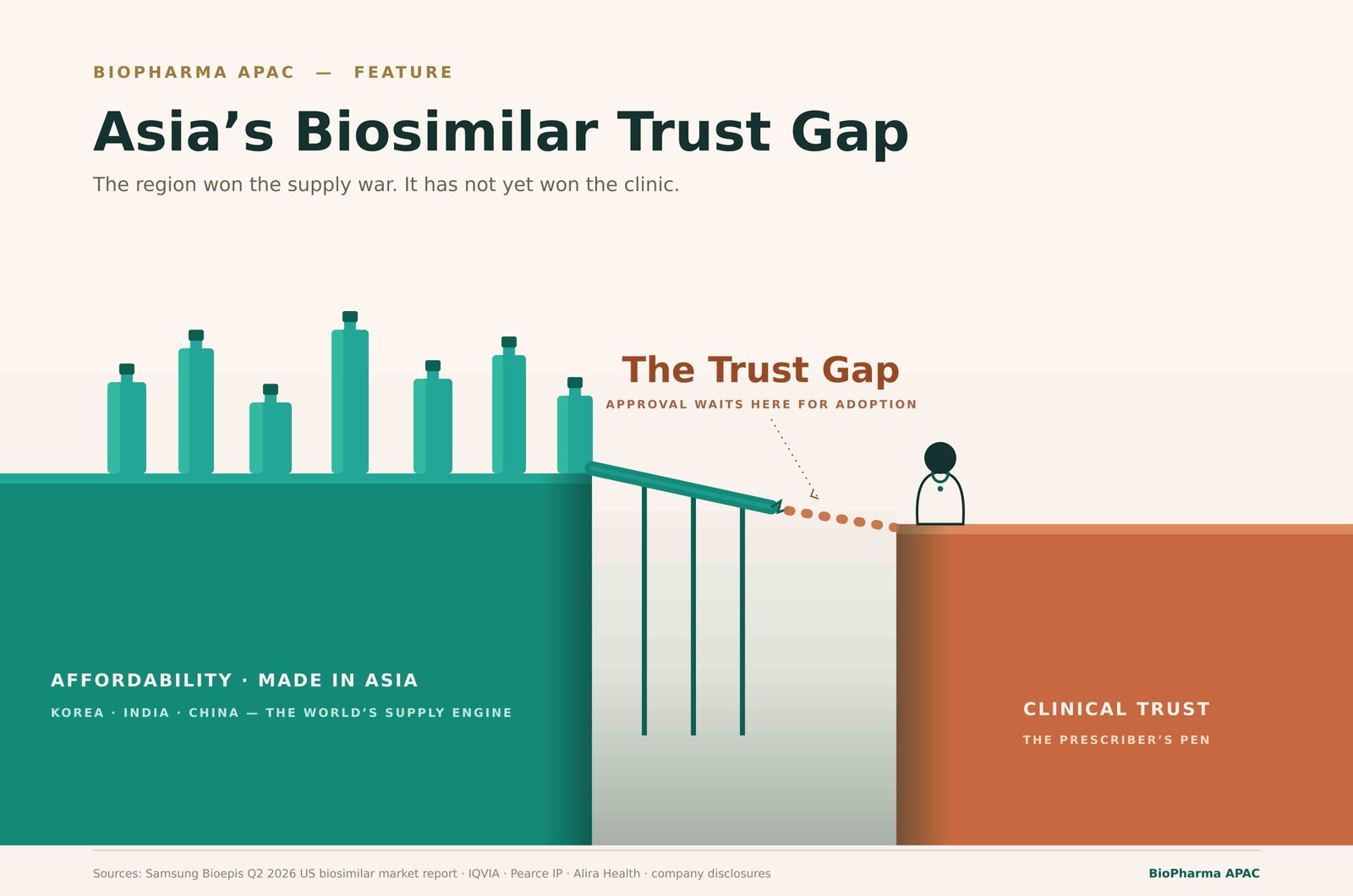
There is a number that captures Asia's biosimilar paradox in a single line. According to Samsung Bioepis's quarterly tracking of the United States market, the average sales price of a biosimilar falls by roughly half within five years of the first competitor arriving, and in the most mature molecule categories by more than three-quarters. The cost case, in other words, is not in dispute. The medicines work. The savings are real and durable. The manufacturing capacity to supply them at scale sits, overwhelmingly, in Incheon, Hyderabad, Bengaluru and Shanghai.
And yet, molecule after molecule, the same story repeats: approval comes years before adoption, and adoption comes years before trust. A biosimilar can clear one of the most demanding regulatory bars in medicine, price itself at a fraction of the originator, and still spend its first years on the market watching prescribers quietly keep writing the brand name they have always written.
That gap — between what Asia can supply and what the clinical world is willing to switch to — is the defining commercial problem of the region's biosimilar industry as it enters the second half of the decade. It is no longer a problem of factories. It is a problem of confidence.
The manufacturing question has been answered. The trust question has not.
This is the story of how Asia won the supply war, why winning it was not enough, and what the next phase — the conversion of capacity into clinical conviction — actually demands.
I. The supply victory: how APAC came to make the world's follow-on biologics
For most of the last decade, the biosimilar story in Asia was a manufacturing story, and a triumphant one. The region's three engines each took a different road to the same destination.
South Korea built champions. Samsung Bioepis and Celltrion turned a national bet on biologics into a pair of genuinely global players. The proof is in the launch calendars. Celltrion's ustekinumab biosimilar, referencing Johnson & Johnson's Stelara, reached the US in March 2025, Europe in late 2024, the Australian Pharmaceutical Benefits Scheme from August 2025, and secured Japanese approval — a near-simultaneous worldwide rollout that very few companies of any origin can execute. Samsung Bioepis, for its part, launched its first product in Japan in 2025 through a partnership with Nipro, having already placed the same molecule across the EU, the UK, Korea and the US under different brand names. These are not contract manufacturers filling someone else's order. They are originators of follow-on biologics, scaling globally on their own labels.
India built breadth. Where Korea concentrated firepower in a few companies, India spread it across an ecosystem. The "big five" — Biocon, Intas, Dr Reddy's, Zydus and Lupin — anchor a market that, by sheer number of approvals, is among the most prolific on earth. Antibody and fusion-protein biosimilars, the most demanding class to make, account for roughly seventy approvals in India through the end of 2025, spanning rituximab, trastuzumab, bevacizumab, adalimumab, denosumab, pertuzumab and beyond. Oncology alone makes up close to forty per cent of the country's approved biosimilars. The domestic biosimilar business has grown from somewhere around USD 866 million in 2024 toward an estimated USD 1.5 billion in 2025, on a compound growth rate near twenty per cent. And the symbolic milestones run deep: Biocon's trastuzumab, co-developed with Mylan and approved in the US in December 2017, was the world's first biosimilar of Herceptin to clear the FDA — an Indian-developed molecule setting a global precedent.
China built volume. The mainland's market is the fastest-compounding of all, expanding from roughly USD 209 million in 2020 to about USD 1.6 billion in 2024 — a growth rate in the region of fifty per cent a year. Domestic firms such as Innovent Biologics, Shanghai Henlius and Fosun Pharma dominate at home, with Henlius increasingly licensing its molecules outward to partners in regulated Western markets.
Put together, the picture is unambiguous. While Europe still holds the largest single slice of global biosimilar revenue — around 37 to 38 per cent — and Europe and the US combined account for over eighty per cent of the money, Asia-Pacific now posts the highest regional growth rate of anywhere in the world, with forecasters pencilling in compound expansion above twenty-eight per cent through the mid-2030s. The global biosimilar market, valued near USD 40 billion in 2025, is widely projected to approach USD 190 billion by 2035. Asia is positioned to capture a disproportionate share of that climb.
The strategy that delivered all this had a name in industry circles: manufacturing victory. Produce a high-quality, analytically tight molecule; price it aggressively; win on cost and scale. For a decade it worked beautifully.
The problem is that the war has moved.
II. The trust deficit: interchangeability, the prescriber's pen, and the switching question
A biosimilar that is approved is not a biosimilar that is used. Between those two states sits a thicket of clinical psychology, regulatory category and prescriber habit that no amount of manufacturing excellence can dissolve on its own.
The most consequential fault line is interchangeability — and it is widely misunderstood. Approval establishes that a biosimilar is, to the satisfaction of regulators, as safe and effective as its reference product. Interchangeability is a separate, higher designation: it governs whether a pharmacist can substitute the biosimilar for the brand at the counter without going back to the prescriber. In the US, that distinction has been a formal legal category, and a slow one — of roughly seventy-five biosimilars approved as of May 2025, only around twenty-one carried interchangeable status. Across much of Asia-Pacific, by contrast, many regulators have no interchangeability framework at all. Korea's Ministry of Food and Drug Safety, harmonised closely with WHO standards and capable of approving a biosimilar in under a year, nonetheless sits among a long list of regional agencies that offer no guidance on substitution. The result is a patchwork in which a molecule can be freely substitutable in one market, prescriber-gated in the next, and silent on the question in a third.
A biosimilar that is approved is not a biosimilar that is used. Between those two states sits the prescriber's habit.
For the physician, the relevant question is rarely "is this molecule analytically similar?" It is "do I move a patient who is stable?" Surveys of prescribers consistently surface the same hesitation: a reluctance to switch a patient who has achieved clinical stability on the originator, particularly in multi-indication biologics where dosing differs across diseases. That caution is not irrational. It is the conservative instinct of clinical medicine applied to a class of products whose entire selling point is that they are similar, not identical — a word that, to a cautious oncologist managing a responding tumour, can carry more weight than any cost argument.
Nowhere is the trust deficit more visible than in insulin and the metabolic space, the use case that most cleanly exposes the gap between regulatory blessing and clinical behaviour. Biosimilar insulins have been commercially available in Europe since 2014; six are approved in the EU and four in the US. By the metrics of access, they should have transformed diabetes economics. Yet the academic consensus is blunt: their commercial success has been limited. The barrier is not the science — narrative reviews of the registration studies conclude that approved biosimilar insulins carry no relevant differences from their reference products, and that patients and prescribers can use them without concern. The barrier is perception. Recent scoping work on biosimilar insulin switching finds that stakeholder perception — patient anxiety, prescriber inertia, the sheer familiarity of an existing pen — continues to play a central role in whether substitution actually happens. The molecule was never the obstacle. The mind was.
This is where the switching study enters the picture, and where the regulatory ground is now visibly shifting. Historically, earning an interchangeable designation in the US required dedicated switching trials — typically at least three alternating switches between biosimilar and reference product, designed to prove that bouncing between them changes nothing in pharmacokinetics or immune response. These studies are expensive, slow, and — a growing body of evidence argues — largely confirmatory of what the analytics already showed. The pivot is now underway on both sides of the Atlantic. The FDA's October 2025 draft guidance signalled that comparative efficacy studies may no longer be routinely expected, and earlier guidance moved to drop switching-study requirements for interchangeability altogether. The EMA, in April 2025, suggested that structural, functional and pharmacokinetic comparability data may be sufficient on their own, proposing to reduce or eliminate comparative clinical studies. A widely-cited 2025 review of more than six hundred biosimilar studies found that no biosimilar with proven analytical similarity has ever failed a comparative efficacy study — a finding that, taken seriously, undercuts the rationale for demanding them.
For Asian manufacturers, this regulatory liberalisation is a double-edged gift. It lowers the cost and time to market — by some estimates eighteen to thirty-six months and tens of millions of dollars per programme. But it also strips away one of the few tangible, citable reassurances a regulatory affairs head could put in front of a sceptical prescriber. As the clinical-trial scaffolding comes down in the name of efficiency, the burden of building confidence shifts even more squarely onto real-world evidence, education and time.
III. The innovator's brake: patent thickets and litigation as an adoption tax
If prescriber hesitancy is the soft brake on biosimilar uptake, litigation is the hard one — and originators have learned to apply it with precision.
The mechanism is elegant in its frustration. A biosimilar can be approved and ready, its factory validated, its price set — and still be barred from the market by a court. The clearest recent illustration is aflibercept, the molecule behind Regeneron's blockbuster eye drug Eylea. As of early 2026, four aflibercept biosimilars stood approved in the US — including Biocon's and Celltrion's — yet not one of them was on the market. Each had been pushed to scheduled launch dates in the second half of 2026 through litigation settlements. Samsung Bioepis's own aflibercept biosimilar was blocked outright by a preliminary injunction in June 2024, a block upheld on appeal in early 2025. The reference product, meanwhile, faced just a single biosimilar competitor offering a modest twelve per cent discount — in a market where, with full competition, discounts would run far deeper. That is the patent thicket working exactly as designed: not to win on the merits forever, but to convert each year of delay into another year of originator pricing.
The patent thicket is not built to win forever. It is built to make every year of delay pay for itself.
The thicket is dense because biologics invite density. A single originator molecule may be wrapped in dozens of patents — composition, formulation, manufacturing process, delivery device, method of use across each separate indication. A biosimilar maker must clear, license around, or litigate through every one. In the US, the Biologics Price Competition and Innovation Act formalised this into a structured "patent dance" that can stretch for years before a single vial ships. The contests are not always losses for the challengers — Janssen's attempt to defend a key Stelara-related patent in the UK was struck down, clearing the path for Korean ustekinumab biosimilars across plaque psoriasis, psoriatic arthritis, Crohn's disease and ulcerative colitis. But every contest, won or lost, is a tax: on capital, on launch timing, and on the confidence of the payers and prescribers watching to see whether a given biosimilar will actually, reliably, be there.
The looming test case is the GLP-1 cliff, and it will be fought hardest in Asia's home markets. Semaglutide — the molecule behind Ozempic and Wegovy — saw its composition-of-matter patent expire across India, China, Canada, Brazil and Turkey in 2026, even as it remains protected in the US and Europe until roughly 2031 to 2032. The Asian response has been a stampede. More than forty generic or biosimilar semaglutide programmes are reported to be in development in India alone; China has well over a dozen candidates in late-stage trials. Dr Reddy's has a semaglutide biosimilar in global registration, targeting Canada, Brazil and India. Biocon has struck a licensing and supply arrangement in Brazil. Lupin is developing both injectable and oral forms for India and South Africa, eyeing a domestic market its own executives have suggested could be worth a billion dollars a year.
But semaglutide also exposes a quieter trust problem unique to this class: what is it, legally? The molecule sits awkwardly between categories — some regulators treat it as a complex generic, others as a biosimilar, depending on how it is synthesised and the jurisdiction's framework for polypeptides. That ambiguity is not academic. It changes the data a manufacturer must generate, the time to market, the price the molecule can command, and — critically — the confidence a prescriber attaches to it. A product that one country waves through as a generic and another scrutinises as a biologic does not arrive in the clinic with a single, stable story about what it is. And in the GLP-1 space, where patient demand is enormous, brand loyalty is intense, and Novo Nordisk has already warned of double-digit sales erosion while betting its brands will hold, the originator's incentive to litigate, to defend secondary patents, and to seed doubt about follow-on quality is as strong as it has ever been.
IV. Harmonisation: is the confidence gap closing, or quietly widening?
If the trust deficit has a structural cause beyond psychology, it is regulatory fragmentation. And here the evidence cuts both ways.
The optimistic reading is real. There is genuine momentum toward convergence on the single most expensive and least defensible requirement in biosimilar development: the comparative efficacy study. The direction of travel — FDA, EMA, and the weight of published science all pointing toward analytical and pharmacokinetic data being sufficient — is converging. International bodies have built shared infrastructure: a standardised public assessment template to let regulators share evaluations across language barriers, WHO competency frameworks for assessors, and structured multi-stakeholder efforts that have produced concrete consensus recommendations for streamlining development. One recent international qualitative study distilled sixteen high-consensus recommendations — among them harmonising reference-product selection, eliminating in-vivo animal studies, accepting clinical data generated for global submissions, and reconsidering comparative efficacy trials outright. When regulators, academics and industry agree on sixteen points, the ground is moving.
The pessimistic reading is equally real, and it lives in the gaps between markets. Despite the convergence rhetoric, meaningful divergences persist precisely where they raise cost and delay access. Some major markets — China, Korea and Brazil among them — may still mandate comparative animal toxicology studies that the FDA and EMA have moved to waive. Certain jurisdictions still demand clinical data drawn specifically from local ethnic populations, even where global studies have already demonstrated comparability, forcing manufacturers to repeat work to satisfy national requirements. These divergences, analysts note, often trace not to science but to outdated legislation and an understandable instinct toward regulatory sovereignty — each agency preserving its right to decide. The cumulative effect is exactly what biosimilars were meant to defeat: higher development costs, slower approvals, and constrained patient access.
Convergence on the science is outpacing convergence on the rules. That gap is where confidence leaks away.
The deeper risk for Asia is asymmetric. A Korean or Indian manufacturer selling into Europe and the US benefits enormously as those markets simplify — faster, cheaper paths to the largest pools of revenue. But within Asia-Pacific, the absence of shared interchangeability frameworks, the uneven appetite for substitution, and the residual local-data demands mean that a biosimilar trusted in one APAC market must, in effect, re-earn that trust in the next. Convergence on the science is, for now, outpacing convergence on the rules. And it is in that gap — between a molecule that is scientifically settled and a regulatory map that is not — that prescriber confidence quietly leaks away.
V. The conversion problem: from manufacturing leadership to clinical trust
Step back, and the strategic picture for Asian biosimilars resolves into a single sentence. The region has comprehensively won the contest it knew how to fight — cost, scale, analytical quality, regulatory throughput — and now finds itself in a contest it is less practised at: persuasion.
The evidence that persuasion works is encouraging. In the US, adalimumab biosimilars climbed to roughly sixty per cent market share by early 2026, and ustekinumab biosimilars to around twenty-seven per cent within a year of launch. Trust, it turns out, is not static. It accrues — through real-world safety records, through payer mandates that nudge prescribers, through the simple accumulation of patients who switched and were fine. The same Samsung Bioepis data showing steep price erosion also shows steady share gains: the curve bends, just more slowly than a spreadsheet would like.
But that bend has to be earned with tools Asian manufacturers have historically under-invested in. The old playbook — make it well, price it low — gets a molecule approved and onto a tender. It does not get it into the hand of a hesitant oncologist or a diabetes specialist managing a stable patient. The new playbook demands clinical engagement: robust real-world evidence generation after launch, sustained education of key opinion leaders, transparent pharmacovigilance, and payer relationships built on outcomes data rather than discount alone. In mature markets, the industry observation is already explicit — competing now requires delivering beyond regulatory compliance, with clinical packages and physician engagement that the cost-and-scale era never required.
So what will it actually take to convert manufacturing leadership into clinical trust? Four things, in roughly this order.
First, interchangeability frameworks that Asian regulators have largely not built. Substitution is where cost savings become automatic rather than aspirational. As long as much of APAC leaves the question unanswered, the prescriber's pen remains the bottleneck, and the savings remain theoretical.
Second, real-world evidence as the new switching study. As regulators drop comparative efficacy trials, the burden of proof migrates to post-marketing data. The manufacturers who invest early in rigorous, published real-world switching evidence will own the confidence narrative; those who treat approval as the finish line will keep losing share to brands long after their molecule is technically equal.
Third, regional harmonisation pursued as commercial strategy, not just regulatory housekeeping. Every redundant local-data requirement, every divergent animal-study mandate, is a tax that falls hardest on the Asian firms best positioned to supply the region. Convergence is in Asia's direct commercial interest, and the region's manufacturers have both the scale and the standing to push for it.
Fourth, the patience to outlast the litigation brake. The patent thicket cannot be eliminated, only navigated and waited out. The GLP-1 cliff will be the proving ground: the firms that combine aggressive but disciplined patent strategy with the clinical-confidence machinery above will convert the semaglutide opening into durable share. Those that win only on price will watch the originator's brand loyalty — and its lawyers — hold the line far longer than the chemistry justifies.
The manufacturing question, then, is closed. Asia makes these medicines, makes them well, and makes them cheaply enough to reshape the economics of cancer, autoimmune disease and diabetes for billions of people. The question that remains — the one that will define the next ten years — is whether the region can make the clinical world believe what its factories have already proven.
Good enough and cheap got Asia to the front of the supply chain. Proving it's equivalent, again and again, in the room where the prescription is written, is what gets it to the front of the market.
(arcilla.fran@biopharmaapac.com )
** Figures drawn from Samsung Bioepis quarterly US biosimilar market reports (2025–2026), IQVIA, Alira Health, Precedence Research, Mordor Intelligence, Pearce IP litigation tracking, peer-reviewed regulatory reviews (2025), and company disclosures from Dr Reddy's, Biocon, Celltrion and Lupin.
Most Read
- Can APAC Biomanufacturing Decarbonise Without Pricing Itself Out?
- The Algorithm on the GMP Floor: AI Promises a Smarter Plant. Regulators Demand the Audit Trail.
- APAC's Peptide-Capacity Gamble
- After the Rush: APAC's mRNA and Vaccine Capacity Hangover
- The Biosimilar Race: Factory to the World — or Stuck in the Copycat Economy?
- The Vein-to-Vein Problem: Can APAC's Cold Chain Carry Advanced Therapies?
- Vectors, Plasmids and the CGT Trap: APAC's Cell and Gene Therapy Ambitions Face an Upstream Bottleneck
- Can APAC Build Radioligand Therapy Before the Atoms Decay?
- The Great Biopharma Reset: 50 Developments That Changed Everything in H1 2026
- Beyond the Trial: Can Real-World Evidence Earn Regulatory Trust in APAC?
- Beyond the Obvious Giant: Where APAC's Clinical Trials Go Next
- The Frontier That Won’t Quite Arrive
Bio Jobs
- Sanofi Turns The Page As Belén Garijo Steps In And Paul Hudson Steps Out
- Global Survey Reveals Nearly 40% of Employees Facing Fertility Challenges Consider Leaving Their Jobs
- BioMed X and AbbVie Begin Global Search for Bold Neuroscience Talent To Decode the Biology of Anhedonia
- Thermo Fisher Expands Bengaluru R&D Centre to Advance Antibody Innovation and Strengthen India’s Life Sciences Ecosystem
- Accord Plasma (Intas Group) Acquires Prothya Biosolutions to Expand Global Plasma Capabilities
- ACG Announces $200 Million Investment to Establish First U.S. Capsule Manufacturing Facility in Atlanta
- AstraZeneca Invests $4.5 Billion to Build Advanced Manufacturing Facility in Virginia, Expanding U.S. Medicine Production
News