Stopped: The Six-Year Cost of Trials That Never Reached the Finish Line
28 July 2026 | Tuesday | Analysis
One infusion, no programme
A gene therapy is a one-way door. The vector goes in once, it cannot be taken out, and with current adeno-associated virus technology the patient cannot be dosed again. Whatever a sponsor decides afterwards, the participant keeps the decision in their body.
CIFFREO was a global, multicentre, randomised, double-blind, placebo-controlled Phase 3 study of fordadistrogene movaparvovec, Pfizer’s investigational mini-dystrophin gene therapy for Duchenne muscular dystrophy. It enrolled 226 ambulatory boys aged four to seven who were on a stable daily glucocorticoid regimen. Half received the therapy. The other half received placebo, on the understanding that they would cross over and be dosed after a year.
In May 2024, dosing was paused after the death of a boy in DAYLIGHT, a companion Phase 2 study in younger children. In June 2024, Pfizer reported that CIFFREO had missed its primary endpoint, a change in the North Star Ambulatory Assessment at one year, and had also missed its key secondary endpoints on ten-metre run and walk velocity and time to rise from the floor. In late July 2024, the company discontinued the programme outright. Around 150 employees at the Sanford, North Carolina facility that manufactured the product were let go. Every boy who had received the therapy would continue to be followed for long-term safety monitoring.
That is the shape of the thing. The trial produced an answer, which is what trials are for, and the sponsor acted on it, which is what sponsors should do. But the participants in the treatment arm are carrying a permanent intervention from a programme that no longer exists. The placebo arm never received what it had consented to a chance at. The sites that recruited those families spent years of investigator time on a file that closed. None of that is a scandal. All of it is a cost, and the striking thing about the six years to July 2026 is how rarely anyone counts it.
What the record actually shows
Start with an absence. There is no published, structured account of why industry clinical trials stopped early between 2020 and 2026. Not from a regulator, not from a registry operator, not from the trade. For a sector that requires pre-registered endpoints, locked statistical analysis plans and audited case report forms, the question of why a study was abandoned is answered nowhere in a form anyone can query. That absence is the first finding of this piece, and everything else follows from it.
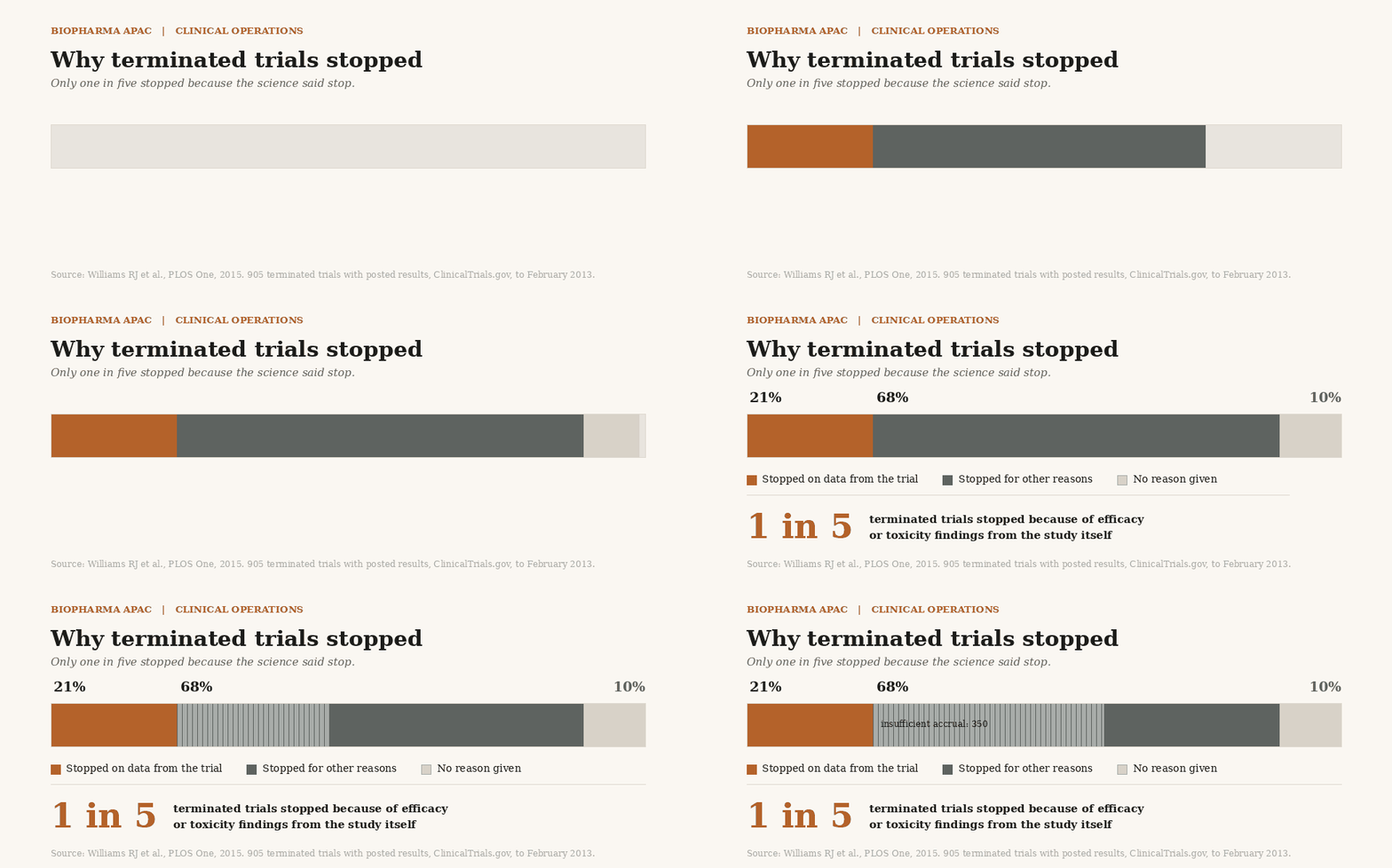
The most careful published work on the question remains an analysis of the ClinicalTrials.gov results database as it stood in February 2013. Williams and colleagues found that 905 of 7,646 trials with posted results had been terminated, about twelve per cent. Of those 905, sixty-eight per cent had stopped for reasons other than data accumulated in the trial itself. Among that group, insufficient accrual was the leading reason at fifty-seven per cent. Only twenty-one per cent had stopped because of efficacy or toxicity findings generated by the study. Ten per cent gave no reason at all.
Read that distribution again, because it is the argument of this piece in a single line. In the largest structured look at the question, roughly one terminated trial in five stopped because the science said stop. The rest stopped for reasons that have nothing to do with what the drug did.
Nothing in the six years since suggests the shape has changed. What has changed is the volume, the geography and the size of the individual write-offs.
Why they stop, and why nobody can tell you precisely
ClinicalTrials.gov asks sponsors why a study was stopped, and then lets them answer in free text. There is no controlled vocabulary and no drop-down. A 2015 analysis that scanned more than three thousand terminated records found the field had produced hundreds of distinct entries, many of them a single word, some of them internally contradictory. Researchers who have tried to work with it have had to build their own termination ontologies before any analysis could begin.
The categories that emerge from that work are stable enough to name. Safety or toxicity. Futility, or a missed endpoint at an interim analysis. Business or strategic decision, including pipeline reprioritisation. Funding loss, sponsor insolvency or acquisition fallout. Enrolment failure. Operational and supply disruption. Regulatory action or clinical hold. And, persistently, no reason given.
There is a genuine limit to how far those categories can be separated using registry data, and it should be stated plainly rather than buried, because it cuts against the argument. A 2026 cohort study of German and Californian trials published in PLOS One made the point that a stated reason such as slow accrual can reflect a business judgement, for instance that the financial incentive to keep enrolling was insufficient, or a scientific one, for instance an early signal of limited efficacy or unacceptable toxicity that never made it into the record. Business and scientific reasons overlap, and registry data alone cannot systematically pull them apart.
That caveat matters. It does not dissolve the finding, for two reasons. First, the ambiguity runs mostly one way. A sponsor that stops on a genuine safety signal has strong regulatory and reputational incentives to say so, because the signal will surface in pharmacovigilance reporting regardless. A sponsor that stops because a portfolio committee reallocated a budget has no such incentive, and slow accrual is the socially acceptable answer. If the free text is biased, it is biased towards understating the business share, not overstating it.
Second, the registry is not the only record. Impairment charges, restructuring provisions and pipeline tables in annual filings describe the same decisions in a document where misdescription carries securities consequences. Reading the two against each other is the only honest way at the answer, and it is what the rest of this article does.
One finding deserves to be said in industry’s favour, because it cuts against the easy story. Where no reason for termination was disclosed at all, academic sponsors were by far the worse offenders, failing to give a reason in about seventy per cent of cases against roughly twenty-nine per cent for company-sponsored studies. Commercial sponsors are more than twice as transparent about stopping as universities are. Whatever is wrong with this system, industry did not invent it alone.
The pandemic cohort, and why it has to come out
Any assessment of this window is contaminated at the front end, and most public commentary on trial terminations has failed to correct for it.
Two distinct things happened in 2020 and 2021. Trials across every therapeutic area were suspended or terminated for operational reasons when sites closed, monitors could not travel and supply chains seized. Then, separately, a very large cohort of COVID-19 vaccine and therapeutic programmes was started at emergency speed and abandoned within two or three years. In most of those cases the science did not fail. The commercial opportunity closed behind them, and partnered programmes collapsed alongside their partners.
Neither phenomenon is representative of ordinary development, and pooling them with everything else produces a spike in the early years and an apparent decline afterwards that is an artefact rather than a trend. Any serious reading of the period has to report the series twice, with the pandemic cohort in and out, and treat the second as the real line. It also, incidentally, makes the business-decision category look larger than it is at the start of the window and smaller than it is at the end, which is the opposite of the direction most commentary assumes.
Where the stopping concentrated
Gene therapy: an orderly retreat, not a scientific collapse
The clearest pattern of the window is not a failure of science. It is a capital reallocation, executed by almost every large diversified pharmaceutical company at roughly the same time, and it is the best single illustration of the argument.
Takeda moved away from discovery and preclinical adeno-associated virus gene therapy programmes in 2023, alongside rare haematology, with associated redundancies. Biogen cut its preclinical AAV programme the same year. AstraZeneca had already sold its preclinical gene therapy portfolio to Pfizer. Pfizer then went furthest: after discontinuing the Duchenne programme in 2024, it announced in February 2025 that it would stop commercialising Beqvez, its haemophilia B gene therapy, despite an FDA approval granted in April 2024 and a European authorisation before that. The stated reason was that essentially no patients had received it and clinicians had not engaged. Roche restructured Spark Therapeutics, the company it had bought in 2019 as its gene therapy platform, taking an impairment charge of around 2.4 billion dollars and absorbing the remaining staff. Vertex halted its AAV vector work.
The financing moved first. Gene therapy investment fell from roughly 8.2 billion dollars in 2021 to about 1.4 billion in 2024. When capital contracts by more than eighty per cent, programmes stop. That is not a scientific verdict on the modality, and a good deal of trade coverage that described it as one obscured what had actually happened to the patients enrolled.
The safety thread is real and separate. Sarepta disclosed a patient death from acute liver failure in March 2025, a second in June, and in July the death of a 51-year-old participant in a Phase 1 study of SRP-9004 for limb-girdle muscular dystrophy, which used the same AAVrh74 serotype as its approved Duchenne product. The FDA revoked the platform technology designation for that vector, placed the limb-girdle programmes on clinical hold, and asked the company to suspend shipments of the marketed therapy. Sarepta initially declined and then reversed, and laid off around a third of its workforce that month. Here the stopping was safety and regulator driven, and the record says so clearly.
Oncology: a whole mechanism, discontinued
The anti-TIGIT class is the window’s clearest case of futility operating at the level of an entire mechanism rather than a single molecule. Roche’s tiragolumab failed in small cell lung cancer in 2022, missed overall survival in first-line metastatic non-small cell lung cancer in SKYSCRAPER-01 in 2024, and was discontinued in July 2025 after a run of pivotal failures spanning liver, lung, oesophageal and head and neck cancers.
Merck stopped dosing in KeyVibe-010, an adjuvant melanoma study of vibostolimab with pembrolizumab in 1,594 patients, in May 2024, after immune-mediated adverse events drove a discontinuation rate that made the primary endpoint unreachable. KeyVibe-008 in small cell lung cancer was halted on futility and excess adverse events. Merck then discontinued the vibostolimab and favezelimab programmes entirely after KeyVibe-003 and KeyVibe-007 met pre-specified futility criteria for overall survival.
Note the exposure. Merck’s vibostolimab programme was evaluating the combination in more than three thousand patients. A class-level failure of this kind is the system working as designed, but it is also several thousand people who received an investigational agent in a mechanism where a competitor had already published a negative pivotal readout in a similar setting. The question raised at the time, and never satisfactorily answered, was why so many sponsors persevered so long after the first signals went against the class.
Metabolic: crowded out, not disproved
Pfizer’s oral GLP-1 programme illustrates the safety category cleanly, and the competitive one underneath it. The twice-daily formulation of danuglipron was dropped in December 2023 after tolerability problems in a mid-stage study. The once-daily formulation was discontinued in April 2025 after a single asymptomatic participant in a dose-optimisation study experienced a potential drug-induced liver injury that resolved on withdrawal.
Pfizer noted that liver enzyme elevations across a safety database of more than 1,400 participants were in line with approved agents in the class, and that the dose-optimisation studies had met their pharmacokinetic objectives and identified a formulation with competitive potential for Phase 3. The company stopped anyway, after reviewing the totality of the data and consulting regulators, and redirected to a different mechanism.
That is a defensible decision and probably the right one. It is also a decision that a company without two entrenched competitors already in the market would very likely have taken differently. The stated reason is safety. The context is position.
What the filings say that the registry does not
The most informative document about why a programme stopped is frequently not the registry entry. It is the impairment note.
Gilead acquired Forty Seven in 2020 for 4.9 billion dollars, principally for magrolimab, an anti-CD47 antibody widely described at the time as a pipeline in a product. The unwinding took three years and is unusually well documented. A Phase 3 study in myelodysplastic syndromes was stopped for futility in July 2023. The FDA placed a partial clinical hold on the acute myeloid leukaemia programme in August 2023. ENHANCE-2, in AML with TP53 mutations, was stopped in September 2023 after an ad hoc analysis found the combination unlikely to improve survival. In February 2024, ENHANCE-3 was discontinued when an independent data monitoring committee found futility and an increased risk of death driven by infections and respiratory failure, and the FDA imposed a full clinical hold across AML and MDS studies, including the related expanded access programmes. By April 2024 the remaining solid tumour studies had been removed from the pipeline.
Every one of those steps is a defensible clinical decision taken on independent advice. Read together in the annual report, they are also a 4.9 billion dollar acquisition being written down. Roche’s charge on Spark tells the same kind of story in a single line. The registry entries for the underlying studies say futility, or safety, or very little. The filings say what the money did.
This is the practical reason the discontinuation record cannot be read from registries alone, and the practical reason so few people read it at all. It requires two documents in two disclosure regimes to be held against each other, one written for regulators and one for investors, neither designed to answer the question.
What Asia-Pacific absorbs
This is where the accounting stops being abstract, because the region now carries a large share of the world’s trial activity and almost none of the decision-making about when that activity ends.
The scale is not in dispute. Analysis of registrations from 2017 to 2021 put Asia-Pacific above fifty per cent of global clinical trial activity, ahead of the United States and the EU5. China’s share of global trial starts rose from about eight per cent in 2013 to twenty-nine per cent in 2023. Across 2020 to mid-2025, six APAC markets, China, South Korea, Australia, Japan, India and Singapore, together recorded close to forty thousand trials, with industry sponsorship dominating in Japan, Australia and South Korea. India recorded 1,710 trial initiations in 2024 against 741 a decade earlier.
When a programme is cancelled, three things happen at those sites, and only the first has any regulatory machinery behind it at all. Participants stop receiving the investigational product. Investigators and coordinators contracted against an enrolment schedule carry fixed staffing costs against a study that will not enrol again. And the site’s record, which shapes whether it is selected for the next multinational protocol, absorbs a closed file that says nothing about the quality of the work done there.
On the first of those, the ethical framework was recently strengthened, and the strengthening reveals the gap rather than closing it. The 2024 revision of the Declaration of Helsinki, adopted in October of that year, rewrote paragraph 34 so that post-trial provisions must be arranged in advance by sponsors and researchers, to be provided by them, by health systems or by governments, for all participants who still need an intervention that the trial identified as beneficial and reasonably safe. Exceptions require research ethics committee approval, and the arrangements must be disclosed to participants during consent.
Read the conditional. The obligation attaches to an intervention identified as beneficial. A trial terminated for futility has, by construction, identified nothing as beneficial. A trial terminated for business reasons has usually not run long enough to identify anything at all. The strongest post-trial access language the world has ever adopted has almost no purchase on precisely the cases examined here.
India’s New Drugs and Clinical Trials Rules 2019 went further than most jurisdictions and met the same wall from the other side. The rules defined post-trial access for the first time, requiring a sponsor to supply the investigational product free of cost to a participant after a trial completes, where the investigator and ethics committee find it beneficial and no alternative therapy exists. They preserved India’s stringent compensation obligations for trial-related injury, with the amount determined by the Drug Controller General on expert committee advice. And they provide that the sponsor bears no liability for post-trial use of the product. The obligation is real, it is conditioned on completion and on demonstrated benefit, and the liability is severed at the point of handover.
The result is a system in which a participant in Hyderabad, Seoul or Shanghai whose programme was cancelled at a portfolio review in New Jersey or Basel has, in most cases, no enforceable claim to anything. Not continued supply, because nothing was identified as beneficial. Not compensation, because there was no injury. Not even, in many cases, an explanation, because there was no finding to explain. This is not a failure by CDSCO, the NMPA, the PMDA, the MFDS or HSA. It is a structural feature of instruments drafted around trials that finish.
The evidence that vanished
A trial that stops early still generated data, and participants still took the risk that produced it. Whether anybody can learn from that risk depends entirely on reporting, and reporting is where terminated trials are weakest.
In the Williams analysis, primary outcome data for terminated trials were available on ClinicalTrials.gov for seventy-two per cent of studies but in the published literature for only twenty-two per cent. The gap widened sharply by reason for stopping. Where the decision to terminate was based on data from the trial itself, reporting rose to ninety-one per cent on the registry and forty-six per cent in the literature. The trials that stopped for business reasons, which are the majority, are also the trials least likely to leave any usable record behind.
The current picture is not obviously better. A cross-sectional study of all 7,547 Phase 2 to Phase 4 drug trials registered on the EU Clinical Trials Information System as of November 2025 found registration data quality high, above ninety-nine per cent complete, but compliance with the legal duty to report results poor. Of 234 trials legally required to have reported, fewer than half, 49.6 per cent, had fully reported within the required timeframe. The authors also identified a set of uploaded results documents that contributed nothing usable to the evidence base, and recommended that regulators publicly flag unreported trials and use existing powers to sanction sponsors who break the law. In June 2026, European health groups wrote to national regulators listing the unreported trials each was responsible for.
In the United States, enforcement of the FDAAA 801 results-reporting requirement has begun to move, from a low base. The FDA Office of Compliance annual report for 2025, published in April 2026, recorded 42 preliminary notices of noncompliance and two formal notices, the largest single-year count since enforcement began. In March 2026 the agency reminded more than 2,200 sponsors to post required results. Longitudinal analysis shows the direction of travel: twelve-month reporting rates rose from 3.6 per cent in the 2008 to 2009 window to 28.2 per cent in the 2020 to 2021 window, and thirty-six-month rates from 24.4 per cent to 55.2 per cent. Better, and still a minority.
The record is thin at the other end too. Benchmarking of nearly eighty thousand company-sponsored studies found that only around fifty-three per cent disclosed initiation within the correct quarter, and roughly thirteen per cent of trials remain undisclosed at the early stage altogether. A system that is unreliable about when studies start and unreliable about whether they reported is not in a strong position to account for why they stopped.
The case for stopping
The strongest argument against everything above is that stopping trials quickly is a virtue, and that a system stopping fewer of them would be a worse one. It is a good argument and deserves to be made at full strength.
Almost every consequential stop in this window was recommended by an independent data monitoring committee, not by a commercial function. Merck stopped KeyVibe-003 and KeyVibe-007 when a pre-planned analysis met pre-specified futility criteria, which is the mechanism doing exactly what it was designed to do, at the cost of a programme the company had spent years and several thousand patients on. Gilead stopped ENHANCE-3 on a committee recommendation when an interim analysis showed futility and excess deaths, and accepted a full clinical hold across the franchise. Pfizer stopped an oral GLP-1 with competitive pharmacokinetics on a single asymptomatic liver signal in a fourteen-hundred-patient safety database. None of those decisions favoured the sponsor commercially in the short run.
Transparency in defeat also runs better than the sector is credited for. Roche presented complete data from four failed pivotal tiragolumab studies at ESMO 2025 rather than letting them disappear, and was noted at the time for doing so. And on the registry evidence above, commercial sponsors disclose termination reasons at more than twice the rate of academic ones.
Attrition, finally, is the design rather than a defect in it. Development is a sequence of decisions to stop, punctuated rarely by a decision to continue. A portfolio review that kills a mediocre asset to fund a better one moves capital towards patients, not away from them. The industry position, fairly stated, is that the alternative to ruthless reprioritisation is not more successful drugs but fewer.
The argument of this piece is narrower than that, and survives all of it. The objection is not that companies stop. It is that the record of why they stopped is a free-text box, that the obligations owed to participants were written for trials that finish, and that the costs land in jurisdictions with no seat at the meeting where the decision was taken.
Four changes that would make this visible
None of what follows requires new primary legislation, and none of it is technically difficult.
Replace the free-text stop reason with a structured field. A mandatory closed vocabulary on ClinicalTrials.gov and CTIS, with free text retained as an optional supplement, would turn a hand-coding exercise into a query. The categories already exist in the published literature.
Make participant notification a required registry field on termination. Sponsors already notify investigators. Requiring confirmation that participants were told, rather than treating it as an ethical expectation, costs nothing and closes the least defensible gap in the current system.
Move post-trial provisions from the ethics submission into the protocol, and extend them to early termination. Helsinki paragraph 34 requires arrangements to be made in advance. Writing them into the protocol, with an explicit clause covering what happens if the programme stops, would make them auditable and would give ethics committee approval of exceptions some real content.
Flag publication status at the registry. A visible field showing whether a terminated trial’s data were ever published, and where, would surface the reporting gap without anyone having to mount a research project. European regulators have already been asked to flag unreported trials publicly. The same mechanism applied to terminations would show the problem at source.
A trial that stops early is not a failure of the system. A trial that stops early, tells nobody why, publishes nothing, and leaves its participants and its sites to absorb the consequence, is. The difference between the two is a handful of database fields and a paragraph in a protocol.
Sources and method
This article is built from published peer-reviewed analyses, regulatory notices, registry records and company disclosures. It does not present an original registry extraction, and no figure in it should be read as one. Where a proportion or count appears, it is drawn from the named study or disclosure cited below and reflects that source’s own scope and date, not the 2020 to 2026 window as a whole.
Registry and reporting evidence. Williams RJ et al., Terminated trials in the ClinicalTrials.gov results database: evaluation of availability of primary outcome data and reasons for termination, PLOS One, 2015. Exploring scalable assessment methods for terminated trials in ClinicalTrials.gov: a cohort analysis of German and Californian trials, PLOS One, 2026. Assessing compliance with reporting requirements in European Phase 2 to 4 clinical trials, a cross-sectional observational study of CTIS records to November 2025. Compliance with results reporting at ClinicalTrials.gov before and after the 2017 FDAAA final rule, 2025. FDA Office of Compliance annual report for 2025, published April 2026. Trial initiation disclosure benchmarking reported by GlobalData.
Ethical and regulatory instruments. World Medical Association, Declaration of Helsinki, 2024 revision, paragraph 34, adopted 19 October 2024. New Drugs and Clinical Trials Rules, India, notified 19 March 2019, provisions on post-trial access, compensation for trial-related injury, and sponsor liability.
Company events. Pfizer statements on CIFFREO and fordadistrogene movaparvovec, June and July 2024; on danuglipron, December 2023 and 14 April 2025; and on Beqvez, February 2025. Gilead statements on the ENHANCE programme, July and September 2023 and 7 February 2024, and the acquisition of Forty Seven, 2020. Merck statements on KeyVibe-010, KeyVibe-008 and the discontinuation of the vibostolimab and favezelimab programmes. Roche disclosures on tiragolumab and on Spark Therapeutics. Sarepta statements of 18 July 2025 and related FDA actions. Takeda, Biogen, AstraZeneca and Vertex disclosures on gene therapy programme changes.
Regional trial volume. Published registry analyses of Asia-Pacific trial activity, including comparative counts for China, South Korea, Australia, Japan, India and Singapore for 2020 to mid-2025, and trial-start share figures for China across 2013 to 2023.
Quotation. This article contains no attributed quotation that was not made publicly by an identified party in a document cited above. No interview material has been paraphrased into the voice of an unnamed source.
arcilla.fran@biopharmaapac.com
Disclaimer
Scope. This article is editorial analysis of publicly available clinical trial registry records, regulatory notices and company disclosures. It does not constitute medical, legal, regulatory, investment or commercial advice.
Registry data. Clinical trial registries are updated continuously by sponsors and investigators. Registry-derived figures reflect the state of the record on the date given in the cited source and may have changed since. Registry status fields are self-reported and are known to contain errors, omissions and inconsistent terminology.
Attribution and inference. Where this article describes the reasons a programme was discontinued, it reports the reasons stated publicly by the sponsor or recorded in the registry. Where it draws an inference about commercial or competitive context, that inference is identified as such in the text and is the author’s, not the company’s.
No adverse implication. A decision to terminate, withdraw or suspend a clinical trial is a normal and frequently necessary part of drug development. Nothing in this article implies wrongdoing, negligence, or breach of any regulatory or ethical obligation by any named sponsor, investigator, site, ethics committee or regulator.
Right of reply. This article relies on the public statements of the companies named and represents their stated positions as recorded in those statements. Any organisation named here that considers its position inaccurately represented is invited to respond, and a response will be published.
Patient safety. This article is not a source of clinical guidance. Any person enrolled in, or formerly enrolled in, a clinical trial who has questions about their treatment, their follow-up or their access to an investigational product should contact their principal investigator or treating physician.
© 2026 BioPharma APAC. All rights reserved. No part of this article may be reproduced, distributed or transmitted in any form without prior written permission.
Most Read
- Can APAC Biomanufacturing Decarbonise Without Pricing Itself Out?
- The Algorithm on the GMP Floor: AI Promises a Smarter Plant. Regulators Demand the Audit Trail.
- APAC's Peptide-Capacity Gamble
- After the Rush: APAC's mRNA and Vaccine Capacity Hangover
- The Biosimilar Race: Factory to the World — or Stuck in the Copycat Economy?
- The Vein-to-Vein Problem: Can APAC's Cold Chain Carry Advanced Therapies?
- Vectors, Plasmids and the CGT Trap: APAC's Cell and Gene Therapy Ambitions Face an Upstream Bottleneck
- Can APAC Build Radioligand Therapy Before the Atoms Decay?
- The Great Biopharma Reset: 50 Developments That Changed Everything in H1 2026
- Beyond the Trial: Can Real-World Evidence Earn Regulatory Trust in APAC?
- Beyond the Obvious Giant: Where APAC's Clinical Trials Go Next
- The Frontier That Won’t Quite Arrive
Bio Jobs
- Sanofi Turns The Page As Belén Garijo Steps In And Paul Hudson Steps Out
- Global Survey Reveals Nearly 40% of Employees Facing Fertility Challenges Consider Leaving Their Jobs
- BioMed X and AbbVie Begin Global Search for Bold Neuroscience Talent To Decode the Biology of Anhedonia
- Thermo Fisher Expands Bengaluru R&D Centre to Advance Antibody Innovation and Strengthen India’s Life Sciences Ecosystem
- Accord Plasma (Intas Group) Acquires Prothya Biosolutions to Expand Global Plasma Capabilities
- ACG Announces $200 Million Investment to Establish First U.S. Capsule Manufacturing Facility in Atlanta
- AstraZeneca Invests $4.5 Billion to Build Advanced Manufacturing Facility in Virginia, Expanding U.S. Medicine Production
News