World-Class Plants, Who Will Run Them? APAC's Biomanufacturing Skills Gap
18 June 2026 | Thursday | Analysis
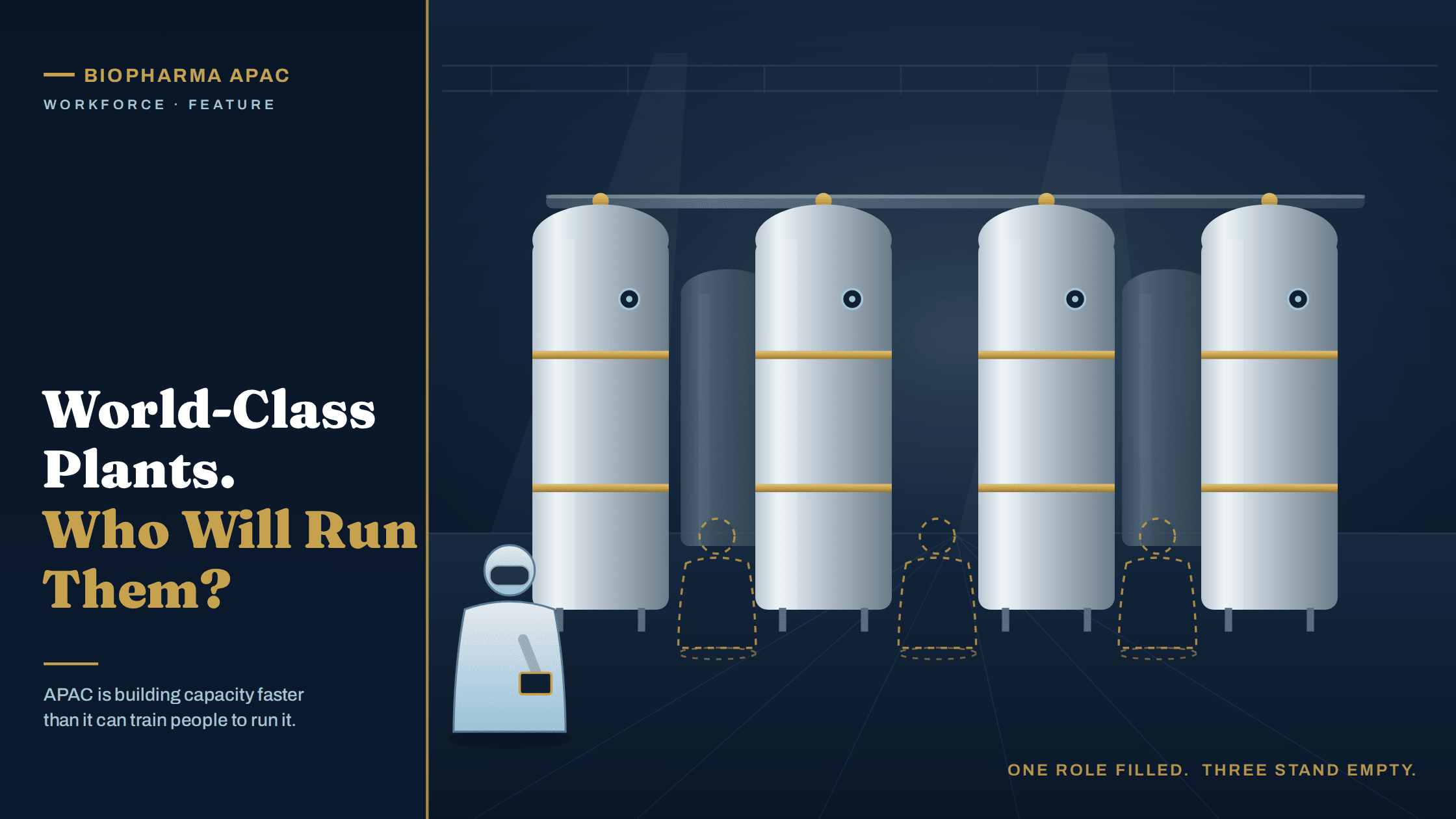
Walk into one of the gleaming new large-molecule plants going up across Songdo, Tuas or Hyderabad and the first impression is of inevitability. The single-use suites are pre-plumbed. The bioreactor trains stand in rows, jacketed and gleaming. Commissioning and qualification runs are ticking through their protocols on schedule. On the engineering side, a modern biologics facility can now be built and brought to mechanical completion in roughly two years. What cannot be built in two years is the person who knows, by instinct as much as by SOP, when an aseptic intervention has gone wrong, why a chromatography step is drifting, or how to write the deviation that will satisfy an inspector six months later.
That asymmetry is the defining tension of APAC’s biomanufacturing decade. The region is adding capacity faster than anywhere on earth, and faster than its own talent pipeline can credibly staff. Plants are arriving on time. The people to run them are not — and across the most demanding roles, the shortfall is measured not in months of recruiting but in years of training. The capacity build-out is a story of capital and ambition. The workforce build-out is a story of time, and time is the one input that cannot be accelerated by writing a bigger cheque.
The arithmetic of ambition
Consider the emblem of the region’s build-out. Samsung Biologics brought its Plant 5 online in 2025, adding 180,000 litres and lifting total capacity across its five plants to roughly 784,000 litres — the largest single biomanufacturing footprint in the world. That is not the end of the plan. The company’s second campus in Incheon is designed to grow toward a combined capacity in excess of 1.3 million litres as Plants 6, 7 and 8 come on by 2032, a build-out the company has said will eventually employ more than 10,000 people on the second campus alone. To staff it, Samsung Biologics has spoken of hiring on the order of 400 people a year — some 4,000 additional employees over the decade — and in early 2026 it extended its network westward by acquiring a Maryland drug-substance site, retaining several hundred skilled American staff in the process.
Samsung is the largest data point, not the only one. Across South Korea, Singapore, China and India, contract manufacturers and innovators are commissioning suites for monoclonal antibodies, antibody-drug conjugates, viral vectors and cell and gene therapies. Each of those modalities carries its own staffing profile, and the newest ones are precisely the areas where experienced people are thinnest on the ground. The build-out assumes a workforce that, in many disciplines, does not yet exist in the numbers required.
The pattern repeats with national accents. China has paired double-digit growth in biologics with an aggressive push under its five-year industrial planning to develop domestic talent and reclaim expertise from abroad. Singapore is leaning on capital-intensive, highly automated plants precisely because its labour market is tight and its unemployment low, forcing a strategy of doing more with fewer, more skilled people. India is scaling biosimilars and contract manufacturing on the strength of a large, English-speaking technical base, yet finds its most specialised process roles as scarce as anyone’s. The headline number is capacity in litres; the number that matters operationally is qualified people per litre, and on that measure the region’s plants are racing the clock.
The macro data confirms what plant heads feel daily. ManpowerGroup’s 2025 talent-shortage survey found that 77 percent of employers across Asia-Pacific were struggling to fill roles, up from 45 percent a decade earlier and above the global average — with engineering among the hardest skill families to source. Inside biomanufacturing specifically, BioPlan Associates' long-running survey of the industry, summarised in its 2026 outlook, found that 36 percent of facilities could not hire the process-development staff they needed, 28 percent could not fill downstream production roles, and 27 percent lacked sufficient process engineers. The share of manufacturers naming the inability to hire experienced technical staff as a brake on future capacity has climbed steadily for more than a decade. Industry surveys have repeatedly found that a large majority of biopharma leaders expect the shortage to persist for years.
A modern biologics plant can be built in two years. A competent aseptic operator or MSAT engineer takes far longer — and cannot be ordered in bulk.
The reason the gap is so stubborn is structural, not cyclical. Bringing a new hire to genuine proficiency in regulated biomanufacturing typically takes one to two years for a production role, and considerably longer for the specialist functions that anchor a site. The industry is also growing faster than schools and academies can graduate ready-to-work people, and the fastest-growing modalities — cell and gene therapy, viral vectors, conjugates — are exactly the ones where the existing workforce has the least depth. Capacity, in other words, is the easy variable. The binding constraint is human.
The roles that hurt the most
Not all vacancies are equal. A site can absorb a slow fill in a generalist position; it cannot run without the handful of disciplines that carry disproportionate risk and require the deepest tacit knowledge. Four stand out across APAC plants.
Aseptic operations sit at the top of every site head’s worry list. Sterile fill-finish is unforgiving: a single lapse in gowning, intervention discipline or line clearance can compromise a batch and trigger a regulatory event. The competence that matters here is behavioural and hard-won — the muscle memory of moving correctly inside a Grade A environment, the judgment to recognise when an intervention has introduced risk. It is taught slowly, under supervision, and it does not transfer from a classroom.
Conjugation is the scarce specialty of the moment. As APAC builds antibody-drug conjugate capacity — Samsung among others has invested heavily in this fast-growing modality — demand has surged for people who can run bioconjugation chemistry inside high-containment, high-potency environments. The intersection of synthetic chemistry, biologics handling and occupational-exposure control is narrow, and the experienced pool is correspondingly small.
MSAT — manufacturing science and technology — is the connective tissue that the org chart tends to undervalue until it is missing. MSAT engineers own technology transfer, process monitoring, scale-up and the investigation of deviations. They need both scientific fluency and shop-floor instinct, and they are the people who make a new plant actually produce rather than merely exist. They are also among the hardest roles to recruit, because the skill set is forged on the floor over years, not conferred by a degree.
Quality assurance and validation round out the quartet. Computer-system validation, data-integrity governance, deviation and CAPA management, and audit-facing QA are the functions regulators scrutinise most closely, and the ones where a thin bench shows up directly in inspection outcomes. As facilities digitalise, the validation burden grows rather than shrinks, widening the gap further.
The economics of this scarcity are revealing. A recent analysis of the Bengaluru cluster — home to India’s largest biopharma employer and its biggest contract research organisation — framed the problem as a 'dual shortage.' Generalist researchers and IT roles are relatively abundant; the genuinely scarce profiles are specialists in mammalian cell culture, bioreactor scale-up and CMC regulatory writing with years of GMP-regulated experience. The crucial insight is that salary inflation alone cannot solve it, because the binding constraint is experience, not price. You can bid up wages, but you cannot bid experienced people into existence; the most qualified are often diaspora professionals already working in Boston, San Francisco or Singapore, reachable only through targeted headhunting.
The five roles APAC plants struggle to fill
|
Aseptic operations |
Sterile fill-finish; intervention and gowning discipline; behavioural competence built only on the floor. |
|
Conjugation |
Bioconjugation chemistry in high-potency, high-containment ADC suites; a narrow, fast-growing specialty. |
|
MSAT |
Tech transfer, scale-up, deviation investigation; the engine that makes a new plant actually produce. |
|
QA & validation |
CSV, data integrity, deviation/CAPA, audit-facing quality; the functions regulators scrutinise hardest. |
|
Process development / engineering |
Mammalian cell culture, downstream, process engineers; the experienced pool is small and largely passive. |
“We can qualify the suite on schedule. Qualifying the team is the part that keeps me up at night.” — a refrain among APAC site-operations heads
Automation: augment, or paper over?
If people are the constraint, the obvious hope is that machines will relax it. The industry is automating fast, and the direction of travel is genuine. Most commercial biomanufacturing today is already partially automated: upstream bioreactors and feeding systems, downstream chromatography and filtration, automated sampling and in-line analytics. Single-use technology has removed whole categories of manual labour by eliminating clean-in-place and steam-in-place cycles. Robotics has transformed aseptic fill-finish, handling vial filling, stoppering, sealing and labelling inside isolators with a consistency human hands cannot match. Digital twins now let engineers calibrate scale-up and lock process set-points virtually, compressing technology transfer and reducing the number of costly engineering runs — Samsung Biologics, for instance, has invested in computational-fluid-dynamics and multivariate modelling to accelerate process development across its network.
The trajectory points further still. Industry voices anticipate fully automated, 'lights-out' biomanufacturing within five to ten years, and a widely cited industry road map envisions a fully automated cell-and-gene-therapy facility by around 2030. The honest reading of that road map, though, is that it changes the shape of the workforce problem rather than dissolving it.
Automation does not empty the plant of people. It raises the skill floor — fewer hands, but each pair more sophisticated.
There are hard limits to what automation can absorb. Mobile robots for environmental monitoring have repeatedly stumbled on return-on-investment and on the simple problem that a robot cannot decontaminate itself to move between classified areas without human help. More fundamentally, the parts of biomanufacturing that are hardest to staff are also the hardest to automate: the deviation that has never happened before, the investigation that requires judgment, the inspection where a regulator wants to hear a human explain a decision and own it. Automation reliably removes repetitive, well-characterised tasks. It does not remove accountability, and it does not yet remove the need for judgment under uncertainty.
What automation does, in practice, is shift the bottleneck. A plant that automates its monitoring and material handling needs fewer manual operators — but it now needs automation engineers, controls specialists, data scientists and validation staff who understand the digital stack. One pattern increasingly visible across newer APAC sites is a reshaped shift model: leaner crews on the floor, supported by centralised, remote monitoring of multiple suites, with the scarce talent concentrated in a control-room function rather than spread thinly across manual stations. That is a real productivity gain. But it trades a shortage of operators for a shortage of automation and data talent — and in many APAC markets, those profiles are competing directly with the technology sector, where IT and data skills are the single hardest category to recruit.
“We took a four-crew manual line down to a leaner model with remote monitoring. The headcount fell, but every remaining role got harder to hire for.” — a common account from plant automation teams
There is also a regulatory dimension that no automation roadmap escapes. Inspectors do not certify machines; they hold people and quality systems accountable. As facilities digitalise, the validation and data-integrity burden grows rather than shrinks, and the people who can defend an automated process to a regulator — who understand both the chemistry and the control system well enough to explain a deviation under questioning — become more valuable, not less. Automation that outruns the workforce able to validate and govern it does not de-risk a plant; it relocates the risk into the quality system, where it surfaces at the worst possible moment.
The verdict, then, is that automation is a partial fix that buys time and lifts output per worker — and a genuine one, not hype. It is not a substitute for the years-long apprenticeship in sterile judgment, process intuition and regulatory craft that the hardest roles demand. Treated as augmentation, it is the industry’s most powerful lever. Treated as a reason to under-invest in people, it is a way of papering over the gap until the next inspection finds it.
Building the pipeline
The more durable response is the one the region’s most serious players are now pursuing in parallel with the concrete: building the workforce deliberately, rather than assuming it will materialise. Three approaches are converging.
The first is the dedicated training academy, modelled on the institution that has become the global reference point. Ireland’s National Institute for Bioprocessing Research and Training (NIBRT) operates a purpose-built facility that replicates a working bioprocessing plant, and licenses its gold-standard curriculum worldwide through a Global Partner Programme. APAC has plugged directly into it: South Korea hosts a K-NIBRT centre at Yonsei University, training operators on equipment that mirrors the commercial floor. The model’s credibility was underscored when the World Health Organization named NIBRT one of seven regional training centres under its Biomanufacturing Workforce Training Initiative, set up specifically to close skills gaps and localise production capability. Comparable hubs — CASTL in Canada, a NIBRT-linked centre in Houston — show the template spreading globally; the question for APAC is how fast it scales regionally.
Singapore offers the most mature home-grown version of the same idea. A*STAR’s Bioprocessing Technology Institute has spent more than three decades developing bioprocesses and, crucially, training people for them, in deliberate alignment with the Economic Development Board’s strategy to anchor the city-state as a biopharma hub. The point of such an institute is not merely research; it is to manufacture the manufacturers — to compress the apprenticeship by giving trainees hands-on time on representative equipment before they ever touch a GMP batch.
The second approach is the university and college tie-up that feeds the academy. The most-copied example sits in the United States — North Carolina’s BioWork programme, which produces technically skilled operators without requiring a four-year degree — but its logic travels well to APAC, where a third or more of biomanufacturing roles can be performed by people with strong technical training rather than advanced degrees. Partnerships that route polytechnic and vocational graduates into structured, plant-relevant curricula widen the base of the pipeline, which is where the volume shortage actually lives.
The third is regional talent mobility — moving people to where the plants are, and pulling experienced expatriates home. China has benefited from a pronounced 'reverse brain drain,' with senior scientists returning from overseas to lead labs and facilities. Japan, facing an ageing workforce, has been easing access for foreign experts to offset domestic gaps. Across the region, the diaspora of experienced biomanufacturing professionals in North America and Europe is an increasingly contested recruiting target. Mobility cannot manufacture experience, but it can redistribute the experience that exists toward the suites that need it most.
“We stopped waiting for ready-made hires. We now train operators on a replica line before they ever touch a real batch — and we treat the academy as core infrastructure, not overhead.” — the view from biomanufacturing training-academy leaders
The talent leaders who are succeeding describe a shift in mindset as much as method. Recruiting alone — bidding for the same scarce, experienced people every competitor wants — is a losing game when the constraint is experience rather than headcount. The organisations pulling ahead are the ones treating internal training, upskilling and reskilling as a permanent capability rather than a crisis response, building structured progression from entry-level operator to specialist, and accepting that a portion of their training investment will inevitably be poached. The alternative — a finished plant that cannot release product because it cannot staff its quality and aseptic functions — is far more expensive.
By the numbers
|
77% |
of APAC employers reported difficulty filling roles in 2025, up from 45% a decade earlier (ManpowerGroup). |
|
36 / 28 / 27% |
of biomanufacturing facilities cannot hire enough process-development staff / downstream production staff / process engineers (BioPlan Associates, 2026). |
|
1–2 years |
typical time to bring a production hire to proficiency; specialist roles take longer. |
|
~4,000 |
additional staff Samsung Biologics has signalled it will hire toward its 2032 build-out (~400/year). |
|
5–10 years |
industry estimate for when fully automated, ‘lights-out’ biomanufacturing could become reality. |
Is ambition outrunning the pipeline?
The candid answer, today, is: in places, yes — and the risk is concentrated exactly where it hurts. The concrete-and-steel build-out will largely arrive on schedule, because capital is plentiful and construction is a solved problem. The workforce build-out is lagging, because it depends on time and tacit knowledge that no amount of capital can compress past a point. Automation genuinely helps; it lifts output per worker and absorbs the repetitive load, and the region should press the advantage hard. But it shifts the shortage toward automation and data talent rather than ending it, and it cannot manufacture the seasoned judgment that aseptic operations, conjugation, MSAT and quality demand.
Whether APAC’s ambitions outrun its talent pipeline will ultimately come down to a question of seriousness. The regions that close the gap will be those that treat training infrastructure — academies, replica lines, university partnerships, structured progression — with the same urgency, capital and board-level attention they lavish on bioreactor capacity. The plants will be ready. The open question, suite by suite and shift by shift, is the people. And on that question, the build-out has a head start the pipeline has not yet matched.
( arcilla.fran@biopharmaapac.com )
Sources & disclaimer
Reporting draws on public company disclosures and industry data, including Samsung Biologics’ capacity announcements, ManpowerGroup’s 2025 Talent Shortage Survey, BioPlan Associates’ 2026 biopharmaceutical manufacturing outlook, and published material from NIBRT, A*STAR’s Bioprocessing Technology Institute and the WHO Biomanufacturing Workforce Training Initiative.
Disclaimer: This feature is an analytical overview prepared from publicly available sources believed to be reliable at the time of writing (June 2026). Figures, capacities, timelines and other data are subject to change and should be independently verified before any commercial reliance. Frontline operator, engineering and training perspectives quoted here are representative composites that illustrate views commonly expressed across the industry; they are not statements attributed to any identified individual or organisation. Company and product names are the property of their respective owners and appear for editorial and identification purposes only. Content is provided for general information and does not constitute investment, legal or other professional advice. Views expressed are those of the author and not necessarily those of the publisher.
Most Read
- Can APAC Biomanufacturing Decarbonise Without Pricing Itself Out?
- The Algorithm on the GMP Floor: AI Promises a Smarter Plant. Regulators Demand the Audit Trail.
- APAC's Peptide-Capacity Gamble
- After the Rush: APAC's mRNA and Vaccine Capacity Hangover
- The Biosimilar Race: Factory to the World — or Stuck in the Copycat Economy?
- The Vein-to-Vein Problem: Can APAC's Cold Chain Carry Advanced Therapies?
- Vectors, Plasmids and the CGT Trap: APAC's Cell and Gene Therapy Ambitions Face an Upstream Bottleneck
- Can APAC Build Radioligand Therapy Before the Atoms Decay?
- The Great Biopharma Reset: 50 Developments That Changed Everything in H1 2026
- Beyond the Trial: Can Real-World Evidence Earn Regulatory Trust in APAC?
- Beyond the Obvious Giant: Where APAC's Clinical Trials Go Next
- The Frontier That Won’t Quite Arrive
Bio Jobs
- Sanofi Turns The Page As Belén Garijo Steps In And Paul Hudson Steps Out
- Global Survey Reveals Nearly 40% of Employees Facing Fertility Challenges Consider Leaving Their Jobs
- BioMed X and AbbVie Begin Global Search for Bold Neuroscience Talent To Decode the Biology of Anhedonia
- Thermo Fisher Expands Bengaluru R&D Centre to Advance Antibody Innovation and Strengthen India’s Life Sciences Ecosystem
- Accord Plasma (Intas Group) Acquires Prothya Biosolutions to Expand Global Plasma Capabilities
- ACG Announces $200 Million Investment to Establish First U.S. Capsule Manufacturing Facility in Atlanta
- AstraZeneca Invests $4.5 Billion to Build Advanced Manufacturing Facility in Virginia, Expanding U.S. Medicine Production
News