The Arbitrage Triangle
09 September 2026 | Wednesday | Analysis
METHOD IN BRIEF
Flow estimates come from published government statistics and press reporting of official material; no authority in the region publishes indication-level patient flow for regenerative interventions, every volume figure is an estimate, and operator disclosure is treated as marketing. Regulatory and liability positions are taken from each market’s own instruments and official communications, cited with dates in the text. Prices are operator-advertised or press-reported self-pay figures with capture dates attached. Complication reporting is drawn from regulators and the peer-reviewed literature only, and no individual patient case is used. Part one of this series owns the legal architecture of the three routes; part two owns the Japanese register data; this story owns the movement between them.
There is a category of Asia-Pacific patient journey that no ministry counts, no airline codes and no operator reports honestly. A patient in Seoul with a condition Korean law would not, until recently, allow anyone to treat outside a research protocol boards a two hour flight to Tokyo, pays between 1.5 and 5 million yen for an infusion of cultured cells, and flies home. A patient in Osaka books a dermatology package in Gangnam. A patient priced out of both cities lands in Bangkok, where the same three words, stem cell therapy, buy anything from an 80,000 baht knee injection to a 1.39 million baht multi-day programme. None of these journeys is driven by evidence that the destination is clinically better. Each is driven by what the destination permits, and what it charges for the permission.
This is the eleventh story in the COMPRESSION series, and it is about movement. The first story in this series set out the three routes by which longevity medicine reaches Asian patients. The second read Japan's provision plan register line by line. This story sits between them: it maps what happens when the routes in one jurisdiction are closed and the routes in the neighbouring one are open, at the moment when the region's most deliberate attempt to stop the resulting traffic, Korea's amended regenerative medicine law, has been in force long enough to be judged.
The judgment has to begin with an admission. Nobody has clean numbers, and this story will not pretend otherwise. Korea's own Ministry of Health and Welfare, in material surfaced by a 2023 audit and reported in the Korean press in March 2026, could only estimate that between 10,000 and 20,000 of its citizens travel abroad each year for stem cell treatment. That is a two-fold range from the single authority with the strongest incentive to know. Japan does not publish how many of its self-pay regenerative medicine recipients are foreign. Thailand and Malaysia publish healthcare traveller totals that bundle cell therapy with dentistry, health screening and fertility care. Every operator in the channel has an incentive to inflate. What follows is built from those flawed statistics, from each market's own regulatory record, and from the peer-reviewed literature, with the flaws stated where they matter.
Three corners, three permissions
The triangle is not a metaphor of convenience. It describes three genuinely different answers to the same question: under what conditions may a clinician give a patient a cell-based intervention that has no product approval?
Japan answers: file a plan. The Act on the Safety of Regenerative Medicine, in force since 2014, allows a licensed clinic to provide unapproved cell interventions on a self-pay basis once a provision plan has been reviewed by a certified committee and filed with the ministry. The register that results, its composition, its ambiguities and its enforcement record, is the subject of the second story in this series and is not re-argued here. What matters for the triangle is the structural fact: Japan is the corner where lawful provision is broadest, where the paperwork is a filing rather than an approval, and, critically, where an inspection infrastructure exists around the paperwork. Certified committees review plans, cell processing facilities are licensed, adverse events carry reporting obligations, and the ministry has shown it will act, most recently through the nationwide self-inspection it requested of every provider, committee and cell manufacturer at the end of July 2026 after finding provision it described as improper. Japan's permissiveness is real, but it is permissiveness with a filing cabinet and an inspectorate attached.
Korea answers: prove it first, and only recently, treat at all. Korea's Act on the Safety of and Support for Advanced Regenerative Medicine and Advanced Biological Products, enacted in 2019, initially confined advanced regenerative medicine to approved clinical research, delivered free of charge to participants. Cell therapy as a purchasable clinical service, the thing Japanese clinics sell every day, did not lawfully exist. The February 2024 amendment, in force since 21 February 2025, created a second category, advanced regenerative medicine treatment, under which designated institutions may charge patients for interventions outside research, provided the condition is serious, rare or incurable, the technology has prior clinical evidence of safety and efficacy, and a national review committee approves the institution's treatment plan. The government's stated purposes included expanding domestic access, and the surrounding policy discussion was explicit that Koreans were travelling, principally to Japan, for treatment they could not lawfully buy at home. One hundred and twelve hospitals and clinics have been designated as implementation institutions. The gate, in other words, was deliberately rebuilt so that the road through it would compete with the airport.
Thailand answers: it depends on the manipulation, and as of this year, it is finally written down. For most of the past decade Thailand ran on a layered arrangement: the Medical Council's ethics rules held stem cell use outside recognised standards to a research pathway, advanced therapy guidance existed from 2018 and 2023, and a large private market operated in the space between instruments. In May 2026 the health minister signed a ministerial decree, reported by The Nation on 27 May, that classifies products containing genes, cells or living tissue as medicines under the Drug Act. Minimally manipulated products, the cutting, separating and cryopreserving that underpins established transplantation, remain outside the drug framework under tissue practice standards. Anything more than minimally manipulated, culture-expanded mesenchymal stromal cells, CAR-T, NK cell preparations, engineered tissue, is now formally an advanced therapy medicinal product requiring PIC/S-standard manufacturing and registration with the Thai FDA. The decree's own public framing is candid about the commercial intent: the health ministry's roadmap conference ran under the theme of being fastest in ASEAN, and official commentary presents advanced therapy as a gateway for attracting patients from across the region. Thailand is formalising, and it is formalising in order to absorb.
And along the triangle's southern edge sits Malaysia , which took the product-regulation route earliest on paper and has enforced it most quietly. The national regulator's cell and gene therapy guidelines, first issued in 2016 with mandatory registration in force from 2021 and a second edition published in September 2025, classify these products as medicines. The health ministry's own clinical guidance treats applications beyond established haematopoietic transplantation as experimental. Yet Malaysia is simultaneously running the region's most energetic healthcare travel promotion: 1.59 million healthcare travellers and 2.72 billion ringgit in revenue in 2024 by the Malaysia Healthcare Travel Council's count, a designated Year of Medical Tourism in 2026, and, as Malaysian academic work observed as far back as 2021, no medical tourism legislation addressing visas, insurance or what happens to a foreign patient after something goes wrong. The paper framework is strict. The question, examined below, is what stands behind the paper.
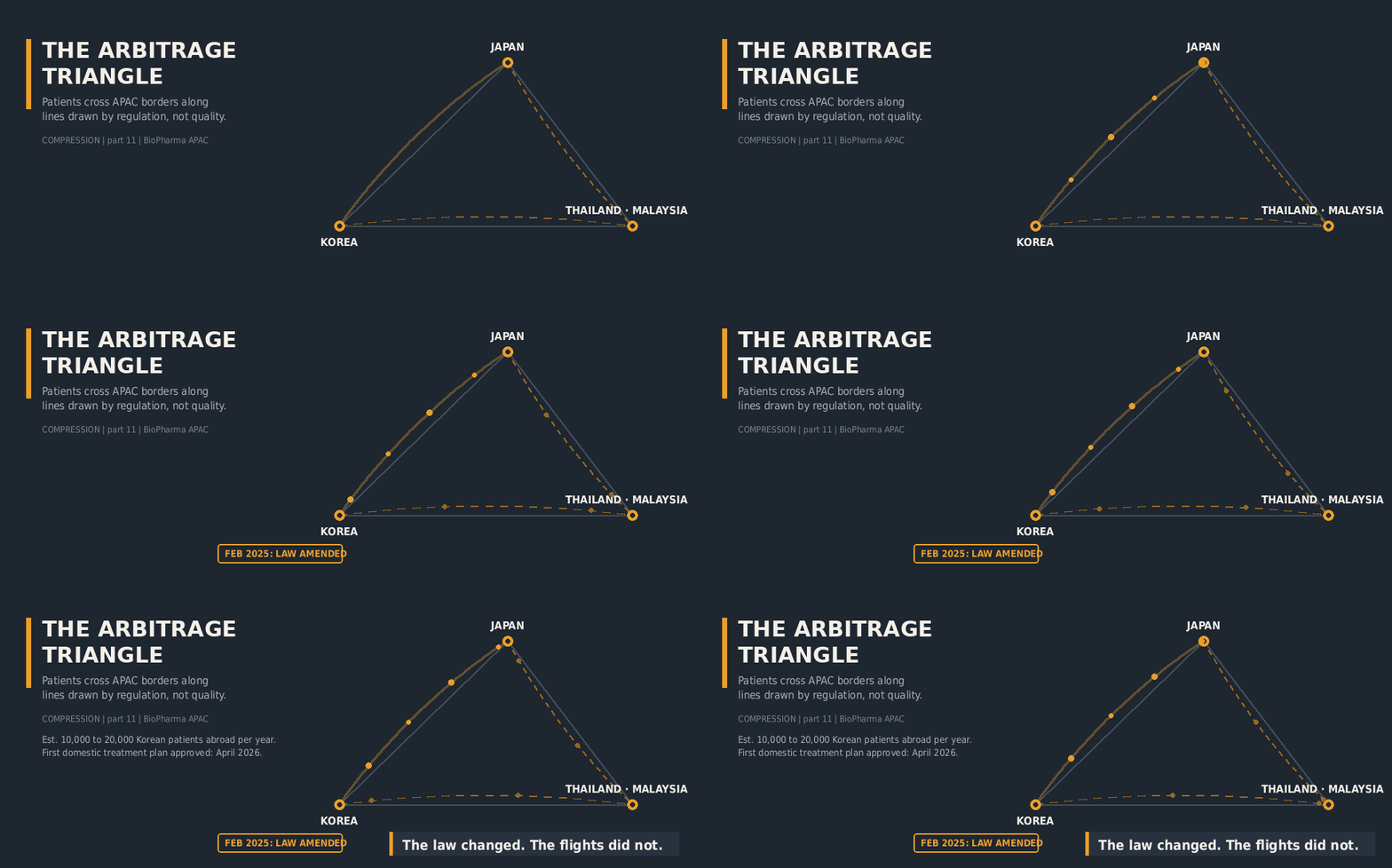
The essential asymmetry is this. Japan pairs broad permission with inspection. Korea pairs narrow permission with a review committee. Thailand and Malaysia are absorbing self-pay volume with product-registration frameworks that are new, partially implemented, or both, and without the provision-level inspection infrastructure, the certified committees, plan registers and facility licensing tied to each clinical offering, that Japan spent a decade building. Volume is moving toward the corners with the least mature machinery for watching it.
The price of permission
Because no corner of the triangle sells an approved product, there is no reimbursed price anywhere. Every figure below is a self-pay price, drawn from operator listings and press reporting with the date attached, and every one should be read as marketing until an invoice proves otherwise.
In Japan, operator-advertised prices captured across 2025 and 2026 cluster around 1.5 to 3 million yen for a single cultured mesenchymal cell joint injection, 2 to 5 million yen for a systemic intravenous infusion, and 3 to 7 million yen for high-dose neurological protocols, roughly 10,000 to 50,000 US dollars per administration, with clinics openly advising repeat dosing at intervals of months. A widely cited investigation as far back as 2019 recorded 1.5 million yen per dose with maintenance infusions every two to three months.
In Korea, the March 2026 press reporting around the ministry's broker warning put the per-session cost of the treatments Koreans travel for at several million to as much as 10 million won, a range that overlaps almost exactly with the Japanese operator listings once currency is converted. The arbitrage between Seoul and Tokyo, in other words, was never primarily a price arbitrage. It was a legality arbitrage: the Korean patient was not buying a cheaper infusion, but a lawful one.
The price arbitrage lives on the third corner. In Thailand, publicly advertised 2026 prices run from roughly 80,000 baht, about 2,400 dollars, for a localised orthopaedic procedure, to 1.39 million baht, about 41,500 dollars, for extended multi-day programmes. Bangkok clinic listings for intravenous infusions of umbilical cord-derived cells at 30 to 100 million cell doses span roughly 200,000 to 1.8 million baht. The floor of the Thai market sits at a small fraction of the Japanese floor. That floor is exactly what a formal ATMP regime, with PIC/S manufacturing and registration costs, will pressure upward, which is why the decree's implementation, and who survives it, is the single most consequential open variable on the triangle's southern corner.
Set beside these, Malaysia's healthcare travel economics explain its role: an average of roughly 1,700 ringgit of medical revenue per traveller across 1.59 million 2024 arrivals says the mass market is screening, dentistry and general care, with regenerative offerings as a premium niche riding a large, price-competitive platform.
Three corners, then: one sells legality at a high price with inspection included, one until recently sold nothing and now sells process, and one sells price with a framework still being bolted on.
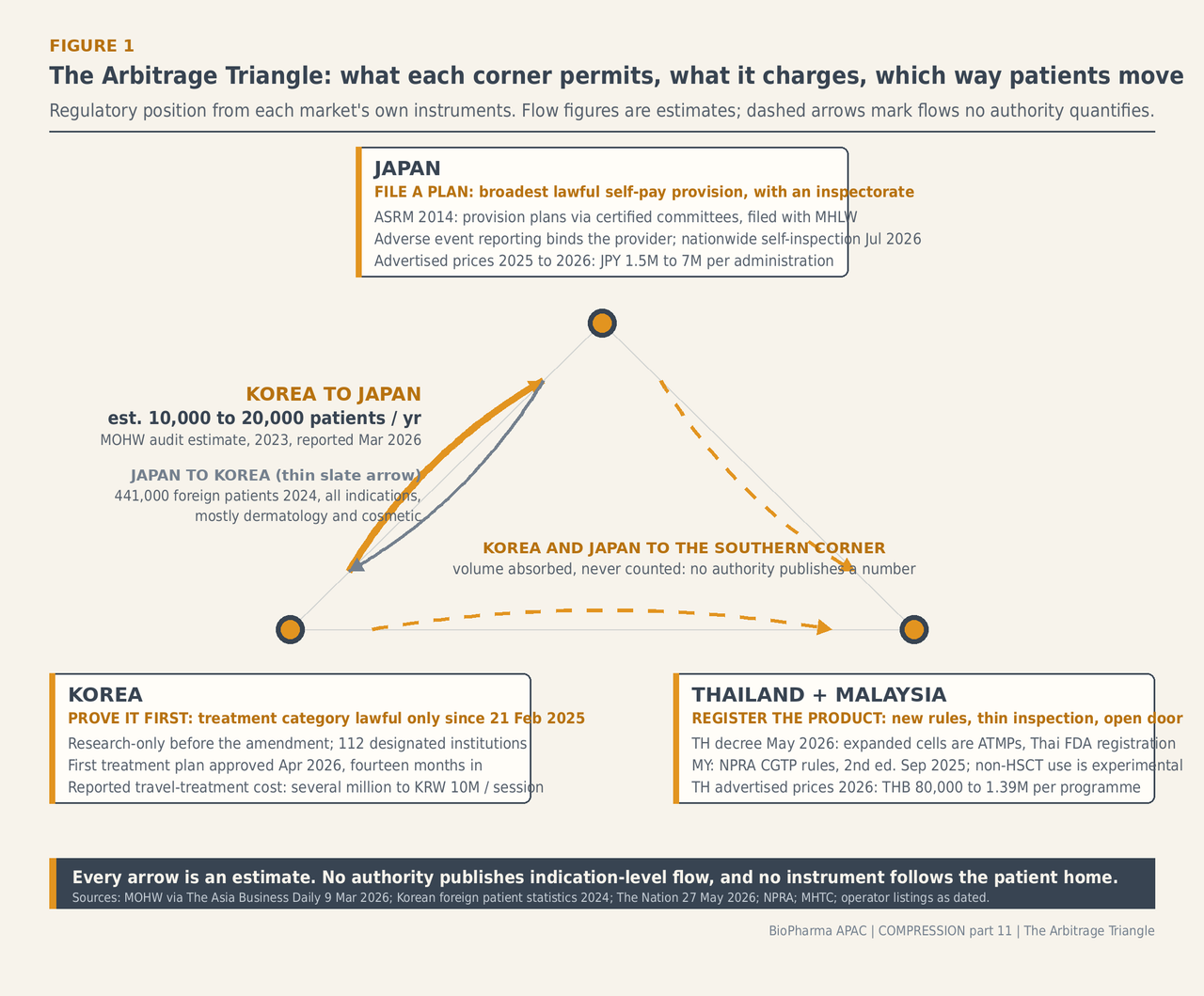
Figure 1. The flow and permissiveness map: what each corner permits, what it charges, and which way the patients move. Dashed arrows mark flows no authority quantifies.
Has the amendment moved the flow?
Korea's treatment category has now been in force for eighteen and a half months, long enough for the first observable test the law will ever face: are Koreans still flying?
The honest answer is that the outbound flow cannot be directly measured, and the government has never published a post-amendment count. But three documented facts point in one direction.
First, the domestic alternative barely exists yet. The treatment category came into force in February 2025, yet the first advanced regenerative medicine treatment plan was not approved until late April 2026, fourteen months later: an autologous virus-specific T cell intervention for relapse prevention in a rare lymphoma, submitted by a Seoul university hospital. The health ministry's own framing of that approval, that the system had until then been building institutional foundations and was only now entering a stage where patients can actually receive treatment, is as clear a statement as a regulator will ever make that, for the amendment's first year, the legal category existed and the treatment did not. On the research side, roughly 50 clinical research plans had been approved by November 2025, most in major hospitals, according to the April 2026 review of the framework in Stem Cell Reports. A patient population estimated in the tens of thousands per year cannot route through a channel that has approved treatments in the single digits.
Second, the ministry is still fighting the brokers. In March 2026, thirteen months after the category took effect, the Ministry of Health and Welfare stated publicly that companies offering to arrange stem cell treatment in Japan for Korean patients may be acting illegally, a warning that only makes sense if the arranging is still happening at scale. The same reporting carried the ministry's audit-era estimate of 10,000 to 20,000 outbound patients a year, unrevised.
Third, the receiving corner's own regulator has documented the pipeline. When Japan's health ministry announced its July 2026 nationwide self-inspection of regenerative medicine providers, it cited investigation findings that included a Tokyo clinic providing treatment in a form the law does not contemplate while following content prepared by a group based in Seoul. The significance for this story is not the individual enforcement matter, which belongs to the Japanese register's own record. It is the structure it reveals: commercial organisation of the Korea-to-Japan channel is sufficiently established that it surfaces inside Japanese enforcement, on the Japanese side of the border, in 2026.
Against those three facts stands one genuine change: the direction of ambition. Korean designated hospitals are now marketing domestic advanced treatments, and international patient platforms have begun listing Korea as a destination for regenerative interventions under the new category, particularly in neurology. Korea's foreign patient statistics, which count registrations rather than indications, recorded roughly 1.17 million inbound patients in 2024, with Japan the largest source country at around 441,000, dominated by dermatology and cosmetic procedures. The triangle's oldest irony sits in that number: while Korean patients flew to Tokyo for cells, Japanese patients flew to Seoul for skin. If the amendment eventually works, Korea will not have ended arbitrage. It will have entered the market for it.
The fair verdict at eighteen months: the amendment has changed what Korea permits, it has not yet changed what Koreans do, and on the government's own enforcement behaviour, the outbound channel was still commercially organised at least into the spring of 2026. Whether the treatment category can bend the curve depends on approvals arriving at a pace the first fourteen months did not remotely achieve.
The gap nobody governs
Now the question this story exists to ask. A patient travels from corner A, is treated in corner B, and presents at a hospital back in corner A with a complication. Which authority is responsible?
Read each market's own instruments and the answer assembles itself into a silence.
Japan's regenerative medicine law binds the Japanese provider: adverse events must be reported up through the certified committee to the ministry. But the obligation attaches to events the provider learns of, and a foreign patient who boards a flight seventy-two hours after infusion and develops a complication at home is, as far as the Japanese reporting chain is concerned, a patient who never had one. Nothing in the framework obliges follow-up across a border, and the ministry's jurisdiction ends at the provider it licenses.
Korea's amended law, to its credit, built exactly the machinery whose absence the border exposes: domestic advanced regenerative medicine treatment comes with institutional designation, treatment plan review and long-term safety monitoring of treated patients. Every element of that architecture stops at Incheon. The outbound patient the amendment was partly designed to retain is precisely the patient it cannot follow. What Korean law can reach, on the ministry's stated March 2026 position, is the domestic broker, through the prohibition on unlicensed arrangement of medical services. That is an instrument against the travel agent, not a remedy for the traveller. When the returning patient presents at a Korean emergency department, the national insurance system absorbs the cost of treating a complication it had no part in creating, with no reporting pathway that reaches the foreign clinic and no register in either country that links the infusion to the outcome.
Thailand's new decree, for all its significance, is a product instrument. It governs what may be manufactured, registered and sold. The Medical Council's rules govern what a Thai-licensed physician may do. Neither creates any obligation to a foreign patient after departure, and nothing in Thailand's medical hub promotion architecture addresses post-departure adverse events. Malaysia is the clearest case of the vacuum because its own scholarship has named it: the 2021 Malaysian academic review of the country's pro-tourism stance found the legislative framework neglects the medical traveller's protection almost entirely, including insurance and recourse.
The peer-reviewed literature has described the clinical end of this gap for years. The 2022 critical review of international stem cell tourism in International Health records the recognised complication classes, infection, immune rejection, tumorigenesis, and death, and notes that patients returning home frequently struggle to obtain follow-up care because home providers have no records, no product information and no relationship with the treating clinic. Regulators' own records supply the rest: Japan's enforcement history over the past two years, including a fatality investigation at a Tokyo clinic in March 2026, demonstrates that serious events occur inside even the triangle's most inspected corner. What happens after events that cross a border is, on the documentary record, governed by no one. No Asia-Pacific jurisdiction has a cross-border adverse event notification arrangement for regenerative interventions. No mutual recognition, no shared registry, no liability treaty. The most consequential regulatory instrument on the triangle is the boarding pass, because it is the instrument that extinguishes every other one.
What the multi-corner operator is optimising
Look at the triangle from the operator's side and the design becomes legible. An organisation with a presence in more than one corner is not running three clinics. It is running one regulatory portfolio.
The optimisation has four terms. Locate manufacturing and product development where a formal pathway confers credibility and eventual registration, which increasingly means Thailand's new ATMP regime or Malaysia's registration framework. Locate provision, the actual administration of cells to paying patients, where lawful self-pay throughput is fastest, which has meant Japan's filing system and may come to mean Korea's treatment category if approvals accelerate. Locate patient acquisition wherever the patients are, through brokers, platforms and content that need not sit in any corner at all. And locate price where the customer's alternative sets it: charge Tokyo prices for legality, Bangkok prices for volume.
That this is not a hypothetical is documented by the regulators themselves. The Seoul-prepared treatment content that Japanese investigators found operating inside a Tokyo clinic in 2026 is a cross-corner operation surfacing in an inspection file. Thailand's decree coverage arrives interleaved with the ambitions of its own listed cell therapy champions. Korea's broker warning is aimed at companies whose product is precisely the connection between a Korean patient and a Japanese chair. The triangle's operators understood it as a single market long before any regulator described it as one.
Which is the closing point, and the uncomfortable one. Each corner is currently legislating as though the unit of regulation is the territory: Korea rebuilding its gate, Thailand registering its products, Japan inspecting its filings, Malaysia polishing its standards. The patients, the brokers and the operators are all behaving as though the unit is the region. Until the regulatory unit matches the market unit, until adverse events, registries and accountability can cross the same borders the patients do, the triangle will keep doing what arbitrage structures always do: routing volume to whichever corner asks the fewest questions this year, and leaving the answers to whichever hospital receives the flight home.
arcilla.fran@biopharmaapac.com
Most Read
- Can APAC Biomanufacturing Decarbonise Without Pricing Itself Out?
- The Algorithm on the GMP Floor: AI Promises a Smarter Plant. Regulators Demand the Audit Trail.
- APAC's Peptide-Capacity Gamble
- After the Rush: APAC's mRNA and Vaccine Capacity Hangover
- The Biosimilar Race: Factory to the World — or Stuck in the Copycat Economy?
- The Vein-to-Vein Problem: Can APAC's Cold Chain Carry Advanced Therapies?
- Vectors, Plasmids and the CGT Trap: APAC's Cell and Gene Therapy Ambitions Face an Upstream Bottleneck
- Can APAC Build Radioligand Therapy Before the Atoms Decay?
- The Great Biopharma Reset: 50 Developments That Changed Everything in H1 2026
- Beyond the Trial: Can Real-World Evidence Earn Regulatory Trust in APAC?
- Beyond the Obvious Giant: Where APAC's Clinical Trials Go Next
- The Frontier That Won’t Quite Arrive
Bio Jobs
- Sanofi Turns The Page As Belén Garijo Steps In And Paul Hudson Steps Out
- Global Survey Reveals Nearly 40% of Employees Facing Fertility Challenges Consider Leaving Their Jobs
- BioMed X and AbbVie Begin Global Search for Bold Neuroscience Talent To Decode the Biology of Anhedonia
- Thermo Fisher Expands Bengaluru R&D Centre to Advance Antibody Innovation and Strengthen India’s Life Sciences Ecosystem
- Accord Plasma (Intas Group) Acquires Prothya Biosolutions to Expand Global Plasma Capabilities
- ACG Announces $200 Million Investment to Establish First U.S. Capsule Manufacturing Facility in Atlanta
- AstraZeneca Invests $4.5 Billion to Build Advanced Manufacturing Facility in Virginia, Expanding U.S. Medicine Production
News