Reading the Register: What Japan's Provision Plans Actually Say
10 August 2026 | Monday | Analysis
A register, not an approval list
Start with the thing that is most often got wrong, including by people who should know better.
The Act on the Safety of Regenerative Medicine, Law No. 85 of 2013, came into force on 25 November 2014 alongside the reworked Pharmaceuticals and Medical Devices Act. The two laws do different jobs. The PMD Act is the approval route: it is how a regenerative medicine product gets a marketing authorisation, including the conditional and time-limited approvals Japan became famous for. The Act on the Safety of Regenerative Medicine, usually shortened to the RM Act or ASRM, is not an approval route at all. It is a procedural regime for cell-based medicine delivered by hospitals and clinics outside the product approval system.
Under the RM Act, the administrator of any hospital or clinic intending to provide regenerative medicine must draw up a provision plan, obtain in advance the opinion of a certified committee for regenerative medicine as to whether the plan conforms to the provision standards, and then submit that plan to the Minister of Health, Labour and Welfare or, depending on class, to the relevant Regional Bureau of Health and Welfare. Providing regenerative medicine without a submitted plan is a breach of the Act.
Look closely at that sequence, because what is absent from it is the whole story. There is a committee opinion on conformity with the standards. There is a submission to the ministry. There is, for treatment plans, no determination by the state that the therapy works. The most economical statement of the problem comes from Misao Fujita of Kyoto University's Center for iPS Cell Research and Application, whose group has surveyed this market for a decade: the Act does not prohibit interventions so long as they follow the procedures the law lays down.
So the register is a record of filings. It is not a list of approved therapies, it is not an efficacy assessment, and a plan number is not a quality signal. This matters because plan numbers are used as one. Clinics marketing to inbound patients routinely cite the count of plans they hold as evidence of standing, and patient-facing guides in English encourage prospective patients to ask a clinic for its provision plan number as a safety check. Asking is reasonable. Reading the answer as an endorsement is not.
The Act sorts regenerative medical technologies into three risk classes, and the class determines the procedure. Class I is the high-risk tier, historically covering technologies using induced pluripotent or embryonic stem cells, and since 2025 also covering in vivo gene therapy. Class II is the moderate tier, which is where autologous mesenchymal stem cells and non-homologous use of somatic cells sit. Class III is the low-risk tier, covering autologous somatic cells for homologous use. A cabinet order carves out several categories entirely, including blood transfusion, haematopoietic stem cell transplantation and assisted reproductive technology, unless gene-transferred cells or certain stem cell lines are involved.
Since a rule change effective 30 November 2017, the ministry publishes, for each institution, its name and address and the name of its administrator, the regenerative medicine it provides and the class, the name of the certified committee named in the plan, the explanatory and consent document forms given to patients, and the content of any order issued against it under Articles 22 or 23. Research plans have since migrated to jRCT, the national clinical research registry, which means a reader working the treatment side and a reader working the research side are now working two different systems.
That publication rule is the reason this story is possible. Very few jurisdictions require a clinic selling an unapproved cell therapy to post its patient consent document where anyone can read it.
What is in it, and how hard it is to count
The founding fact about this register is visible in the first year of data and has never really changed.
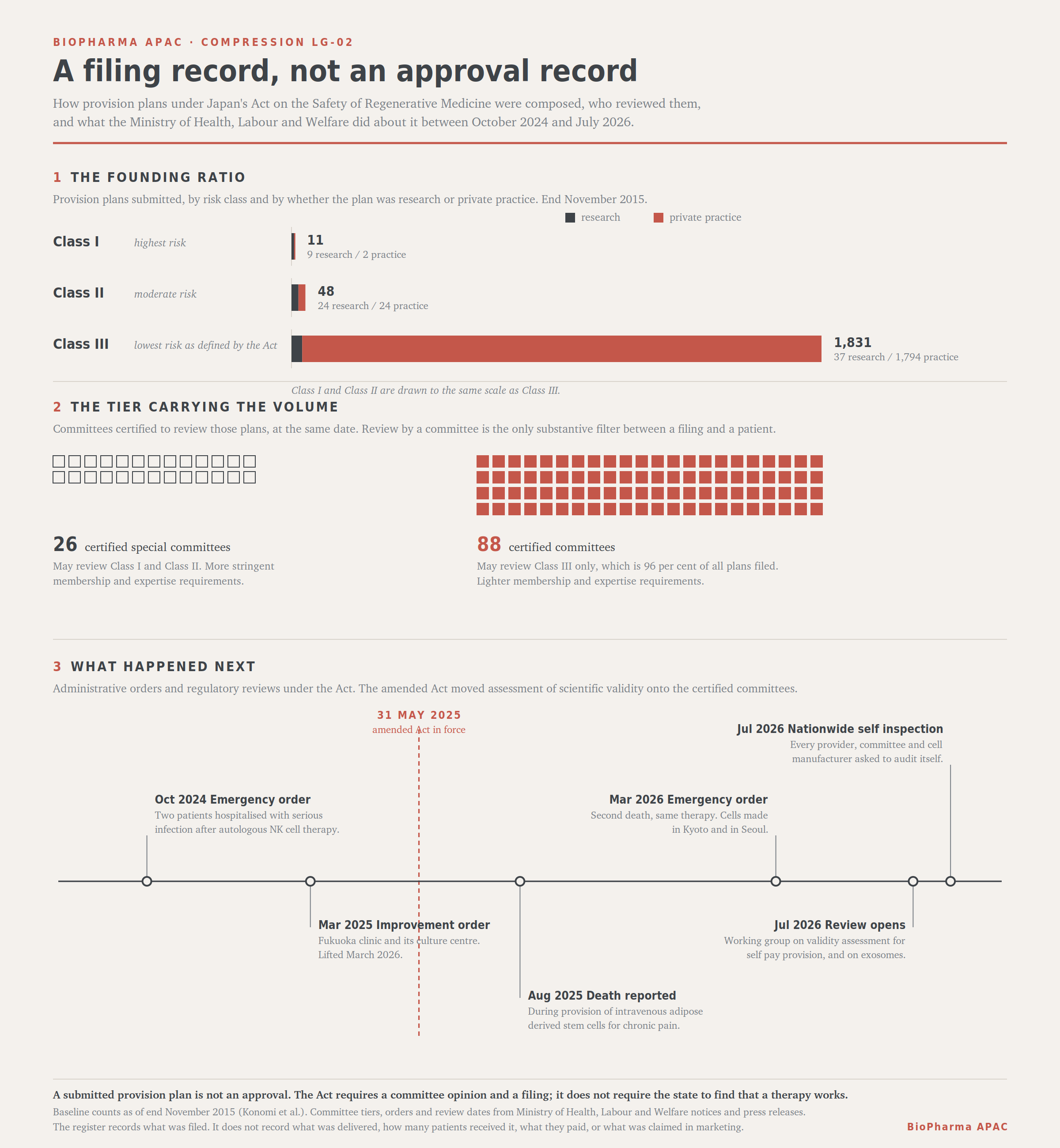
As of the end of November 2015, the plans submitted comprised 11 in Class I, of which 9 were research studies and 2 were private practice; 48 in Class II, split evenly at 24 research and 24 private practice; and 1,831 in Class III, of which 37 were research and 1,794 were private practice. Sit with that last pair. In the largest category, private practice outnumbered research by roughly 48 to one. At the same date there were 26 certified special committees able to review Class I and Class II plans, and 88 certified committees able to review Class III. Cell processing facilities numbered 2,194 inside medical institutions and 41 outside them.
The system was built with the language of translational research and populated almost entirely by self-pay clinical practice. Every subsequent argument about the Act is downstream of that.
The most substantial published read of the register remains the survey Fujita, Taichi Hatta and Kazuki Ide published in Cell Stem Cell in September 2022. They collected the explanatory and informed consent documents for 3,467 provision plans accepted and published by the ministry, and coded target illnesses and symptoms against a scheme derived from their own earlier survey work and referenced to ICD-10. They also coded cell type and origin, whether the procedure was autologous or allogeneic, implantation method and site, secondary use of medical information, and the cell processing facility including its location. Their conclusion was blunt: the published material included treatments that would attract international criticism.
Two features of that dataset should govern how anyone reads the register today.
The first is a counting trap. The same group had surveyed cell therapy on the Japanese web before the Act came in, and the growth between the two surveys looks explosive. Part of it is real. Part of it is definitional. The earlier survey did not include cancer immunotherapy in its search terms, because cancer immunotherapy is not generally thought of as regenerative medicine. Under the RM Act it is squarely in scope. Any comparison that straddles the 2014 boundary is comparing two different definitions of the field, and anyone quoting a growth multiple across that line is quoting an artefact.
The second is that this is not a stem cell register. The Act admits platelet-rich plasma, a range of anti-cancer immune cell preparations, and other interventions that are not stem cell interventions in any sense a reader would recognise from the international literature on unproven stem cell clinics. Comparisons between this register and counts of stem cell businesses in the United States, Australia or Southeast Asia are not like for like, and the direction of the distortion is not obvious in advance: the Japanese figure captures things those counts exclude, and excludes things those counts capture.
Where the register has been read at sub-field level, the results are specific enough to be useful. A 2024 analysis of obstetrics and gynaecology under the Act found that therapeutic provision plans in that field accounted for about 1.9 per cent of regenerative medicine in Japan and were classified as Class II. Most were delivered in clinics in urban areas, treating endometrial or ovarian infertility by local administration of platelet-rich plasma or autologous cells. The handful of Class III plans in the same field were a different shape entirely: one used intrauterine administration of autologous peripheral blood lymphocytes for implantation failure, and two used systemic administration of tumour-infiltrating lymphocytes for advanced or recurrent cervical cancer.
That last detail is the coding problem in miniature. Two plans in the low-risk tier involve systemic administration of expanded lymphocytes to patients with advanced cancer. The class is a function of how the Act defines homologous use and processing, not of how dangerous the procedure feels. A reader who takes Class III as shorthand for minor will misread the register from the first row.
Which brings us to stated purpose, and to the single largest methodological hazard in this dataset. The purpose recorded against a plan is written by the filer. It is not a diagnosis coded by a third party, and it is not drawn from a controlled vocabulary. In practice the register contains purposes at wildly different levels of resolution, from a named disease with a defined patient population to formulations such as chronic pain, prevention of malignant tumour, or anti-ageing, which describe a market rather than an indication. Some plans state a purpose that could be coded three ways depending on assumptions the filer never made explicit.
Any honest coding of this register therefore needs an ambiguous category, and that category has to be published at full size rather than distributed by inference across the neat ones. A composition chart with no ambiguous bucket is not a cleaner analysis. It is a less honest one.
What changed after 31 May 2025
The amendment is the reason this is worth reading now rather than in 2015.
The revised RM Act, together with amended cabinet order and ministerial ordinance, took effect on 31 May 2025. It did three things that matter here. It extended the Act's scope to in vivo gene therapy and related technologies, placing them in Class I, the highest-risk category. It introduced a requirement for conflict of interest management. And it required certified committees to conduct a specific evaluation of the scientific validity of provision plans, rather than assessing conformity with the provision standards alone. The ministry issued the accompanying Q&A, drafting guidance and transitional arrangements on 30 May 2025, and has continued to issue implementing notices since, including revised guidance on the microbiological safety of specified processed cells in October 2025 and a second edition in June 2026.
Note carefully what the amendment did not do. It did not create a state assessment of efficacy for treatment plans. It relocated the scientific validity question onto the certified committee, which is a body funded by fees paid by the institutions whose plans it reviews. The amendment made the committee the answer to a question the committee system was already struggling with.
Fourteen months of post-amendment operation is now on the record, and the clearest read on whether it worked comes from the ministry itself. On 1 July 2026, an MHLW working group opened discussion on two questions: a mechanism for evaluating the validity of regenerative medicine provided as self-pay treatment, largely for cosmetic and oncology indications, and whether treatments using exosomes and cell culture supernatant should be brought within the Act at all. The working group is to compile a report.
Read the sequence rather than the individual items. The amendment introducing scientific validity assessment took effect on 31 May 2025. Thirteen months later, the ministry began designing the mechanism that assessment was meant to supply. The framing in the ministry's own working group materials is candid: self-pay regenerative medicine requires notification of a plan, but there is no arrangement under which the state individually confirms the content's efficacy or safety, provision has spread, and patients given cells have died.
The exosome question is the other half of it. Treatments using exosomes, and the culture supernatant said to contain them, fall outside the current Act because they do not use cells themselves. This is a live commercial channel in Japan and increasingly across the region, and it is currently regulated by nothing in this framework. Whatever the working group concludes about validity assessment, a scope decision on exosomes will move more money than the validity decision will.
The committee is the control point, and it is not holding
If the state does not assess treatment plans, the certified committee is the only substantive filter between a filing and a patient. This is where the register's structure and its enforcement record converge.
The two-tier design matters. Certified special committees, which review Class I and Class II plans, face more stringent membership and expertise requirements. Ordinary certified committees, which review only Class III, face lighter ones. Class III is by a wide margin the largest category. The tier carrying the most volume is the tier with the least demanding constitution.
This is not a new observation, and it is not an outsider's observation. In 2019 the ministry itself commissioned a series of studies to evaluate the quality of committee review, in response to concerns about that quality. The findings, published in Japanese as material for the 66th session of the Health Sciences Council's Regenerative Medicine Evaluation Subcommittee and in English in Stem Cell Reports in February 2023 by Tsunakuni Ikka, Hatta, Fujita and colleagues, were specific and quantified. Some committees could not be expected to deliver independent and fair review. Among treatment plans approved on the basis of that review, a certain proportion showed doubtful scientific grounds for safety, or doubt as to whether the physician had relevant expertise. Advertising by providers risked misleading patients about what they were choosing.
Then came the enforcement record, which since late 2024 has run at a pace this framework had not previously seen.
In October 2024 the ministry issued an emergency order suspending provision of autologous NK cell therapy for cancer prevention at a Tokyo clinic, after two patients required hospitalisation for a serious infection suspected to have come from the treatment and the associated culture centre reported a positive microbiological result in the reference sample of the administered product. An improvement order followed in December 2024. In March 2025 an improvement order went to a Fukuoka clinic and its culture centre, lifted a year later in March 2026 once improvements were confirmed.
In August 2025 a disease report was filed describing a patient whose condition deteriorated during provision under a treatment plan and who subsequently died. The therapy was intravenous administration of autologous adipose-derived mesenchymal stem cells for chronic pain. In March 2025 the Japanese Society for Regenerative Medicine had published recommendations on the safe conduct of intravenous mesenchymal stem cell administration, addressing embolism risk and protocol.
On 13 March 2026 it happened again. A foreign national woman in her sixties received adipose-derived stem cells for chronic pain at a clinic in Chuo City, Tokyo on 10 March, deteriorated the same day, went into cardiopulmonary arrest during emergency transport, and died at the receiving hospital. The ministry issued an emergency order suspending the therapy at the clinic and suspending manufacture of the related cell product at a Kyoto culture centre. It also established that cells had been manufactured at a culture centre in Seoul and requested that shipments be halted.
Improvement orders followed in January 2026 and again on 31 July 2026. On that date the ministry also issued a self-inspection request, addressed to every regenerative medicine providing institution, every certified committee establisher, and every manufacturer of specified processed cells in the country.
The wording of that notice is the most consequential sentence written about this framework in years. In the case underlying the July order, the ministry found improper provision of regenerative medicine and manufacture of processed cells under the influence of a third party, and stated that provision had been confirmed in a form the Act does not contemplate. Reporting the following day established what that meant in practice: the investigation had found the clinic performing procedures in accordance with content prepared by a South Korean regenerative medicine group. A third party was leading.
Sit with what that describes. Not a rogue clinician. Not a lax committee. A structure in which the entity setting clinical content is not the entity holding the licence, does not appear in the register, does not file a plan, does not answer to a committee, and is not subject to the Act at all. The register records the Japanese clinic and the Japanese culture centre. The determining party is outside the frame.
The self-inspection checklist attached to the notice asks institutions to confirm, among other things, whether plans currently submitted still conform to the Act and its enforcement regulation; whether the responsible physician or dentist has sufficient scientific knowledge and clinical experience in the disease being treated; whether patients receive adequate written explanation covering expected benefits and disadvantages, withdrawal of consent, and the existence, content and comparative benefits and disadvantages of other treatments; and whether the institution confirms that processed cells were manufactured in accordance with the product summary document before deciding to administer them.
Every one of those is something the committee was already supposed to have checked. Asking eleven thousand-odd filers to check their own homework is what a regulator does when it has concluded that the designed control point is not reliably operating and it does not yet have a replacement.
What the register cannot tell you
The register cannot tell you whether any of this works, and it is important to be precise about why, because the reason is not that nobody collects outcome data.
Institutions must file a periodic report annually, within 90 days of each anniversary of the plan's acceptance, first to the certified committee and then to the minister. The report is required even where zero cases were provided in the period, and where provision has been discontinued a final report covering the period up to discontinuation is still required. Under Article 21 the minister is required to compile these reports and publish a summary. Committee minutes record the process: a submitted periodic report, a chair's decision to handle a zero-case report by simplified review, questions put to the applicant.
What the framework does not produce is per-plan outcome data in a form that supports comparison. There is no common endpoint, no requirement to report against a pre-specified measure for treatment plans, and no route by which a reader could establish, for any of the therapies in the register, whether patients who received it did better than patients who did not. Safety signals surface through the disease reporting obligations under Articles 17 and 18, which is to say through harm severe enough to be noticed and reported, on a timetable that requires the most serious cases to reach the ministry within seven days. That is a harm-detection system. It is not an efficacy-measurement system, and it was never designed as one.
There is a second and more mundane limitation. The register records what was filed. It does not record what was delivered, how many patients received it, what they were charged, or what the clinic said in its marketing. The 2023 committee-quality study identified advertising as a distinct risk precisely because advertising is where the claims are, and advertising is not in this dataset. A plan whose filed purpose is narrow and defensible can sit behind a website that is neither.
This is why the reporting rule for any work on this dataset has to be absolute: no individual clinic is characterised on register data alone. The two Tokyo cases and the Fukuoka case are in this article because the ministry published orders naming them, not because anything in the register flagged them in advance. Nothing in the register flagged them in advance. That is the finding, not an aside.
What to watch
Four things will determine whether the next reading of this register looks different.
The first is the working group report. The question is not whether validity assessment is strengthened but where it is placed. If it stays with certified committees, the reform is an instruction to the body the ministry's own commissioned research found wanting. If it moves to a central assessor, Japan has quietly created an efficacy gate for self-pay medicine, which is a much larger policy move than it currently looks.
The second is scope. Bringing exosome and culture supernatant treatments inside the Act would expand the register substantially and would, for the first time, put a fast-growing cosmetic channel into the same public record as the cell therapies.
The third is the third-party question. The July 2026 finding describes an arrangement the Act has no grip on. Whether the review addresses cross-border content providers, and whether foreign manufacturing sites supplying Japanese clinics are brought into a comparable disclosure regime, is the difference between fixing a case and fixing a structure.
The fourth is aggregation. Article 21 already requires the minister to compile periodic reports and publish a summary. A decision to publish that aggregation at plan level, even without patient-level detail, would convert this register from a filing archive into something a payer, a regulator or a journalist elsewhere in Asia-Pacific could actually use.
Until then, the honest summary is this. Japan built the most transparent public record of unapproved cell-based medicine anywhere in the world, and then declined to put an efficacy assessment behind it. The transparency is real and it is worth studying, including by regulators in Singapore, Korea, Australia and India who are being asked to accommodate similar demand. But transparency about filings is not the same as oversight of practice, and the summer of 2026 is the point at which the Japanese government said so in writing.
(arcilla.fran@biopharmaapac.com)
|
METHOD This article is a structured reading of the public record maintained under Japan's Act on the Safety of Regenerative Medicine: the published provision plan listings, the certified committee listings and their disclosed review records, the ministry's notices and administrative orders, and the materials of the Health Sciences Council's Regenerative Medicine Evaluation Subcommittee. Japanese-language source material was read in the original. Where prior coded analyses of the register are cited, they are attributed to the researchers who produced them, with the sample size and cut-off date attached, because sample and date determine what the figure means. Figures from November 2015 are baseline figures and are described as such; they are not presented as current. Stated purpose in this register is written by the filing institution and is not drawn from a controlled vocabulary. Where a plan's stated purpose admits more than one reading, the coding scheme used for this series records it as ambiguous rather than assigning it, and the ambiguous category is reported at full size. No individual clinic or committee is characterised on register data alone. Institutions named in this article are named because the Ministry of Health, Labour and Welfare published an administrative order identifying them. The register records what was filed. It does not record what was delivered, how many patients received it, what they paid, or what was claimed in marketing. |
Most Read
- Can APAC Biomanufacturing Decarbonise Without Pricing Itself Out?
- The Algorithm on the GMP Floor: AI Promises a Smarter Plant. Regulators Demand the Audit Trail.
- APAC's Peptide-Capacity Gamble
- After the Rush: APAC's mRNA and Vaccine Capacity Hangover
- The Biosimilar Race: Factory to the World — or Stuck in the Copycat Economy?
- The Vein-to-Vein Problem: Can APAC's Cold Chain Carry Advanced Therapies?
- Vectors, Plasmids and the CGT Trap: APAC's Cell and Gene Therapy Ambitions Face an Upstream Bottleneck
- Can APAC Build Radioligand Therapy Before the Atoms Decay?
- The Great Biopharma Reset: 50 Developments That Changed Everything in H1 2026
- Beyond the Trial: Can Real-World Evidence Earn Regulatory Trust in APAC?
- Beyond the Obvious Giant: Where APAC's Clinical Trials Go Next
- The Frontier That Won’t Quite Arrive
Bio Jobs
- Sanofi Turns The Page As Belén Garijo Steps In And Paul Hudson Steps Out
- Global Survey Reveals Nearly 40% of Employees Facing Fertility Challenges Consider Leaving Their Jobs
- BioMed X and AbbVie Begin Global Search for Bold Neuroscience Talent To Decode the Biology of Anhedonia
- Thermo Fisher Expands Bengaluru R&D Centre to Advance Antibody Innovation and Strengthen India’s Life Sciences Ecosystem
- Accord Plasma (Intas Group) Acquires Prothya Biosolutions to Expand Global Plasma Capabilities
- ACG Announces $200 Million Investment to Establish First U.S. Capsule Manufacturing Facility in Atlanta
- AstraZeneca Invests $4.5 Billion to Build Advanced Manufacturing Facility in Virginia, Expanding U.S. Medicine Production
News