Vendor to Co-Innovator — or Bring It In-House? The CDMO Relationship Rewires
25 June 2026 | Thursday | Analysis
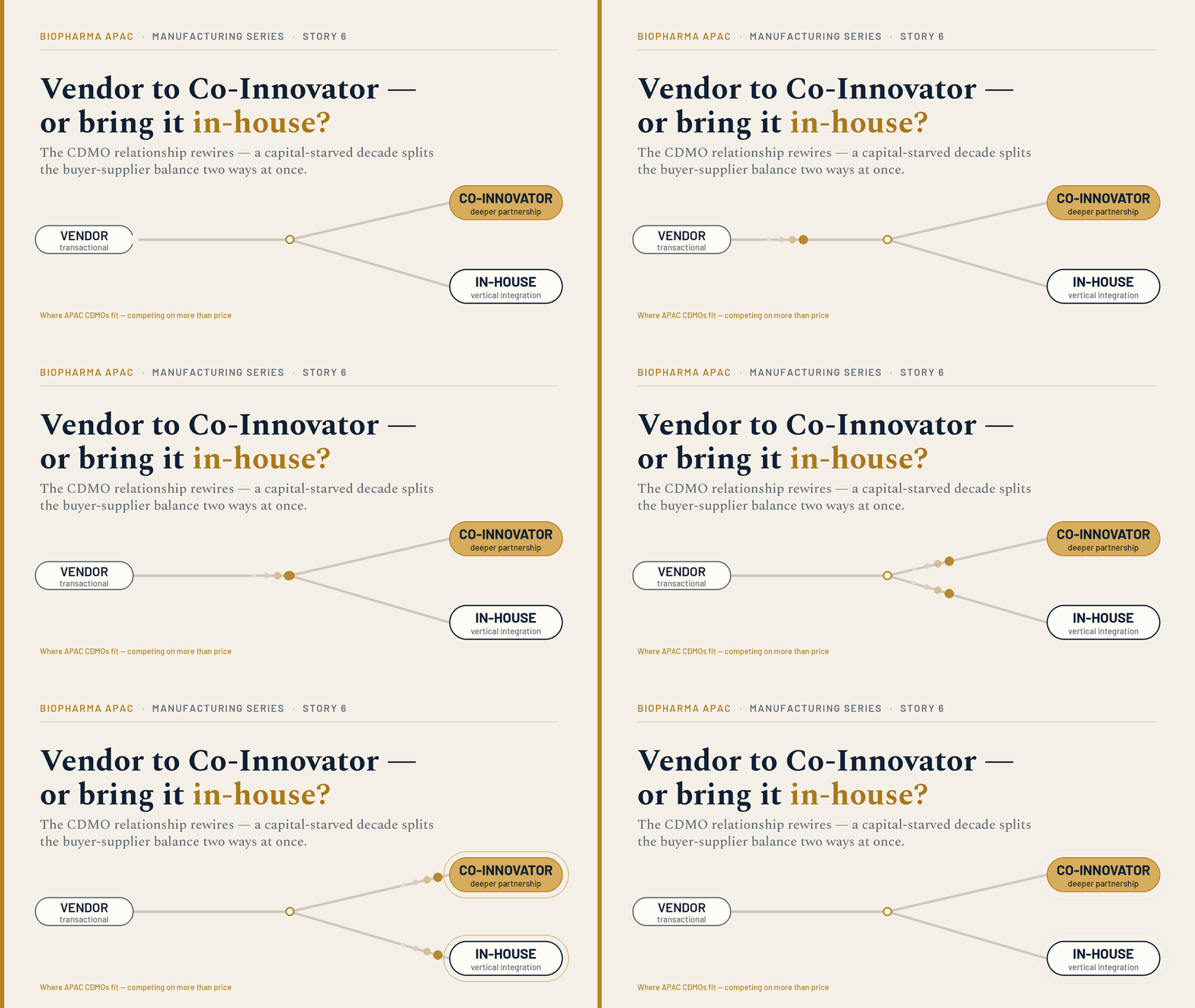
For two decades the contract development and manufacturing organisation occupied a comfortable, clearly understood place in the biopharma value chain. The innovator owned the molecule and the science; the CDMO owned the steel, the suites and the regulatory know-how to make it at scale. Money moved one way, product moved the other, and the relationship rarely strayed beyond the boundaries of a master service agreement. That settlement is now coming apart from both ends at once.
On one side, a multi-year contraction in biotech capital has hollowed out the pipeline of small and mid-cap sponsors that kept contract suites full, forcing CDMOs to compete for fewer, larger, more demanding programmes. On the other, the rise of antibody-drug conjugates, cell and gene therapies, multispecifics and GLP-1 injectables has made manufacturing so tightly coupled to product success that the old hand-off model looks increasingly inadequate. The result is a relationship being rewired in two opposite directions simultaneously: deeper, co-developmental partnership for most, and full vertical integration for the few with the balance sheet to pay for control.
For Asia-Pacific's manufacturers — Samsung Biologics, Fujifilm Biotechnologies, India's CDMO cohort, and a long tail of specialists across China, Korea, Singapore and Japan — the question is no longer whether they can win work on price. It is whether they can reposition fast enough to be the partner an innovator co-develops with, rather than the vendor it eventually buys, builds around, or walks away from.
The capital backdrop: a pipeline running dry at the top of the funnel
Every conversation about the CDMO relationship in 2026 begins with the same uncomfortable fact: the money that feeds the contract-manufacturing pipeline has been scarce for the better part of four years, and the scarcity has changed its character.
The numbers describe a peak and a long descent. Pharmaceutical venture capital deal value reached roughly $70 billion at the 2021 high, according to GlobalData; US life-sciences VC alone touched around $47 billion that year. The reversal was brutal. Capital raised by dedicated biotech VC funds fell from about $30.8 billion in 2021 to $11.7 billion by 2024 as higher rates made new vehicles harder to close, and the XBI biotech index dropped roughly 61% from its February 2021 high before bottoming in late 2023. IQVIA's tally of total biopharma funding — public and private combined — fell 20% in 2025 to $82 billion from $102 billion the prior year, with the IPO haul collapsing to a ten-year low of around $3 billion.
The headline decline matters less than its shape. Capital has not simply shrunk; it has concentrated. EY's life-sciences team has noted that more than half of publicly traded biotechs entered recent years with under two years of cash runway, while the rounds that do close are larger and rarer — investors making bigger bets on fewer companies with de-risked, later-stage assets. Median venture rounds have drifted toward the $100 million "megaround," but the early-formation cohort that historically seeded the next generation of clinical programmes is being starved. Drug discovery and preclinical work, as one analysis put it, are bearing the brunt while capital chases clinical proof.
That distribution is precisely the wrong shape for the CDMO model. Contract manufacturers monetise a funnel: a broad base of early-stage programmes that feed process-development revenue, of which a fraction graduate to lucrative commercial supply. When the base narrows and the survivors consolidate, two things happen. First, demand for early-phase and CGT-specific capabilities softens — several CDMOs visibly stepped back from cell-and-gene specialisation through 2025, rerouting orphaned programmes and slowing innovation in the process. Second, the surviving sponsors arrive with more leverage and less cash, ready to renegotiate terms that were written in a more forgiving market.
The cash-constrained biotech renegotiating its CDMO contract has become an archetype of the era. Sponsors are stretching timelines, rescoping batches, deferring scale-up milestones and pressing for risk-sharing structures that would have been unthinkable in 2021. Service providers, in turn, are being asked to flex scope, adjust schedules and absorb a share of programme risk rather than simply invoice for work performed. As Fortrea's global head of strategic deals, Samir Kagrana, observed of the climate, biotechs are finding it genuinely difficult to access capital even as molecules grow more complex and expensive to develop. The CRO and CDMO that wants to keep the relationship has little choice but to bend.
Against that backdrop, the green shoots are real but uneven. GlobalData recorded a 70.9% jump in quarterly biotech venture financing, from $1.8 billion in Q2 2025 to $3.1 billion in Q3, and US rate cuts in September 2025 lowered the cost of capital that had frozen the market. Yet the recovery favours later-stage, de-risked assets — the very programmes most likely to in-house their manufacturing or command bespoke partnership terms. The funnel is refilling, but in a shape that pushes the CDMO relationship away from transactional piecework at both ends.
The partnership thesis: complex modalities make piecework obsolete
If capital scarcity is the push, modality complexity is the pull. The therapies driving today's pipeline simply cannot be manufactured at arm's length.
Consider the antibody-drug conjugate, the modality of the moment. With more than 300 ADC candidates in clinical trials, the bottleneck has moved from monoclonal antibody production — a mature, almost commoditised competence — to bioconjugation, high-potency handling and the seamless integration of a biologic backbone with a cytotoxic payload and linker chemistry. Manufacturing an ADC is not three sequential hand-offs; it is a single, tightly coupled process where a decision made in payload synthesis constrains what is possible in conjugation and fill-finish months later. The sponsor that treats this as piecework — bid out to the lowest qualified suite at each step — invites exactly the manufacturability failures that kill programmes at scale-up.
The same coupling holds across the new modality map. Cell and gene therapies demand patient-specific, small-batch manufacturing that bears no resemblance to the million-unit identical runs CDMO infrastructure was built for. Multispecific antibodies and fusion proteins introduce purification and analytical challenges that reward deep, accumulated process knowledge over generic capacity. Even the GLP-1 wave, for all its blockbuster volumes, has exposed how thin sterile fill-finish capacity really is, and how much a sponsor depends on a manufacturer that understands its product intimately rather than slotting it into a standard line.
The industry's own behaviour confirms the shift. Of the contract-manufacturing activity tracked across 2025, partnerships — not independent capacity builds — were consistently the dominant announcement type, accounting for 301 collaborations, roughly 41% of all news in the sector. These were not simple supply agreements. They spanned technology-platform integrations, modality-specific co-development arrangements, CRO-CDMO tie-ups offering seamless development-to-manufacturing transitions, and geographic alliances pairing Asian production capacity with Western regulatory market access. The piecework contract is quietly being displaced by the long-term collaboration agreement.
The strategic logic runs in both directions. For the capital-constrained sponsor, a deep CDMO partnership is a way to access end-to-end capability without the balance-sheet burden of building it — speed and efficiency bought through relationship rather than capex. For the CDMO, long-term commitments are the only durable answer to the utilisation problem: a multi-year, modality-specific partnership lets a manufacturer optimise a facility for a defined set of products and hold utilisation steady through a volatile demand cycle. Some commentators have begun calling this the PDMO — the preferred development and manufacturing organisation — a relationship built on standing collaboration rather than transaction by transaction.
This is the co-innovator thesis in its strongest form: as molecules get harder to make, the manufacturer that knows the molecule best becomes indispensable, and indispensability converts a vendor into a partner. But the thesis has a powerful counter-argument, and it is being written in eleven-figure cheques.
The in-housing counter-move: when control is worth $16.5 billion
In February 2024, Novo Holdings — the investment arm that controls Novo Nordisk — agreed to take Catalent, one of the world's largest CDMOs, private in an all-cash deal valuing the contract manufacturer at roughly $16.5 billion. In a related transaction that completed in December 2024, Novo Nordisk paid its parent $11 billion to acquire three of Catalent's fill-finish sites outright — Anagni in Italy, Bloomington in Indiana, and Brussels in Belgium — facilities employing more than 3,000 people that were already running Novo Nordisk product.
The deal is the defining vertical-integration move of the cycle, and its motive was unambiguous: control of capacity. Demand for Novo's GLP-1 franchise, Ozempic and Wegovy, had outstripped supply to the point of rationing, and the company concluded that the surest way to secure sterile filling capacity for its most valuable products was to own the plants rather than contract for them. The acquired sites are expected to lift Novo's filling capacity progressively from 2026, complementing a capital-investment programme that reached roughly $6.8 billion in 2024 — nearly double the prior year — including a $4.1 billion build in Clayton, North Carolina and a multi-billion-dollar expansion at Kalundborg in Denmark.
What makes the Catalent deal so instructive for the CDMO sector is what it revealed about the limits of the partnership model. Catalent was not a marginal supplier; over the preceding decade it had a hand in roughly half of all FDA approvals. Novo Nordisk and Catalent already worked together at the three sites in question. The relationship was, by any measure, a deep strategic partnership — and Novo still chose to convert it into ownership the moment its commercial stakes became existential. For a product line generating tens of billions in revenue, the calculus is straightforward: the cost of capacity insecurity dwarfs the cost of the plant.
The deal also exposed the zero-sum edge of vertical integration. Eli Lilly's chief executive David Ricks publicly flagged that his company relied on one of the Catalent sites for diabetes production — and now found a direct competitor owning it. When an innovator brings capacity in-house, that capacity leaves the open market, and the rivals who shared it are left scrambling. Vertical integration is not merely a make-versus-buy decision; it is a capacity-security play that can strand the competitors who depended on the same supplier.
Novo is the largest example, not the only one. The broader 2025 pattern — a reported $24.86 billion of reshoring-driven manufacturing investment — included a steady stream of pharma companies expanding internal capacity and acquiring capability rather than contracting for it. The signal to CDMOs is sobering: the most valuable, most strategic, highest-volume work — exactly the commercial supply that anchors a manufacturer's economics — is the work most at risk of being pulled in-house by sponsors wealthy enough to want certainty over flexibility.
So the relationship is bifurcating. For the large, well-capitalised innovator with a franchise product, the answer is increasingly own it. For everyone below that tier — the cash-constrained, the early-stage, the modality-complex — the answer is partner deeper. The CDMO that thrives will be the one that understands which conversation it is in.
Where APAC CDMOs fit: competing on more than price
For most of their history, Asia-Pacific's contract manufacturers competed on a single, powerful proposition: cost. India and China built formidable positions as the world's lowest-cost research and manufacturing ecosystems, and Western biotech outsourced to them precisely because it was cheaper than anywhere else. That proposition is no longer sufficient — and in some markets it has become a liability.
The clearest evidence is the Samsung Biologics repositioning. On 3 November 2025 the Korean manufacturer completed the spin-off of its biosimilar arm, Samsung Bioepis, into a separate holding company, Samsung Epis Holdings, leaving Samsung Biologics to operate as a pure-play CDMO. The strategic rationale went to the heart of the partnership question. Some multinational clients had been uneasy that their contract manufacturer also operated a biosimilars business — a potential competitor sharing a corporate roof, however strict the internal firewalls. By separating the two, chief executive John Rim argued, the company could resolve that conflict of interest and present itself as a "fully independent, trusted manufacturing partner."
That is a price-immaterial move. Samsung Biologics already serves 17 of the world's top 20 pharmaceutical companies and won three separate contracts worth more than a billion dollars apiece in a single recent stretch; it is not competing for those clients on cost. It is competing on trust, conflict-free alignment, and the ability to be a genuine co-developer — and it restructured a multi-billion-dollar listed company to make that case more credible. Rim has been blunt that even as some innovators expand their own manufacturing, outsourcing remains the dominant trend, and the CDMO that positions itself as an integrated partner "from idea to launch" captures it. The company is reinforcing the point with capacity — a fifth plant brought its total to 784,000 litres, with a second Bio Campus targeted to reach 1.32 million litres by 2032 — and with capability, pushing beyond manufacturing into organoid-based drug screening to engage sponsors earlier in development and lock in the relationship.
Fujifilm Biotechnologies illustrates the same ambition through scale of commitment. Chairman Toshi Iida has set out a path from roughly $1.3 billion in revenue to $5 billion within five years, backed by a pledge to invest about two-thirds of Fujifilm's entire annual capex into the business. That is not the posture of a price-taking vendor; it is a bid to be a primary, strategic-scale partner to the largest innovators. India's players are moving on the capability axis too — Syngene's acquisition of Emergent BioSolutions' US biologics facility for around $50 million signalled an appetite to own regulated-market capacity rather than serve it only from offshore.
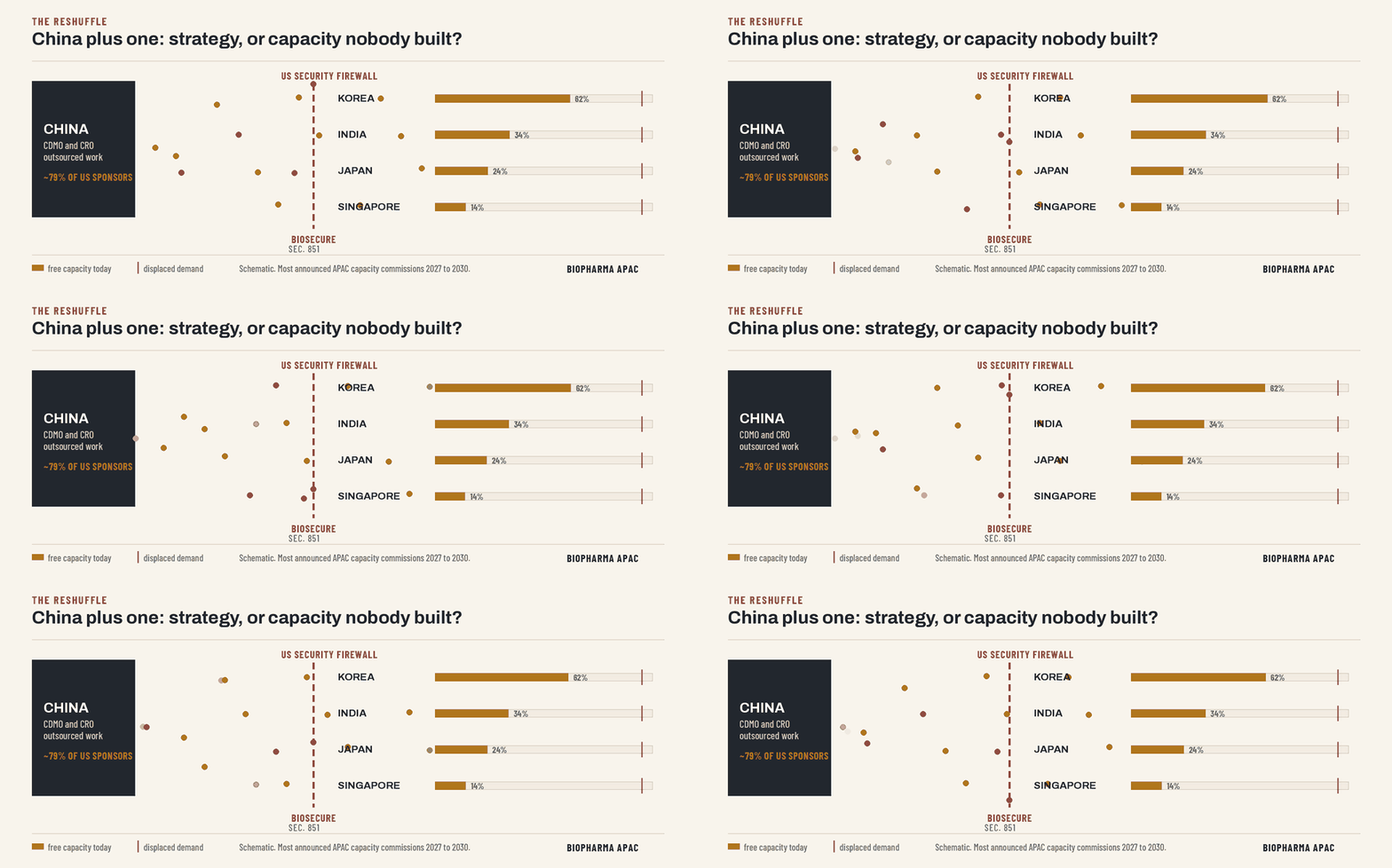
Layered over all of this is the geopolitical wildcard that may reshape APAC's competitive map more than any commercial strategy: the BIOSECURE Act. After failing in an earlier session, the legislation was signed into law on 18 December 2025 as part of the FY2026 National Defense Authorization Act, restricting US federal procurement from and grants to designated "biotechnology companies of concern." On 8 June 2026, the US Department of Defense added WuXi AppTec — the Chinese CRDMO estimated to be involved in producing roughly a quarter of drugs used in the United States — to its 1260H list of Chinese military companies, a designation that places it within scope of the Act's prohibitions. WuXi disputes the listing and is pursuing remedies; the prohibitions themselves do not bite until the Federal Acquisition Regulation is revised and a further 60 days elapse. But the direction of travel is set.
The implications cut two ways for APAC. A Biotechnology Innovation Organization survey found that 79% of biopharma companies have a product or contract tied to a Chinese CMO or CDMO, and consultancy LEK reported that around a quarter of life-sciences firms were already looking to shift away from Chinese partners. That diverted demand has to land somewhere — and South Korea, India, Japan and Singapore are the obvious beneficiaries, capturing business that can no longer comfortably sit in China. Samsung's $1.3 billion contract with an unnamed US biopharma partner is exactly the kind of work in motion. Yet the same legislation is a warning to every APAC manufacturer that price and capacity are not enough; regulatory trust, supply-chain transparency and geopolitical alignment have become selection criteria in their own right. WuXi's order backlog actually rose more than 41% year-on-year in Q3 2025 as customers locked in contracts ahead of the restrictions — a reminder that switching CDMOs is slow, costly and risk-laden, which itself argues for the kind of deep, durable partnership now in demand.
The takeaway: the balance of power has moved, and so must the model
The buyer-supplier relationship in biopharma manufacturing has not simply tilted; it has fractured along a new axis. The old single spectrum — make it yourself or buy it on contract — has split into a more complex map defined by capital, complexity and control.
For the largest innovators with franchise-defining products, the lesson of Novo and Catalent is that strategic capacity is too important to rent. Expect more vertical integration at the top, more capacity quietly leaving the open market, and more competitors stranded when it does. For the vast middle and tail of the industry — capital-constrained, modality-complex, unable to build — the lesson is that the arm's-length contract is dying, replaced by co-development partnerships that share risk, knowledge and timelines because the new therapies cannot be made any other way.
For APAC's CDMOs, caught between these forces, the path is narrow but clear. Competing on price alone leaves a manufacturer exposed to in-housing from above and commoditisation from below. The winners are repositioning as trusted, conflict-free, modality-specialised partners — Samsung restructuring a listed company to remove a conflict of interest, Fujifilm betting two-thirds of its capex on becoming indispensable, Indian and Korean players acquiring regulated-market capacity and pushing upstream into development. The BIOSECURE tailwind will hand them demand they did not have to earn; whether they keep it will depend on whether they can be the partner an innovator co-innovates with, rather than the vendor it switches away from the moment something cheaper or closer appears.
The CDMO that still thinks of itself as a supplier of suites and steel is selling into a market that no longer exists. The one that understands it is now selling a relationship — and can prove it is worth more than the cost of bringing the work in-house — owns the next decade.
(arcilla.fran@biopharmaapac.com)
This feature is part of BioPharma APAC's manufacturing series examining the structural forces reshaping biopharmaceutical production across Asia-Pacific.
Most Read
- Can APAC Biomanufacturing Decarbonise Without Pricing Itself Out?
- The Algorithm on the GMP Floor: AI Promises a Smarter Plant. Regulators Demand the Audit Trail.
- APAC's Peptide-Capacity Gamble
- After the Rush: APAC's mRNA and Vaccine Capacity Hangover
- The Biosimilar Race: Factory to the World — or Stuck in the Copycat Economy?
- The Vein-to-Vein Problem: Can APAC's Cold Chain Carry Advanced Therapies?
- Vectors, Plasmids and the CGT Trap: APAC's Cell and Gene Therapy Ambitions Face an Upstream Bottleneck
- Can APAC Build Radioligand Therapy Before the Atoms Decay?
- The Great Biopharma Reset: 50 Developments That Changed Everything in H1 2026
- Beyond the Trial: Can Real-World Evidence Earn Regulatory Trust in APAC?
- Beyond the Obvious Giant: Where APAC's Clinical Trials Go Next
- The Frontier That Won’t Quite Arrive
Bio Jobs
- Sanofi Turns The Page As Belén Garijo Steps In And Paul Hudson Steps Out
- Global Survey Reveals Nearly 40% of Employees Facing Fertility Challenges Consider Leaving Their Jobs
- BioMed X and AbbVie Begin Global Search for Bold Neuroscience Talent To Decode the Biology of Anhedonia
- Thermo Fisher Expands Bengaluru R&D Centre to Advance Antibody Innovation and Strengthen India’s Life Sciences Ecosystem
- Accord Plasma (Intas Group) Acquires Prothya Biosolutions to Expand Global Plasma Capabilities
- ACG Announces $200 Million Investment to Establish First U.S. Capsule Manufacturing Facility in Atlanta
- AstraZeneca Invests $4.5 Billion to Build Advanced Manufacturing Facility in Virginia, Expanding U.S. Medicine Production
News