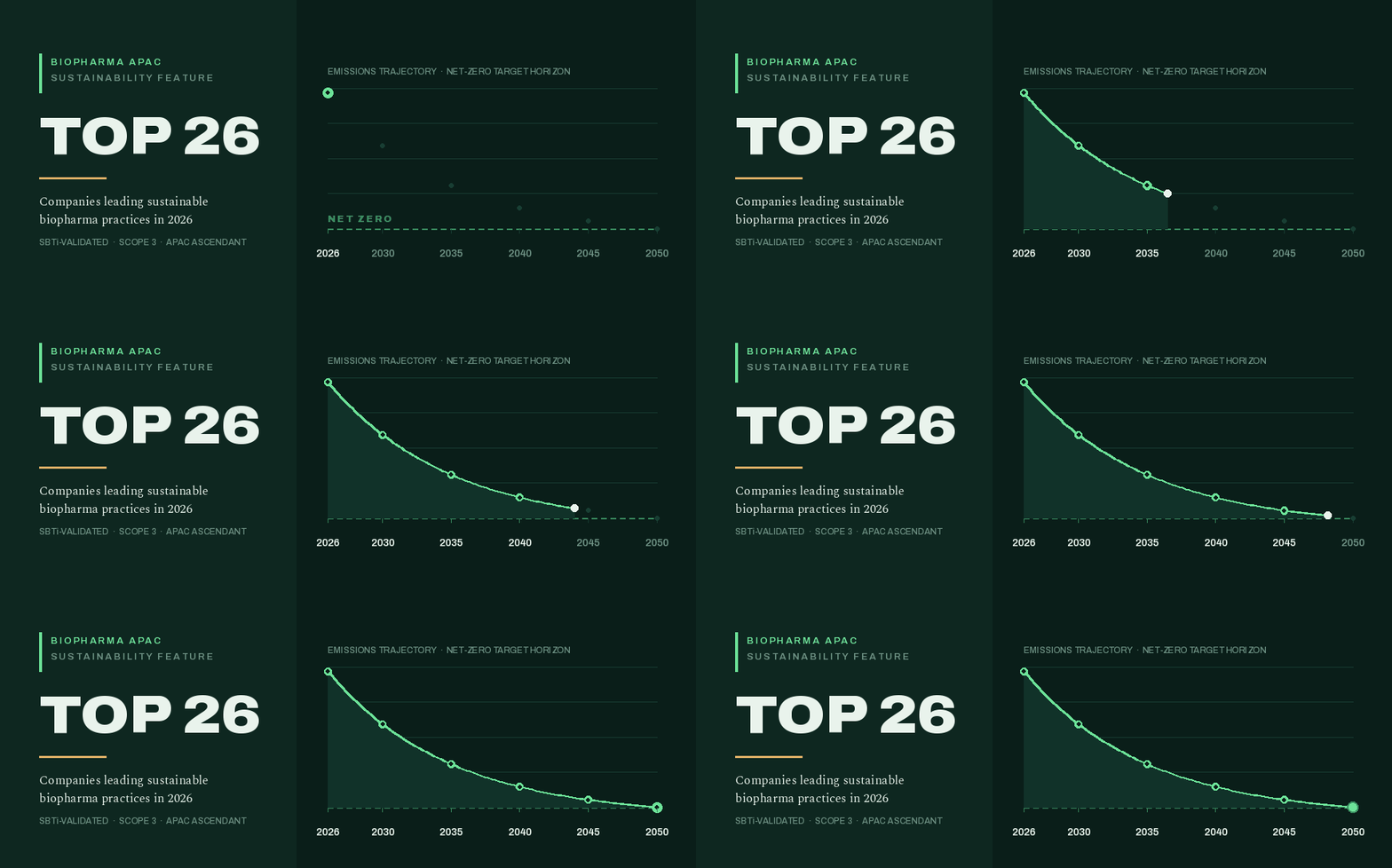
Top 26 Companies Leading Sustainable Biopharma Practices in 2026
23 July 2026 | Thursday | Analysis
Sustainability has stopped being a side conversation in the pharmaceutical industry. In 2026 it sits at the centre of how the sector defines leadership. The reason is simple enough: healthcare systems account for a meaningful slice of global emissions, and the medicines that keep people well cannot be produced on a planet that is quietly falling apart. Human health and planetary health, as almost every company in this benchmark now phrases it, are two sides of the same coin.
The bar has also risen, and it has moved in a specific direction. The 2026 Global 100 ranking from Corporate Knights introduced a sharper lens this year, weighing not just emissions and resource use but how quickly companies are growing revenues tied to genuinely sustainable products and services. That metric alone accounts for a third of a company’s score. Meanwhile the Science Based Targets initiative has become the industry’s shared referee, and the meaningful distinction is no longer between companies that have a target and companies that do not. It is between those whose targets have been externally validated and those still working from ambition.
The third shift is where the difficulty now lives. Operational emissions, Scope 1 and 2, are falling fast at the leading firms, in several cases by more than 90 per cent. But for most drugmakers those emissions were never the bulk of the footprint. Scope 3, buried in supplier networks, purchased goods, distribution and product life cycles, routinely accounts for 90 per cent or more of the total. Novo Nordisk puts the figure at over 95 per cent, spread across roughly 60,000 suppliers. Roche puts it above 90 per cent. That is the frontier, and it cannot be solved by any company acting alone.
What follows is a look at 26 companies setting the pace, grouped by region. This is not a strict quantitative league table and the running order within each section is not a scorecard. It is a snapshot of the commitments, recent announcements and leadership positions shaping sustainable biopharma right now, with deliberate weight given to the Asia-Pacific players who increasingly define where the world’s medicines are actually made.
THE TARGET-YEAR MAP
|
HORIZON |
SCOPE AND COMPANIES |
|
2027 to 2030 |
Own operations. Amgen (2027) · Eli Lilly · Gilead Sciences · Boehringer Ingelheim · Bayer · GSK (net-zero climate impact) |
|
2035 to 2040 |
Operations or full value chain. Takeda (operations before 2035, value chain before 2040) · Novartis · Pfizer · Biogen (operations) · Eisai · Bristol Myers Squibb |
|
2045 |
Full value chain. Novo Nordisk · Roche · AstraZeneca · GSK · Sanofi · Merck (MSD) · Johnson & Johnson · Biogen |
|
2050 |
Full value chain. Astellas · Daiichi Sankyo · Samsung Biologics · WuXi Biologics · AbbVie · Lonza · Bayer · Roche (absolute zero, Scope 1 and 2) |
Several companies appear twice because their operational and value-chain horizons differ. CSL and Novonesis carry validated near-term science-based targets without publishing a single net-zero year, and are assessed here on near-term performance.
Europe’s Pacesetters
01 Novo Nordisk
The Danish GLP-1 giant runs its entire strategy under the banner “Circular for Zero,” aiming for net-zero emissions across its value chain by 2045 alongside a 33 per cent cut in Scope 3 emissions by 2033. Every one of its production sites already runs on renewable power. The harder problem is upstream, which is why over 3,000 suppliers, representing 54 per cent of its emissions, have now committed to renewable electricity. The company is candid about what remains unsolved: most of its plastic injection pens still end their life in landfill, which is why reusable, longer-life devices have moved up the agenda. Its climb from 62nd to 51st on Corporate Knights’ 2026 list reflects momentum rather than arrival.
02 Roche
Roche made history as the first in the industry to secure SBTi validation for both net-zero and absolute-zero targets, committing to net zero across all scopes by 2045 through a 90 per cent absolute reduction, and pushing beyond the standard to absolute zero Scope 1 and 2 emissions by 2050. Near-term it is targeting a 70 per cent cut in operational emissions by 2029 against a 2022 baseline. Group CEO Thomas Schinecker noted that after two decades of work the company has cut its own emissions by 67 per cent, adding that by submitting science-based targets Roche will “hold ourselves accountable to the highest standards.” Site-level decarbonisation roadmaps run to geothermal storage and heat pumps, and Genentech is a major solar producer in the San Francisco Bay Area.
03 AstraZeneca
Five years into its Ambition Zero Carbon strategy, AstraZeneca has become one of the most concrete operational stories in the sector. As of early 2026 it had cut Scope 1 and 2 emissions by 98 per cent against a 2015 baseline. It is targeting a 50 per cent reduction in Scope 3 emissions by 2030 and 90 per cent by 2045, and has planted 200 million trees in support of a carbon-negative ambition. Annual supplier conferences and mandatory yearly climate data submissions keep its value chain accountable, which matters more than the tree count.
04 GSK
GSK carries what many consider the boldest near-term promise in pharma: a net-zero impact on climate and a net-positive impact on nature by 2030, with net zero across the full value chain by 2045 approved by the SBTi. It has already met its 2025 commitment for 100 per cent imported renewable electricity and is working towards 100 per cent renewably imported and generated power by 2030. CEO Emma Walmsley has framed the ambition around wanting to “play our full part in protecting and restoring the planet’s health.” The company is unusually transparent about the difficulty, including scepticism around carbon credit quality in the voluntary market.
“We have less than 60 months to our target; that’s nothing.”
Giulia Usai, senior director for procurement sustainability, GSK, on the 2030 deadline
05 Sanofi
Sanofi’s Planet Care programme targets net-zero emissions across all scopes by 2045, with an interim trajectory towards carbon neutrality by 2030 and a 90 per cent reduction across the value chain against a 2019 baseline. The results are visible: renewable sources now cover roughly 85 per cent of its electricity, backed by long-term power purchase agreements, and it is on track for 100 per cent by 2030. The French group has also leaned hard into an area many peers underplay, committing that every production site will have a plan to monitor and reduce pharmaceutical residues in wastewater. It reinvests several million euros a year into employee-led environmental projects.
06 Novartis
Novartis is chasing net-zero emissions across its entire value chain by 2040, a decade ahead of many peers, backed by SBTi-validated near-term and long-term targets. Its interim goals are aggressive: a 90 per cent absolute cut in Scope 1 and 2 emissions and a 42 per cent reduction in Scope 3 by 2030 from a 2022 base year. The company follows an explicit mitigation hierarchy, avoiding emissions through efficiency first, then substituting fossil fuels with renewables, and neutralising only what genuinely cannot be eliminated, with carbon removals expected to cover less than 10 per cent of base-year emissions.
07 Novonesis
Formed from the merger of Novozymes and Chr. Hansen, Novonesis is the highest-ranked pharmaceutical name on Corporate Knights’ 2026 Global 100, leaping from 49th to eighth place globally. Its enzymes and microbial solutions replace resource-intensive chemical processes across agriculture, bioenergy and food, which is decarbonisation embedded in the product rather than bolted onto the factory. The company reports a 67 per cent cut in Scope 1 and 2 emissions against 2018, operations powered entirely by renewable electricity, 20 billion litres of water restored and 99.6 per cent of waste reused, recycled or recovered. It scored sustainable revenue and investment ratios of 100 per cent.
08 Bayer
Bayer is on a path to climate neutrality in its own operations by 2030, meaning a 42 per cent absolute cut in Scope 1 and 2 emissions against a 2019 baseline, with remaining emissions offset through verified projects. By 2035 it targets a 56 per cent operational cut and a 44 per cent Scope 3 reduction. Looking further out, the company aligns capital spending with a net-zero ambition by 2050 and has committed to phasing out all capital expenditure in new unabated carbon-intensive assets, a governance commitment few peers have matched in writing.
09 Boehringer Ingelheim
As one of the few large family-owned players in the industry, Boehringer Ingelheim has committed to carbon-neutral operations by 2030 through its Carbon Footprint initiative. Ingo Weiss, who leads the effort, put the rationale plainly, noting that “the environment has a direct impact on people’s wellbeing.” The company funds capital-intensive green projects through a dedicated internal green fund, investing millions annually, and partners with external specialists on verified emissions-reduction projects spanning reforestation, water and waste management.
PART TWO
The North American Field
10 Pfizer
Pfizer intends to meet the SBTi Net-Zero Standard by 2040, a decade earlier than the standard’s own timeline, cutting operational emissions by 95 per cent and value chain emissions by 90 per cent from 2019 levels. Chairman and CEO Albert Bourla has tied the effort to the company’s purpose, describing accelerated decarbonisation as a way to help “build a healthier, more sustainable world.” As the first pharmaceutical company to have emission goals recognised by the SBTi back in 2015, Pfizer treats climate action as a two-decade discipline rather than a recent pivot. Its Scope 3 footprint runs several times larger than its own operations, dominated by purchased goods and services.
11 Merck (MSD)
Known as MSD outside the US and Canada, Merck is targeting net zero across Scopes 1, 2 and 3 by 2045, and reached carbon neutrality across its operations in 2025 while pulling its 100 per cent renewable electricity goal forward by fifteen years. President Robert Davis has called global efforts to combat climate change essential to the health and sustainability of the planet. More than 400 supplier partnerships cover roughly 60 per cent of its Scope 3 emissions, and the company has added sustainability metrics to its corporate scorecard, meaning environmental performance now directly affects annual incentive payouts.
12 Johnson & Johnson
J&J is working towards net-zero emissions across its value chain by 2045, with carbon neutrality in operations by 2030. In a notable 2025 milestone, the company matched 100 per cent of its annual operational electricity consumption with renewable sources, drawing on more than 40 on-site systems across 15 countries alongside 16 off-site deals. Its SBTi-validated near-term goals include a 44 per cent cut in Scope 1 and 2 emissions by 2030 and a push for 80 per cent of suppliers by emissions to hold science-based targets. The company is unusually frank that the complexity of a two-sector business has kept it from a validated long-term net-zero goal.
13 Bristol Myers Squibb
Bristol Myers Squibb set its climate course early, committing to carbon neutrality in Scope 1 and 2 emissions by 2040 and to sourcing 100 per cent renewable electricity by 2030. The strategy folds in a wider set of operational goals, from equitable water use and zero waste to landfill through to a fully electric vehicle fleet, positioning environmental responsibility as one strand of a broader 2030 and 2040 roadmap rather than a standalone climate pledge.
14 Eli Lilly
Eli Lilly has anchored its near-term ambition on carbon neutrality in its own operations by 2030, covering both direct and purchased-energy emissions, alongside securing 100 per cent of its electricity from renewable sources. Just as importantly, the company has committed to sharpening how it tracks and reports emissions across its full value chain. That is less headline-friendly than a distant net-zero date, but credible Scope 3 accounting is precisely where the next phase of pharmaceutical decarbonisation will be won or lost.
15 Amgen
Amgen backed its environmental strategy with a substantial multi-year investment and an unusually tight horizon, targeting 2027. The biotech is pursuing carbon neutrality alongside a 40 per cent reduction in water use and a 75 per cent cut in total waste disposed. Central to the plan is the adoption of next-generation biomanufacturing technology designed to shrink carbon emissions at the source, which makes it one of the clearer examples of process innovation and emissions reduction advancing together rather than in tension.
16 Biogen
Biogen holds a genuine claim to first-mover status, having become the first company in the life sciences industry to reach carbon neutrality back in 2014. Its Healthy Climate, Healthy Lives initiative, a twenty-year, 250 million dollar commitment, aims to eliminate fossil fuels across operations by 2040, with net-zero value chain emissions targeted for 2045 and a near-term 55 per cent cut in Scope 1 and 2 emissions by 2032. The programme deliberately links climate and health, funding research into how fossil-fuel-driven air pollution affects the brain and the body, and it explicitly rules out reaching its goal through land use or carbon capture.
17 AbbVie
AbbVie is targeting net-zero emissions by 2050, with SBTi-validated near-term goals to cut absolute Scope 1 and 2 emissions by 42 per cent by 2030 from a 2021 baseline. The company has committed to lifting renewable electricity sourcing from under a third to 100 per cent by 2030, and wants around 79 per cent of its suppliers, weighted by emissions, to hold science-based targets by 2027. On-the-ground steps such as solar installations at its Belgian site and dual-fuel boiler upgrades across European manufacturing show the incremental grind behind the headline numbers.
18 Gilead Sciences
Gilead has set an ambition of net-zero operational greenhouse gas emissions by 2030, underpinned by a science-based target to cut absolute Scope 1 and 2 emissions by 46 per cent and Scope 3 emissions by 15 per cent from a 2019 baseline. Its projections imply a 90 per cent reduction in operational emissions by 2030. The company pairs its carbon goals with commitments many peers treat as secondary, pledging water neutrality in the water-stressed regions where it operates, a 30 per cent reduction in potable water use at owned facilities, fully recyclable or reusable product packaging, and green chemistry in manufacturing wherever possible.
PART THREE
Asia-Pacific and the Manufacturing Base
19 Takeda
Japan’s largest drugmaker has accelerated its climate goals and now aims for net-zero greenhouse gas emissions in its own operations before 2035 and across its entire value chain before 2040, in line with the SBTi Corporate Net-Zero Standard. Notably, Takeda moved away from carbon neutrality as a headline goal in 2024, redirecting resources towards genuine abatement rather than annual offsetting, a shift more companies are likely to follow. It also pursues zero waste to landfill by 2030, a 10 per cent cut in freshwater withdrawal, and a target for 95 per cent of secondary and tertiary packaging to use recycled or certified content.
“The health of our planet and the health of people are inextricably linked.”
Christophe Weber, president and chief executive officer, Takeda
20 Eisai
Eisai ties its environmental agenda tightly to its human-health mission, and that integration earned it a strong showing on Corporate Knights’ 2026 list with an A-minus rating and a sustainable revenue ratio near 60 per cent. The Japanese firm is targeting carbon neutrality by fiscal 2040 under its Environmental Management Vision, steadily expanding renewable energy consumption, which passed 176,000 MWh globally in FY2024, while driving Scope 2 emissions down to a few thousand tonnes. Access to medicines sits alongside emissions as a core pillar of its ESG strategy rather than a separate corporate responsibility exercise.
21 Astellas
Astellas has committed to net-zero greenhouse gas emissions by 2050, planning to cut Scopes 1, 2 and 3 emissions by 90 per cent from 2015 levels and neutralise the remaining 10 per cent, with its 2030 targets accredited by the SBTi. President and CEO Kenji Yasukawa has positioned the goal to deepen the company’s engagement in sustainability as a strategic priority rather than a compliance obligation. Astellas also collaborates with fellow Japanese majors on lower-impact pharmaceutical packaging, including blister packs using biomass-based plastic in place of petroleum-derived material.
22 Daiichi Sankyo
Daiichi Sankyo has secured SBTi net-zero certification for its climate transition plan and is committed to net-zero greenhouse gas emissions by fiscal 2050. Its near-term plan targets a 42 per cent reduction in Scope 1 and 2 emissions by 2030 from a 2023 baseline, and it intends to lift renewable electricity sourcing from a low single-digit starting point to 100 per cent by fiscal 2030. Supplier engagement is built in, with a target for the majority of suppliers by emissions to hold science-based targets. The company frames environmental conservation as a core management materiality issue.
23 Samsung Biologics
South Korea’s contract manufacturing powerhouse is proving that CDMOs can lead rather than follow. Samsung Biologics targets net zero across operations and its supply chain by 2050, joined RE100 in 2022 for 100 per cent renewable electricity, and became the first biopharma CDMO to receive the Sustainable Markets Initiative’s Terra Carta Seal. Interim milestones include cutting direct emissions 32 per cent by 2030 and 62 per cent by 2040. Its Plant 5, launched in 2025, used more than 15,000 square metres of low-carbon green concrete, halving emissions from the parking structure, while on-site solar generates over 1,100 MWh a year. Crucially for clients, it now offers product carbon footprint assessments across the full lifecycle.
24 WuXi Biologics
In August 2025, WuXi Biologics became one of the first companies in the industry to win SBTi approval for both near-term and net-zero targets aligned with the most ambitious 1.5 degree pathways, committing to net zero across its value chain by 2050 and a 58.8 per cent cut in Scope 1 and 2 emissions by 2034 from a 2024 base year. CEO Chris Chen, who chairs the company’s ESG committee, said the approval further inspires its dedication to “leading the way to a net-zero economy.” Its Green CRDMO positioning has attracted an MSCI AAA rating, an EcoVadis Platinum medal, DJSI listing and CDP A List recognition for water security.
25 CSL
Australia’s biotech leader reached a milestone in May 2025 when the SBTi approved its near-term science-based targets. CSL has committed to a 42 per cent absolute cut in Scope 1 and 2 emissions by fiscal 2030 from a 2021 base year, and wants suppliers representing 73.1 per cent of its emissions to hold science-based targets by 2030. Its Melbourne headquarters earned a five-star environmental rating, and its German site runs one of Europe’s larger ice-storage cooling systems, cutting primary energy consumption well below the legal minimum standard. For a plasma business dependent on an energy-intensive collection network, operational efficiency is the whole game.
26 Lonza
Rounding out the benchmark, the Swiss CDMO anchors the manufacturing side of sustainable biopharma with an SBTi-validated ambition to reach net zero by 2050 or earlier. It has committed to a 42 per cent absolute reduction in Scope 1 and 2 emissions by 2030 from a 2021 baseline and reports it has already cut greenhouse gas intensity by 53 per cent against 2018, beating its 2030 target early while generating 50 per cent more value from the same footprint. Sites including Colmar in France now run entirely on renewable electricity, and a supplier engagement target covering 79 per cent of Scope 3 emissions keeps the value chain in focus.
ANALYSIS
What the Benchmark Reveals
Read together, these 26 stories describe a sector in transition rather than a sector that has arrived. Three patterns stand out.
The first is convergence on validation. Net-zero commitments have clustered around SBTi approval, and the initiative’s Corporate Net-Zero Standard has effectively become the sector’s common language. Roche, WuXi Biologics, CSL, Lonza, Novartis, GSK, Astellas and Daiichi Sankyo have all pushed their targets through external validation. Independent analysis suggests roughly half of biotech and pharma companies now hold Scope 1 and 2 targets aligned to a net-zero pathway, up sharply from a third two years earlier, though smaller companies and start-ups lag well behind the majors.
The second is that operational decarbonisation is close to a solved problem for the well-capitalised. AstraZeneca at 98 per cent, Roche at 67 per cent and Novonesis at 67 per cent demonstrate that Scope 1 and 2 emissions yield to sustained capital investment in renewables, efficiency and electrification. The companies making the most credible progress have shifted their attention entirely to Scope 3, treating decarbonisation as a supply-chain discipline: engaging thousands of vendors, redesigning products and packaging, and in the case of Merck and Sanofi, tying executive incentives to environmental results.
The third is regional. A decade ago, sustainability leadership in this industry was largely a Western story. In 2026 it is not. Japanese majors hold their own against European and American peers, with Eisai and Takeda both ahead of several US names on external ESG assessments. Samsung Biologics and WuXi Biologics have turned the CDMO model, once assumed to be where environmental accountability goes to disappear, into a competitive showcase. CSL flies the flag for Australia. For a region that manufactures a growing share of the world’s medicines, and increasingly makes them for someone else, that shift carries commercial weight, not just reputational weight.
That last point deserves emphasis. As buyers write ESG clauses into supply agreements and European reporting rules push Scope 3 disclosure down the chain, a CDMO’s carbon position is becoming a commercial qualification rather than a marketing line. Samsung Biologics offering product carbon footprint assessments to clients, and WuXi Biologics branding itself a Green CRDMO, are not incidental. They are the early shape of how manufacturing work will be awarded.
OUTLOOK
What to Watch Through 2026 and Beyond
Three questions will determine whether this benchmark reads as progress or as a well-documented plateau when it is revisited next year.
Can the 2030 cohort actually land? GSK, Gilead, Boehringer Ingelheim, Eli Lilly and Bayer have all placed significant commitments inside this decade. These are the nearest tests of whether ambitious corporate climate targets survive contact with capital constraints, patent cliffs and cost pressure. GSK’s own procurement leadership has acknowledged how little time remains.
Will supplier targets translate into supplier reductions? Almost every company in this benchmark now reports a percentage of suppliers expected to hold science-based targets. Very few report the emissions those suppliers have actually eliminated. The gap between commitment coverage and delivered abatement is the single most important number the industry does not yet publish consistently.
And will offsets hold up? Several companies plan to neutralise residual emissions with carbon credits, and several are openly uneasy about the quality of what is available. GSK has said as much. As scrutiny of the voluntary carbon market intensifies, the difference between companies abating and companies purchasing will become harder to blur, and Takeda’s decision to step back from carbon neutrality as a headline claim may prove to be the leading indicator.
None of this is finished work. But the direction of travel is clear, and the companies profiled here are the ones others will be measured against.
SOURCES AND METHOD
Company commitments, target years, baselines and progress figures in this benchmark are drawn from corporate sustainability and ESG disclosures, regulatory filings, SBTi target validations and company press releases current as of July 2026. Ranking context is drawn from the 2026 Global 100 published by Corporate Knights. Quoted remarks are taken from published company statements and interviews and are attributed to the named individual and organisation. Inclusion reflects editorial assessment of commitment scope, external validation and disclosed progress, and does not constitute a quantitative ranking.
DISCLAIMER
This article is editorial and analytical journalism intended for information purposes only. It does not constitute investment, financial, legal, regulatory, medical or clinical advice, and should not be relied upon as such.
Emissions data, target dates, baselines and percentage reductions are directional, are stated as disclosed by the companies concerned, and are current as of the date of publication. Targets may be revised, reweighted, accelerated or withdrawn, and baseline years and reporting boundaries differ between companies, which limits direct comparability.
References to specific companies, facilities, products, certifications, ratings and initiatives are illustrative of the practices discussed. No endorsement, recommendation, accreditation or verification of any company’s environmental performance is implied, and BioPharma APAC has not independently audited the figures reported.
The selection and ordering of companies reflects editorial judgement and is not a quantitative ranking, index or scoring system. Readers should consult primary company disclosures and validated third-party assessments before drawing conclusions.
BioPharma APAC is an independent publication. Views expressed are those of the editorial desk and not of any company, organisation or initiative named in this article.
Most Read
- Can APAC Biomanufacturing Decarbonise Without Pricing Itself Out?
- The Algorithm on the GMP Floor: AI Promises a Smarter Plant. Regulators Demand the Audit Trail.
- APAC's Peptide-Capacity Gamble
- After the Rush: APAC's mRNA and Vaccine Capacity Hangover
- The Biosimilar Race: Factory to the World — or Stuck in the Copycat Economy?
- The Vein-to-Vein Problem: Can APAC's Cold Chain Carry Advanced Therapies?
- Vectors, Plasmids and the CGT Trap: APAC's Cell and Gene Therapy Ambitions Face an Upstream Bottleneck
- Can APAC Build Radioligand Therapy Before the Atoms Decay?
- The Great Biopharma Reset: 50 Developments That Changed Everything in H1 2026
- Beyond the Trial: Can Real-World Evidence Earn Regulatory Trust in APAC?
- Beyond the Obvious Giant: Where APAC's Clinical Trials Go Next
- The Frontier That Won’t Quite Arrive
Bio Jobs
- Sanofi Turns The Page As Belén Garijo Steps In And Paul Hudson Steps Out
- Global Survey Reveals Nearly 40% of Employees Facing Fertility Challenges Consider Leaving Their Jobs
- BioMed X and AbbVie Begin Global Search for Bold Neuroscience Talent To Decode the Biology of Anhedonia
- Thermo Fisher Expands Bengaluru R&D Centre to Advance Antibody Innovation and Strengthen India’s Life Sciences Ecosystem
- Accord Plasma (Intas Group) Acquires Prothya Biosolutions to Expand Global Plasma Capabilities
- ACG Announces $200 Million Investment to Establish First U.S. Capsule Manufacturing Facility in Atlanta
- AstraZeneca Invests $4.5 Billion to Build Advanced Manufacturing Facility in Virginia, Expanding U.S. Medicine Production
News