When America Builds a Wall: Who Inherits China’s Displaced Biotech Work?
02 June 2026 | Tuesday | Analysis | By arcilla.fran@biopharmaapac.com
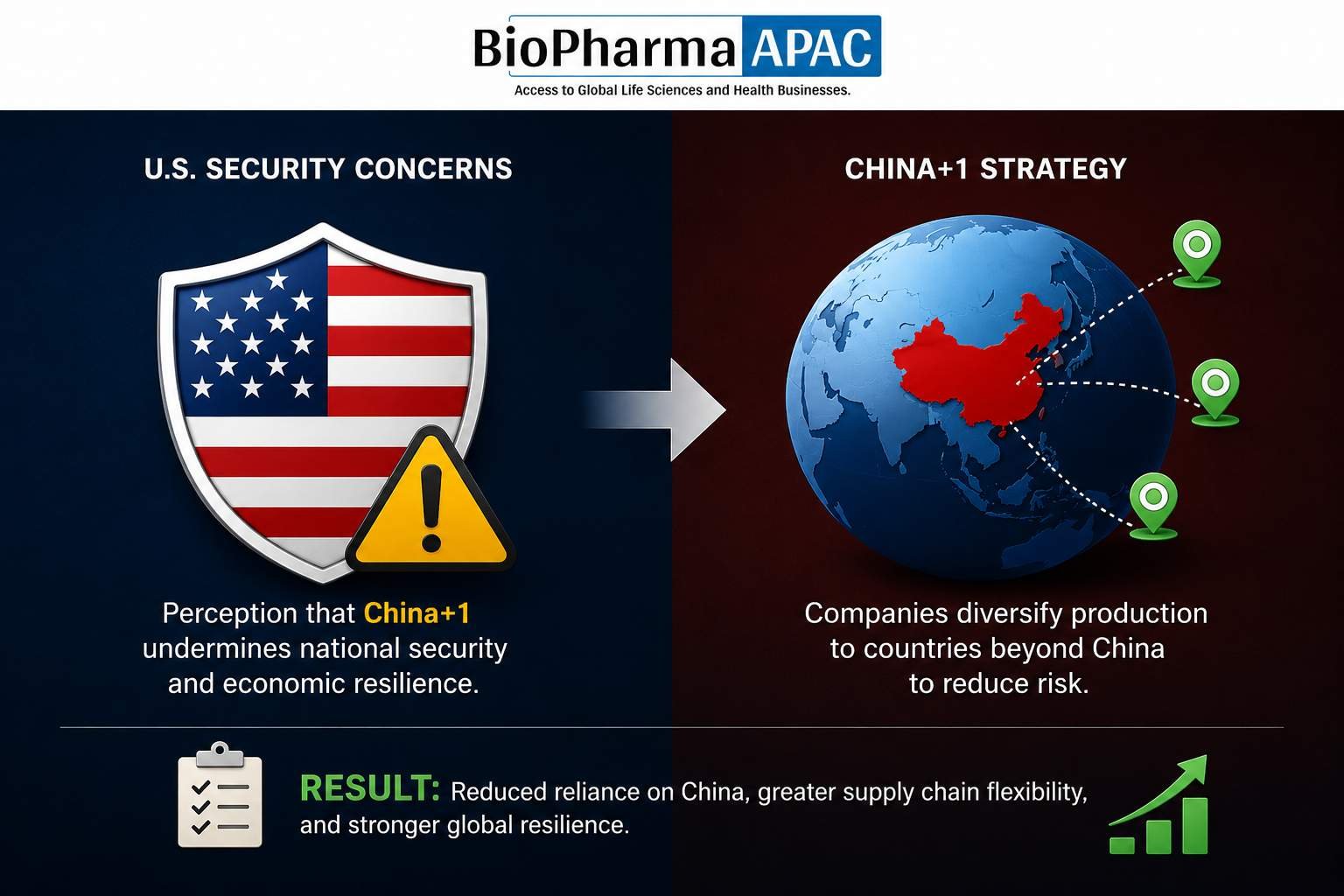
When President Trump signed the FY2026 National Defense Authorization Act on December 18, 2025, the biopharmaceutical industry finally got the law it had spent three years anticipating, debating, and quietly hedging against. Tucked into Section 851 of the must-pass defense bill was the long-circling BIOSECURE Act — the most consequential attempt yet to decouple America’s drug supply chain from China.
The intent is straightforward enough: stop federal dollars from flowing, directly or indirectly, to Chinese firms that Washington views as security threats. The consequence is anything but. The legislation lands on a global biopharma system so deeply woven into Chinese contract manufacturers and research outfits that unpicking it cleanly may be impossible on any timeline buyers would recognize as reasonable.
The reassuring story the industry tells itself is that the work will simply move — to India, Korea, Singapore, Japan. “China+1,” in the shorthand. The harder question, and the one this piece is built around, is whether that’s a strategy or a hope dressed up as one.
What BIOSECURE actually does — and doesn’t
Strip away the headlines and BIOSECURE is narrower than its reputation suggests. It does not ban American companies from doing business with Chinese biotech. It does something more surgical: it bars federal agencies, federal contractors, and recipients of federal grants and loans from procuring biotechnology equipment or services from a designated “biotechnology company of concern,” and from contracting with anyone who uses such equipment or services in performing federal work.
The leverage is money. A company that wants to keep its NIH grants, its BARDA contracts, or its federal loan eligibility cannot rely on a blacklisted supplier. For a sector that runs on federal research funding and government purchasing, that threat is enough to force compliance without an outright commercial prohibition.
The most important structural change from earlier drafts is that the final law names no companies. The original 2024 version explicitly listed five — WuXi AppTec, WuXi Biologics, BGI, MGI, and Complete Genomics. Senators including Rand Paul objected to legislation that singled out specific firms by name, and the enacted text instead routes designation through two mechanisms. The first is automatic: any entity already on the Defense Department’s Section 1260H list of “Chinese military companies operating in the United States” that is also involved in biotechnology becomes a company of concern. The second is a criteria-based process run by the Office of Management and Budget for adding firms tied to a foreign adversary that pose a national security risk.
This matters more than it first appears. Of the original five, BGI and its affiliate MGI already sit on the 1260H list — so they are effectively pre-designated. The WuXi companies, notably, are not on the current list, though reporting in late 2025 indicated the Defense Department intended to add WuXi AppTec, and a January 2026 update is the document the whole industry is now watching.
The deadline that anchors everything is December 2026: OMB must publish its initial list of companies of concern no later than one year after enactment, then review it at least annually. But — and this is the part that gets lost in alarmed coverage — publication of the list does not flip a switch. The prohibitions only bite after the Federal Acquisition Regulation is amended, which the FAR Council has up to a year to do, after which restrictions on 1260H-listed firms take effect 60 days later. Lawyers at Morrison Foerster have calculated that, at the outer bound, restrictions on 1260H companies could take effect as late as roughly 970 days — about two years and eight months — after enactment, with OMB-list entities following 30 days after that.
On top of that, the law carries a five-year grandfathering window for contracts signed before a company’s effective designation date, plus a safe harbor for equipment or services a firm no longer provides, and narrow carve-outs for medical countermeasures during a public health emergency and overseas care for U.S. government personnel.
The plain-English version: BIOSECURE is real, it is law, and it is slow. It is a firewall being built in public, brick by brick, with the foundations not yet poured. That gap between the alarm and the actual enforcement clock is precisely where the supply-chain drama is unfolding.
The exposure map: how deep the dependency runs
To understand why a law this gradual is causing this much disruption, follow the dependency.
Global biopharma did not drift into reliance on Chinese outsourcing by accident. China rebuilt its drug-approval system in 2015, decoupling approval from manufacturing and unleashing a feedback loop of innovation, R&D, and outsourced production. The result is a contract-research and contract-manufacturing ecosystem that is faster and dramatically cheaper than the West — Chinese drug-discovery costs run an estimated 30 to 40 percent below U.S. and European levels, with clinical-trial enrollment two to three times faster thanks to the country’s patient population.
The numbers on how far that reliance now extends are stark. The Coalition for a Prosperous America, citing intelligence assessments, estimates that nearly 80 percent of surveyed U.S. biotech firms are embedded in a supply chain with ties to Chinese entities, and that Chinese biotech now supplies roughly a third of the new compounds entering U.S. drug pipelines — up from virtually zero five years ago. U.S. drug companies have struck some $53 billion in licensing deals with Chinese biopharma since 2020.
The licensing data is where the dependency becomes undeniable. China’s share of global biotech out-licensing deal value rose from 8 percent in 2021 to 16 percent in 2022, to 21 percent across 2023–24, and to roughly 32 percent in the first quarter of 2025, according to Jefferies research. By full-year 2025, cross-border out-licensing from Greater China reached a record $137.7 billion, per data provider PharmCube — a nearly tenfold jump from 2021’s $13.9 billion. Q1 2026 alone reportedly saw close to $60 billion in signed outbound deals, approaching half of the prior full year’s total. The driver is brutal arithmetic for Western pharma: looming patent cliffs and the lure of Chinese assets priced 60 to 70 percent below Western equivalents on upfront payments.
This is the crucial distinction the exposure map reveals. There are two different Chinese dependencies, and BIOSECURE touches them unequally. One is licensing — buying the rights to Chinese-discovered molecules — which BIOSECURE does not restrict at all. The other is services and equipment — the CDMO manufacturing and CRO research work, plus the genomics platforms — which is exactly what the law targets. A Western company can keep in-licensing Chinese ADCs and bispecifics while being forced to move the physical manufacturing and lab work elsewhere. Those are not the same problem, and conflating them is the first analytical error in most coverage.
The relocation thesis versus the capacity reality
Here is where the comforting narrative meets the wall.
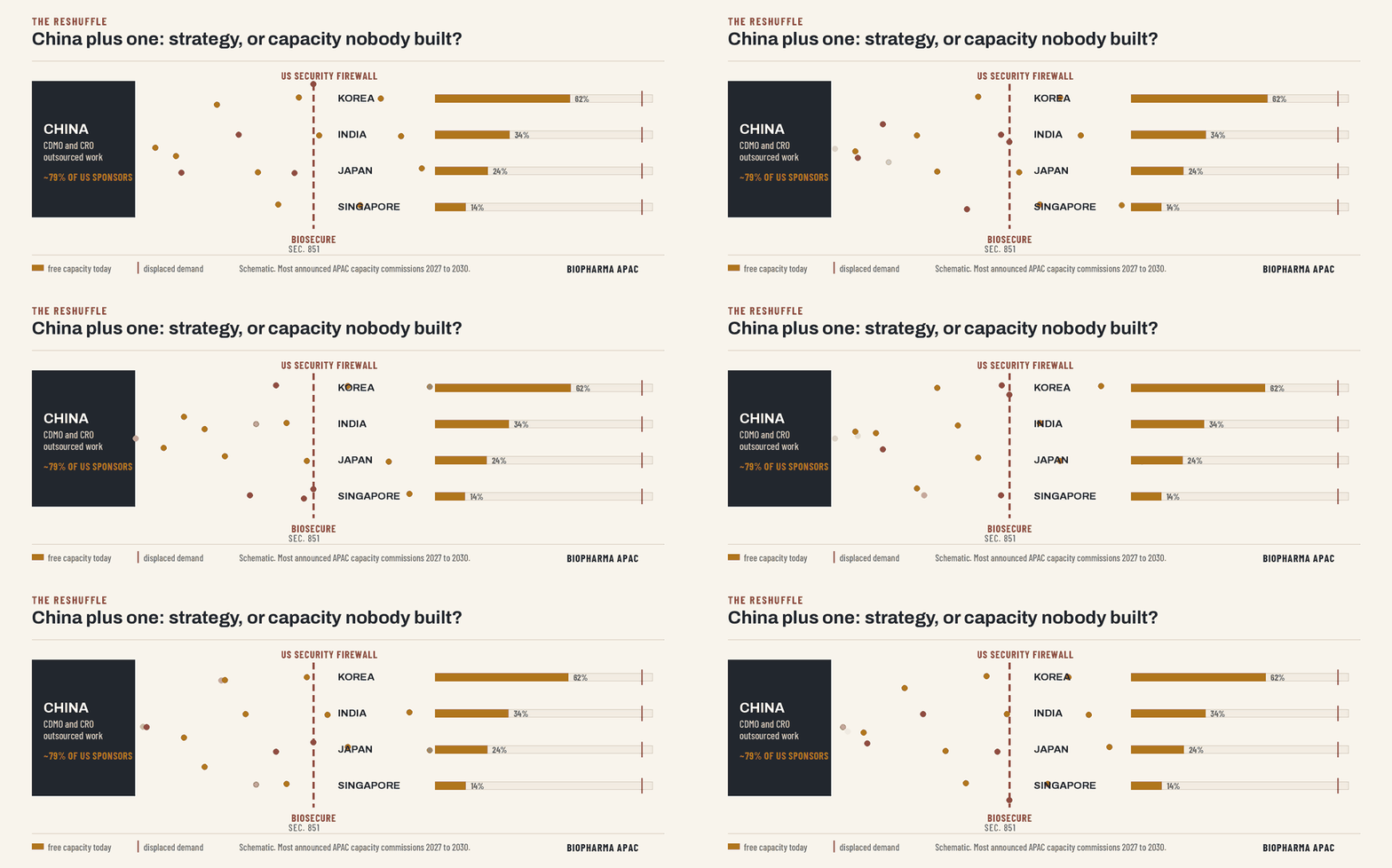
The “China+1” thesis holds that displaced volume will simply redistribute across Asia-Pacific and the West. There is genuine substance behind it — capacity is being built, and fast. But the thesis quietly assumes three things that don’t all hold: that there is enough capacity, that it is the right capacity, and that it can be qualified on the timeline buyers need. Examine each and the picture gets more sober.
Korea is the clearest winner — in biologics. Samsung Biologics has expanded to 620,000 liters of bioreactor capacity, the world’s largest single-site biologics operation, has signed more than $3 billion in new contracts since BIOSECURE’s passage, and is plowing $5.6 billion into a “Super Plant 2” adding another 784,000 liters. For large-molecule manufacturing, Korea can genuinely absorb meaningful displaced volume.
Japan is investing on the back of state support. Fujifilm Diosynth has committed over $4 billion to global expansion, and the Japanese government’s economic-security legislation is subsidizing domestic CDMO build-out. Japan offers high-trust, high-quality capacity, though at premium cost.
India is the most-hyped destination and the most misunderstood. Its CDMO market is projected to roughly double from $8.4 billion in 2024 to $15.4 billion by 2029, growing well above the global average precisely because of the China+1 redistribution. Syngene and Aragen have spent the past two years standing up biologics suites — Aragen’s Bangalore facility, a $30 million investment, completed its first monoclonal-antibody project for a U.S. client, and the company has earmarked some $250 million over five years. Inbound inquiries have surged; Aragen’s CEO has spoken of significant interest from U.S. firms reviewing their supply chains.
But India’s strength is overwhelmingly in small-molecule and generic-API work, not the novel biologics, cell and gene therapies, and ADCs where the highest-value Chinese work sits. Industry analysis puts the contrast bluntly: China has roughly 20 ADC manufacturers; India has about three. And India carries a dependency of its own — it relies heavily on China for the key starting materials that feed its API plants, so “moving to India” can mean moving one step down a chain whose first link is still in China. The country’s PLI subsidy scheme is trying to close that gap, but Chinese scale keeps domestic Indian key-starting-materials uncompetitive without permanent support.
The hardest constraints are time and qualification. Bringing a new manufacturing site online is not like switching cloud providers. A biologics facility takes years to build, validate, and win regulatory approval for a specific product; tech transfer of a complex molecule from one site to another can itself consume 18 to 36 months and risks yield loss along the way. The total global capacity that WuXi alone represents cannot be reconstituted elsewhere in the time BIOSECURE’s grandfathering window allows, let alone on the compressed timelines a company facing a patent cliff is working against.
So the honest answer to “can India, Korea, Singapore and Japan absorb displaced volume on the timeline buyers need?” is: partially, unevenly, and slower than the relocation thesis assumes. Korea can take biologics now. India can take small molecules now and biologics eventually. The cutting-edge modalities — the very work that makes China indispensable — are the hardest to move and the slowest to replace.
The two pressure points
WuXi AppTec is the company the entire system is organized around. It is the market leader in drug-services outsourcing, with an estimated two-thirds of its revenue historically coming from U.S. customers and a client base north of 6,000. The mere prospect of BIOSECURE has already reshaped its business: it has reported consecutive quarters of revenue decline, and by late 2025 was reportedly marketing some of its U.S. and European operations for sale — a partial, market-driven divestiture occurring before the law’s restrictions have even taken legal effect. Tellingly, WuXi AppTec’s order backlog jumped more than 40 percent year-over-year in Q3 2025, a signal that customers may be rushing to lock in contracts before the grandfathering door narrows. WuXi’s position captures the whole paradox: not yet on the 1260H list, possibly soon to be, and already being repriced by a market that isn’t waiting for certainty.
BGI Genomics is the cleaner case, and a different kind of threat. Where WuXi is an economic-security story, BGI is a data story. BGI Group, including BGI Genomics and MGI Tech, already sits on the 1260H list, making it effectively pre-designated. The congressional concern is explicit: that genomic data collected by Chinese-linked firms could, under China’s 2017 National Intelligence Law, be compelled into the hands of the Chinese state and used to develop competing biotech — or worse. The bill’s sponsors framed it as protecting Americans’ genetic information. For BGI, there is no realistic argument that it will be spared; the only question is the timing of when the prohibitions attach.
The Chinese counter-argument, voiced by the targeted firms and their defenders, is that the policy backfires on the people it claims to protect. By cutting U.S. patients off from the cheapest, fastest research and manufacturing ecosystem in the world, the argument runs, BIOSECURE raises drug-development costs, slows pipelines, and ultimately delays therapies — punishing American patients to make a geopolitical point. Pfizer’s own CEO acknowledged in early 2026 that China is no longer merely catching up in biotech but has become a genuine competitor, with 8 of the top 10 global research institutions on the 2025 Nature Index now Chinese. The firms argue Washington is choosing to slow China rather than outpace it, and that patients will pay the difference.
The mid-cap caught in the middle
The companies with the least room to maneuver are not the Chinese giants or the Asian challengers — they are the Western mid-caps. Picture a mid-sized biopharma with a clinical-stage asset, a manufacturing contract with a soon-to-be-designated Chinese CDMO, and federal grant exposure it cannot afford to lose. For that company, BIOSECURE is not an abstraction; it is a re-papering exercise.
It must audit every supplier relationship against a list that won’t be final until December 2026, decide whether to invoke the five-year grandfathering window or move proactively, and absorb the cost and delay of tech transfer to a new site that may not have proven capacity in its modality. Small-cap U.S. biopharma will, rightly, complain that it is being locked out of the cheapest research ecosystem on earth while its better-capitalized competitors absorb the switching costs more comfortably. The compliance burden is regressive: it falls hardest on the firms least able to carry it.
Compliance lawyers advising on the list counsel a posture of watchful preparation rather than panic — map exposure now, model the grandfathering math, but don’t trigger expensive, irreversible moves before OMB’s list and the FAR revisions clarify who is actually covered and when. The attenuated timeline is, for once, a gift: it buys the planning runway that the headlines obscure.
The clear-eyed read
So: strategy or wishful thinking?
Both, depending on what you’re moving. For biologics, China+1 is a real strategy with real capacity coming online in Korea and, increasingly, India. For small-molecule API, India and others can absorb volume, though often while remaining tethered to Chinese starting materials. For the frontier modalities — ADCs, cell and gene therapy, the high-value work that made China indispensable — China+1 is closer to wishful thinking on the timelines buyers actually face. You cannot rebuild twenty ADC manufacturers’ worth of capacity, validated and regulator-approved, in the window BIOSECURE’s grandfathering clause allows.
The second-order effects follow directly. Expect costs to rise as the cheapest node in the system is removed and replaced by pricier capacity in Korea, Japan, and the West. Expect timelines to lengthen as tech transfers and new-site qualifications work through the pipeline. And expect the most exposed therapeutic areas to be precisely the ones where China led — oncology ADCs and bispecifics above all, where Chinese assets dominate recent licensing.
BIOSECURE’s intent was to protect federal data and federal dollars. Its unintended consequence is a multi-year, uneven, and costly reshuffling of a supply chain that took a decade to build around China and cannot be rebuilt around anyone else in less time. The wall is going up. The work will move. But it will move slower, cost more, and leave gaps where China was simply better — and that, not the reassuring “China+1” slogan, is the reality the industry is now pricing in.
2023–2024 — BIOSECURE Act introduced and debated; early versions name WuXi AppTec, WuXi Biologics, BGI, MGI, and Complete Genomics directly. Passes the House in 2024 but fails to clear the Senate or pass standalone.
January 7, 2025 — DoD updates its Section 1260H list of “Chinese military companies.” BGI Group (including BGI Genomics, Forensic Genomics International, and MGI Tech) is on it; the WuXi companies are not.
October 2025 — Senate adopts a revised BIOSECURE amendment to the FY2026 NDAA. Crucially, it names no companies, tying designation instead to the 1260H list plus an OMB-led process. Deputy Defense Secretary reportedly urges adding WuXi AppTec to the 1260H list.
December 7, 2025 — Final reconciled FY2026 NDAA text released, retaining BIOSECURE as Section 851 with industry-favorable adjustments (five-year grandfathering, safe harbor, narrow exceptions).
December 17–18, 2025 — Senate passes the NDAA; President Trump signs it into law on December 18. BIOSECURE is enacted.
Anticipated January 2026 — Watch for the annual 1260H list update. Whether WuXi AppTec is added is the single most-watched designation question in the sector.
By December 2026 — OMB must publish its initial list of “biotechnology companies of concern” and review it at least annually.
~1 year after OMB list / guidance — FAR Council revises the Federal Acquisition Regulation to incorporate the prohibition.
60 days after FAR revision — Prohibitions take effect for 1260H-listed companies; OMB-list entities follow 30 days later. At the outer bound, full effect for 1260H firms could arrive roughly 970 days (about two years and eight months) after enactment.
Through ~2032 — Five-year grandfathering window protects qualifying contracts signed before a company’s effective designation date.
(arcilla.fran@biopharmaapac.com)
Most Read
- Can APAC Biomanufacturing Decarbonise Without Pricing Itself Out?
- The Algorithm on the GMP Floor: AI Promises a Smarter Plant. Regulators Demand the Audit Trail.
- APAC's Peptide-Capacity Gamble
- After the Rush: APAC's mRNA and Vaccine Capacity Hangover
- The Biosimilar Race: Factory to the World — or Stuck in the Copycat Economy?
- The Vein-to-Vein Problem: Can APAC's Cold Chain Carry Advanced Therapies?
- Vectors, Plasmids and the CGT Trap: APAC's Cell and Gene Therapy Ambitions Face an Upstream Bottleneck
- Can APAC Build Radioligand Therapy Before the Atoms Decay?
- The Great Biopharma Reset: 50 Developments That Changed Everything in H1 2026
- Beyond the Trial: Can Real-World Evidence Earn Regulatory Trust in APAC?
- Beyond the Obvious Giant: Where APAC's Clinical Trials Go Next
- The Frontier That Won’t Quite Arrive
Bio Jobs
- Sanofi Turns The Page As Belén Garijo Steps In And Paul Hudson Steps Out
- Global Survey Reveals Nearly 40% of Employees Facing Fertility Challenges Consider Leaving Their Jobs
- BioMed X and AbbVie Begin Global Search for Bold Neuroscience Talent To Decode the Biology of Anhedonia
- Thermo Fisher Expands Bengaluru R&D Centre to Advance Antibody Innovation and Strengthen India’s Life Sciences Ecosystem
- Accord Plasma (Intas Group) Acquires Prothya Biosolutions to Expand Global Plasma Capabilities
- ACG Announces $200 Million Investment to Establish First U.S. Capsule Manufacturing Facility in Atlanta
- AstraZeneca Invests $4.5 Billion to Build Advanced Manufacturing Facility in Virginia, Expanding U.S. Medicine Production
News