The Algorithm on the GMP Floor: AI Promises a Smarter Plant. Regulators Demand the Audit Trail.
13 July 2026 | Monday | Analysis
A control room that thinks it knows what happens next
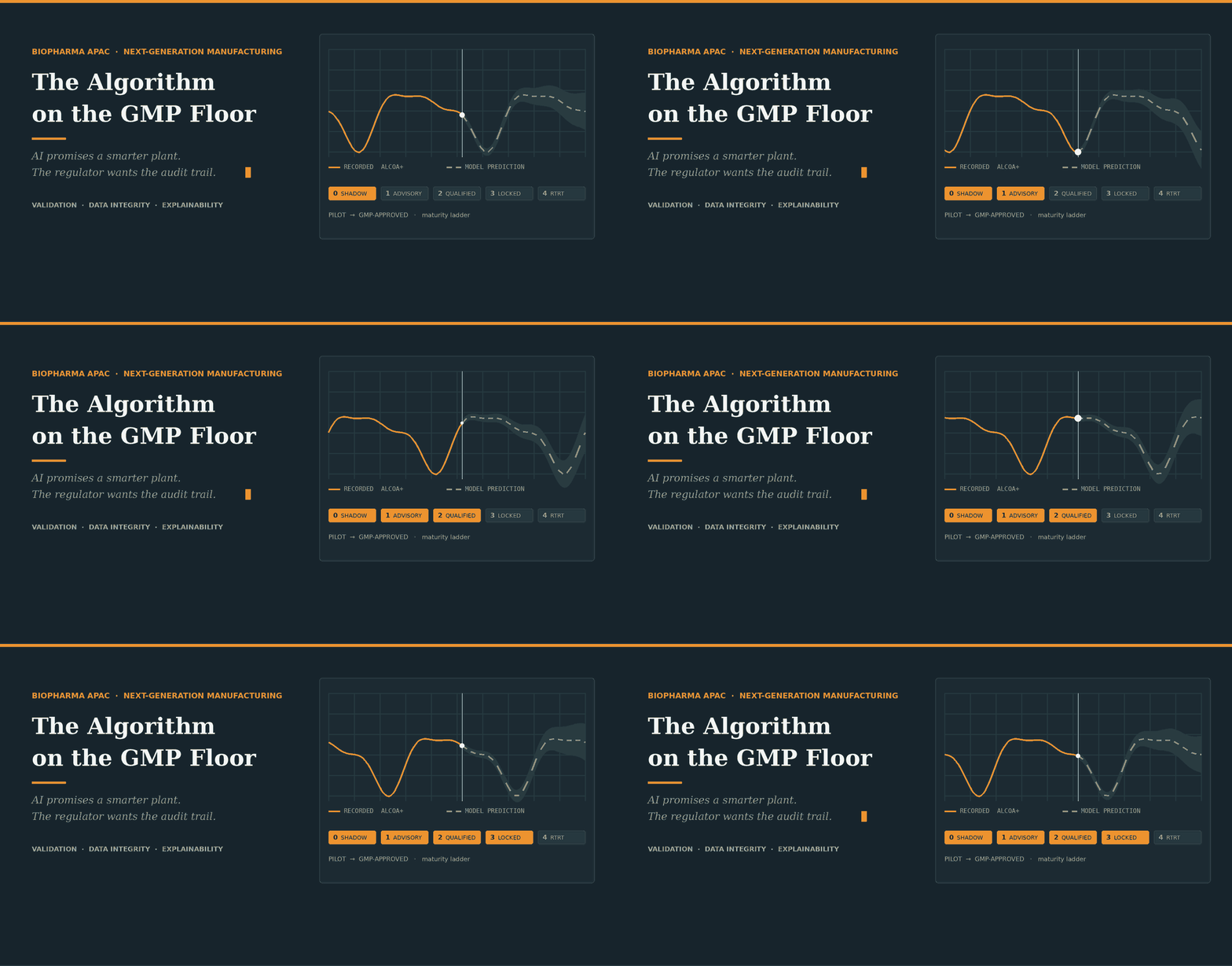
Walk the mezzanine above a modern biologics suite in Singapore, Songdo or Hyderabad and the change is not the stainless steel below — it is the screen in front of you. A live model of the bioreactor runs alongside the reactor itself, predicting the glucose feed the batch will need in three hours, flagging a pump whose vibration signature has drifted a fraction outside its normal envelope, and quietly estimating final titre before the run is half done. This is the promise of the smart plant: fewer surprises, fewer deviations, faster release, more product from the same footprint.
Then a quality auditor asks the question that decides everything: show me the audit trail. How was this model validated? What changed since? And if it learns, how do you know today's answer is the one you qualified? That single exchange is the fault line running through Asia-Pacific biomanufacturing in 2026. The engineering is largely solved. The regulatory grammar for trusting it is not — and until it is, most of this intelligence stays one step back from the decisions that matter.
The promise: where AI genuinely earns its place
The value case is not hype, and it is not uniform. AI and digital twins add the most where processes are variable, data-rich and expensive to get wrong — which describes biologics, vaccines and cell and gene therapy almost perfectly. Four use-cases now have real evidence behind them.
Predictive maintenance. Models trained on vibration, temperature, motor current and historical failure data forecast equipment problems before they halt a batch. Analysts size the pharma predictive-maintenance opportunity at roughly US$10 billion by 2030, driven almost entirely by avoided unplanned downtime. On a single-use bioreactor skid, one prevented mid-run failure can pay for the analytics for a year.
Digital twins for process optimisation. A validated virtual replica of a production line lets a team test a parameter change in silico before touching the floor. Singapore has become an unusually concrete example: in August 2025 the Cambridge CARES centre and A*STAR's Institute for Infocomm Research unveiled a platform that automates digital-twin construction from real-time plant data for fault detection and predictive maintenance, now being commercialised for the Pharma Innovation Programme Singapore consortium. The regional context matters — McKinsey projects APAC will hold close to 40% of global biomanufacturing capacity by 2030, and China, South Korea, Japan and Singapore are all pushing digital-twin adoption to defend that position.
AI-driven quality control and investigations. Machine-vision systems inspect 100% of vials or syringes where a legacy line sampled a fraction of a percent. On the paperwork side, AI-assisted analytics have been shown to cut deviation-investigation time by 50–70%, and digital quality workflows can compress batch-record review by 70–90% while reducing deviation rates substantially. The prize here is not glamour; it is the single largest cost centre in a GMP plant — quality overhead. McKinsey's benchmarking finds top-quartile manufacturers run roughly one-sixth the deviations per thousand batches of the average, at a fraction of the quality cost.
Real-time release testing (RTRT). The frontier prize: use process-analytical data and models to release product on the basis of what the process demonstrably did, rather than waiting days for end-product lab testing. RTRT is not new in principle — it is embedded in ICH Q8–Q10 thinking — but AI makes the underlying prediction sharper and, in doing so, raises the validation stakes.
|
The productivity case, in one line Where AI touches maintenance, monitoring and investigations, the evidence is strong and the validation burden is manageable. Where it touches release, the value is highest and the regulatory grammar is least settled. That gradient explains almost everything about adoption in the region. |
The validation problem: three words that stop a project
A GMP environment is not hostile to software; it validates software constantly. The friction is specific to how modern AI behaves, and it reduces to three words auditors use as tripwires: data integrity, model drift and explainability.
Data integrity
Every GMP record must be attributable, legible, contemporaneous, original and accurate — the ALCOA+ principles that PIC/S codified for inspectors in guidance PI 041-1, in force across its member authorities since July 2021. An AI system multiplies the surface area of that obligation. What were the training data, and were they themselves generated under integrity controls? Who can change a model version, and is that change logged with the same rigour as a change to a batch record? Can you reproduce, months later, exactly the model state that made a given call? A digital twin that ingests thousands of live signals is, from an inspector's chair, thousands of new opportunities for an unattributable or altered record — and inspectorates already treat data-integrity findings as among the most serious deficiencies they issue.
Model drift
Traditional computerised-system validation rests on a comforting assumption: qualify the system once, control changes tightly, and it behaves tomorrow as it did today. A machine-learning model that continues to learn breaks that assumption by design. If the model updates itself as new batches arrive, then the thing you validated in March is not the thing running in September. This is the central collision. The productivity case for AI is strongest precisely when the model keeps improving; the validation framework is strongest precisely when it does not. The pragmatic resolution the industry has converged on is the locked model: freeze the model, validate the frozen version, and treat any retraining as a formal change-control event with revalidation. It works — at the cost of surrendering the self-optimising dream that made the technology exciting in the first place.
Explainability
When a batch-release decision is challenged, the manufacturer must explain the basis for it. A deterministic rule explains itself. A deep model that outputs a number with no legible reasoning does not — and "the algorithm decided" is not a defensible entry in a deviation investigation. This is why explainable-by-design approaches, confidence bounds and human-in-the-loop checkpoints are not optional niceties in GMP; they are the difference between a tool an inspector will accept and one they will not. The regulator is not asking the model to be simple. It is asking to be able to reconstruct why.
The regulatory state: a framework being written in real time
There is no single "AI GMP" rulebook anywhere in the world in 2026. What exists is a fast-thickening layer of guidance built on top of established quality principles — and the direction of travel is now clear enough to plan against.
At the harmonisation level, the ICH Assembly endorsed a reflection paper on advanced manufacturing in October 2025 that explicitly engages continuous process verification and model-based approaches, signalling where the Q-series is heading. The existing ICH toolkit already carries much of the load: Q8–Q10 for design space and quality systems, Q9(R1) for risk management, and Q14/Q2(R2) for analytical procedures. The near-term regulatory logic for AI is less "new law" than "apply the risk-based frameworks you already have, rigorously."
On data integrity, PIC/S PI 041-1 remains the operative text for inspectors — and, crucially for Asia-Pacific, it is the shared reference point. Singapore's HSA, Australia's TGA, and a growing roster of regional authorities are PIC/S members who adopt the PE 009 GMP guide and inspect against the same ALCOA+ expectations. That common baseline is why a data-integrity approach that satisfies one PIC/S inspectorate travels reasonably well across the others.
The most concrete AI-specific movement has come from the US FDA, whose January 2025 draft guidance on using AI to support regulatory decision-making introduced a risk-based credibility-assessment framework — scale the evidence you owe to the risk the model's output carries — alongside its longer-running FRAME initiative on advanced manufacturing. Europe is moving in parallel through EMA reflection work and revisions touching Annex 11. And the industry's own engineering consensus now has a spine: ISPE's GAMP 5 Second Edition and its dedicated GAMP Guide on Artificial Intelligence give validation teams a practical, regulator-aligned method for qualifying AI-enabled systems. None of these is a mandate. Together they describe, unmistakably, the shape of the audit trail regulators will expect.
|
The through-line Regulators are not waiting for a grand AI statute. They are extending data integrity, risk management and computerised-system validation onto AI — and rewarding manufacturers who bring that evidence unprompted. |
Four chairs around the table
The debate inside a manufacturing organisation is not abstract. It plays out between four roles whose incentives only partly align. The positions below are drawn from the recurring, documented arguments each function makes across the public record — representative viewpoints rather than any single individual's remarks.
The digital manufacturing lead sees stranded value. Models sit in "shadow mode," demonstrably outperforming the status quo, yet forbidden from touching a decision. The frustration is real: every quarter a validated advisory system runs without acting is a quarter of avoided downtime and yield left on the table.
The MSAT and quality head carries the liability. They are the ones who sign, and who face the inspector. Their instinct — freeze the model, validate the frozen version, control every change — is not obstruction; it is the only posture that survives an audit today. They will move, but only when the evidence package is bulletproof.
The regulator or inspector is more open than the industry often assumes, and consistently says so: the door is open to science- and risk-based approaches, provided data integrity and control are demonstrable. What inspectors will not accept is opacity dressed up as innovation. Bring them a legible audit trail and they engage; bring them "trust the algorithm" and they will not.
The AI-validation specialist translates between the other three. Their message is consistent: the technology is ready, the frozen-model pattern is workable, and the real bottleneck is neither code nor guidance but the change-management capacity of the quality organisation asked to absorb an unfamiliar class of system.
The adoption reality: a wall between pilot and production
Ask how many APAC plants are "doing AI" and the honest answer is: most of the large ones, in pilot. Ask how many have an AI system making or gating a GMP batch decision at commercial scale and the number collapses. Broad industry surveys put roughly half of manufacturers using some form of factory AI, and enterprise AI adoption has climbed steeply across every developed economy — but in regulated pharma manufacturing the distribution is bimodal. There is a great deal of Stage-1 advisory activity and very little Stage-3 closed-loop control on a licensed product.
The wall between the two is not technical. It is organisational. A quality function is engineered — correctly — to resist unvalidated change, and an AI system is unfamiliar, harder to explain to an auditor, and owned by data-science teams who do not speak fluent GMP. Crossing from pilot to production therefore demands three things that have nothing to do with model accuracy: a validation approach the quality head will defend, a change-control process that treats retraining as a formal event, and the internal credibility to move a model from advising humans to acting alongside them. The manufacturers pulling ahead in Asia-Pacific are not the ones with the cleverest models. They are the ones whose quality organisations learned to validate this class of system first.
A maturity framework: pilot versus GMP-approved
It helps to stop asking "has this plant adopted AI?" and start asking "at what stage, on what decision?" The ladder below maps the journey from an offline model with no regulatory standing to the adaptive, self-optimising systems that remain aspirational. Adoption headlines almost always describe Stages 0–1. The regulated prize — and the validation difficulty — lives at Stages 3–4.
|
Stage |
What it is |
GMP / data-integrity status |
Where APAC sits |
|
0 — Shadow |
Model runs offline against historical data; no influence on batch decisions. |
Outside GMP scope. No validation burden; also no regulatory credit. |
Common. Most plants start here. |
|
1 — Advisory pilot |
AI flags anomalies or predicts failures; humans decide and act. |
Decision-support tool. Qualified as software; outputs are non-binding. |
The dominant live tier in APAC. |
|
2 — Qualified, human-in-loop |
AI output is a controlled input to a GMP decision, with human sign-off. |
Validated computerised system under GAMP 5 / Annex 11 logic; locked model, full audit trail. |
Early production cases (predictive maintenance, MES support). |
|
3 — Locked closed-loop |
Model adjusts a process parameter automatically within a validated design space. |
Validated control strategy; change control governs any model update. |
Pilots and first submissions; rare at scale. |
|
4 — Real-time release / adaptive |
AI supports batch release, or a model that keeps learning in production. |
Frontier. Continued-learning models sit outside settled validation practice. |
Aspirational; no clear APAC precedent at commercial scale. |
Reading the ladder: the value of AI rises as you climb; so does the validation burden, non-linearly. Most APAC plants live at Stages 0–2. The commercial breakthrough is durable, inspector-ready Stage-2 and Stage-3 operation on a licensed product.
Which APAC regulator accepts it first?
No Asia-Pacific authority has published a definitive "AI on the GMP floor" approval framework. But the leaders are visible in their behaviour rather than their paperwork, and three names recur.
Singapore is the front-runner on posture. HSA is a PIC/S member with a sophisticated inspectorate, and — unusually — the state itself is co-funding the enabling technology through A*STAR's Pharma Innovation Programme and the CARES digital-twin work. A regulator whose national innovation agency is building the twin is a regulator primed to assess one. Singapore also has the regulatory reliance agreements — including deepened cooperation with China's NMPA that has extended into AI-based products — to let a precedent set there ripple outward.
Japan brings the deepest continuous-manufacturing and PAT heritage through PMDA, and a culture of methodical, evidence-led acceptance. It is less likely to be first with a splashy framework and more likely to be first with a quietly robust real-world approval that others cite.
China moves on a different axis — scale and state direction. NMPA is actively engaging AI-based products in its bilateral regulatory dialogues, and China's smart-manufacturing policy push means domestic plants may reach closed-loop operation at volume before Western peers, even if the guidance trails the practice.
The likely pattern, then, is not a single winner but a division of labour: Singapore first to signal openness and host the reference deployment; Japan first to grant a rigorously evidenced approval; China first to run it at scale. India's CDSCO and Australia's TGA, both anchored to PIC/S expectations, follow the precedents rather than set them. The manufacturer's practical move is to build the audit trail once, to the strictest common denominator — ALCOA+, locked models, credibility-scaled evidence — so the same package can be walked into whichever inspectorate opens the door first.
The takeaway: onto the floor, or stuck in the airlock
The question this series set out to answer is whether AI reaches the regulated production floor at scale or stalls indefinitely in validation limbo. The honest answer for 2026 is: it reaches the floor, but slowly, and one stage at a time. Predictive maintenance, machine-vision QC and AI-assisted investigations are crossing into production now because their validation story is tractable and their outputs are advisory or contained. Closed-loop control and AI-supported real-time release will cross later, plant by plant, as quality organisations build the change-control muscle to govern models that must not silently change.
The self-optimising bioprocess — the model that keeps learning in production — is not stalled so much as waiting for a validation grammar that does not yet exist. It will come, but it will arrive after the locked-model era has proved the audit trail can hold. The winners in Asia-Pacific will not be decided by who has the best algorithm. They will be decided by who can hand an inspector a complete, legible account of how a learning system was made trustworthy — and do it before their competitors, in the jurisdiction that opens the door first. The algorithm is already on the GMP floor. Whether it gets to decide anything depends entirely on the audit trail behind it.
(arcilla.fran@biopharmaapac.com)
Key public sources
ICH Reflection Paper on Advanced Manufacturing (endorsed October 2025); ICH Q8(R2)–Q10, Q9(R1), Q2(R2)/Q14; PIC/S PI 041-1 Good Practices for Data Management and Integrity (in force 2021); US FDA draft guidance on AI to support regulatory decision-making (January 2025) and the CDER FRAME initiative; EMA reflection work and Annex 11 revision; ISPE GAMP 5 (Second Edition) and GAMP Guide: Artificial Intelligence; HSA (PIC/S member) GMP guidance and A*STAR Pharma Innovation Programme Singapore / Cambridge CARES digital-twin platform; industry benchmarking from McKinsey, ISPE and market analysts on adoption and efficiency. Figures are drawn from these public sources and cited industry surveys.
|
Disclaimer This article is an independent editorial analysis produced by BioPharma APAC for information purposes only. It summarises publicly available regulatory guidance, industry research and technical developments as at the date of publication, and does not constitute regulatory, legal, compliance or investment advice. Regulatory frameworks for AI in GMP manufacturing are evolving; readers should verify current requirements with the relevant authority and qualified advisers before acting. Representative role-based viewpoints are syntheses of positions in the public record and are not attributed to, or quotations from, any named individual. Company, agency and product references are for illustration and imply no endorsement. |
Most Read
- Can APAC Biomanufacturing Decarbonise Without Pricing Itself Out?
- The Algorithm on the GMP Floor: AI Promises a Smarter Plant. Regulators Demand the Audit Trail.
- APAC's Peptide-Capacity Gamble
- After the Rush: APAC's mRNA and Vaccine Capacity Hangover
- The Biosimilar Race: Factory to the World — or Stuck in the Copycat Economy?
- The Vein-to-Vein Problem: Can APAC's Cold Chain Carry Advanced Therapies?
- Vectors, Plasmids and the CGT Trap: APAC's Cell and Gene Therapy Ambitions Face an Upstream Bottleneck
- Can APAC Build Radioligand Therapy Before the Atoms Decay?
- The Great Biopharma Reset: 50 Developments That Changed Everything in H1 2026
- Beyond the Trial: Can Real-World Evidence Earn Regulatory Trust in APAC?
- Beyond the Obvious Giant: Where APAC's Clinical Trials Go Next
- The Frontier That Won’t Quite Arrive
Bio Jobs
- Sanofi Turns The Page As Belén Garijo Steps In And Paul Hudson Steps Out
- Global Survey Reveals Nearly 40% of Employees Facing Fertility Challenges Consider Leaving Their Jobs
- BioMed X and AbbVie Begin Global Search for Bold Neuroscience Talent To Decode the Biology of Anhedonia
- Thermo Fisher Expands Bengaluru R&D Centre to Advance Antibody Innovation and Strengthen India’s Life Sciences Ecosystem
- Accord Plasma (Intas Group) Acquires Prothya Biosolutions to Expand Global Plasma Capabilities
- ACG Announces $200 Million Investment to Establish First U.S. Capsule Manufacturing Facility in Atlanta
- AstraZeneca Invests $4.5 Billion to Build Advanced Manufacturing Facility in Virginia, Expanding U.S. Medicine Production
News