APAC Biotech IPOs of 2026: Who Listed, What It Raised, Where It Trades Now
28 September 2026 | Monday | Analysis
How this list was built
|
Scope. Every biotech initial public offering with a first trading day between 1 January and 24 September 2026 on five venues: the Hong Kong Stock Exchange (Main Board Chapter 18A, plus the one biotech that used Chapter 18C), the Shanghai STAR Market, KOSDAQ, TSE Growth and the ASX. Where a venue has a biotech gateway (18A, STAR Standard 5, KOSDAQ's technology special listing track) we take its listings. Where it has none, we take the local trade press's biotech tally. Medtech companies that entered through a biotech gateway are included and flagged. General healthcare listings (hospitals, clinics, device makers listed under ordinary rules) are excluded and named in the notes. Raise. Gross proceeds at the offer price, base deal, excluding over-allotment, from allotment announcements, listing notices and prospectuses. Converted at fixed rates: HKD 7.8, CNY 7.1, KRW 1,380, JPY 147 and AUD 1.52 to the US dollar. Use of proceeds. As stated in the prospectus, in the company's own allocation. Where our sources did not carry the percentage split, the entry says so. Performance. One number per listing: the closing price at the cut date against the offer price. The franchise convention is the last trading day of November. This edition is set at a provisional cut of 24 September 2026 (23 September for KOSDAQ, closed for Chuseok) and is re-priced to 30 November 2026 in publication week. The change is logged in a dated revision note, never rolled forward silently. What performance is not. A share price below offer is a statement about the offer price and the market on that date. No entry reads an aftermarket loss as a verdict on a company's science. |
The class in five numbers
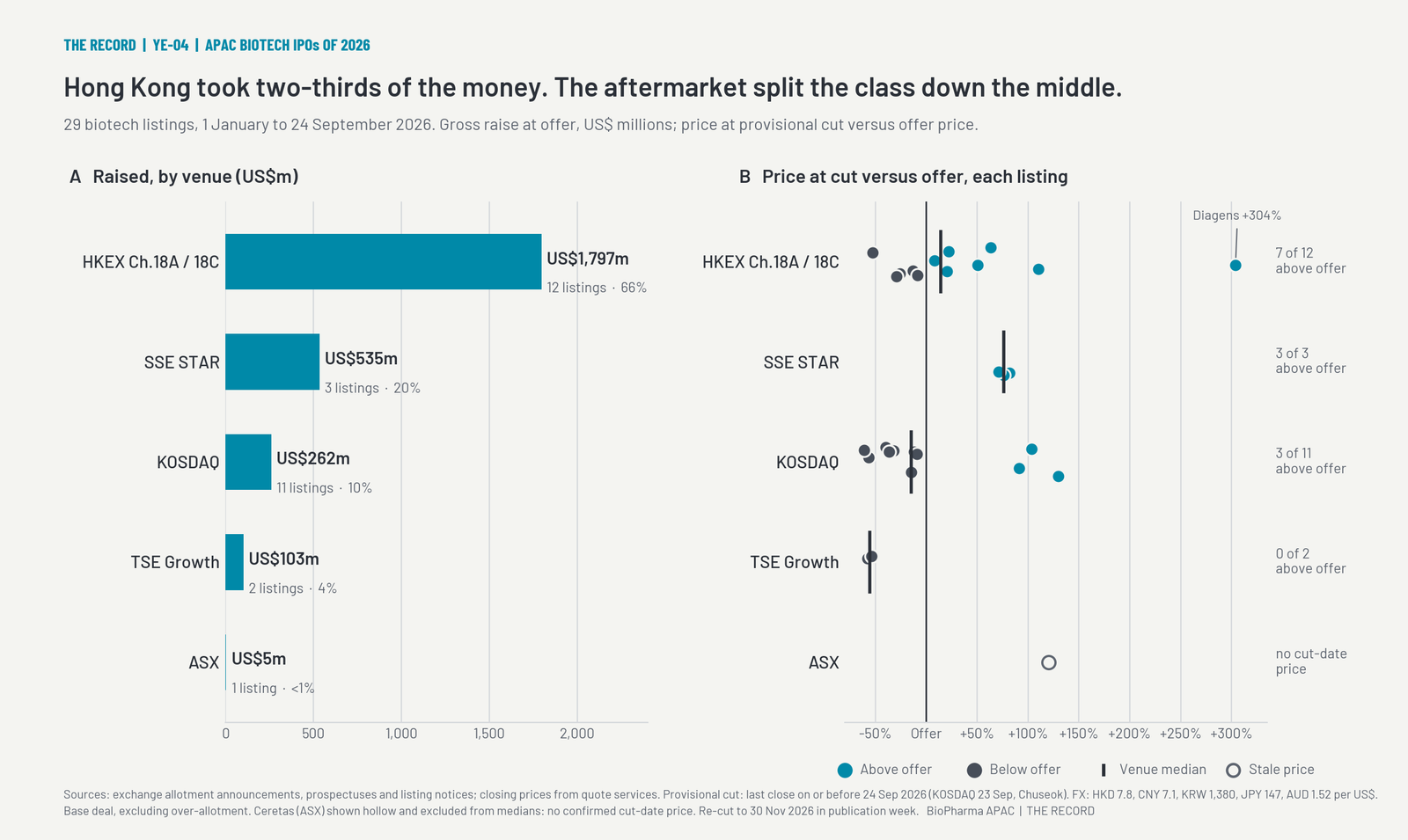
The class of 2026 is 29 listings and US$2.70 billion of gross proceeds at the provisional cut. Hong Kong supplied 12 of the listings and US$1.80 billion, or 66 per cent of the money. Twenty-one of the 29 listed in the first half, carrying US$2.17 billion. Of the 28 listings with a confirmed cut-date price, 13 trade above their offer and 15 below, and the median listing sits 8.7 per cent under water. Drug developers split exactly in half, eight up and eight down. Medtech did better, five of nine up, including the two largest gains of the year, Diagens and True Health.
Those numbers describe a class. The venue split describes a market, and it is the part of this record that compounds year on year.
The venue competition
Hong Kong set the price and then stopped. Chapter 18A produced 11 listings in the first half, and all 11 came between 8 January and 30 June. The 11 raised HK$11.9 billion by one count and HK$12.5 billion by another, the spread coming from over-allotment treatment. Add METiS TechBio, which used Chapter 18C, and Hong Kong's biotech class is 12 companies averaging US$150 million each: six times the Korean average and three times the Japanese. By Frost & Sullivan's count the chapter reached 94 cumulative listings at 30 June. Then nothing. Our sources show no 18A listing between 1 July and the cut, even as Hong Kong's overall IPO calendar stayed crowded with A+H issuers and technology names.
The pause is not a closed door. By early September, 110 biopharma companies had filed for Hong Kong listings this year, 46 of them under 18A. The backlog is a pricing question, and the aftermarket is the answer the backlog is waiting on. Hong Kong's day-one median was a gain of 103 per cent. The cut-date median is a gain of 14 per cent. Most of the first-day pop has been handed back, and HJ Science became the only Hong Kong biotech in this record to break issue on its first day, closing 56.9 per cent below offer. Why the chapter recovered at all was argued in our Fault Lines analysis of China's licensing-out market, which read 18A's revival as the funding channel that lets Chinese developers negotiate rather than sell at a discount. That argument stands; this record simply counts what came through the channel.
Shanghai reopened, on rations. STAR's Standard 5, the route for pre-revenue innovators, carried three biomedicine listings: Insight Lifetech in February, Trinomab in July and Evopoint in September. All three trade above offer, by 71 to 82 per cent. All three also raised less than they planned. Together they sought CNY 5.97 billion and took CNY 3.80 billion, 64 per cent of the plan. That is the shape of a policy-managed channel: the regulator admits a small number of issuers, sizes their raises down, and the aftermarket rewards scarcity. Sixteen biomedicine companies filed for STAR in the first half seeking more than CNY 27 billion, so the queue is long, but the release valve is the regulator, not demand.
Mabwell is the case that joins the two Chinese venues. Already listed on STAR, it raised HK$1.3 billion through an 18A H-share offering in April. For an A-share biotech with a clinical pipeline to fund, Hong Kong is now a second window rather than an alternative.
Seoul listed the most companies and the smallest tickets. Eleven KOSDAQ listings raised KRW 361 billion, about US$262 million, an average of US$24 million. Nine of the 11 closed their first day above offer. At the cut only three remain there. The detail that matters sits in the pricing. All six first-half deals priced at the top of their bands, and four of those six trade below offer. In the second half, Ingenia Therapeutics priced at the bottom of its band and Sky Labs below its band, each raising about KRW 12 billion less than planned. They are now the two best performers on the venue, up 103 and 130 per cent. The Korean class of 2026 is a controlled experiment in the cost of a full price.
Tokyo produced two listings and a withdrawal. Innovacell in February ended what FierceBiotech described as a Tokyo biotech IPO drought dating to 2024. J-Pharma followed in March. Both opened below offer and both trade more than 50 per cent below it. ReqMed, due to list on 2 April, had its approval cancelled at its own request in March. Behind the numbers is the TSE Growth reform: from March 2030 a company five years past listing needs a market capitalisation of at least ¥10 billion. J-Pharma listed at about ¥15.7 billion and now sits near ¥7.4 billion. Underwriters are already turning away smaller Growth IPOs, and a Japanese drug developer weighing a listing now prices in a threshold, not only a valuation.
Sydney is between classes. The ASX biotech and medtech window of this record's period is a single A$8 million float, Ceretas, in July. The ASX's larger medtech floats, Saluda Medical and Epiminder, listed in December 2025, just before this window opened, and Identifai Genetics is scheduled for 13 October. The Australian class of 2026 will be decided in the fourth quarter.
The listings
Entries run by venue, then by listing date. Each answers the query in its first line.
HONG KONG: HKEX MAIN BOARD, CHAPTERS 18A AND 18C
1 Shenzhen Edge Medical
HKEX Chapter 18A | 2675.HK | Listed 8 January 2026 | Raised HK$1,198.6m (US$153.7m)
Use of proceeds: Core product R&D 42%, commercialisation 20%, capacity 10%, M&A and partnerships 10%, other pipeline 8%, working capital 10%.
At the cut: HK$37.54 at cut against HK$43.24 offer: down 13.2% (day one up 30.9%).
The signal. The year's first 18A listing was a surgical-robot company, not a drug developer, and it set a pattern Hong Kong repeated: medtech opened the window. Its allocation leans on commercialisation and capacity alongside R&D, the budget of a company already selling.
2 Suzhou Ribo Life Science
HKEX Chapter 18A | 6938.HK | Listed 9 January 2026 | Raised HK$1,832.4m (US$234.9m)
Use of proceeds: RBD4059 37.4%, RBD5044 19.6%, RBD1016 15.9%, other clinical 10.1%, preclinical 8.9%, working capital 8.1%.
At the cut: HK$53.10 against HK$57.97: down 8.4% (day one up 41.6%).
The signal. The largest 18A raise of the year went to siRNA, with more than a third of the money earmarked for one anti-Factor XI asset. Investors paid for a modality with Western validation and a named lead, the clearest template for 18A pricing in 2026.
3 Hangzhou Diagens Biotechnology
HKEX Chapter 18A | 2526.HK | Listed 30 March 2026 | Raised HK$791.9m (US$101.5m)
Use of proceeds: AutoVision 49%, iMedImage AI 20%, other imaging software and devices 10%, China commercialisation 8%, partnerships and M&A 8%, global 5%.
At the cut: HK$400.00 against HK$99.00: up 304.0% (day one up 111.7%).
The signal. The best performer in the class is an AI chromosome-karyotyping software company. Its run says more about Hong Kong's appetite for AI than about biotech valuation, and it skews every Hong Kong average in this record.
4 Mabwell (Shanghai) Bioscience
HKEX Chapter 18A, A+H | 2493.HK | Listed 28 April 2026 | Raised HK$1,302.7m (US$167.0m)
Use of proceeds: 9MW2821 trials, pipeline R&D, commercialisation and working capital; percentage split not captured in our sources.
At the cut: HK$20.50 against HK$27.64: down 25.8% (day one up 0.6%).
The signal. A STAR-listed company using 18A as a second window to fund a Nectin-4 ADC. The flat debut and the discount since are what an H-share looks like when an A-share price already exists: there is no discovery premium to capture.
5 IMPACT Therapeutics
HKEX Chapter 18A | 7630.HK | Listed 13 May 2026 | Raised HK$843.7m (US$108.2m)
Use of proceeds: Senaparib 51%, IMP1734 and IMP9064 31%, other pipeline 8%; balance not captured.
At the cut: HK$14.23 against HK$20.10: down 29.2% (day one up 108.3%).
The signal. Half the money goes behind a PARP inhibitor already approved in China in January 2025. A day-one double followed by a cut-date loss is the purest example of the Hong Kong round trip.
6 METiS TechBio
HKEX Chapter 18C | 7666.HK | Listed 13 May 2026 | Raised about HK$2,110m (US$270.5m)
Use of proceeds: Platform R&D 50%, clinical pipeline 20%, animal health and anti-ageing 10%, global ecosystem 10%; balance not captured.
At the cut: HK$15.82 against HK$10.50: up 50.7% (day one up 126.7%).
The signal. The largest single raise of the class came through the specialist-technology chapter, not 18A. An AI drug-delivery platform chose to be valued as technology, and the aftermarket has agreed. Expect more platform companies to test the same door.
7 TenNor Therapeutics (Suzhou)
HKEX Chapter 18A | 6872.HK | Listed 22 May 2026 | Raised HK$670.4m (US$85.9m)
Use of proceeds: Rifaquizinone injection R&D 43.1%, rifasutenizol clinical, registration and launch 27.9%; balance not captured.
At the cut: HK$123.60 against HK$75.70: up 63.3% (day one up 178.7%).
The signal. An anti-infectives developer, a category Western capital markets have largely abandoned, priced small and has held a large premium. Hong Kong funded a category that Western public markets have largely stopped funding.
8 LongBio Pharma (Suzhou)
HKEX Chapter 18A | 1779.HK | Listed 5 June 2026 | Raised about HK$1,363m (US$174.7m)
Use of proceeds: R&D, capacity, working capital and M&A; percentage split not captured.
At the cut: HK$117.40 against HK$96.06: up 22.2% (day one up 37.2%).
The signal. Antibodies for allergic and complement-driven disease, priced high per share and still above offer. A modest first-day move and a steady aftermarket is the profile the 18A backlog would most like to copy.
9 HJ Science
HKEX Chapter 18A | 6132.HK | Listed 23 June 2026 | Raised about HK$1,112.5m (US$142.6m)
Use of proceeds: R&D and product capacity, brand promotion and business development, working capital, strategic acquisitions; percentage split not captured.
At the cut: HK$38.80 (provisional, 25 September midday) against HK$81.80: down 52.6% (day one down 56.9%).
The signal. The only Hong Kong biotech in this record to break issue on its first day, in the crowded final week of June. Its cut-date price sits close to its first-day close: the discount was set on day one and has not widened since.
10 Shaanxi Micot Pharmaceutical Technology
HKEX Chapter 18A | 2335.HK | Listed 24 June 2026 | Raised about HK$1,056.5m (US$135.4m)
Use of proceeds: Percentage split not captured in our sources; to be completed from the prospectus.
At the cut: HK$21.94 against HK$18.20: up 20.5% (day one up 102.8%).
The signal. A Phase 3 peptide for secondary hyperparathyroidism in kidney disease. A late-stage, single-indication renal asset found buyers in the last week of June and has held above offer.
11 Alebund Pharmaceuticals (Jiangsu)
HKEX Chapter 18A | 9637.HK | Listed 29 June 2026 | Raised about HK$1,282.8m (US$164.5m)
Use of proceeds: R&D and capacity, BD and branding, operations, M&A; percentage split not captured.
At the cut: HK$24.40 (provisional, 25 September midday) against HK$22.60: up 8.0% (day one up 103.5%).
The signal. The first 18A company built around nephrology listed a day after Micot, giving Hong Kong two renal stories in one week. Both remain above offer at the cut.
12 Guangdong True Health Medical Technology
HKEX Chapter 18A | 2697.HK | Listed 30 June 2026 | Raised about HK$450m (US$57.8m, derived; see notes)
Use of proceeds: Percentage split not captured; to be completed from the prospectus.
At the cut: HK$265.00 against HK$126.20: up 110.0% (day one up 217.0%).
The signal. The smallest 18A raise of the year and the biggest first-day gain. A percutaneous ablation robot closed Hong Kong's biotech half the way Edge Medical opened it, with a surgical robot, and marks the last 18A listing before the pause.
SHANGHAI: SSE STAR MARKET
13 Insight Lifetech
SSE STAR, Standard 5 | 688712.SS | Listed 5 February 2026 | Raised CNY 999.7m (US$140.8m); planned CNY 1,274m
Use of proceeds: R&D CNY 470m (49%), industrialisation base CNY 382m (40%), working capital CNY 100m (11%), on the revised plan.
At the cut: CNY 31.88 (22 September close, provisional) against CNY 17.52: up 82.0% (day one up 183.3%).
The signal. STAR's first biomedicine listing of the year was an intravascular imaging and physiology company that cut its raise before pricing. The reduction became the discount the aftermarket has rewarded.
14 Zhuhai Trinomab Pharmaceutical
SSE STAR, Standard 5, growth tier | 688806.SS | Listed 21 July 2026 | Raised CNY 998.9m (US$140.7m); planned CNY 1,500m
Use of proceeds: New-drug R&D CNY 830m (55%), antibody capacity CNY 330m (22%), working capital CNY 340m (23%).
At the cut: CNY 25.50 against CNY 14.46: up 76.4% (day one up 211.9%).
The signal. A developer with a first-in-class tetanus antibody already approved listed straight into the growth tier. It raised two-thirds of its plan, and the policy channel's rationing is visible in that gap.
15 Evopoint Biosciences
SSE STAR, Standard 5 | 688837.SS | Listed 16 September 2026 | Raised CNY 1,802.9m (US$253.9m); planned CNY 2,940m
Use of proceeds: New-drug R&D CNY 2.34bn (80%), working capital CNY 600m (20%).
At the cut: CNY 47.31 against CNY 27.60: up 71.4% (day one up 45.6%).
The signal. A Claudin18.2 ADC licensed ex-Greater China to Astellas gave STAR its largest biotech raise of the year. Out-licensing economics now travel into A-share prospectuses: the Western partner is part of the equity story.
SEOUL: KOSDAQ
16 Kanaph Therapeutics
KOSDAQ, technology special listing | 0082N0.KQ | Listed 16 March 2026 | Raised KRW 40.0bn (US$29.0m)
Use of proceeds: Partnered-pipeline clinical and joint development, new pipelines, operating costs; amounts not captured.
At the cut: KRW 11,980 (23 September) against KRW 20,000: down 40.1% (day one up 154.5%).
The signal. Priced at the top of its band and more than doubled on day one. The subsequent retreat is the Korean first-half pattern in a single line.
17 IMBiologics
KOSDAQ, technology special listing | 493280.KQ | Listed 20 March 2026 | Raised KRW 52.0bn (US$37.7m)
Use of proceeds: All to R&D, including IMB-201 and IMB-402 preclinical and clinical work and new antibody candidates.
At the cut: KRW 17,670 against KRW 26,000: down 32.0% (day one up 300.0%).
The signal. Autoimmune antibodies already licensed to Navigator and Huadong. A 300 per cent first day is the ceiling of Korean retail enthusiasm; the cut-date price is where institutional pricing settled.
18 Mezoo
KOSDAQ, growth-potential special listing | 0088M0.KQ | Listed 26 March 2026 | Raised about KRW 29.1bn (US$21.1m)
Use of proceeds: North American and European distribution, AI diagnostics R&D, next-generation product trials; amounts not captured.
At the cut: KRW 13,740 against KRW 21,600: down 36.4% (day one up 80.6%).
The signal. A wearable cardiac-monitoring company whose proceeds go mostly to distribution abroad. Korean listings are funding go-to-market, not only the clinic.
19 RecensMedical
KOSDAQ, technology special listing | 394420.KQ | Listed 31 March 2026 | Raised KRW 15.4bn (US$11.2m)
Use of proceeds: In-house automated manufacturing, smart factory, new-indication trials and approvals, global marketing; amounts not captured.
At the cut: KRW 9,710 against KRW 11,000: down 11.7% (day one up 67.7%).
The signal. The smallest KOSDAQ raise of the year, for a cryogenic-cooling device with an FDA De Novo. A ticket of US$11 million exists on KOSDAQ and the ASX and almost nowhere else in this record.
20 Inventera
KOSDAQ, technology special listing | 0007J0.KQ | Listed 2 April 2026 | Raised KRW 19.6bn (US$14.2m)
Use of proceeds: R&D and operating funds.
At the cut: KRW 14,200 against KRW 16,600: down 14.5% (day one up 112.3%).
The signal. Late-stage MRI contrast agents on a nano platform. Priced at the top of the band, like every first-half Korean deal, and now below it.
21 Cosmo Robotics
KOSDAQ, technology special listing | 439960.KQ | Listed 11 May 2026 | Raised KRW 25.0bn (US$18.1m)
Use of proceeds: About KRW 10.5bn R&D; FDA work and overseas subsidiaries; factory expansion and automation; operating funds.
At the cut: KRW 11,480 against KRW 6,000: up 91.3% (day one up 300.0%).
The signal. Rehabilitation exoskeletons, counted in Korea's biotech tallies, are the only first-half Korean listing still well above offer. It priced at the top of its band like the rest of the first half, and is the exception that held.
22 Lemon Healthcare
KOSDAQ, technology growth track | 365660.KQ | Listed 6 July 2026 | Raised KRW 20.0bn (US$14.5m)
Use of proceeds: On the minimum-raise plan: facilities KRW 3.2bn, operating funds KRW 9.7bn, debt repayment KRW 1.8bn.
At the cut: KRW 4,350 against KRW 10,000: down 56.5% (day one down 6.0%).
The signal. The first Korean deal of the second half, priced at the top of its band, and the first Korean listing of the year to fall on day one. A medical-data platform with debt repayment in its use of proceeds marked the turn in Korean pricing.
23 Remedi
KOSDAQ, technology special listing | 387690.KQ | Listed 13 July 2026 | Raised KRW 24.8bn (US$18.0m)
Use of proceeds: Second factory lifting annual capacity from 3,500 to more than 7,000 units; operating funds.
At the cut: KRW 18,850 against KRW 20,700: down 8.9% (day one up 6.3%).
The signal. A portable low-dose X-ray maker that listed at the third attempt. Its proceeds build a factory, and its modest aftermarket is what a manufacturing story earns on KOSDAQ.
24 HLGenomics
KOSDAQ, general listing | 0156T0.KQ | Listed 24 July 2026 | Raised KRW 55.1bn (US$39.9m)
Use of proceeds: About KRW 31.7bn to a second active pharmaceutical ingredient plant.
At the cut: KRW 8,340 (23 September, provisional) against KRW 21,500: down 61.2% (day one down 31.2%).
The signal. Despite its name, a Hanlim Pharm drug-substance manufacturer. The weakest cut-date result in the class belongs to a profitable supplier, a reminder that profitability did not protect the offer price.
25 Ingenia Therapeutics
KOSDAQ, technology special listing (foreign issuer) | 950260.KQ | Listed 18 August 2026 | Raised KRW 60.0bn (US$43.5m); planned KRW 72.5bn
Use of proceeds: Net KRW 57.8bn, about 88% to R&D; the published split needs reconciling against the prospectus.
At the cut: KRW 24,400 against KRW 12,000: up 103.3% (day one up 49.9%).
The signal. A US-incorporated Tie2 antibody developer whose lead asset sits with Merck in Phase 3. It priced at the bottom of its band and is now the second-best Korean performer. Discipline at the offer bought the premium.
26 Sky Labs
KOSDAQ, technology special listing | 386380.KQ | Listed 4 September 2026 | Raised KRW 20.0bn (US$14.5m); planned KRW 32bn
Use of proceeds: Global expansion, FDA work, the CART NET data platform; amounts not captured.
At the cut: KRW 22,950 against KRW 10,000: up 129.5% (day one up 135%).
The signal. Korea's 300th technology special listing priced below its band and is the best-performing Korean listing of the year. The two Korean offers that took less than planned are the two best Korean stocks.
TOKYO: TSE GROWTH
27 Innovacell
TSE Growth | 504A.T | Listed 24 February 2026 | Raised ¥12.32bn (US$83.8m) excluding over-allotment; ¥14.17bn including
Use of proceeds: R&D including the ICEF15 Phase 3 and preparation for a US study; manufacturing and marketing build-out; loan repayment; working capital.
At the cut: ¥573 against ¥1,350: down 57.6% (first trade down 7.6%; day-one close down 22.2%).
The signal. The first Tokyo biotech IPO since 2024, for an autologous muscle-cell therapy in Phase 3 in Europe and Japan. It opened below offer, which in Japan is the market saying the book was built for a price the floor would not pay.
28 J-Pharma
TSE Growth | 520A.T | Listed 25 March 2026 | Raised ¥2.85bn (US$19.4m) excluding over-allotment; ¥3.28bn including
Use of proceeds: R&D and selling and administrative costs for the LAT1-inhibitor pipeline.
At the cut: ¥407 against ¥880: down 53.8% (first trade down 8.1%).
The signal. A first-in-class LAT1 inhibitor in global Phase 3 in biliary tract cancer, now valued below the ¥10 billion line that TSE Growth companies must clear from 2030. The reform, not the molecule, is the constraint in this entry.
SYDNEY: ASX
29 Ceretas
ASX | CTS.AX | Listed 23 July 2026 | Raised A$8.0m (US$5.3m)
Use of proceeds: Clinical trials (the largest share), device development, regulatory work and operations over about two years.
At the cut: No confirmed cut-date price; last confirmed A$0.55 in early August against A$0.25 offer, up 120%. The quote page showed a trading-halt label at the cut, which we could not confirm.
The signal. A University of Queensland spin-out building a portable ultrasound headset for Alzheimer's behavioural symptoms, now in Phase 2. It is the whole of Australia's 2026 class to the cut, and its size is the point: the ASX funds early devices at micro-cap scale.
What the class of 2026 says about the class of 2027
Three readings survive the numbers.
First, the price-setter is Hong Kong, and it sets the price by pausing. The 18A backlog of 46 filings will list when the first-half class trades well enough to make new offers look cheap. At the provisional cut, seven of 12 Hong Kong listings are above offer but the median gain is 14 per cent, not the 103 per cent of day one. The re-price to 30 November is the number the backlog is watching.
Second, the premium went to restraint. Outside Hong Kong, six listings trade above offer, and five of them are the five that took less than they asked for: STAR's three and Korea's two discounted deals, up 71 to 130 per cent. Issuers and underwriters planning 2027 books have a clear record to price against: a smaller raise at a lower price bought an aftermarket premium in both venues where it was tried.
Third, the venue choice is now a choice about the buyer. Hong Kong buys scale and Western-validated modalities. STAR buys scarcity under policy control. KOSDAQ buys small, commercial and device-led stories and punishes a full price. TSE Growth, under a ¥10 billion rule, is harder for small Japanese biotechs to enter and stay on, and Australia funds devices at micro-cap scale. The next class will list where its buyer is, and on this record, for any Asian drug developer that needs more than US$100 million, that is Hong Kong or, by permission, Shanghai.
arcilla.fran@biopharmaapac.com
Most Read
- Can APAC Biomanufacturing Decarbonise Without Pricing Itself Out?
- The Algorithm on the GMP Floor: AI Promises a Smarter Plant. Regulators Demand the Audit Trail.
- APAC's Peptide-Capacity Gamble
- After the Rush: APAC's mRNA and Vaccine Capacity Hangover
- The Biosimilar Race: Factory to the World — or Stuck in the Copycat Economy?
- The Vein-to-Vein Problem: Can APAC's Cold Chain Carry Advanced Therapies?
- Vectors, Plasmids and the CGT Trap: APAC's Cell and Gene Therapy Ambitions Face an Upstream Bottleneck
- Can APAC Build Radioligand Therapy Before the Atoms Decay?
- The Great Biopharma Reset: 50 Developments That Changed Everything in H1 2026
- Beyond the Trial: Can Real-World Evidence Earn Regulatory Trust in APAC?
- Beyond the Obvious Giant: Where APAC's Clinical Trials Go Next
- The Frontier That Won’t Quite Arrive
Bio Jobs
- Sanofi Turns The Page As Belén Garijo Steps In And Paul Hudson Steps Out
- Global Survey Reveals Nearly 40% of Employees Facing Fertility Challenges Consider Leaving Their Jobs
- BioMed X and AbbVie Begin Global Search for Bold Neuroscience Talent To Decode the Biology of Anhedonia
- Thermo Fisher Expands Bengaluru R&D Centre to Advance Antibody Innovation and Strengthen India’s Life Sciences Ecosystem
- Accord Plasma (Intas Group) Acquires Prothya Biosolutions to Expand Global Plasma Capabilities
- ACG Announces $200 Million Investment to Establish First U.S. Capsule Manufacturing Facility in Atlanta
- AstraZeneca Invests $4.5 Billion to Build Advanced Manufacturing Facility in Virginia, Expanding U.S. Medicine Production
News