Plastic, Steel and Software: APAC’s Next-Generation Bioprocessing Choice
23 June 2026 | Tuesday | Analysis
When a biologics manufacturer in Bengaluru, Songdo or Singapore signs off on a new production suite today, the hardest question is rarely which molecule to make. It is which kind of plant to build. The choice between disposable plastic and fixed stainless steel — increasingly overlaid with continuous processing and software-driven quality — is no longer a procurement footnote. It is a strategic bet on speed, on capital discipline, and, as the last five years have made painfully clear, on supply-chain resilience.
Asia-Pacific is making that bet faster than any other region. Industry analysts consistently rank APAC as the fastest-growing market for single-use bioprocessing worldwide, propelled by a wave of biosimilars, vaccines, monoclonal antibodies and advanced therapies across China, India, South Korea, Singapore and Japan. Grand View Research data put the region at roughly 28 per cent of global single-use revenue in 2024, with double-digit annual growth rates outpacing North America and Europe through the rest of the decade. The build-out is real, it is regional, and every new line forces the same trade-off: the flexibility that wins programmes today against the dependencies that can halt them tomorrow.
The single-use surge
The case for single-use is, on paper, overwhelming — and the modalities now driving APAC’s pipeline make it stronger still. Antibody-drug conjugates (ADCs), cell and gene therapies, and personalised biologics are produced in smaller batches, switched between products frequently, and held to exacting contamination-control standards. Disposable bioreactor bags, tubing assemblies and filters arrive pre-sterilised, eliminate clean-in-place and steam-in-place validation between runs, and let a single suite pivot from one product to the next in days rather than weeks.
ADCs sharpen the argument in a way that goes beyond convenience. Conjugating a highly potent cytotoxic payload to an antibody demands closed, contained processing that protects both product sterility and operator safety, and pre-sterilised disposable assemblies are purpose-built for that containment: a single-use flow path can be installed, run and discarded without ever exposing staff or facility to the payload, and without the cleaning-verification burden of removing trace cytotoxic residue from fixed equipment. For the advanced-therapy programmes increasingly defining APAC pipelines — autologous cell therapies made one patient-batch at a time — the same closed, disposable logic is not merely preferable but close to mandatory.
The economics reinforce the science. By avoiding the clean-steam, water-for-injection and piping networks that stainless plants demand, single-use facilities sidestep tens of millions of dollars in capital. Mordor Intelligence estimates disposable lines can remove US$50–100 million of capital outlay relative to a comparable stainless build, while cutting commissioning timelines by up to two years — a decisive advantage for emerging biotechs and contract manufacturers racing competitors to clinic and market.
Suppliers are pouring local capacity into the region to capture that demand. In February 2026, Cytiva inaugurated an expanded Fast Trak process-development and validation facility in Bengaluru, a roughly 30,000-square-foot site that brings upstream and downstream development, optimisation, scale-up and validation under one roof. Operating in a GLP-compliant, biosafety-level-2 environment, the centre supports single-use bioreactor scale-up to 200 litres and houses an ISO-certified laboratory for validating sterilising-grade filters and single-use systems — the qualification work that underpins every disposable line downstream. It is built to serve monoclonal antibodies, recombinant proteins, plasmid DNA, mRNA and viral vectors for customers across India and the wider Asia-Pacific.
Cytiva frames the investment against India’s ambition to grow its bioeconomy to US$300 billion by 2030. Chief Operating Officer Pierre-Alain Ruffieux has described India’s scientific strength as central to global biopharma, positioning the expanded infrastructure as a way for customers to move from concept to commercial supply with greater speed and reliability. The company’s 2025 Biopharma Index lends the strategy a data point: more than half of surveyed global executives — 56 per cent — expect domestic biologics manufacturing in their markets to rise significantly within three years.
Scale is following development. Syngene International, the Bengaluru-headquartered CRDMO, more than doubled its single-use bioreactor capacity from 20,000 to 50,000 litres through the March 2025 acquisition of a US biologics plant in Baltimore from Emergent BioSolutions, a deal worth about US$36.5 million and roughly US$50 million all-in. The site adds multiple monoclonal-antibody lines built around 2,000- and 4,000-litre disposable bioreactors, paired with Syngene’s high-titre cell-line platform. CEO-designate Peter Bains has cast the network — spanning India and North America — as a flexible, multi-site option for global customers; development partner Alex Del Priore tied the move to surging demand in the United States, the fastest-growing biologics market.
The strategic backdrop is a once-in-a-generation reshuffling of where the world’s biologics get made. A February 2025 analysis by Boston Consulting Group and the Innovative Pharmaceutical Services Organization projected the Indian CRDMO industry could expand from roughly US$3–3.5 billion today to US$22–25 billion by 2035, as global customers diversify supply chains away from China. Single-use flexibility is the technology that lets a regional player say yes to a new programme this quarter rather than next year.
Yet the engineers who design these suites are clear-eyed about the bargain. Disposable lines let a team qualify a new programme in a quarter rather than a year, and that speed is the entire commercial pitch. The same architecture, though, turns a back-ordered bag or a delayed connector into a single point of failure — a vulnerability that scarcely registered while supply ran smoothly, and became impossible to ignore when it did not.
“Flexibility is the whole pitch — until the moment a single back-ordered consumable can idle an otherwise fully-stocked suite.”
The dependency the surge creates
Every disposable advantage is also a recurring obligation. A stainless vessel is a one-time capital purchase that a plant owns outright; a single-use line consumes bags, tubing, connectors and filters with every batch, and almost all of those consumables are imported into APAC from a small set of global manufacturers concentrated in North America and Europe. Flexibility, in other words, is rented — and the rent is paid in supply-chain exposure.
The COVID-19 pandemic turned that abstraction into a production-floor reality. When vaccine demand collided with shortages of the polyethylene films and specialised components used in disposable systems, supplier capacity fell below demand at scale for the first time. The consequence was stark: facilities running single-use seed trains and production bioreactors could not start a run without qualified bags, regardless of whether cells, media, staff and equipment were all ready and waiting. Stainless-steel plants with equivalent capacity were untouched by the bag shortage. The pandemic, in effect, validated a vulnerability the industry had long discussed only in theory.
Lead times tell the story. Industry accounts from the period describe critical consumables stretching from three or four months to five or six months and beyond, with new equipment orders pushed out toward a year. Those pressures have eased but not vanished: smaller biotechs still report lead times of six to twelve months on key inputs such as single-use assemblies, chromatography resins and cell-culture media, compounded by reliance on a single qualified supplier when purchasing power is limited.
Not all components carry equal risk. Sterile connectors sit near the top of the danger list: their precise coupling mechanism is difficult to replicate across vendors, and only a handful of manufacturers make them globally. A back-order on a single connector configuration can idle an otherwise fully-stocked suite — the textbook definition of a hidden dependency. Pricing adds a second sting. BioPlan Associates’ industry survey work shows consumable prices that spiked during the pandemic have remained stubbornly elevated, even as the demand surge faded; lower-cost single-use devices remain among the most frequently cited upstream priorities for manufacturers.
The mitigation playbook is now well understood, if unevenly applied. Manufacturers are multi-sourcing wherever qualification allows, deliberately bringing second- and third-tier suppliers through validation to break dependence on a single vendor. They are mapping component- and supplier-level risk through failure-modes analysis before a programme starts, holding contingency stock on the highest-risk items, and weighing whether strategic products belong on stainless steel precisely because it severs the consumable umbilical. For APAC, where most consumables are imported, the resilience calculation carries an extra layer: currency exposure, customs lead time, and the geopolitics of supply that the same BCG analysis identified as a tailwind for regional capacity in the first place.
Viewed from the procurement desk, the contrast is stark. Stainless steel converts supply risk into a single, one-time capital decision; single-use re-poses that risk with every purchase order, and concentrates it on components — sterile connectors chief among them — that may be available from only two or three manufacturers on the planet. Resilience, on this view, is not a contingency line item but a design parameter, set the day the operating model is chosen.
There is a quieter counter-pressure building behind the supply question: waste. Every disposable advantage produces single-use plastic that must be incinerated or landfilled, and regulators across the region are paying closer attention to the environmental footprint of biomanufacturing. Stainless steel, for all its capital intensity, is a multi-decade asset; single-use generates a steady stream of contaminated polymer waste and carries its own embedded carbon in films and components shipped halfway around the world. For now, sustainability rarely overrides flexibility in the buying decision, but it is moving up the list of vendor-selection criteria — and a resilience strategy that ignores the disposal and carbon side of the ledger is only half a strategy.
Continuous processing: faster scale-up, harder validation
If single-use versus stainless is the first axis of the decision, batch versus continuous is the second — and it increasingly cuts across the first. Intensified and continuous bioprocessing, built on perfusion cultures and connected downstream trains, promises smaller footprints, higher volumetric productivity and steadier output than traditional fed-batch runs. Done well, it compresses scale-up: a process developed at a few litres of perfusion can deliver commercial quantities without the stepwise tank-by-tank enlargement that stainless campaigns require, and disposable formats in the 2,000-litre range now make intensified single-use lines commercially viable.
Continuous bioprocessing has moved from conference theory to active agenda item across the region. End-to-end continuous processing now shares headline billing with single-use systems at APAC’s flagship biomanufacturing forums, and suppliers are wiring digital control into the equipment itself: Sartorius and Tulip Interfaces launched a digital manufacturing platform integrated with single-use bioprocessing in 2025, while Thermo Fisher both extended its disposable bioreactor range downward to small development scales and announced bioprocess design centres in Hyderabad, Incheon and Singapore — a deliberate clustering of process-development support around APAC’s emerging continuous and intensified workflows.
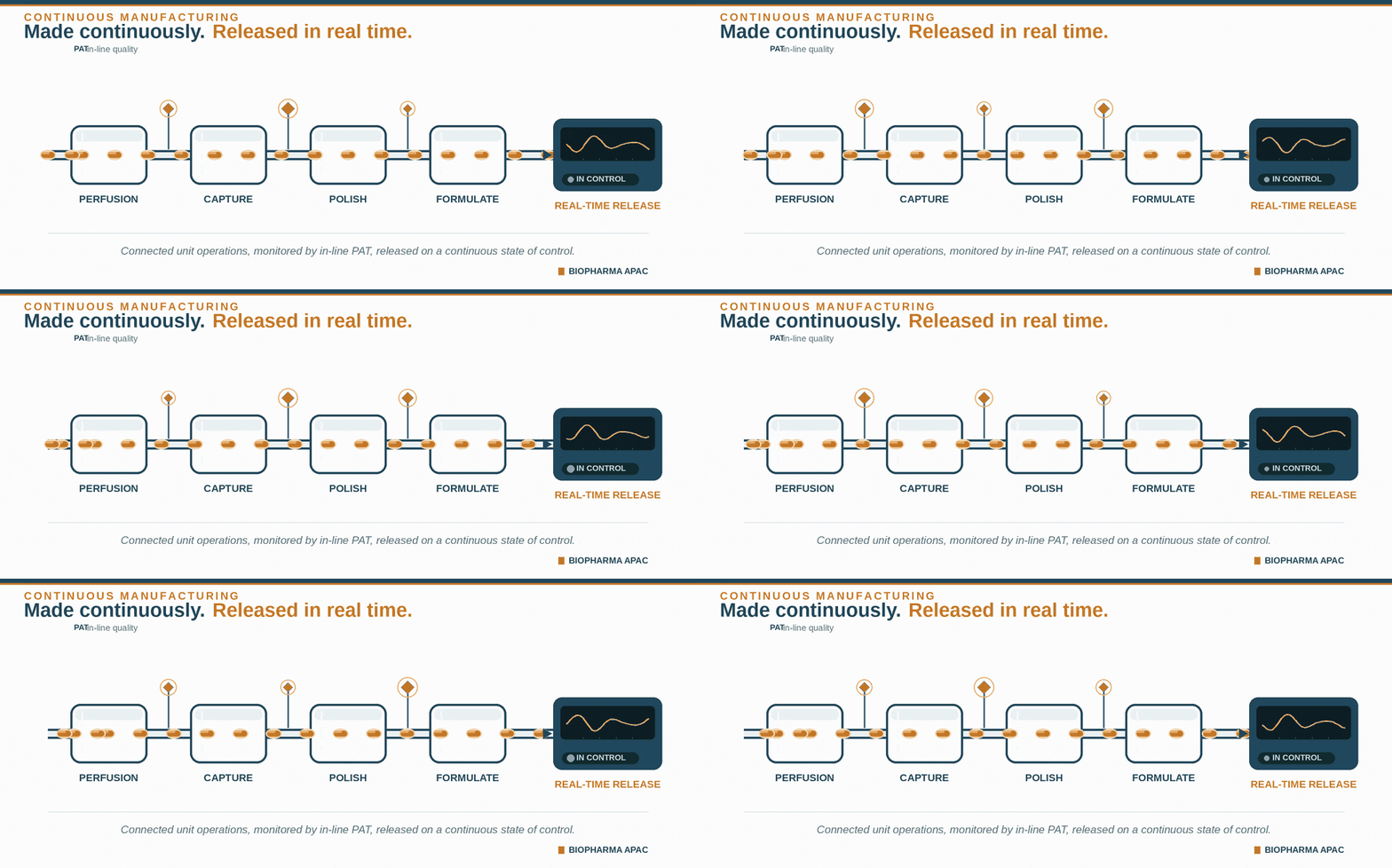
The mechanics are worth making concrete. In a perfusion culture, fresh media flows continuously into the bioreactor while spent media and product are drawn off, holding cells at high density and steady productivity for weeks rather than the days of a fed-batch run. Upstream intensification — running a high-density “N-1” seed step to inoculate the production reactor at far greater cell mass — lets a smaller vessel do the work of a larger one, which is precisely why intensified single-use lines can rival the output of much bigger stainless tanks. Connect that to a continuous downstream train of capture and polishing steps and a facility can, in principle, run a process end to end without ever assembling a discrete batch.
The catch is validation. A batch is a discrete, well-understood regulatory object: it has a beginning, an end, and a defined set of release tests. A continuous process blurs those boundaries, raising questions regulators and quality teams are still working through — how a “batch” is defined when material flows for weeks, how diversion and traceability are managed when a deviation occurs mid-run, and how process analytical technology must be qualified to support real-time decisions rather than end-of-batch testing. For APAC manufacturers serving multiple regulators, that validation burden is not theoretical; it is the difference between a process that scales globally and one that is stranded in a single market.
Manufacturing-science and technology (MSAT) teams sit squarely on that fault line. They own the tech transfer that turns a developer’s process into a reproducible plant operation, and continuous processing makes their job both more powerful and more exacting. The reward is batch reliability and yield; the price is a control strategy that must be richer, more instrumented and more thoroughly documented than anything a fed-batch campaign demanded.
For MSAT teams, the trade is explicit: continuous processing delivers the yield and consistency, but it demands a control strategy that must be defended to every regulator a manufacturer serves — and, in many cases, a working definition of “batch” that is still being negotiated. The reward scales globally; so does the obligation.
“Continuous processing scales the yield and the consistency — and, in equal measure, the burden of proving control to every regulator a manufacturer serves.”
AI-driven quality: differentiation today, table stakes tomorrow
The third axis is software, and it is the one moving fastest. As plants generate continuous streams of sensor data — pH, dissolved oxygen, temperature, agitation, pressure, flow, feed — the value increasingly lies in what manufacturers do with it. Automation and process control already form the dominant segment of the digital-biomanufacturing market, reflecting how central real-time parameter control has become to yield, purity and batch consistency. The next layer is analytical: machine-learning models that flag a drifting culture before it fails specification, predict the outcome of a run from its early trajectory, and shift quality control from end-of-batch testing toward continuous, in-line release.
APAC’s largest manufacturers are already building the organisational scaffolding for this. South Korea’s SK Bioscience runs a dedicated Digital Innovation Office applying AI across R&D, manufacturing and business development, while Samsung Biologics has invested heavily in data integrity, GxP digitalisation and digital governance — the unglamorous foundations without which AI-driven quality is merely a dashboard. In India, CRDMOs are reframing the quality-control laboratory itself around Pharma 4.0 principles, layering automation and digital traceability onto bench operations. AI-led biomanufacturing now headlines the region’s technical conferences, a reliable signal that it has crossed from pilot to priority.
The strategic point for plant operators is one of timing. Today, a credible AI-driven quality capability is a differentiator — a reason a global innovator chooses one APAC partner over another. Within a few years, it will be table stakes: the expectation, not the edge. Manufacturers building suites now must decide whether to design data infrastructure, sensor density and analytics in from the start, or retrofit later at higher cost into facilities that were never instrumented for it. The decision compounds the others. A single-use line is easier to re-instrument than a fixed stainless plant; a continuous process generates exactly the rich, time-series data that machine-learning models feed on. The three axes — plastic, steel and software — are not independent choices but a single interlocking system.
Weighing flexibility, resilience and cost
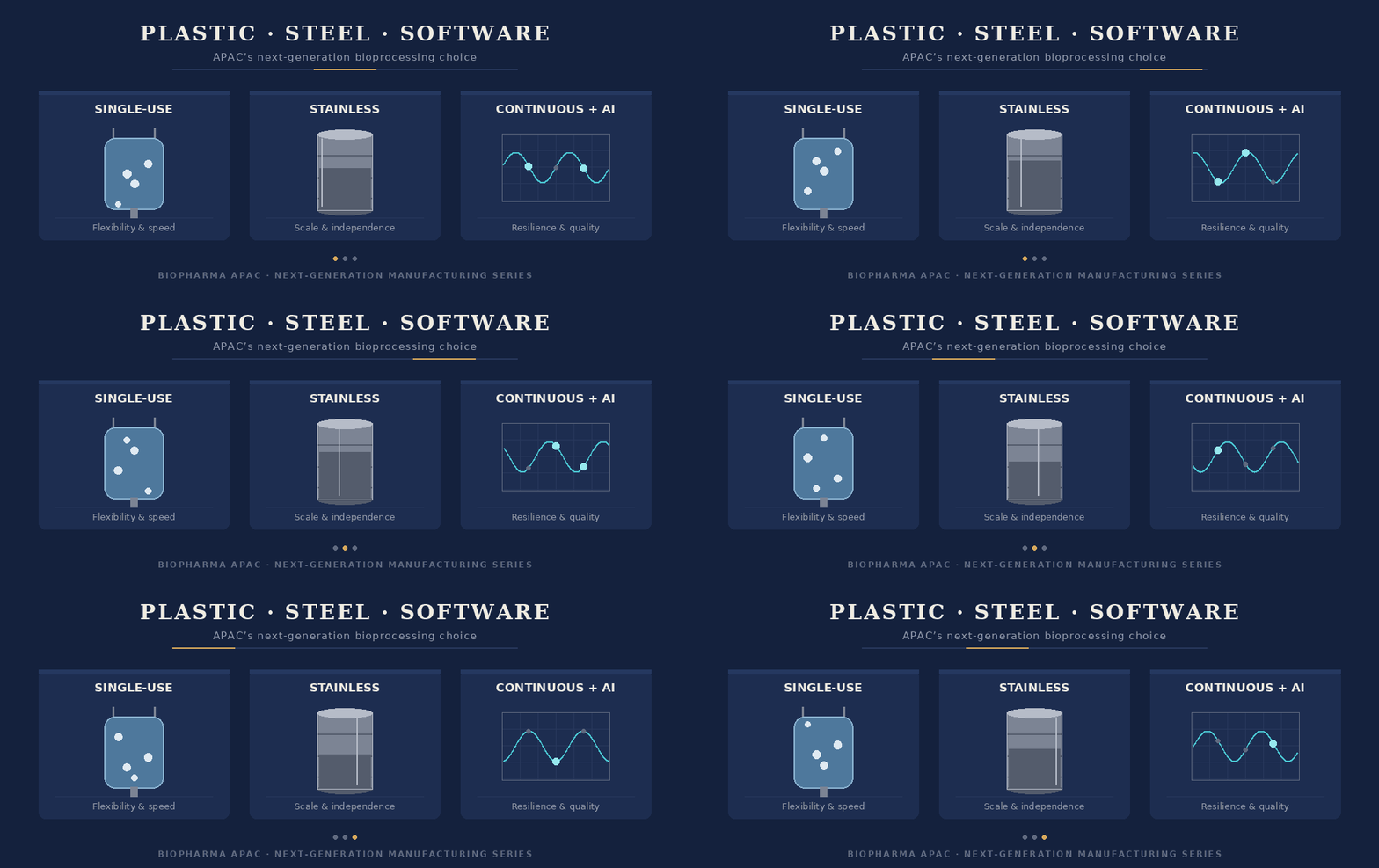
There is no universally correct answer — only a fit between operating model and strategic priority. The clearest way to navigate the choice is to be honest about which of three goals dominates a given facility.
Optimise for flexibility and speed — multi-product suites, advanced therapies, ADCs, clinical-stage and early-commercial programmes — and single-use is almost always the answer. The capital savings, fast changeovers and short commissioning timelines are decisive when the priority is getting molecules into clinic and pivoting between them. Accept that the cost is recurring consumable spend and structural supply-chain exposure, and budget for resilience deliberately rather than discovering the dependency in a crisis.
Optimise for scale and independence — high-volume, long-lived blockbuster biologics and biosimilars with stable demand — and stainless steel’s economics reassert themselves. At large volumes the per-batch consumable cost of single-use overtakes the amortised capital of a fixed plant, and ownership of the asset removes the consumable umbilical that the pandemic exposed. The price is capital intensity, longer commissioning and far less agility when the product mix changes.
Optimise for resilience and long-run quality and the answer is increasingly a hybrid: single-use upstream for flexibility, selective stainless or continuous trains where volume and supply-security justify them, and a software-and-data layer designed in from day one. Most sophisticated APAC operators are converging on exactly this blend — not as a compromise, but as a portfolio strategy that matches each product to the operating model it actually needs.
The discipline that separates winners is treating the three axes as one decision rather than three. A flexibility win that ignores consumable concentration is a hidden liability. A stainless investment that ignores demand volatility is stranded capital. A continuous line without a validated control strategy is a regulatory dead end. And any of them, built without the data infrastructure to support AI-driven quality, will be playing catch-up within the decade. For Asia-Pacific’s biomanufacturers, the plant they design today is a statement about which risks they are willing to own — in plastic, in steel, and increasingly in software.
arcilla.fran@biopharmaapac.com
Disclaimer:
Reporting draws on company announcements and press coverage from Cytiva (Bengaluru Fast Trak expansion, February 2026) and Syngene International (US biologics acquisition increasing single-use bioreactor capacity from 20,000 to 50,000 litres, March 2025), and on the February 2025 Indian CRDMO analysis by Boston Consulting Group and the Innovative Pharmaceutical Services Organization. Market-size and growth figures are drawn from third-party research, including Grand View Research, Mordor Intelligence, MarketsandMarkets and BioPlan Associates; figures are current as of early 2026.
Practitioner perspectives reflect prevailing industry conditions across the engineering, manufacturing-science, procurement and digital-manufacturing functions described, synthesised from public reporting and the cited research rather than attributed to a single named individual.
Most Read
- Can APAC Biomanufacturing Decarbonise Without Pricing Itself Out?
- The Algorithm on the GMP Floor: AI Promises a Smarter Plant. Regulators Demand the Audit Trail.
- APAC's Peptide-Capacity Gamble
- After the Rush: APAC's mRNA and Vaccine Capacity Hangover
- The Biosimilar Race: Factory to the World — or Stuck in the Copycat Economy?
- The Vein-to-Vein Problem: Can APAC's Cold Chain Carry Advanced Therapies?
- Vectors, Plasmids and the CGT Trap: APAC's Cell and Gene Therapy Ambitions Face an Upstream Bottleneck
- Can APAC Build Radioligand Therapy Before the Atoms Decay?
- The Great Biopharma Reset: 50 Developments That Changed Everything in H1 2026
- Beyond the Trial: Can Real-World Evidence Earn Regulatory Trust in APAC?
- Beyond the Obvious Giant: Where APAC's Clinical Trials Go Next
- The Frontier That Won’t Quite Arrive
Bio Jobs
- Sanofi Turns The Page As Belén Garijo Steps In And Paul Hudson Steps Out
- Global Survey Reveals Nearly 40% of Employees Facing Fertility Challenges Consider Leaving Their Jobs
- BioMed X and AbbVie Begin Global Search for Bold Neuroscience Talent To Decode the Biology of Anhedonia
- Thermo Fisher Expands Bengaluru R&D Centre to Advance Antibody Innovation and Strengthen India’s Life Sciences Ecosystem
- Accord Plasma (Intas Group) Acquires Prothya Biosolutions to Expand Global Plasma Capabilities
- ACG Announces $200 Million Investment to Establish First U.S. Capsule Manufacturing Facility in Atlanta
- AstraZeneca Invests $4.5 Billion to Build Advanced Manufacturing Facility in Virginia, Expanding U.S. Medicine Production
News