Billions on Bioconjugation: Is APAC Building the Right ADC Capacity — or Too Much?
19 June 2026 | Friday | Analysis
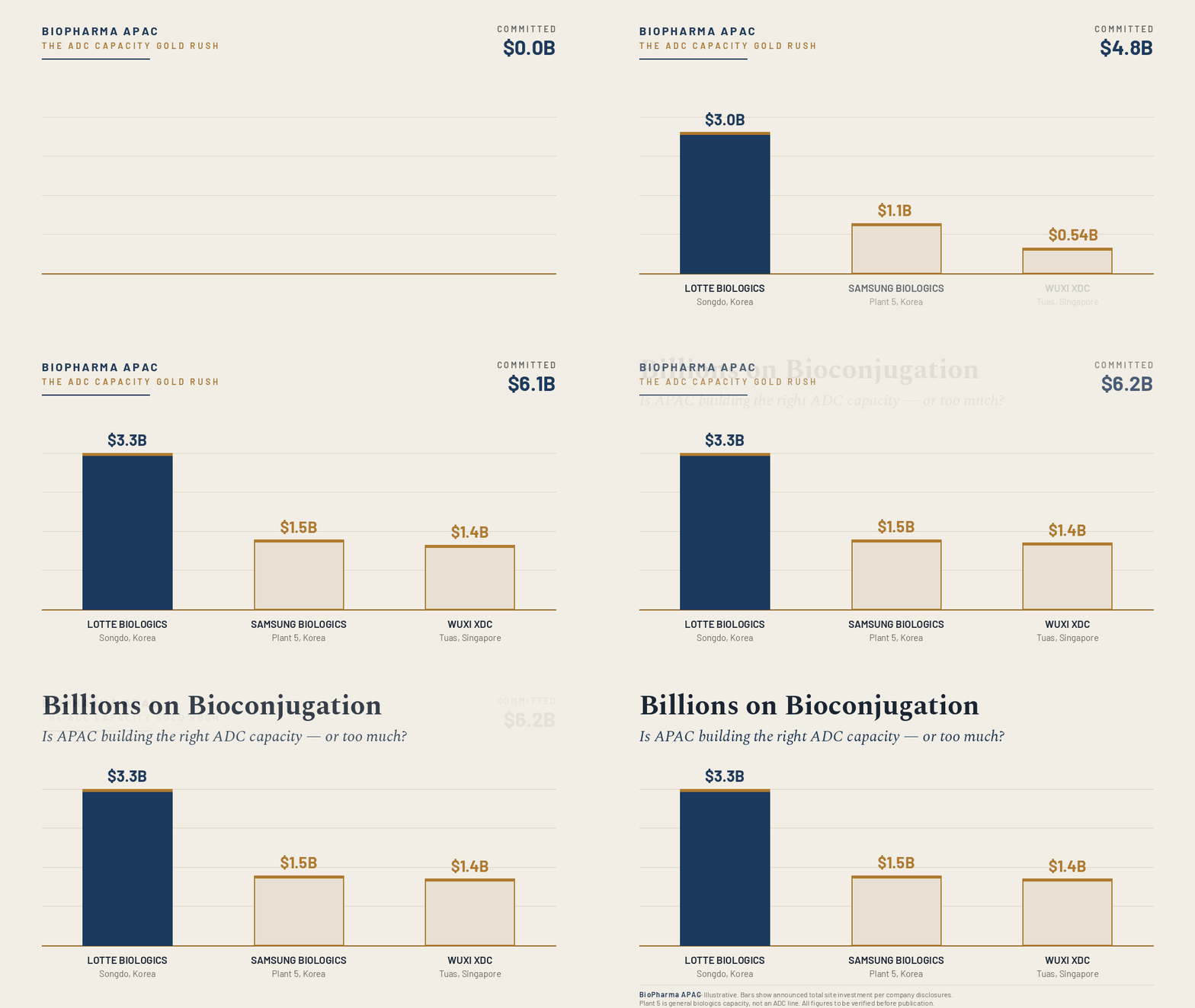
In Songdo, on the reclaimed waterfront west of Seoul, a 202,000-square-metre construction site is becoming the most expensive single statement Korea's biopharma sector has made about its future. Lotte Biologics is spending roughly 4.6 trillion won — about US$3.3 billion — to raise three "mega plants" with a combined 360,000 litres of biomanufacturing capacity, the first of which is scheduled for GMP readiness in late 2026 and commercial production in 2027. A few kilometres away, Samsung Biologics' second Bio Campus is already running, and the company has secured land for a third campus explicitly earmarked for antibody-drug conjugates, antibody vaccines and cell and gene therapies. And 5,000 kilometres south, in Singapore's Tuas Biomedical Park, WuXi XDC has mechanically completed a dedicated bioconjugates plant as part of a US$1.4 billion, decade-long WuXi Biologics investment in the city-state.
Taken together, these are not incremental upgrades. They are a regional wager — placed almost simultaneously by three of Asia's most ambitious manufacturers — that the antibody-drug conjugate will be the defining oncology modality of the next decade, and that whoever controls the conjugation suites will control a disproportionate share of the value.
The wager is rational. It may also be oversized. ADCs are among the hardest biologics to make safely and reproducibly, the clinical pipeline is deep but narrowly concentrated, and the industry has watched, very recently, what happens when capital outruns demand in a "hot" modality. This is the reality check: is APAC building ADC capacity sized to the pipeline, or to the hype?
The build-out map
The most striking feature of the current wave is that the biggest APAC players are pursuing ADCs along two distinct tracks — large-scale antibody (drug substance) capacity on home soil, and smaller, specialised conjugation and fill-finish capability that is frequently sited offshore, closer to clients or to existing chemistry expertise.
Lotte Biologics is the clearest example of the two-track logic. Its Songdo campus is, in headline terms, a monoclonal-antibody play: three 120,000-litre plants, stainless-steel bioreactors, a path to becoming a global top-10 CDMO by 2030. But Lotte's actual ADC manufacturing today sits not in Korea but in East Syracuse, New York, at the former Bristol Myers Squibb site it acquired in 2022. There, the company has converted a 45,000-square-foot facility into a single-use conjugation suite and, in 2025, formally launched a dedicated ADC business after signing its first customer. Lotte says it has invested more than US$100 million in ADC modalities — both drug substance and conjugation — and has deliberately chosen single-use systems for bioconjugation. As Syracuse general manager Brian Greven framed the rationale, single-use allows quicker changeovers and lowers cross-contamination risk in multi-product operations. The company has also layered on partnerships that fill the chemistry gap: an October 2025 letter of intent with SK pharmteco, under which SK handles linker-payload synthesis while Lotte handles antibody drug substance and bioconjugation, plus a proprietary linker platform, SoluFlex Link, developed with Korean biotech Kanaph Therapeutics.
Samsung Biologics has moved faster and at greater absolute scale, though here the ADC story needs a careful read. The company's Plant 5 — a 180,000-litre facility that came online in April 2025 at a cost of roughly 1.98 trillion won (about US$1.47 billion) — is a general mammalian drug-substance plant, not an ADC line, and it lifted Samsung's total Songdo capacity across Plants 1 to 5 to about 785,000 litres, among the largest in the world. The genuinely ADC-specific asset is separate: a dedicated, much smaller conjugation facility in Songdo that began operations in 2025 and, by the first quarter of 2026, had completed its first commercial-scale engineering run for ADCs. Samsung has also signalled where the next phase goes, securing a site for a third Bio Campus that names ADCs as a primary modality, deepening an ADC drug-substance partnership with LigaChem Biosciences, and — through a US$353 million acquisition of a GSK facility in Rockville, Maryland — adding 60,000 litres and a first US manufacturing base in early 2026. The pattern is the same as Lotte's: enormous antibody capacity at home, with conjugation treated as a distinct, specialised, smaller-footprint capability bolted alongside it.
WuXi XDC, the bioconjugates subsidiary of WuXi Biologics, is the purest specialist of the three, and its Singapore site is the one most directly built for ADC manufacturing end to end. The roughly 25,000–30,000-square-metre Tuas facility achieved mechanical completion in 2025, with GMP manufacturing targeted for early 2026. It is designed as a one-stop bioconjugates centre: a dual-function line capable of producing monoclonal-antibody intermediates and conjugate drug substance at up to 2,000 litres per batch, a conjugation drug-product line with annual capacity above eight million vials, on-site quality control and manufacturing science and technology labs, and — crucially — a payload-linker laboratory with a containment design rated for OEB 5 materials and reaction kettles for kilogram-scale GMP payload production. The site is expected to create more than 500 jobs. It does, however, carry a strategic complication its rivals do not: WuXi's China parentage keeps it inside the long shadow of US legislative scrutiny over Chinese CDMOs, which is part of why dual-sourcing and a Singapore address matter so much to the company's pitch.
The combined effect can be read in a single table.
Announced APAC ADC / bioconjugation capacity at a glance
| Player | Site | Investment | Capacity / scope | ADC-specific role | Status |
|---|---|---|---|---|---|
| Lotte Biologics | Songdo, Korea | ~US$3.3bn (₩4.6tn) | 360,000 L (3 × 120,000 L) | Antibody drug substance; ADC capability planned | Plant 1 GMP late 2026, commercial 2027 |
| Lotte Biologics | Syracuse, NY (US) | >US$100m in ADC modalities | 45,000 sq ft single-use conjugation suite | Dedicated ADC drug substance + conjugation | Operational; dedicated ADC business launched 2025 |
| Samsung Biologics | Songdo, Korea (Plant 5) | ~US$1.47bn (₩1.98tn) | 180,000 L mammalian DS | General biologics (not ADC line) | Operational April 2025 |
| Samsung Biologics | Songdo, Korea (ADC facility) | Undisclosed | Dedicated conjugation suite | ADC drug substance | First commercial-scale engineering run by Q1 2026 |
| Samsung Biologics | Bio Campus III, Korea | Undisclosed | Site secured | ADC / antibody vaccine / CGT | Planning |
| WuXi XDC | Tuas, Singapore | Part of US$1.4bn WuXi Bio Singapore programme | DS up to 2,000 L/batch; DP >8m vials/yr | End-to-end bioconjugates incl. OEB 5 payload-linker lab | Mechanical completion 2025; GMP early 2026 |
Capacity definitions differ across drug substance, conjugation and fill-finish and are not directly comparable. Figures compiled from company disclosures and industry reporting as of June 2026.
Why ADCs are hard
The temptation, looking at that table, is to treat ADC capacity as a bigger, fancier version of monoclonal-antibody capacity. It is not. An ADC is three products fused into one — a monoclonal antibody, a highly potent cytotoxic payload, and a chemical linker that holds them together and controls when the payload is released — and each component demands a different manufacturing discipline, under a single quality system, with no margin for the kind of variability a conventional biologic might tolerate.
The first hard problem is linker-payload chemistry. The payloads at the heart of modern ADCs are not ordinary small molecules; they are deliberately, extraordinarily toxic. Conjugating them to an antibody at a controlled, reproducible drug-to-antibody ratio (DAR) is a synthetic and process-engineering challenge that sits at the seam between biology and high-hazard chemistry — two cultures that have historically lived in separate buildings, separate companies and separate regulatory mindsets. The recent flurry of linker-payload partnerships across the region (Lotte with SK pharmteco and Kanaph; WuXi XDC's own payload-linker labs; Samsung with LigaChem) is the industry's tacit admission that few organisations hold all three competencies in-house.
The second hard problem is containment. Because ADC payloads are so potent, they fall at the extreme end of the occupational exposure scale. Under the Occupational Exposure Band framework, a high-potency active ingredient is generally defined as one with an occupational exposure limit at or below 10 micrograms per cubic metre of air over an eight-hour shift — and ADC payloads routinely sit far below that, in OEB 5 and the so-called OEB 6 "ultra-potent" territory, where exposure limits drop into the nanogram range. (For scale, the industry's favourite analogy holds that an OEB 5 limit is roughly equivalent to a single grain of table salt dispersed across the air of a small room.) Building for that means sealed isolators, dedicated negative-pressure HVAC, closed-system waste handling and supplied-air respirators — and, critically, third-party certification of all of it. WuXi XDC's decision to specify OEB 5 containment in its Singapore payload-linker lab, and Lotte's choice of single-use conjugation to limit cross-contamination, are not marketing details. They are the load-bearing engineering of the whole proposition.
The third hard problem — the one most often underweighted in capacity announcements — is analytical comparability. A regulator does not approve a litres-of-capacity number; it approves a product that can be shown, batch after batch and site after site, to be the same molecule with the same DAR distribution, the same impurity profile and the same stability. That requires validated analytical methods able to detect trace residues at the sub-nanogram level for cleaning verification, and the deep expertise to interpret matrix interference at those thresholds. As one industry framing puts it, by 2026 the binding constraint on ADC manufacturing will be solving process and analytical challenges rather than simply adding bioreactor volume. Steel is the easy part. Proving the molecule is the hard part.
The demand question
So is the pipeline deep enough to fill all these suites?
On the surface, yes — and emphatically so. Depending on the database, the global ADC pipeline runs to somewhere between 200 and 600-plus clinical-stage candidates, with on the order of 40 already in Phase III as of 2025. There were roughly 15 FDA-approved ADCs by mid-2025, with the total count of approvals globally higher still, and the most recent additions arriving steadily through 2025. Commercially, the class crossed US$10 billion in annual sales in 2023 and was tracking toward US$16 billion or more for 2025, led by AstraZeneca and Daiichi Sankyo's Enhertu. Market forecasts diverge wildly — conservative houses model high-single-digit compound growth toward roughly US$28–33 billion by the mid-2030s, while the most bullish project growth rates near 29% — but no credible analyst calls the trajectory anything other than up. Asia-Pacific specifically is forecast to be among the fastest-growing regions for ADC contract manufacturing.
The risk is not in the headline depth. It is in the concentration and the timing.
Concentration first. The pipeline is deep but narrow: roughly ten targets account for around 40% of all ADC candidates, with HER2 still dominant despite a widening field of newer antigens. A pipeline clustered on a handful of targets is a pipeline exposed to correlated failure — if a leading target disappoints in a pivotal trial, or if a class-defining safety signal emerges, demand for conjugation slots does not taper gently; it can drop in clusters. The high probability of technical and regulatory success that has made ADCs attractive to dealmakers cuts both ways: it has pulled enormous capital, and enormous commissioned capacity, toward a relatively narrow scientific bet.
Timing second, and more uncomfortably. The industry has a fresh, cautionary precedent for exactly this pattern. Around 2020, a wave of investment in cell and gene therapy manufacturing over-anticipated demand; the therapies advanced more slowly than the capacity, and CDMOs were left with suites that took years to fill. By mid-2025, commentators were openly describing an "outsourcing hangover" — overcapacity in parts of the European and Chinese contract-manufacturing sectors after pandemic-era expansion outran demand from 2019 to 2024. Several analysts now expect mammalian drug-substance capacity specifically to tip into oversupply in 2026, which is precisely one of the forces pushing CDMOs toward higher-margin specialised modalities such as ADCs in the first place. The danger is circular: the same overcapacity anxiety that motivates the pivot into bioconjugation could, if every major player pivots at once, simply relocate the glut from monoclonal antibodies into conjugation suites.
There is a genuine counter-argument, and it deserves equal weight. ADC capacity is not fungible with antibody capacity — a contained OEB 5 conjugation suite cannot be cheaply repurposed downward, but neither can ordinary mammalian capacity be cheaply upgraded to handle cytotoxic payloads, which means specialist ADC capacity is genuinely scarce rather than merely abundant. Industry observers note that there are still relatively few qualified ADC conjugation sites worldwide, that geopolitical reshoring is intensifying demand for non-China-exposed capacity, and that sponsors of the most advanced bioconjugates are increasingly reserving GMP slots a year or two ahead. On that reading, APAC is not overbuilding; it is racing to claim a structurally short resource before Western and Swiss incumbents lock it up. Both stories can be partly true at once — and which one dominates will be decided suite by suite, by utilisation rates that almost no company discloses.
Safety, and the people problem
If the demand question is about whether the suites fill, the safety-and-workforce question is about whether they can be run at all — and run without harming the people inside them.
The containment standards are unforgiving and, importantly, separate from GMP. A US FDA inspection confirms that a facility meets manufacturing-quality standards; it does not confirm that the facility's containment is adequate for sub-microgram payloads. That assurance comes from a distinct, specialist assessment — typically a third-party certification of OEB 5 capability from a consultancy such as SafeBridge — and the uncomfortable open secret of the sector is that claiming OEB 5 capability costs nothing, while genuinely achieving and certifying it costs a great deal. Many CDMOs that market high-potency handling in fact operate at OEB 3 or 4. For a sponsor placing a multi-year ADC programme, the gap between a marketing claim and a dated, third-party certificate is the gap between a safe supply chain and a regulatory and human-safety liability.
This is where the cautionary anchor for the whole capacity story properly sits. It is not, on the public record, a single dramatic accident; it is the quieter, systemic risk that capacity is being announced faster than certified containment and validated analytics can be stood up behind it. The most reassuring signals in the current build-out are precisely the containment-first design choices — WuXi XDC purpose-building an OEB 5 payload-linker lab rather than retrofitting one; Lotte engineering single-use conjugation specifically to manage multi-product cross-contamination risk. The signals to watch warily are capacity announcements that lead with litres and bioreactor counts and say nothing about exposure banding, cleaning-validation thresholds or third-party containment certification. In high-potency manufacturing, what a company chooses not to mention is often the most telling line in the press release.
And then there is the scarcest input of all: people. Containment hardware can be bought and built in 24 months — Samsung famously erected Plant 5 on that timeline. The conjugation chemists, high-potency process-development leads, occupational-hygiene specialists and analytical scientists who can actually run an ADC suite to commercial GMP cannot be manufactured on the same schedule. The job market makes the bottleneck visible: Samsung is actively recruiting conjugation scientists for its Songdo ADC facility; WuXi's Singapore site needs to staff more than 500 roles; Lotte leaned heavily on retaining the experienced BMS workforce it inherited in Syracuse precisely because that expertise is so hard to replace. A region that commissions a dozen new conjugation suites in the same three-year window will be competing for the same small global pool of people who have actually conjugated a cytotoxic payload to a clinical or commercial standard. The steel is rising faster than the talent to operate it — and an empty, perfectly contained suite with no one qualified to run it is not capacity; it is a stranded asset with a very high carrying cost.
The reality check
The honest verdict is that APAC's ADC build-out is neither pure foresight nor pure hype — it is a high-conviction bet whose sizing will only be vindicated or exposed in retrospect, and the variables that decide it are not the ones the announcements emphasise.
The litres are real, the partnerships are real, the pipeline is real, and the strategic logic — claim a scarce, hard-to-replicate, geopolitically advantaged capability before incumbents do — is sound. But the risks are real and structurally linked: a pipeline concentrated on a narrow set of targets, a recent and unflattering precedent in cell and gene therapy overcapacity, containment standards that are easy to claim and expensive to certify, and a talent pool too shallow to staff every suite now under construction.
The single most useful question a sponsor, an investor or a board can ask of any APAC ADC facility over the next 24 months is not "how many litres?" It is three quieter questions: what is your current utilisation, what is your dated third-party containment certification, and who, specifically, will run the suite. The companies that answer all three crisply are building to the pipeline. The ones that answer only the first are building to the hype.
arcilla.fran@biopharmaapac.com
Disclaimer: This article is provided for general information and industry-analysis purposes only. Capacity, investment, pipeline and market figures are drawn from company disclosures, regulatory filings and third-party industry reporting available as of June 2026 and may have changed since publication. Capacity figures differ in definition across drug substance, conjugation and fill-finish operations and are not directly comparable; where a comparative chart accompanies this article, it shows announced total site investment, and Samsung Biologics' Plant 5 is a general biologics facility rather than a dedicated ADC line. Market-size and growth projections reflect third-party forecasts that vary materially between sources. Forward-looking statements are subject to change and are not guarantees of future outcomes. Nothing in this article constitutes investment, legal, regulatory or commercial advice. Company and product names are the property of their respective owners
Most Read
- Can APAC Biomanufacturing Decarbonise Without Pricing Itself Out?
- The Algorithm on the GMP Floor: AI Promises a Smarter Plant. Regulators Demand the Audit Trail.
- APAC's Peptide-Capacity Gamble
- After the Rush: APAC's mRNA and Vaccine Capacity Hangover
- The Biosimilar Race: Factory to the World — or Stuck in the Copycat Economy?
- The Vein-to-Vein Problem: Can APAC's Cold Chain Carry Advanced Therapies?
- Vectors, Plasmids and the CGT Trap: APAC's Cell and Gene Therapy Ambitions Face an Upstream Bottleneck
- Can APAC Build Radioligand Therapy Before the Atoms Decay?
- The Great Biopharma Reset: 50 Developments That Changed Everything in H1 2026
- Beyond the Trial: Can Real-World Evidence Earn Regulatory Trust in APAC?
- Beyond the Obvious Giant: Where APAC's Clinical Trials Go Next
- The Frontier That Won’t Quite Arrive
Bio Jobs
- Sanofi Turns The Page As Belén Garijo Steps In And Paul Hudson Steps Out
- Global Survey Reveals Nearly 40% of Employees Facing Fertility Challenges Consider Leaving Their Jobs
- BioMed X and AbbVie Begin Global Search for Bold Neuroscience Talent To Decode the Biology of Anhedonia
- Thermo Fisher Expands Bengaluru R&D Centre to Advance Antibody Innovation and Strengthen India’s Life Sciences Ecosystem
- Accord Plasma (Intas Group) Acquires Prothya Biosolutions to Expand Global Plasma Capabilities
- ACG Announces $200 Million Investment to Establish First U.S. Capsule Manufacturing Facility in Atlanta
- AstraZeneca Invests $4.5 Billion to Build Advanced Manufacturing Facility in Virginia, Expanding U.S. Medicine Production
News