
Thyroscope and TORC to Study Smartphone AI and Orbital Imaging for Thyroid Eye Disease Monitoring
19 November 2026 | Thursday | News
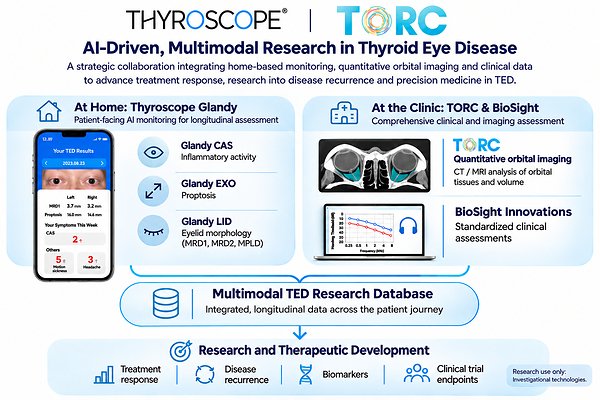
Smartphone monitoring, quantitative orbital imaging and clinical data will support a planned longitudinal study and a TORC-led research database.
Thyroscope (THYROSCOPE INC.) and The Orbital Radiology Center (TORC) announced a memorandum of understanding to investigate an integrated approach to monitoring thyroid eye disease (TED) using smartphone-based artificial intelligence, quantitative orbital imaging and longitudinal clinical data.
Thyroscope will contribute its Glandy smartphone-based AI platform for monitoring patients between clinical visits, while TORC will provide quantitative orbital imaging expertise. Together, the partners will develop a multimodal TED research database integrating smartphone-based assessments, quantitative imaging and longitudinal clinical data. BioSight Innovations, also led by TORC CEO Dr. Shoaib Ugradar, will provide treatment sites, clinical assessments and longitudinal follow-up for the initial study.
TORC has provided contracted imaging assessment services for four clinical trials sponsored by Viridian Therapeutics, Zenas BioPharma, Lassen Therapeutics and Immunovant, and for an Amgen post-marketing study. Its scientific work includes nine published papers on quantitative imaging in TED.
Why Better Monitoring Matters
TED is an autoimmune disease that can cause inflammation, proptosis, eyelid retraction, double vision and, in severe cases, irreversible vision loss. Despite expanding treatments, assessment still relies on scheduled clinic visits. Measurements such as proptosis and the Clinical Activity Score (CAS) may vary between assessors and do not fully capture changes within orbital tissues.
The partners will study whether home measurements and imaging improve longitudinal assessment.
Combining Complementary Technologies
Thyroscope's Glandy TED suite uses smartphone images and patient-reported information to assess inflammatory activity (Glandy CAS), proptosis (Glandy EXO) and eyelid morphology (Glandy LID). Its clinician-facing Glandoc platform makes patient-generated information available for review between appointments. All three Glandy TED solutions have obtained medical device authorization in South Korea and CE marking under the European Medical Device Regulation (EU MDR).
TORC analyzes orbital CT and MRI, clinical photographs and associated clinical data to quantify tissue morphology and volumetric change. Its imaging capabilities complement the more frequent external measurements that patients may collect at home.
BioSight Innovations will provide the clinical infrastructure for treatment and longitudinal follow-up, including conventional pure-tone audiometry using SHOEBOX Audiometry.
Initial 40-Patient Research Study
The partners plan to begin a prospective longitudinal feasibility and validation study of approximately 40 patients receiving TED treatment at BioSight Innovations centers in Los Angeles in January 2027. Participants will be followed from treatment initiation until up to 12 months after treatment completion.
The study will compare smartphone-derived assessments with clinician-performed measurements and examine relationships with quantitative orbital imaging where CT or MRI is clinically appropriate and available. It will explore changes in disease activity, proptosis, eyelid position, anatomical findings, treatment response and clinically confirmed recurrence.
All participants will undergo conventional audiometry at BioSight using SHOEBOX Audiometry. These measurements will inform iterative development and evaluation of an investigational smartphone-based pure-tone hearing assessment integrated into Glandy. The study will assess agreement, distinguishing development from independent validation. The smartphone test is not intended to replace conventional audiometry.
The initial study is designed to establish feasibility and measurement agreement, not to validate recurrence prediction or treatment-selection algorithms. Interim findings are targeted for the first quarter of 2028, depending on enrollment and data availability.
Building a Multimodal TED Research Database
TORC and Thyroscope plan to jointly develop a longitudinal, multimodal TED research database integrating orbital imaging, smartphone-based assessments, standardized clinical findings, treatment exposures, outcomes and audiometric data. Future phases may incorporate consented tissue-derived and molecular information and larger patient cohorts.
The longer-term goal is to support studies of treatment response, disease recurrence, imaging biomarkers and potential predictors of therapeutic benefit.
Subject to scientific validation and appropriate data governance, the resource could also support pharmaceutical research into reproducible clinical trial endpoints and patient stratification.
Leadership Perspectives

Dr. Shoaib Ugradar (CEO, TORC)
DR. SHOAIB UGRADAR
CEO, TORC
"Thyroid eye disease is entering a new era of targeted therapeutics, yet our ability to objectively characterize treatment response and predict recurrence remains limited," said Dr. Shoaib Ugradar, CEO of TORC. "By combining quantitative orbital imaging with measurements collected between visits, we hope to better understand how patients respond, why some relapse and how more personalized care might eventually be supported."

Jamey Park (CEO, Thyroscope)
JAEMY PARK
CEO, Thyroscope
"Combining Glandy's smartphone-based assessments with TORC's imaging expertise creates an opportunity to study thyroid eye disease more continuously," said Jaemy Park, CEO of Thyroscope. "We aim to make objective measurement more accessible while contributing patient-generated information to rigorous longitudinal research."
Most Read
- Can APAC Biomanufacturing Decarbonise Without Pricing Itself Out?
- The Algorithm on the GMP Floor: AI Promises a Smarter Plant. Regulators Demand the Audit Trail.
- APAC's Peptide-Capacity Gamble
- After the Rush: APAC's mRNA and Vaccine Capacity Hangover
- The Biosimilar Race: Factory to the World — or Stuck in the Copycat Economy?
- The Vein-to-Vein Problem: Can APAC's Cold Chain Carry Advanced Therapies?
- Vectors, Plasmids and the CGT Trap: APAC's Cell and Gene Therapy Ambitions Face an Upstream Bottleneck
- Can APAC Build Radioligand Therapy Before the Atoms Decay?
- The Great Biopharma Reset: 50 Developments That Changed Everything in H1 2026
- Beyond the Trial: Can Real-World Evidence Earn Regulatory Trust in APAC?
- Beyond the Obvious Giant: Where APAC's Clinical Trials Go Next
- The Frontier That Won’t Quite Arrive
Bio Jobs
- Sanofi Turns The Page As Belén Garijo Steps In And Paul Hudson Steps Out
- Global Survey Reveals Nearly 40% of Employees Facing Fertility Challenges Consider Leaving Their Jobs
- BioMed X and AbbVie Begin Global Search for Bold Neuroscience Talent To Decode the Biology of Anhedonia
- Thermo Fisher Expands Bengaluru R&D Centre to Advance Antibody Innovation and Strengthen India’s Life Sciences Ecosystem
- Accord Plasma (Intas Group) Acquires Prothya Biosolutions to Expand Global Plasma Capabilities
- ACG Announces $200 Million Investment to Establish First U.S. Capsule Manufacturing Facility in Atlanta
- AstraZeneca Invests $4.5 Billion to Build Advanced Manufacturing Facility in Virginia, Expanding U.S. Medicine Production
News


