12 APAC-Originated Programmes to Watch at ESMO 2026
12 October 2026 | Monday | News
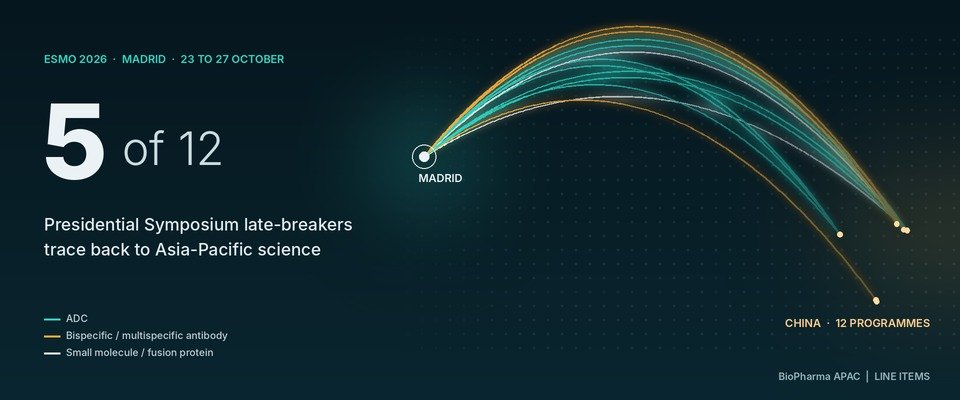
When the ESMO Congress 2026 opens at IFEMA Madrid on Friday 23 October, the region that most European oncologists still think of as a fast follower will hold more of the main stage than at any meeting before it. The Presidential Symposia, ESMO's highest-profile sessions, carry 12 late-breaking abstracts. Five of them belong to China-originated molecules: HUTCHMED's savolitinib, Akeso's ivonescimab, the Keymed and Lepu Claudin 18.2 ADC now owned by AstraZeneca, Hansoh's B7-H3 ADC partnered with GSK, and Kelun-Biotech's TROP2 ADC partnered with MSD.
The depth beneath the headline is the bigger story. A tally of the late-breaking list by Aijian Securities counts 32 China-sourced studies, more than three in ten of the total. Of those, 23 are China-led trials of Chinese innovative drugs, five are global trials of Chinese molecules run by overseas partners, and four are academic studies of treatment strategy. Fifteen of the 32 are ADCs, three of them bispecific. Before a single late-breaker was announced, Chinese investigators had already secured 47 Proffered Paper and Rapid Oral slots from the regular abstract pool.
So the question this year is not whether Asia-Pacific science turns up in Madrid. It is whether the data hold once Western regulators, payers and the partners who paid the upfronts read the full tables. Outside Greater China, most of the assets below now sit with AstraZeneca, GSK, MSD, Bristol Myers Squibb, Takeda or BioNTech. Madrid is therefore also an audit of the out-licensing thesis that has dominated the region's dealmaking for two years.
There is one more reason to read the sessions closely. Topline press releases have already told markets that most of these trials hit their endpoints. What they have not said is by how much. Every entry below is built around that gap: for each, the result that would genuinely move practice or partnership value, and the result that would disappoint even if the headline stays positive.
|
How this list was built • Origin rule. An asset qualifies if it was discovered in Asia-Pacific, whoever now holds rights outside the region. A Western-origin drug tested in Asian patients does not qualify; a Chinese-origin drug run by a Western partner does. • Slot rule. Each entry holds at least one accepted late-breaking, Proffered Paper or Rapid Oral slot in the published programme or in sponsor disclosures that cite it. Posters are in the sidebar. • Numbers. Only figures already disclosed before the congress are reported. Late-breaking data stay under ESMO embargo until each presentation, and nothing here anticipates them. • Times. All session times are Madrid local time. Spain moves from summer time to standard time at 03:00 on Sunday 25 October, so from Sunday Madrid is UTC+1: the Sunday Presidential Symposium at 16:30 starts at 21:00 in India and 23:30 in Singapore. Before Sunday, Madrid is UTC+2. |
1. Savolitinib plus osimertinib (SAFFRON and SANOVO)
|
Asset |
Savolitinib, oral selective MET inhibitor, combined with osimertinib |
|
Sponsor and partner |
HUTCHMED; AstraZeneca (joint developer, markets savolitinib as Orpathys and owns osimertinib) |
|
Origin |
China (discovered by HUTCHMED, Shanghai) |
|
Trial and phase |
SAFFRON, global Phase 3, EGFR-mutant NSCLC with MET overexpression and/or amplification after osimertinib, vs platinum-pemetrexed. SANOVO, China Phase 3, first-line EGFR-mutant NSCLC with MET overexpression, vs osimertinib plus placebo |
|
Session and date |
SAFFRON: LBA6, Presidential Symposium II, Sunday 25 October, 16:30 to 18:15 (Shun Lu). SANOVO: LBA69, Proffered Paper, NSCLC metastatic, Monday 26 October, 08:30 to 10:00 (Yi-Long Wu) |
HUTCHMED arrives with two positive Phase 3 trials and the year's most prominent lung slot from the region. SAFFRON reported on 17 August that the all-oral doublet beat platinum doublet chemotherapy on both progression-free and overall survival. SANOVO followed on 31 August with a statistically significant progression-free survival gain over osimertinib alone and what the company described as a clinically meaningful overall survival benefit.
What would matter: In SAFFRON, an overall survival hazard ratio with a confidence interval tight enough to make the chemo-free sequence the default conversation after osimertinib, set against amivantamab-based regimens and the newer ADCs in the same line. Just as important is whether benefit holds evenly across MET overexpression and MET amplification, because the selection test will decide how many patients this regimen actually reaches.
What would disappoint: A benefit concentrated in the smaller amplified subgroup, which would shrink the addressable population, or a SANOVO survival result that turns out to be descriptive rather than formally tested. Oedema and liver enzyme rises at rates that blunt the convenience argument would also cost it.
HUTCHMED also has surufatinib in a Rapid Oral slot (2394RO, first-line extrapulmonary neuroendocrine carcinoma with serplulimab and chemotherapy, Friday 23 October, 16:15 to 17:45).
2. Ivonescimab (HARMONi-GI1)
|
Asset |
Ivonescimab, PD-1 x VEGF bispecific antibody |
|
Sponsor and partner |
Akeso; Summit Therapeutics holds licensed rights in major Western markets |
|
Origin |
China (engineered by Akeso, Zhongshan) |
|
Trial and phase |
HARMONi-GI1, randomised, double-blind Phase 3 in China, 682 patients, ivonescimab plus chemotherapy vs durvalumab plus chemotherapy, first-line advanced biliary tract cancer |
|
Session and date |
LBA8, Presidential Symposium II, Sunday 25 October, 16:30 to 18:15 (Jian Zhou) |
This is the most consequential comparator on the list. HARMONi-GI1 did not test ivonescimab against chemotherapy alone; it went head to head with the regimen that is the current global first-line standard in biliary cancer, and Akeso said on 25 August that it met its overall survival endpoint. Akeso brings nearly 30 studies to Madrid, with ivonescimab in 12 of them, including Rapid Orals in thymic carcinoma (iTHYM) and favourable-risk renal cell carcinoma.
What would matter: A median overall survival gap that is visibly larger than the increment durvalumab itself delivered over chemotherapy in TOPAZ-1, where the hazard ratio was 0.80. That would make HARMONi-GI1 the first time a PD-1 x VEGF bispecific has beaten an approved PD-(L)1 regimen on survival in a gastrointestinal cancer, which matters well beyond biliary disease.
What would disappoint: A hazard ratio in the high 0.8s, or a confidence interval that leaves the effect size open to argument. Bleeding events and cholangitis in a population that often carries biliary stents would be the safety story to watch. Because Summit has stressed that the data were generated, managed and analysed by Akeso in a single country, Western regulators will want global confirmation either way.
3. Sonesitatug vedotin, or Sone-Ve (CLARITY-Gastric01)
|
Asset |
Sonesitatug vedotin (CMG901, AZD0901), Claudin 18.2 ADC with MMAE payload |
|
Sponsor and partner |
AstraZeneca (global exclusive licensee since February 2023); originated by KYM Biosciences, a joint venture of Keymed Biosciences (70%) and Lepu Biopharma (30%) |
|
Origin |
China |
|
Trial and phase |
CLARITY-Gastric01, global Phase 3, second-line and later CLDN18.2-positive gastric, GEJ and oesophageal adenocarcinoma, vs investigator's choice |
|
Session and date |
LBA7, Presidential Symposium II, Sunday 25 October, 16:30 to 18:15 (Rui-Hua Xu) |
AstraZeneca called CLARITY-Gastric01 the first Phase 3 to show an overall survival benefit for an anti-CLDN18.2 ADC. The topline in July met the dual primary endpoint of overall survival in third-line and later patients and the key secondary endpoint of survival across the broader second-line-plus group. The other dual primary endpoint, progression-free survival by blinded central review, trended favourably but missed significance.
What would matter: Survival benefit that holds at the trial's permissive entry bar of CLDN18.2 expression on at least 25% of tumour cells at any intensity. That is a far wider net than the high-expression selection used for zolbetuximab, and if low expressers benefit, the commercial ceiling rises sharply.
What would disappoint: Kaplan-Meier curves that separate late and narrowly, which would fit the progression-free survival miss, or benefit that sits almost entirely in high expressers. Neuropathy and neutropenia from the MMAE payload will be compared, unavoidably, with entry 4.
4. Arcotatug tavetecan, IBI343 (G-HOPE-001)
|
Asset |
Arcotatug tavetecan (IBI343, TAK-921), Claudin 18.2 ADC with topoisomerase I inhibitor payload |
|
Sponsor and partner |
Innovent Biologics; Takeda holds rights outside Greater China |
|
Origin |
China (Innovent, Suzhou) |
|
Trial and phase |
G-HOPE-001, randomised open-label Phase 3 in China and Japan, CLDN18.2-positive HER2-negative gastric or GEJ adenocarcinoma after at least two prior lines, vs treatment of physician's choice; dual primary endpoints PFS and OS; first interim analysis |
|
Session and date |
LBA77, Proffered Paper, upper GI, Friday 23 October, 13:30 to 15:00 (Kohei Shitara, Kashiwa) |
Madrid will see two China-originated CLDN18.2 ADCs on different payloads within 48 hours of each other. IBI343 met its primary endpoint at the first interim analysis, and China's regulator accepted its new drug application with priority review in June, making it the first CLDN18.2 ADC to reach regulatory review anywhere. A Japanese investigator presenting registrational data from a China-Japan trial is itself a signal of how Takeda intends to position the asset.
What would matter: Clarity on whether both dual primary endpoints were met at this interim, and a Japanese subgroup that tracks the Chinese one. A cleaner haematological profile than MMAE-based Sone-Ve would give Innovent and Takeda a payload argument to carry into first-line and pancreatic trials.
What would disappoint: Survival data too immature to read, or nausea and vomiting, the recognised on-target cost of CLDN18.2 in gastric mucosa, at rates that complicate later-line use. Any interstitial lung disease signal would draw scrutiny given the topoisomerase payload.
5. Risvutatug rezetecan, Ris-Rez (ARTEMIS-011)
|
Asset |
Risvutatug rezetecan (HS-20093), B7-H3 ADC |
|
Sponsor and partner |
Hansoh Pharma; GSK holds worldwide rights outside Greater China |
|
Origin |
China (Hansoh) |
|
Trial and phase |
ARTEMIS-011, open-label Phase 3 in China, 117 patients randomised 2:1 vs gemcitabine plus docetaxel, relapsed osteosarcoma after at least two prior systemic lines |
|
Session and date |
LBA9, Presidential Symposium III, Monday 26 October (Lu Xie) |
Osteosarcoma mostly strikes children and young adults, and relapsed disease has no clear standard of care. ARTEMIS-011 met its independent review progression-free survival endpoint in July, with consistent signals in overall survival, and the Aijian Securities tally of ESMO late-breakers describes it as the first positive Phase 3 in the disease in roughly a decade. Ris-Rez already holds US Breakthrough Therapy Designation here, and it follows a second Phase 3 win, ARTEMIS-008 in small cell lung cancer, where it beat topotecan on survival.
What would matter: An overall survival effect that stands up despite the small sample, plus durable responses. Timing matters too: on 25 September Merck and Daiichi Sankyo withdrew their US filing for the rival B7-H3 ADC ifinatamab deruxtecan in small cell lung cancer, and a clean Presidential Symposium readout positions Ris-Rez as the B7-H3 asset with positive Phase 3 data across two tumour types.
What would disappoint: A survival hazard ratio whose confidence interval swallows the point estimate, or haematological toxicity heavy enough to worry paediatric and young adult investigators, who will shape uptake in a disease this rare.
6. Sacituzumab tirumotecan, sac-TMT (TroFuse-005, OptiTROP-Lung06, OptiTROP-Lung04)
|
Asset |
Sacituzumab tirumotecan (SKB264, MK-2870), TROP2 ADC |
|
Sponsor and partner |
Kelun-Biotech; MSD holds rights outside Greater China since May 2022 and sponsors the global programme |
|
Origin |
China (Kelun-Biotech, Chengdu) |
|
Trial and phase |
TroFuse-005 (ENGOT-en23/GOG-3095), MSD-run Phase 3, previously treated advanced or recurrent endometrial cancer. OptiTROP-Lung06, Phase 3, sac-TMT plus pembrolizumab vs chemotherapy plus pembrolizumab, first-line PD-L1-negative non-squamous NSCLC. OptiTROP-Lung04, Phase 3 final OS, EGFR-mutant NSCLC after TKI, vs platinum chemotherapy |
|
Session and date |
TroFuse-005: LBA11, Presidential Symposium, Monday 26 October, 16:30 to 18:15. OptiTROP-Lung06 (LBA66, Caicun Zhou) and OptiTROP-Lung04 (LBA67, Li Zhang): Proffered Paper, NSCLC metastatic, Sunday 25 October, 10:15 to 11:45 |
No APAC-origin molecule has more on the Madrid stage. Kelun-Biotech holds three late-breakers, and sac-TMT also has the final overall survival analysis of OptiTROP-Breast01 in triple-negative breast cancer as a Rapid Oral (4639RO, Monday 26 October). The headline is TroFuse-005, because it is MSD's own global trial in Western-heavy sites: this is where a China-discovered ADC is judged on someone else's data infrastructure.
What would matter: In TroFuse-005, a survival advantage over chemotherapy large enough to matter in a post-platinum, post-immunotherapy endometrial setting. In OptiTROP-Lung06, evidence that an ADC can replace the platinum backbone in PD-L1-negative patients, the group that gains least from immunotherapy alone. Final OptiTROP-Lung04 survival should hold the advantage despite crossover.
What would disappoint: A TroFuse-005 effect that looks modest beside existing options, a Lung06 progression-free survival win with survival too immature to interpret, or stomatitis and ocular events, the familiar TROP2 class costs, at rates that make first-line combination use harder to sell.
7. Izalontamab brengitecan, iza-bren (PANKU-Breast01)
|
Asset |
Izalontamab brengitecan (BL-B01D1), EGFR x HER3 bispecific ADC |
|
Sponsor and partner |
Sichuan Biokin Pharmaceutical and its US subsidiary SystImmune; Bristol Myers Squibb co-develops outside China |
|
Origin |
China (Biokin, Chengdu) |
|
Trial and phase |
PANKU-Breast01, randomised Phase 3, previously treated unresectable locally advanced or metastatic HR-positive, HER2-negative breast cancer |
|
Session and date |
LBA50, Proffered Paper, Saturday 24 October, session from 08:30 (Dennis Slamon). Also 1542RO, Phase 2 iza-bren plus pembrolizumab in recurrent or metastatic head and neck cancer, Rapid Oral |
Biokin holds two late-breakers, and the choice of UCLA's Dennis Slamon to present PANKU-Breast01 tells you how the partners want it read: as a global breast cancer dataset, not a regional one. The bispecific ADC already has form in the clinic. In February a separate Phase 3 in previously treated triple-negative breast cancer hit both of its dual primary endpoints, progression-free and overall survival, against physician's choice chemotherapy.
What would matter: Separation from chemotherapy that stands out in a line already crowded with trastuzumab deruxtecan, datopotamab deruxtecan and sacituzumab govitecan, ideally with a survival trend. A patient population that maps onto Western sequencing after CDK4/6 inhibitors would make the dataset portable.
What would disappoint: A progression-free survival gain in line with existing ADCs and no survival signal, or the myelosuppression seen in earlier iza-bren datasets showing up at rates that make the drug harder to use than incumbents.
8. IBI363, TAK-928 (randomised IO-resistant lung and first-line gastric)
|
Asset |
IBI363 (TAK-928), PD-1 / IL-2 alpha-biased bispecific fusion protein |
|
Sponsor and partner |
Innovent Biologics; Takeda co-develops and co-commercialises |
|
Origin |
China (Innovent, Suzhou) |
|
Trial and phase |
Randomised Phase 1b, IBI363 plus bevacizumab vs docetaxel, immunotherapy-resistant lung adenocarcinoma without actionable alterations. Investigator-initiated study, IBI363 plus XELOX, first-line gastric or GEJ adenocarcinoma |
|
Session and date |
1952RO, Rapid Oral, Investigational Immunotherapy, Saturday 24 October, 08:30 to 10:00 (Jianya Zhou). 1008RO, Rapid Oral, Developmental Therapeutics, Sunday 25 October, 08:30 to 10:00 (Pengfei Yu) |
IBI363 is Innovent's bet that immunotherapy can be rescued in tumours that have already beaten it. The lung abstract is notable for being randomised against docetaxel even at Phase 1b, which gives readers a control arm rather than a single-arm response rate. A first-line NSCLC update sits in the poster hall (1044P, Friday 23 October).
What would matter: A survival or progression-free survival signal against docetaxel in IO-resistant lung adenocarcinoma, a setting where docetaxel sets a low bar and where nothing has convincingly replaced it. That would underwrite the Phase 3 programme Takeda is co-funding.
What would disappoint: Arms too small for the hazard ratios to mean much, or IL-2 pathway toxicity, including capillary leak, that limits combination with chemotherapy in the gastric study.
9. IBI3001 (EGFR x B7-H3 bispecific ADC)
|
Asset |
IBI3001, EGFR x B7-H3 bispecific ADC |
|
Sponsor and partner |
Innovent Biologics; Takeda holds an option |
|
Origin |
China (Innovent, Suzhou) |
|
Trial and phase |
Multi-regional Phase 1, advanced solid tumours, first clinical disclosure |
|
Session and date |
1001O, Proffered Paper, Developmental Therapeutics, Saturday 24 October, 14:45 to 16:15 (Yi Hu, Chinese PLA General Hospital) |
The Developmental Therapeutics proffered block reads like a census of Chinese bispecific ADC engineering. IBI3001 sits beside Hansoh's EGFR x cMET bispecific ADC HS-20122 (1000O) and the Duality Biologics combination in entry 10 (999O). Bispecific ADCs account for three of the 15 ADC late-breakers that the Aijian Securities count attributes to China-sourced research this year.
What would matter: Responses in tumours that co-express both targets, such as squamous lung and head and neck cancers, at doses that avoid the skin and mucosal toxicity that limits EGFR-directed drugs. Data strong enough to make Takeda's option decision straightforward.
What would disappoint: Response rates no better than single-target B7-H3 ADCs already in Phase 3, or dose-limiting rash and interstitial lung disease that erode the case for adding a second target at all.
10. Elfetabart drozuntecan (DB-1311/BNT324) plus pumitamig
|
Asset |
DB-1311/BNT324, B7-H3 ADC; pumitamig, PD-L1 x VEGF-A bispecific antibody |
|
Sponsor and partner |
Duality Biologics (ADC originator) and BioNTech (global partner); pumitamig originated at Biotheus, now part of BioNTech |
|
Origin |
China (Duality Biologics, Shanghai; Biotheus, Zhuhai) |
|
Trial and phase |
Global Phase 2, advanced solid tumours, first results. Separately, Phase 2 of second-line pumitamig plus chemotherapy in unresectable neuroendocrine neoplasms |
|
Session and date |
999O, Proffered Paper, Developmental Therapeutics block alongside IBI3001 (Ye Guo, Shanghai East Hospital). 2393O, Proffered Paper, neuroendocrine tumours (Jianming Xu, PLA General Hospital) |
Two Chinese-originated molecules, one Western owner, one combination: this is the clearest picture on the programme of how the region's science now flows. The ADC-plus-PD-(L)1 x VEGF template is where several large pharma oncology strategies are converging, and this is a global dataset rather than a China-only one.
What would matter: Response rates and durability that clearly exceed what either component achieves alone in the same tumour types, without stacking toxicity. A coherent tumour-selection rationale would tell investors where BioNTech takes the pairing into registrational trials.
What would disappoint: Additive rather than synergistic activity, or overlapping haematological and vascular toxicity that forces dose reductions and undercuts the premise.
11. Opamtistomig (LBL-024) and LBL-034
|
Asset |
Opamtistomig (LBL-024), PD-L1 x 4-1BB bispecific antibody; LBL-034, GPRC5D x CD3 bispecific T-cell engager |
|
Sponsor and partner |
Leads Biolabs; no ex-China partner named in its ESMO disclosures |
|
Origin |
China (Leads Biolabs, Nanjing) |
|
Trial and phase |
Opamtistomig plus chemotherapy, Phase 1b/2, first-line advanced extrapulmonary neuroendocrine carcinoma. LBL-034, first-in-human Phase 1, relapsed or refractory multiple myeloma |
|
Session and date |
2392O, Proffered Paper, neuroendocrine tumours (Panpan Zhang, Peking University Cancer Hospital). 1456O, Proffered Paper, haematological malignancies (Xuelin Dou, Peking University People's Hospital) |
Leads Biolabs, a Hong Kong-listed Nanjing biotech, has two Proffered Papers and late-breaking status for a further study. Opamtistomig carries US Orphan Drug Designation in neuroendocrine carcinoma and, since January 2026, FDA Fast Track Designation. Extrapulmonary neuroendocrine carcinoma has no first-line standard beyond platinum-etoposide, which makes any durable benefit noteworthy.
What would matter: Responses that last, which platinum-etoposide rarely delivers, and a clean liver profile. 4-1BB agonism has a history of hepatotoxicity, and the company's claim of conditional, tumour-localised activation needs clinical proof. For LBL-034, response depth in a GPRC5D field where Western competitors are already ahead.
What would disappoint: Transaminase elevations that echo earlier 4-1BB failures, or response durations as short as chemotherapy's. For LBL-034, the nail, skin and taste toxicities that come with GPRC5D, without a differentiating efficacy edge.
12. CS2009 (PD-1 x VEGF x CTLA-4 trispecific)
|
Asset |
CS2009, PD-1 x VEGF x CTLA-4 trispecific antibody |
|
Sponsor and partner |
CStone Pharmaceuticals; wholly owned |
|
Origin |
China (CStone, Suzhou) |
|
Trial and phase |
Phase 2 in advanced NSCLC; Phase 1/2 in metastatic colorectal cancer |
|
Session and date |
2616RO, Rapid Oral, NSCLC (Anwen Xiong, Shanghai East Hospital). 1953RO, Rapid Oral, Investigational Immunotherapy, colorectal cancer (Rui-Hua Xu, Sun Yat-sen University Cancer Center) |
If the PD-1 x VEGF bispecific is the class of the moment, CS2009 asks what happens when a CTLA-4 arm is added. CStone has said its Madrid presentations will use a later data cutoff than the April snapshot in the published abstracts.
What would matter: Real activity in microsatellite-stable colorectal cancer, a tumour that has resisted almost every immunotherapy, with a toxicity profile closer to a PD-1 bispecific than to classic PD-1 plus CTLA-4 combinations. That combination of facts would make CS2009 one of the more licensable unpartnered assets in China.
What would disappoint: Immune-related adverse events at ipilimumab-like rates, or colorectal responses confined to patients without liver metastases, a pattern that has limited other CTLA-4-based approaches in this disease.
The map: modality by tumour type
Laid out as a grid, the list shows where the region's oral-slot science is concentrated. ADCs dominate gastric, lung and gynaecological cancers; bispecific and multispecific antibodies carry the immunotherapy ambitions; small molecules are now the exception rather than the rule.
|
Tumour type |
ADC |
Bispecific or multispecific antibody |
Other (small molecule, fusion protein) |
|
Lung |
Sac-TMT (Lung04, Lung06) |
CS2009 |
Savolitinib (SAFFRON, SANOVO); IBI363 |
|
Gastric and GEJ |
Sone-Ve; IBI343 |
|
IBI363 (first-line, IIT) |
|
Biliary |
|
Ivonescimab |
|
|
Breast |
Iza-bren (PANKU-Breast01) |
|
|
|
Endometrial |
Sac-TMT (TroFuse-005) |
|
|
|
Sarcoma |
Ris-Rez |
|
|
|
Neuroendocrine |
|
Opamtistomig; pumitamig |
Surufatinib |
|
Colorectal |
|
CS2009 |
|
|
Head and neck |
Iza-bren (with pembrolizumab) |
|
|
|
Myeloma |
|
LBL-034 |
|
|
Pan-tumour, early phase |
IBI3001; DB-1311 (with pumitamig) |
Pumitamig (with DB-1311) |
|
The poster hall, and the rest of the region
Posters do not qualify for the main list, but several are worth a walk past.
- IBI354, its HER2 ADC, with pertuzumab as first-line treatment for HER2-positive metastatic breast cancer, Phase 2 (1776P, Saturday 24 October, 12:00 to 12:45); and the IBI363 first-line NSCLC update (1044P, Friday 23 October).
- A broad fruquintinib and surufatinib poster programme, including the updated fruquintinib expanded access data in colorectal cancer (848P) and a final Phase 2 of surufatinib with camrelizumab and chemotherapy in first-line pancreatic cancer (3156P).
- LigaChem Biosciences brings two posters on its CLDN18.2 ADC LCB02A, preclinical efficacy and safety plus a global Phase 1/2 trial design, putting a Korean entrant into the same target race as entries 3 and 4. Qurient presents completed Phase 1 dose-escalation data for mocaciclib (Q901), its CDK7 inhibitor. HLB has a Rapid Oral for rivoceranib in thymic epithelial tumours, but the molecule was originally discovered by US-based Advenchen Laboratories, so it falls outside the origin rule.
- Japan's presence on the oral stage this year runs largely through investigators rather than molecules. Kohei Shitara of the National Cancer Center Hospital East presents both the IBI343 registrational data and the HERIZON-GEA-01 second interim analysis for zanidatamab. Daiichi Sankyo's DXd ADC portfolio remains the country's main molecular contribution, largely in poster and partner-led sessions, and no Japanese-origin asset cleared this list's slot rule in sponsor disclosures as of 12 October.
What Madrid will actually decide
Three tests run through every entry on this list. The first is magnitude. Topline releases have established direction; Madrid establishes size, and a hazard ratio of 0.70 tells a very different commercial story from one of 0.85. The second is geography. HARMONi-GI1, ARTEMIS-011 and SANOVO are single-country trials, while SAFFRON, CLARITY-Gastric01, TroFuse-005 and PANKU-Breast01 are global. How European discussants treat the China-only datasets will say a great deal about how far regional evidence now travels without replication.
The third test is the one boardrooms care about most: whether the partners' bets are paying off. AstraZeneca, GSK, MSD, Bristol Myers Squibb, Takeda and BioNTech each have an APAC-originated asset in a top-tier slot this year. If the full data match the toplines, the price of the next Chinese licence goes up again. If they underwhelm, expect the next wave of deals to carry smaller upfronts and heavier milestones.
Either way, the most important oncology session of the autumn for the region is not in Shanghai or Singapore. It is the Sunday evening Presidential Symposium in Madrid, where three of the five APAC-origin late-breakers present back to back.
Most Read
- Can APAC Biomanufacturing Decarbonise Without Pricing Itself Out?
- The Algorithm on the GMP Floor: AI Promises a Smarter Plant. Regulators Demand the Audit Trail.
- APAC's Peptide-Capacity Gamble
- After the Rush: APAC's mRNA and Vaccine Capacity Hangover
- The Biosimilar Race: Factory to the World — or Stuck in the Copycat Economy?
- The Vein-to-Vein Problem: Can APAC's Cold Chain Carry Advanced Therapies?
- Vectors, Plasmids and the CGT Trap: APAC's Cell and Gene Therapy Ambitions Face an Upstream Bottleneck
- Can APAC Build Radioligand Therapy Before the Atoms Decay?
- The Great Biopharma Reset: 50 Developments That Changed Everything in H1 2026
- Beyond the Trial: Can Real-World Evidence Earn Regulatory Trust in APAC?
- Beyond the Obvious Giant: Where APAC's Clinical Trials Go Next
- The Frontier That Won’t Quite Arrive
Bio Jobs
- Sanofi Turns The Page As Belén Garijo Steps In And Paul Hudson Steps Out
- Global Survey Reveals Nearly 40% of Employees Facing Fertility Challenges Consider Leaving Their Jobs
- BioMed X and AbbVie Begin Global Search for Bold Neuroscience Talent To Decode the Biology of Anhedonia
- Thermo Fisher Expands Bengaluru R&D Centre to Advance Antibody Innovation and Strengthen India’s Life Sciences Ecosystem
- Accord Plasma (Intas Group) Acquires Prothya Biosolutions to Expand Global Plasma Capabilities
- ACG Announces $200 Million Investment to Establish First U.S. Capsule Manufacturing Facility in Atlanta
- AstraZeneca Invests $4.5 Billion to Build Advanced Manufacturing Facility in Virginia, Expanding U.S. Medicine Production
News