Becton Dickinson and Company And Suttons Creek Partner To Streamline Combination Product Development
29 April 2026 | Wednesday | News
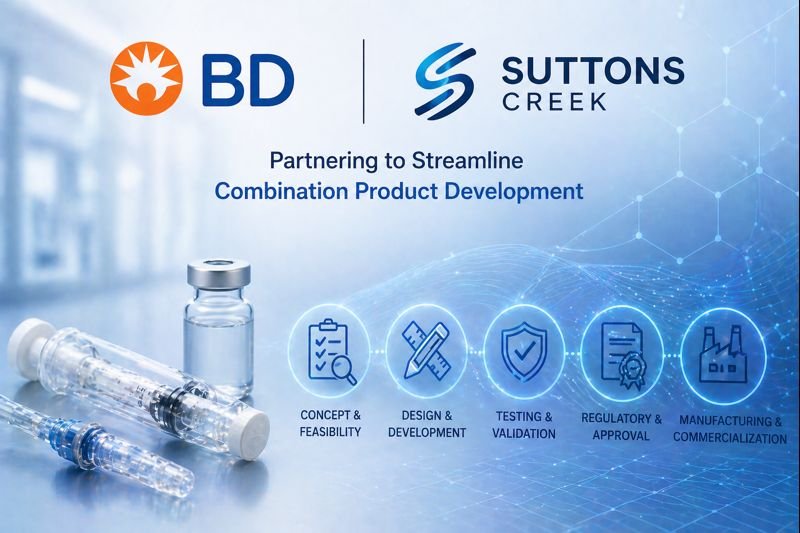
The collaboration brings together consulting, device agnostic testing, and drug delivery expertise to help pharmaceutical and biotech companies reduce risk and navigate complexity for combination products, including biologics and GLP1 therapies
Becton, Dickinson and Company (BD) (NYSE:BDX), one of the largest global medical technology companies in the world, and Suttons Creek, a BlueRidge Life Sciences company, announced a strategic, non-exclusive collaboration designed to help pharmaceutical and biotech companies more efficiently navigate the engineering, testing, quality and regulatory complexity associated with combination product development.
Under the collaboration, ZebraSci, BD’s device-agnostic combination product testing organization, is complemented by Sutton’s Creek combination product development and systems integration expertise. ZebraSci provides objective, data-driven testing services that support informed decision making across feasibility, performance, verification and validation activities.
As pharmaceutical pipelines increasingly include biologics, GLP-1 therapies and other complex drug-device combinations, development teams often face fragmented vendor ecosystems and disconnected workstreams. The ZebraSci and Suttons Creek collaboration is intended to support greater coordination across development activities while preserving customers’ flexibility in selecting partners and technologies.
“Combination product development increasingly requires close coordination across strategy, testing and delivery system considerations,” said Patrick Jeukenne, Worldwide President, BD Pharmaceutical Systems. “This collaboration brings together complementary expertise from both companies, helping customers reduce development risk and address regulatory considerations while maintaining choice and flexibility in how they move their programs forward.
The BD ZebraSci and Suttons Creek collaboration will help biotech and pharma combination product development teams navigate tight timelines and increasingly complex delivery requirements, especially as biologics and GLP-1 therapies gain traction. By addressing potential gaps and handoffs earlier in the process, the model is intended to support more predictable development pathways and reduce the likelihood of late-stage rework.
“Combination product development spans multiple vendors and siloed workstreams, driving friction, delays, duplication, and regulatory risk," said Carolyn Dorgan, Vice President of Solutions Engineering at Suttons Creek. This fragmentation often drives FDA data requests stemming from misaligned strategy and testing partners—our collaboration enables a more coordinated and efficient path forward."
Under the collaboration, customers will benefit from:
- Earlier alignment across strategy, testing, and delivery device considerations.
- Strengthening integration and coordination across the planning and execution of key Design History File deliverables, which should reduce development and regulatory risks.
- Faster decision-making and fewer delays caused by disconnected vendor handoffs.
- More efficient management of external partners.
- Objective device evaluation supported by ZebraSci’s testing expertise.
- Continued flexibility to choose the providers and solutions best suited to their program.
Because Suttons Creek often works with clients early in product planning and development strategy, the collaboration creates an opportunity to introduce testing and delivery considerations sooner—before timing gaps, supplier onboarding issues or misaligned assumptions can delay downstream work. At the same time, ZebraSci can identify customers who would benefit from strategic and development support earlier in the process, creating a more connected model across the combination product lifecycle.
By reducing fragmentation and improving continuity between planning and execution, the collaboration model is intended to help sponsors move from concept to clinical review and ultimately to market with greater efficiency and confidence.
Most Read
- Can APAC Biomanufacturing Decarbonise Without Pricing Itself Out?
- The Algorithm on the GMP Floor: AI Promises a Smarter Plant. Regulators Demand the Audit Trail.
- APAC's Peptide-Capacity Gamble
- After the Rush: APAC's mRNA and Vaccine Capacity Hangover
- The Biosimilar Race: Factory to the World — or Stuck in the Copycat Economy?
- The Vein-to-Vein Problem: Can APAC's Cold Chain Carry Advanced Therapies?
- Vectors, Plasmids and the CGT Trap: APAC's Cell and Gene Therapy Ambitions Face an Upstream Bottleneck
- Can APAC Build Radioligand Therapy Before the Atoms Decay?
- The Great Biopharma Reset: 50 Developments That Changed Everything in H1 2026
- Beyond the Trial: Can Real-World Evidence Earn Regulatory Trust in APAC?
- Beyond the Obvious Giant: Where APAC's Clinical Trials Go Next
- The Frontier That Won’t Quite Arrive
Bio Jobs
- Sanofi Turns The Page As Belén Garijo Steps In And Paul Hudson Steps Out
- Global Survey Reveals Nearly 40% of Employees Facing Fertility Challenges Consider Leaving Their Jobs
- BioMed X and AbbVie Begin Global Search for Bold Neuroscience Talent To Decode the Biology of Anhedonia
- Thermo Fisher Expands Bengaluru R&D Centre to Advance Antibody Innovation and Strengthen India’s Life Sciences Ecosystem
- Accord Plasma (Intas Group) Acquires Prothya Biosolutions to Expand Global Plasma Capabilities
- ACG Announces $200 Million Investment to Establish First U.S. Capsule Manufacturing Facility in Atlanta
- AstraZeneca Invests $4.5 Billion to Build Advanced Manufacturing Facility in Virginia, Expanding U.S. Medicine Production
News