
Scaling Personalised Therapies Across APAC Starts With Supply Chain Readiness
11 November 2026 | Wednesday | Expert Insight
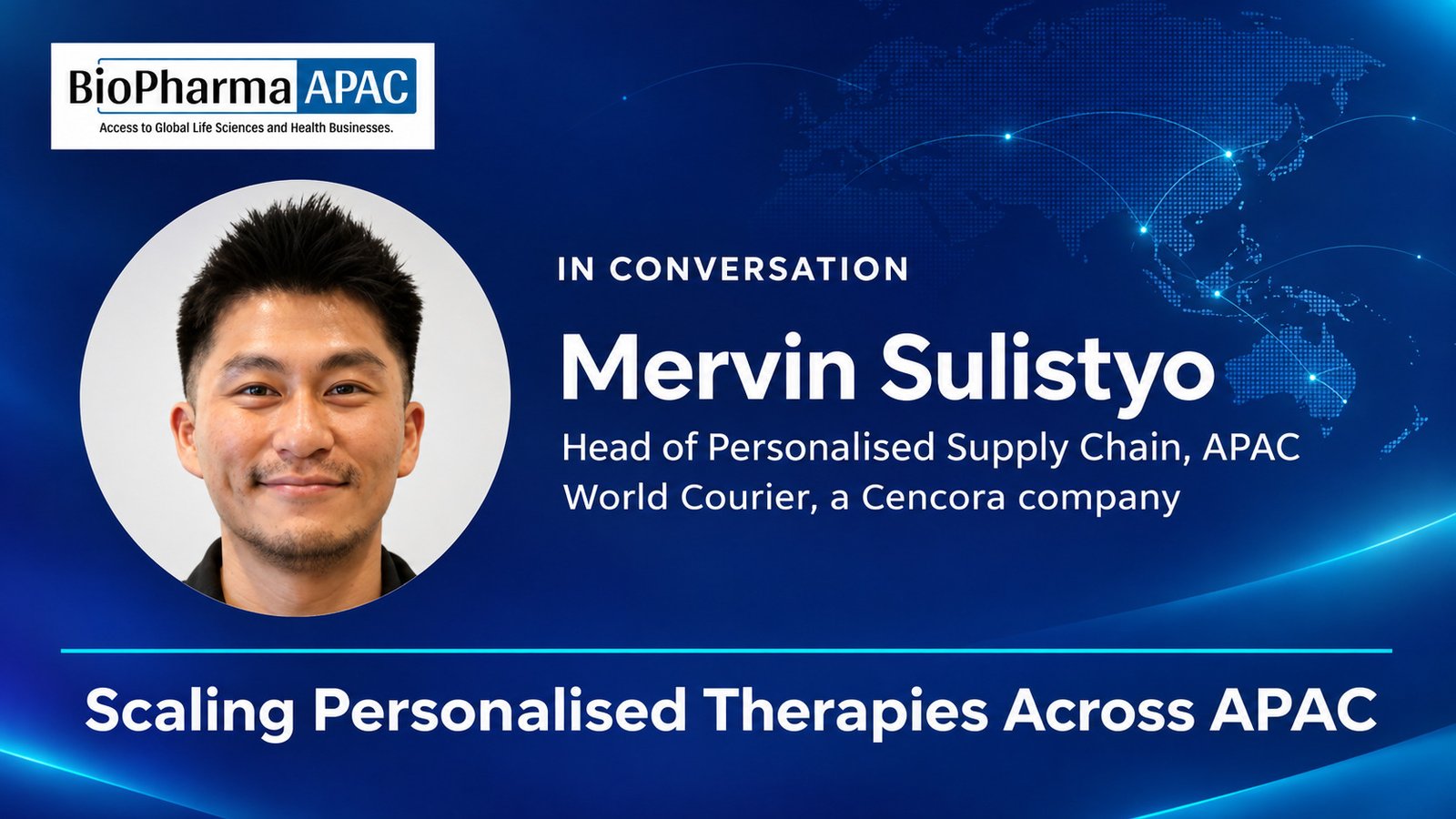
As cell and gene therapies advance across Asia-Pacific, supply chains must connect complex manufacturing processes with individual patients’ treatment schedules. In this BioPharma APAC interview, Mervin Sulistyo, Head of Personalised Supply Chain, APAC, World Courier, a Cencora company, explores the regulatory, operational and infrastructure challenges shaping commercial readiness. He explains why early planning, regional collaboration and shipment visibility are essential to scaling access while protecting every patient’s treatment opportunity.
Asia-Pacific has emerged as a leading hub for cell and gene therapy clinical trials. How is this rapid growth reshaping supply chain requirements, and where do you see the most significant gaps between clinical innovation and commercial readiness?
Asia-Pacific has become a major growth engine for cell and gene therapy. The region has overtaken North America in active CGT clinical trials, with 982 active trials and more than 738 developers. That growth shows how quickly personalised therapies are moving from scientific promise toward clinical and commercial reality.
The supply chain now has to evolve at the same pace. These therapies may represent a single dose for a single patient, with a specific treatment window and little room for delay. That requires supply chain planning to begin much earlier in development.
One of the biggest gaps we see is between having a clinically promising therapy and having an operating model that can reliably reach patients across multiple markets. Emerging biotechs may have deep scientific expertise, but they do not always have regulatory knowledge, commercial infrastructure or operational partners in every country they plan to enter.
Commercial readiness therefore needs to include supply chain readiness from the beginning. Companies need to understand how manufacturing, import and export requirements, customs, treatment-center delivery and patient access will fit together before launch.
With APAC comprising diverse regulatory frameworks, customs procedures and market-specific requirements, what are the biggest logistical barriers to delivering time- and temperature-sensitive personalised therapies across the region?
Asia-Pacific cannot be treated as a single market. Japan, China, Korea, Indonesia and Singapore all have different regulatory pathways, customs expectations, healthcare systems and infrastructure.
For a personalised therapy, those differences can have a direct impact on the patient timeline. A product may need to move from Asia to a manufacturing site in the US or Europe and then return to a treatment center. Every additional border crossing, handoff and quality release step introduces another dependency.
Climate and infrastructure also vary significantly. Some parts of Southeast Asia are consistently warm, while airport and GDP infrastructure may differ from what companies are accustomed to in the US or Europe. That makes route design, temperature control and contingency planning especially important.
The key is to combine global reach with local knowledge. Companies need teams that understand how each market works, while designing regional processes that are as consistent as possible. The goal should be to satisfy local requirements without creating an entirely separate supply chain for every country.
Unlike conventional pharmaceuticals, personalised therapies often require patient-specific manufacturing and delivery schedules. How can emerging biotechs build scalable, patient-centric supply chain models without compromising treatment integrity, speed or cost efficiency?
The first step is recognising that personalised therapies require a fundamentally different operating model.
Traditional pharmaceuticals are generally manufactured in batches and moved closer to market before they are needed. Personalised therapies are often demand-led and connected directly to an individual patient. In autologous cell therapy, for example, the starting material may come from the patient themselves, so manufacturing timelines, quality release, customs clearance, transportation and treatment scheduling all become part of the same patient journey.
For an emerging biotech, scalability does not mean building a different solution in every market. It means standardising what can be standardised while allowing for the local requirements that cannot.
That may involve deciding whether a market is best served through a distributor, local entity, regional depot, direct-to-patient model or a combination of approaches. It also means working with partners that can connect those pieces instead of relying on a fragmented group of local vendors.
The earlier those decisions are made, the easier it becomes to create a model that can grow without adding unnecessary cost or operational complexity.
As more cell and gene therapies transition from clinical trials towards commercialisation, what operational and infrastructure investments should biotechnology companies prioritise to ensure reliable cross-border distribution and broader patient access?
Companies should start with the infrastructure that protects continuity across the entire patient journey.
That includes validated temperature-control solutions, reliable transportation lanes, contingency routes, local customs expertise and visibility across every handoff. For therapies manufactured outside the region, companies also need to account for longer transit times and additional quality-release requirements.
Just as important is building the right commercial infrastructure. A route that works for a clinical trial may not be sufficient once patient volumes increase or a therapy enters several markets at once. Companies should think about regional distribution models, depot strategies, treatment-center delivery and patient-support services before commercial demand arrives.
Patient access also needs to remain part of those decisions. Direct-from-patient sample collection, for example, can reduce the need for some patients to travel repeatedly to major centers during a clinical trial. After approval, coordinated delivery and patient-support models can reduce disruption for people receiving treatment.
The supply chain becomes much more resilient when these capabilities are designed together rather than added one at a time as the therapy expands.
How are technologies such as real-time shipment visibility, predictive analytics, AI-driven monitoring and advanced temperature-control solutions transforming the management of complex personalised therapy supply chains across APAC?
Technology is becoming an important enabler, particularly because personalised therapies leave very little room for uncertainty.
Real-time visibility allows teams to see where a shipment is, whether it remains within the required temperature range and whether intervention may be needed. If a shipment is delayed, loaded onto the wrong aircraft or begins to experience a temperature issue, teams can act before the problem reaches the patient.
Predictive analytics and AI can add another layer by using historical shipment data to identify route risks, such as weather, offloads, strikes or geopolitical disruption, before a shipment begins. That can support better route selection and stronger contingency planning.
The next step is connecting logistics visibility more closely with the broader patient journey. If manufacturing milestones, quality release, shipment timing and treatment scheduling are more integrated, clinicians can plan with greater confidence and patients can face less uncertainty.
Technology should support experienced teams rather than replace them. In personalised medicine, human judgement remains essential because every shipment can represent one patient and one treatment opportunity.
Looking ahead to 2027 and beyond, how do you envision the personalised medicine supply chain evolving across Asia-Pacific, and what strategic changes must industry stakeholders embrace to make advanced therapies more accessible, commercially sustainable and scalable?
I expect the supply chain to become increasingly personalised alongside the therapies themselves.
That will mean more direct connections between manufacturing sites, treatment centers and patients, rather than relying on traditional distribution models designed for large batches of medicine. We will also see companies build more regional infrastructure so therapies and supporting materials can be positioned closer to the markets where they are needed.
For emerging biotechs, the strategic shift is to treat supply chain design as part of commercialisation rather than something that happens after regulatory approval. Decisions around market entry, manufacturing footprint, distribution partners, treatment-center readiness and patient support all influence whether a therapy can scale successfully.
Across APAC, collaboration will also be critical. Regulators, manufacturers, logistics providers, healthcare organizations and treatment centers all need to work together to reduce unnecessary complexity while preserving the local requirements that protect patients.
Ultimately, scalability should not come at the expense of personalisation. The most successful models will be those that can grow across markets while still treating every shipment as part of an individual patient’s care journey.
Most Read
- Can APAC Biomanufacturing Decarbonise Without Pricing Itself Out?
- The Algorithm on the GMP Floor: AI Promises a Smarter Plant. Regulators Demand the Audit Trail.
- APAC's Peptide-Capacity Gamble
- After the Rush: APAC's mRNA and Vaccine Capacity Hangover
- The Biosimilar Race: Factory to the World — or Stuck in the Copycat Economy?
- The Vein-to-Vein Problem: Can APAC's Cold Chain Carry Advanced Therapies?
- Vectors, Plasmids and the CGT Trap: APAC's Cell and Gene Therapy Ambitions Face an Upstream Bottleneck
- Can APAC Build Radioligand Therapy Before the Atoms Decay?
- The Great Biopharma Reset: 50 Developments That Changed Everything in H1 2026
- Beyond the Trial: Can Real-World Evidence Earn Regulatory Trust in APAC?
- Beyond the Obvious Giant: Where APAC's Clinical Trials Go Next
- The Frontier That Won’t Quite Arrive
Bio Jobs
- Sanofi Turns The Page As Belén Garijo Steps In And Paul Hudson Steps Out
- Global Survey Reveals Nearly 40% of Employees Facing Fertility Challenges Consider Leaving Their Jobs
- BioMed X and AbbVie Begin Global Search for Bold Neuroscience Talent To Decode the Biology of Anhedonia
- Thermo Fisher Expands Bengaluru R&D Centre to Advance Antibody Innovation and Strengthen India’s Life Sciences Ecosystem
- Accord Plasma (Intas Group) Acquires Prothya Biosolutions to Expand Global Plasma Capabilities
- ACG Announces $200 Million Investment to Establish First U.S. Capsule Manufacturing Facility in Atlanta
- AstraZeneca Invests $4.5 Billion to Build Advanced Manufacturing Facility in Virginia, Expanding U.S. Medicine Production
News


