
The 10 New Drugs Japan Expects to Sell Most: Peak-Sales Forecasts From Every 2026 NHI Listing Round
17 November 2026 | Tuesday | Analysis
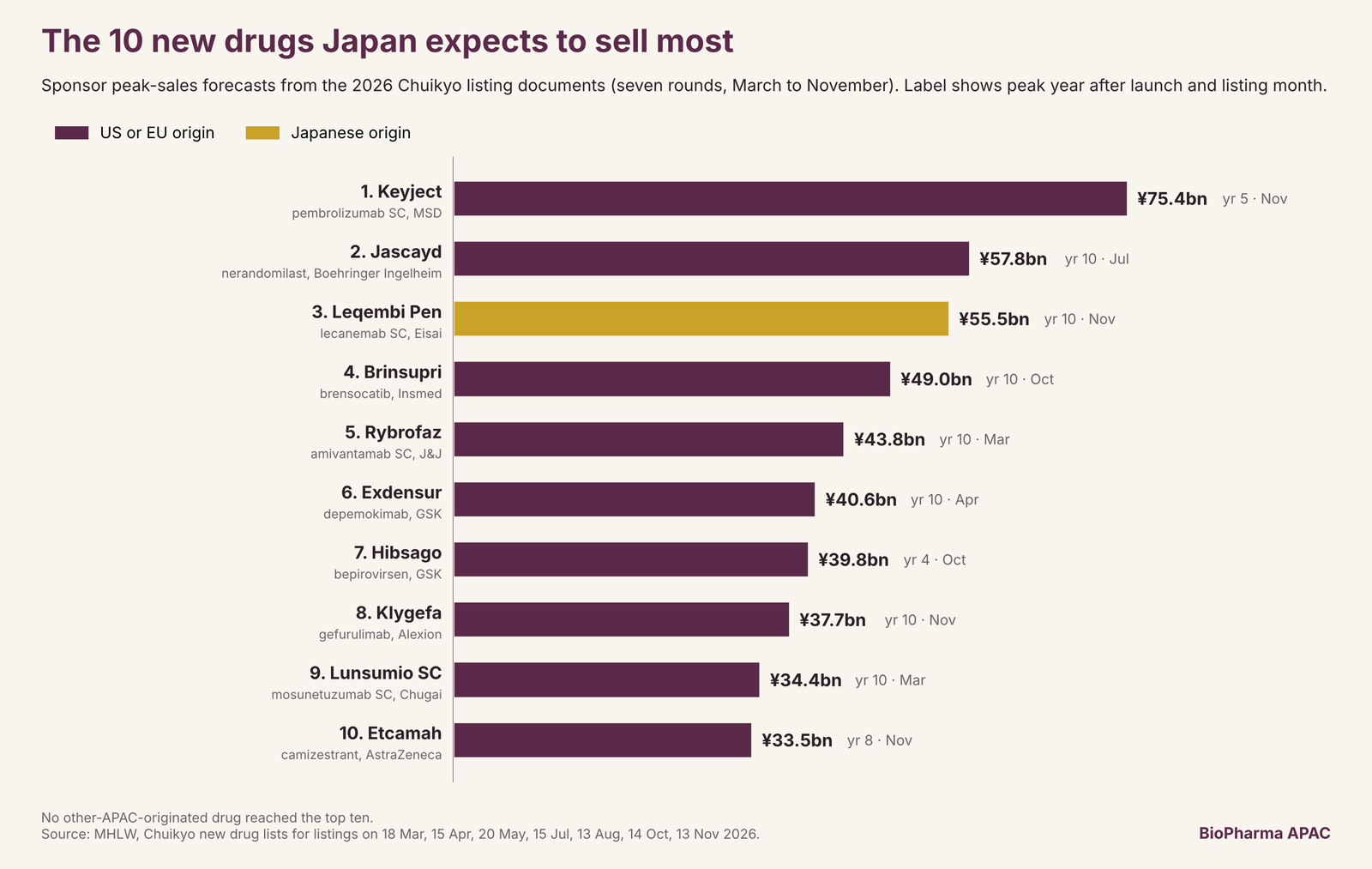
On 13 November, 16 new medicines joined Japan's National Health Insurance (NHI) price list. It was the last of the seven listing rounds Japan now runs each year, and it arrived in the quiet weeks before the government settles its FY2027 off-year price revision. That makes this the right moment to close the books on what the year's launches are expected to earn.
Japan offers something no other market in the region does. Every time Chuikyo, the Central Social Insurance Medical Council, approves a listing, the health ministry publishes the sponsor's own forecast of peak annual sales, the year that peak is reached and the number of patients expected to be on treatment at that point. The figure sits on the same sheet as the price, the pricing method and every premium granted or refused. In the US, China or South Korea, peak-sales expectations live in analyst models and investor decks. In Japan they are an official, comparable, public record.
We read every new-drug listing sheet from the 2026 rounds (18 March, 15 April, 20 May, 15 July, 13 August, 14 October and 13 November) and ranked the 63 listed ingredients by forecast peak sales. The top ten follows, with the price, the method behind it and the premiums each one won or lost. The ranking is less interesting as a leaderboard than as a map: it shows quite precisely what Japan's pricing system is willing to pay for in 2026, and what it is not.
The year in four numbers
- ¥829.8 billion. Total forecast peak sales across the 63 ingredients listed in 2026, by our count from the Chuikyo sheets. AnswersNews put the 2025 total at ¥674.3 billion across 55 ingredients, so 2026 is running roughly a fifth higher.
- Ingredients with a forecast of ¥10 billion or more, against 25 in 2025. Fewer big launches, but bigger ones at the top.
- 56 percent. Share of the year's forecast value held by the top ten (¥467.5 billion).
- 33 percent. Share delivered by the November round alone, which carried four of the top ten, including the year's number one.
The top forecast of 2026, ¥75.4 billion for MSD's Keyject, is well above 2025's leader (MSD's Winrevair at ¥54.4 billion) but below the Alzheimer's peaks of 2024 (Kisunla, ¥79.6 billion) and 2023 (Leqembi IV, ¥98.6 billion). For a market whose ethical drug sales passed ¥11 trillion on an NHI price basis in FY2025, no single 2026 launch is expected to move the national bill on its own. Collectively, they are another matter.
The ranking
Forecast peak sales as filed by the sponsor in the Chuikyo listing documents. Peak year counts fiscal years from launch. Prices are per the unit shown.
|
# |
Drug |
Company (origin) |
Indication |
Listed |
NHI price |
Method and premiums |
Peak sales (year) |
|
1 |
Keyject (pembrolizumab / berahyaluronidase alfa, SC) |
MSD (US) |
All Keytruda indications |
13 Nov |
¥368,613 (395mg); ¥728,172 (790mg) |
Comparator (II) vs Keytruda IV; no premium |
¥75.4bn (yr 5) |
|
2 |
Jascayd (nerandomilast) |
Boehringer Ingelheim (Germany) |
IPF and PPF |
15 Jul |
¥4,190.10 (9mg); ¥8,363.00 (18mg) |
Comparator (I) vs Ofev; usefulness (I) 35%, marketability (I) 5% |
¥57.8bn (yr 10) |
|
3 |
Leqembi Pen (lecanemab, SC) |
Eisai (Japan) |
Early Alzheimer's disease |
13 Nov |
¥27,141 (250mg pen) |
Comparator (I) vs Leqembi IV; no premium |
¥55.5bn (yr 10) |
|
4 |
Brinsupri (brensocatib) |
Insmed (US) |
Non-CF bronchiectasis |
14 Oct |
¥24,695.70 (25mg) |
Cost accounting; usefulness (I) 45%, paediatric 5%; coefficient 0 |
¥49.0bn (yr 10) |
|
5 |
Rybrofaz (amivantamab / vorhyaluronidase alfa, SC) |
Janssen, J&J (US) |
EGFR-mutant NSCLC |
18 Mar |
¥480,046 (10mL vial) |
Comparator (I); no premium |
¥43.8bn (yr 10) |
|
6 |
Exdensur (depemokimab) |
GSK (UK) |
Severe asthma; CRSwNP |
15 Apr |
¥1,143,284 (100mg) |
Comparator (I); usefulness (II) 5%, paediatric 5% |
¥40.6bn (yr 10) |
|
7 |
Hibsago (bepirovirsen) |
GSK (UK), from Ionis (US) |
Chronic hepatitis B, functional cure |
14 Oct |
¥183,015 (150mg syringe) |
Cost accounting; usefulness (I) 50%, sakigake 10%; coefficient 0 |
¥39.8bn (yr 4) |
|
8 |
Klygefa (gefurulimab) |
Alexion, AstraZeneca (US/UK) |
Generalised myasthenia gravis |
13 Nov |
¥909,041 (300mg autoinjector) |
Comparator (I) vs Ultomiris; no premium |
¥37.7bn (yr 10) |
|
9 |
Lunsumio SC (mosunetuzumab) |
Chugai, Roche group (US) |
R/R follicular lymphoma |
18 Mar |
¥266,843 (5mg); ¥2,327,787 (45mg) |
Comparator (I); no premium |
¥34.4bn (yr 10) |
|
10 |
Etcamah (camizestrant) |
AstraZeneca (UK) |
ESR1-mutant HR+/HER2- breast cancer |
13 Nov |
¥55,103.60 (75mg) |
Comparator (I) vs Imulrio; no premium |
¥33.5bn (yr 8) |
Source: MHLW, Chuikyo general assembly papers, new drug lists for each 2026 listing date. Origin reflects where the molecule was discovered or developed, not the Japanese marketing company.
The ten, one by one
1. Keyject: the biggest forecast belongs to a faster way to give the biggest drug
MSD (Merck & Co., US) | All indications of IV Keytruda | Listed 13 Nov 2026 | ¥368,613 per 395mg vial; ¥728,172 per 790mg vial | Comparator method (II) vs Keytruda IV, no premium | ¥75.4bn peak in year 5, 24,000 patients
Keytruda has been Japan's best-selling medicine for more than two years running, so it is no surprise that a subcutaneous version tops the table. What stands out is how it was priced. Keyject went through comparator method (II), the route reserved for products judged to offer little new, and its daily price of ¥17,553 lands about 7.6 percent below the ¥18,996 a day of the IV infusion it is designed to replace. Japan is paying less per day for the newer, more convenient form.
The forecast reflects switching, not new demand: 24,000 patients at peak, reached in year five rather than the usual ten. MSD has a short runway to move as much of the Keytruda base as possible onto a one-to-two-minute injection before biosimilar pressure arrives on the molecule itself. There is also a regional thread here. The berahyaluronidase alfa that makes the subcutaneous dose possible was developed and is manufactured by Alteogen of South Korea, which makes Korea's enzyme platform a quiet partner in Japan's largest new forecast of the year.
2. Jascayd: the only top-five drug that earned a real premium
Boehringer Ingelheim (Germany) | Idiopathic and progressive pulmonary fibrosis | Listed 15 Jul 2026 | ¥4,190.10 per 9mg tablet; ¥8,363.00 per 18mg tablet | Comparator method (I) vs Ofev; usefulness premium (I) 35%, marketability premium (I) 5% | ¥57.8bn peak in year 10, 18,000 patients
Nerandomilast is a preferential PDE4B inhibitor and the first new treatment for idiopathic pulmonary fibrosis in more than a decade. That novelty is visible on the price sheet. Priced against Boehringer's own Ofev, it collected a 35 percent usefulness premium plus a 5 percent marketability premium, and because it went through the comparator route, those premiums flowed straight into the price. At 18mg twice daily the daily cost works out to ¥16,726.
Jascayd is the clearest case in the 2026 top ten of Japan doing what its rules promise: rewarding a new mechanism in a disease with few options. It is also designated for cost-effectiveness assessment, so its forecast is the baseline against which its value will be tested once it is on the market.
3. Leqembi Pen: the one Japanese molecule in the top ten
Eisai (Japan), with BioArctic (Sweden) and Biogen | Mild cognitive impairment and mild dementia due to Alzheimer's disease | Listed 13 Nov 2026 | ¥27,141 per 250mg pen | Comparator method (I) vs Leqembi IV, no correction premium | ¥55.5bn peak in year 10, 22,000 patients
Eisai's lecanemab returns to the top of the forecast tables in a new form. The subcutaneous autoinjector was approved in Japan after the US (July 2026) and China (September 2026), making Japan the third country to clear it. The price was set at parity with the IV product, plus the material cost of the pen, which lifted the unit price from ¥25,865 to ¥27,141. The daily price is ¥7,755 against ¥7,390 for the infusion, a gap of about 5 percent that is entirely device.
The more important decision was made the same day: Chuikyo also added the pen to the list of drugs eligible for home self-injection. That is what turns a formulation change into a capacity change for maintenance dosing, and it is why Eisai is forecasting 22,000 patients at peak. Gold on our chart is lonely. Leqembi Pen is the only product in the top ten that originated in Japan.
4. Brinsupri: a first-in-class drug whose premium was cancelled by its cost sheet
Insmed (US) | Non-cystic fibrosis bronchiectasis | Listed 14 Oct 2026 | ¥24,695.70 per 25mg tablet | Cost accounting; usefulness premium (I) 45%, paediatric premium 5%; premium coefficient 0 | ¥49.0bn peak in year 10, 9,500 patients
Brensocatib, an oral DPP1 inhibitor, is the first drug approved in Japan for non-CF bronchiectasis. With no comparator available, it was priced by cost accounting. The pricing organisation judged it worthy of a 45 percent usefulness premium and a 5 percent paediatric premium, then applied a coefficient of zero because cost disclosure fell short of the threshold. Net uplift: nothing.
It is the year's highest forecast for a product priced from costs, and one of two top-ten drugs (the other is Hibsago) where Japan formally recognised innovation and then declined to pay for it. Insmed's once-daily tablet still prices at roughly ¥9 million a year at list, and its forecast assumes about ¥5.2 million in sales per treated patient at peak.
5. Rybrofaz: subcutaneous amivantamab opens the year
Janssen, Johnson & Johnson (US; antibody from Genmab, Denmark) | EGFR exon 20 insertion and EGFR-mutant non-small cell lung cancer | Listed 18 Mar 2026 | ¥480,046 per 10mL vial | Comparator method (I), no correction premium | ¥43.8bn peak in year 10, 6,900 patients
The March round's leader was the first sign of the theme that would define the year. Rybrofaz combines amivantamab with vorhyaluronidase alfa so that a bispecific antibody previously given by long IV infusion can be injected. It took no correction premium. Its forecast rests on displacing time in the infusion chair rather than on a new clinical claim.
With 6,900 patients at peak and ¥6.3 million of sales per patient, it is one of the more expensive per-head forecasts in the top ten, which reflects lung cancer's long treatment durations rather than the pricing route.
6. Exdensur: twice-a-year dosing, modestly rewarded
GSK (UK) | Severe asthma uncontrolled on existing therapy; chronic rhinosinusitis with nasal polyps | Listed 15 Apr 2026 | ¥1,143,284 per 100mg syringe or pen | Comparator method (I); usefulness premium (II) 5%, paediatric premium 5% | ¥40.6bn peak in year 10, 18,000 patients
Depemokimab is an ultra-long-acting anti-IL-5 antibody dosed every six months. On the comparator method that gives a daily price of ¥6,282, and the sheet awarded a 5 percent usefulness premium for the dosing interval and 5 percent for paediatric use. Those are the smallest premiums in Japan's usefulness scale, but they count, because comparator pricing passes them through in full.
Exdensur is also flagged for cost-effectiveness assessment. Its forecast, 18,000 patients and ¥2.3 million per patient a year at peak, makes it the lowest per-patient revenue in the top ten. That is what a crowded biologic class looks like in Japan: volume, not price, carries the number.
7. Hibsago: a world first in Japan, priced at cost
GSK (UK), licensed from Ionis (US) | Functional cure in chronic hepatitis B | Listed 14 Oct 2026 | ¥183,015 per 150mg syringe | Cost accounting; usefulness premium (I) 50%, sakigake premium 10%; premium coefficient 0 | ¥39.8bn peak in year 4, 5,600 patients
Bepirovirsen received its first approval anywhere in the world from Japan's health ministry on 24 August 2026, ahead of the FDA. It is an antisense oligonucleotide aimed at functional cure rather than lifelong viral suppression. The pricing organisation awarded it the largest usefulness premium in the top ten, 50 percent, plus 10 percent for sakigake designation. The zero coefficient wiped out all 60 percent.
The peak arrives in year four because treatment is a finite course, not chronic therapy. Hibsago is the clearest illustration in 2026 of a tension Japan has not resolved: the system rewards being first to Japan with designations, and then the cost-accounting rules take the reward back unless the manufacturer opens its books.
8. Klygefa: Japan approved it first, and paid ravulizumab's price
Alexion, AstraZeneca Rare Disease (US/UK) | Generalised myasthenia gravis inadequately controlled by steroids or other immunosuppressants | Listed 13 Nov 2026 | ¥909,041 per 300mg autoinjector; ¥907,922 per syringe | Comparator method (I) vs Ultomiris, no correction premium | ¥37.7bn peak in year 10, 795 patients
Gefurulimab, a weekly self-injected C5 inhibitor that also binds albumin, was approved in Japan in September 2026, the same month Europe's CHMP issued its positive opinion. Japan priced it at daily parity with Alexion's own Ultomiris: ¥129,863 a day against ¥129,640, the small difference being the device.
Klygefa's forecast is the most concentrated in the top ten. It needs just 795 patients at peak to reach ¥37.7 billion, which implies about ¥47 million of sales per patient a year. In a list dominated by broad-population products, it is the reminder that Japan's complement inhibitor market is priced at rare-disease levels and stays there.
9. Lunsumio SC: the bispecific goes under the skin
Chugai, Roche group (origin Genentech, US) | Relapsed or refractory follicular lymphoma | Listed 18 Mar 2026 | ¥266,843 per 5mg vial; ¥2,327,787 per 45mg vial | Comparator method (I), no correction premium | ¥34.4bn peak in year 10, 1,600 patients
Mosunetuzumab's subcutaneous presentation is the third of four injectable reformulations in the top ten. Like the others, it priced on the comparator route with no correction premium. Its forecast implies roughly ¥21.5 million in sales per patient at peak, second only to Klygefa on that measure.
Chugai books it as a Japanese company, but the molecule came from Genentech, which is why it is plum, not gold, on our chart. The distinction matters for anyone reading the ranking as a scorecard of Japanese R&D.
10. Etcamah: a price inherited from a rival's foreign-price uplift
AstraZeneca (UK) | ESR1-mutant, HR-positive, HER2-negative inoperable or recurrent breast cancer without progression on endocrine therapy | Listed 13 Nov 2026 | ¥55,103.60 per 75mg tablet | Comparator method (I) vs Imulrio, no correction premium | ¥33.5bn peak in year 8, 2,700 patients
Camizestrant's price tells a story that runs across two listing rounds. Its comparator is Eli Lilly's oral SERD Imulrio, which joined the price list on 14 October. Imulrio's comparator-based price of ¥13,775.90 per tablet was doubled to ¥27,551.80 by Japan's foreign average price adjustment, the maximum uplift the rule allows. A month later Etcamah was set at exact daily parity with Imulrio's adjusted price: ¥55,103.60 a day.
In other words, the price Japan pays for Etcamah was determined largely by what Lilly's drug costs abroad. Etcamah was approved in Japan on 19 June and listed only in November, at the company's request. Its forecast, built on ctDNA-triggered switching, assumes about ¥12.4 million in sales per patient at peak.
What the ranking says about where Japan will pay
It pays for reach, not for premiums
Six of the ten carried no correction premium at all. Two more (Brinsupri and Hibsago) were awarded premiums that the coefficient reduced to zero. Only Jascayd and Exdensur ended up with a price lifted by a premium, and Exdensur's was the minimum on the scale. The big forecasts in Japan this year are built on patient numbers and switching, not on the system paying a markup for innovation.
2026 was the subcutaneous year
Four of the top ten (Keyject, Leqembi Pen, Rybrofaz and Lunsumio SC) are injectable versions of antibodies Japan already reimburses. Together they forecast ¥209.1 billion, 45 percent of the top ten's value. Every one was priced at or below the daily cost of its IV parent, with device costs the only uplift. Japan is clearly willing to fund the shift of biologics out of infusion suites, as long as it does not cost more per day. For sponsors, that makes reformulation a volume and lifecycle play, not a pricing one.
Cost accounting has become a premium-free zone
By our count, 18 new drugs were priced by cost accounting across the seven 2026 rounds. Seventeen of them had their premium coefficient set at zero, whatever premiums the pricing organisation recognised. The single exception was Nipro's CB-Pack continuous blood-purification fluid, a domestic product that kept a full coefficient. For overseas companies whose Japanese affiliates import finished product and cannot disclose upstream manufacturing costs, a premium under cost accounting is now close to theoretical. That cost Insmed a 50 percent uplift and GSK a 60 percent one in October alone.
Japan is increasingly a first market, but not for Japanese drugs
Two top-ten products, Hibsago and Klygefa, were approved in Japan before anywhere else. So was MSD's HIV combination Idvinso (April, ¥13.2 billion forecast) and Haihe Biopharma's PI3K-alpha inhibitor Haizexin (July, ¥1.4 billion), a Chinese-originated drug that chose Japan for its first approval. The traffic also runs the other way: Takeda's narcolepsy drug Orzeyful, listed in October with a ¥7.0 billion forecast, was approved in China before Japan. None of these APAC stories reached the top ten. The regional R&D map is visible in the 2026 sheets, but at the lower end of the forecast range.
Listing timing is now a pricing tool
Several of the year's launches were approved months before they were listed. Etcamah waited roughly five months; Imulrio waited close to 300 days; GSK's Blenrep, approved in 2025, was listed only in March 2026. Chuikyo members have criticised the gaps, and some companies held back products from the April round. The Etcamah and Imulrio sequence shows why a sponsor might wait: in Japan's comparator system, the order and timing of listings decide whose price becomes the anchor.
A forecast is also a tripwire
These numbers are not just marketing ambition. Japan uses the forecast filed at listing as one of the reference points for market-expansion repricing once actual sales are known. A sponsor that forecasts low and sells high risks a later price cut; one that forecasts high signals scale to the pricing organisation from day one. Read the ten forecasts above as commitments made in front of the regulator, not as best cases.
Sidebar: the regenerative medicine listings of 2026
Regenerative medicine products are priced under a separate framework, so they sit outside the ranking. They were among the most watched listings of the year, including the world's first two iPSC-derived products to win reimbursement.
|
Product |
Company |
Indication |
Listed |
Price |
Method and premiums |
Peak sales |
|
Elevidys (delandistrogene moxeparvovec) |
Chugai (origin Sarepta, US) |
Duchenne muscular dystrophy |
20 Feb |
¥304,972,042 per patient |
Cost accounting; marketability (I) 10%; coefficient 0 |
¥11.3bn (yr 2) |
|
Amchepry (raguneprocel, iPSC-derived) |
Sumitomo Pharma (Japan) |
Parkinson's disease |
20 May |
¥55,306,737 |
Cost accounting; marketability (I) 10%, sakigake 10%; coefficient 1.0 |
¥7.4bn (yr 10) |
|
Akuugo (vandefitemcel) |
SanBio (Japan) |
Chronic motor paralysis after traumatic brain injury |
20 May |
¥72,716,528 |
Cost accounting; marketability (I) 10%, sakigake 10%; coefficient 1.0 |
¥2.8bn (yr 10) |
|
Zolgensma intrathecal |
Novartis (US) |
Spinal muscular atrophy |
20 May |
¥167,077,222 per patient |
Same price as IV Zolgensma |
¥4.3bn (yr 2) |
|
Edstiladrin (nadofaragene firadenovec) |
Ferring (Switzerland) |
BCG-unresponsive high-risk NMIBC |
15 Jul |
¥2,327,036.90 per vial |
Cost accounting; usefulness (II) 10%, marketability (I) 10%; coefficient 0 |
¥20.3bn (yr 10) |
|
Allostem Sheet |
Ishin Pharma (Japan) |
Epidermolysis bullosa |
15 Jul |
¥182,096 per sheet |
Cost accounting; marketability (I) 10%; coefficient 0 |
¥0.8bn (yr 9) |
|
Telomelysin (suratadenoturev) |
Oncolys BioPharma (Japan) |
Oesophageal cancer unsuited to surgery or chemoradiotherapy |
13 Aug |
¥3,102,489 per vial |
Comparator (I) vs Delytact; usefulness (II), marketability (I), sakigake, each 10% |
¥2.2bn (yr 10) |
|
Riheart (iPSC-derived cardiomyocyte sheet) |
Cuorips (Japan) |
Severe ischaemic heart failure |
1 Sep (planned) |
¥53.2 million |
Cost accounting; marketability (I) 10% |
About ¥5.1bn |
Source: MHLW Chuikyo regenerative product papers (May, July, August 2026); Elevidys and Riheart figures as reported by AnswersNews and Yakuji Nippo.
Three things stand out. First, the colour of this table is the reverse of the ranking: five of the eight regenerative products originated in Japan, against one of the top ten drugs. Second, Amchepry and Akuugo are the only cost-accounted products in Japan this year to keep their premiums in full, because their Japanese developers could disclose costs. Third, scale: Edstiladrin's ¥20.3 billion forecast would have ranked 16th among the year's drugs, while Elevidys set a new national price record at more than ¥300 million per patient. Japan is willing to pay very high unit prices for one-off therapies; it is just not forecasting large volumes for them.
How we built the list
Inclusion: new drugs added to the NHI price list in calendar 2026, counted by ingredient as Chuikyo counts them, including new routes, new combinations and new formulations that went through the new-drug pricing process. Ranking: sponsor peak-sales forecast (予測販売金額, ピーク時) as stated on each Chuikyo pricing sheet. Prices, methods, premiums, patient forecasts and first-approval data come from the same sheets. Origin is where the molecule was discovered or developed. Implied sales per patient is forecast peak sales divided by forecast peak patients and is our calculation. Year-on-year comparisons use AnswersNews's 2025 count, which may differ slightly in scope. This piece carries no FY2027 revision figures; those follow in our separate coverage of the ministers' decision.
Most Read
- Can APAC Biomanufacturing Decarbonise Without Pricing Itself Out?
- The Algorithm on the GMP Floor: AI Promises a Smarter Plant. Regulators Demand the Audit Trail.
- APAC's Peptide-Capacity Gamble
- After the Rush: APAC's mRNA and Vaccine Capacity Hangover
- The Biosimilar Race: Factory to the World — or Stuck in the Copycat Economy?
- The Vein-to-Vein Problem: Can APAC's Cold Chain Carry Advanced Therapies?
- Vectors, Plasmids and the CGT Trap: APAC's Cell and Gene Therapy Ambitions Face an Upstream Bottleneck
- Can APAC Build Radioligand Therapy Before the Atoms Decay?
- The Great Biopharma Reset: 50 Developments That Changed Everything in H1 2026
- Beyond the Trial: Can Real-World Evidence Earn Regulatory Trust in APAC?
- Beyond the Obvious Giant: Where APAC's Clinical Trials Go Next
- The Frontier That Won’t Quite Arrive
Bio Jobs
- Sanofi Turns The Page As Belén Garijo Steps In And Paul Hudson Steps Out
- Global Survey Reveals Nearly 40% of Employees Facing Fertility Challenges Consider Leaving Their Jobs
- BioMed X and AbbVie Begin Global Search for Bold Neuroscience Talent To Decode the Biology of Anhedonia
- Thermo Fisher Expands Bengaluru R&D Centre to Advance Antibody Innovation and Strengthen India’s Life Sciences Ecosystem
- Accord Plasma (Intas Group) Acquires Prothya Biosolutions to Expand Global Plasma Capabilities
- ACG Announces $200 Million Investment to Establish First U.S. Capsule Manufacturing Facility in Atlanta
- AstraZeneca Invests $4.5 Billion to Build Advanced Manufacturing Facility in Virginia, Expanding U.S. Medicine Production
News


