Discount or Validation? Western Pharma’s Appetite for Chinese Assets
24 July 2026 | Friday | Analysis
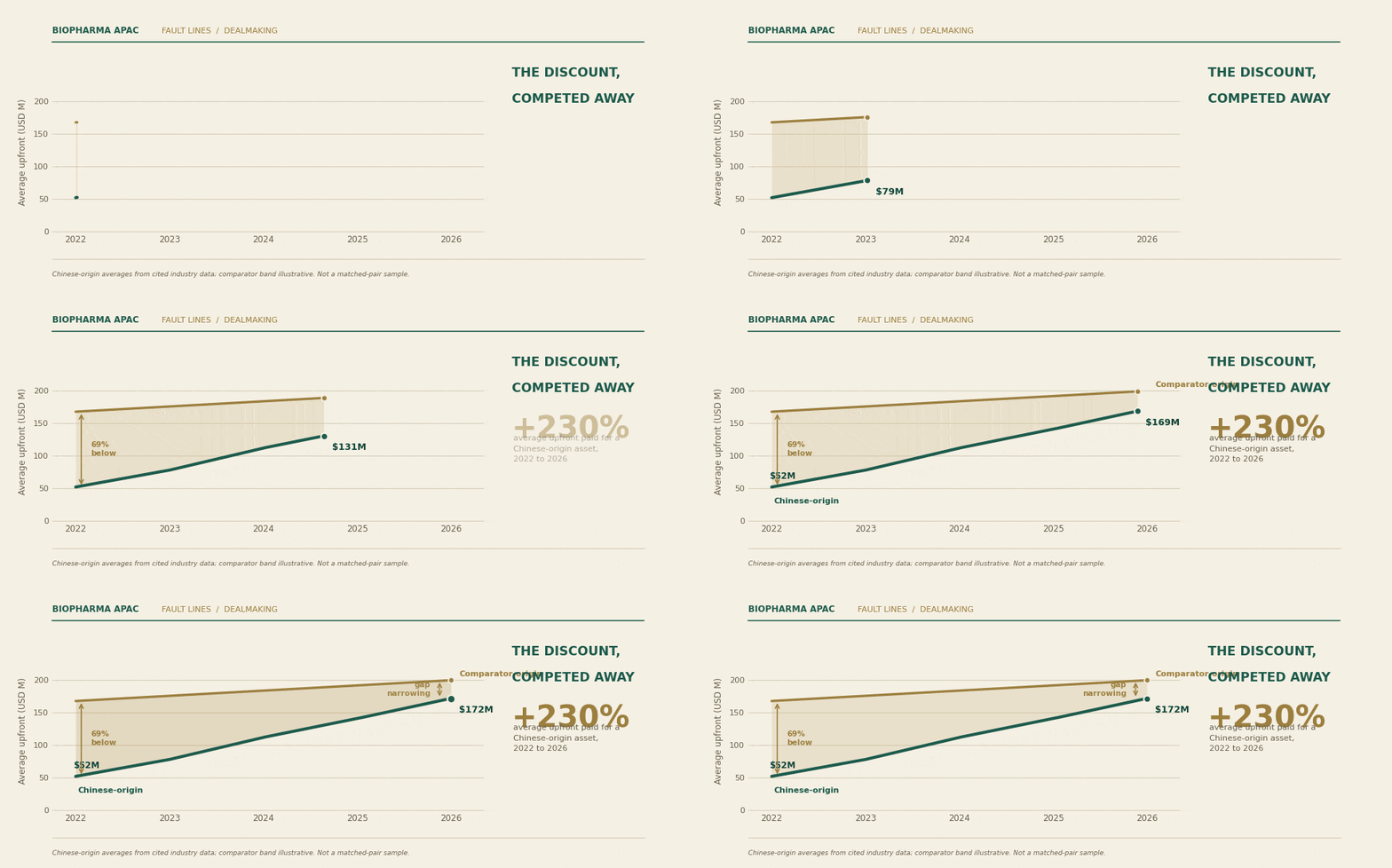
There is a number that has stopped being a niche statistic for Asia-watchers and started reshaping where the global drug industry shops. The average upfront paid by a Western buyer to license a molecule from a Chinese biotech has climbed roughly 230 percent in four years, from about 52 million dollars in 2022 to around 172 million dollars in early 2026. Over the same stretch, Chinese drugmakers went from a rounding error in global out-licensing to signing something on the order of half of all such deals by count, with disclosed 2025 value estimated near 136 billion dollars across roughly 157 transactions. In the first quarter of 2026 alone, cross-border out-licensing out of China reportedly crossed 60 billion dollars.
Those numbers are not in dispute. What they mean is where the argument lives. Ask a business development head at a top-five buyer why the assets came cheap and you will hear a clean, defensible story about development-stage risk, single-country data, and the discipline of paying for probability rather than promise. Ask a Chinese founder who has licensed out, or an analyst who has watched the same molecules read out in the clinic, and you will hear a different story: a persistent haircut applied to Chinese origin itself, a reflex that survived long after the data stopped justifying it.
Both stories are told by serious people. Both are partly true. This piece sets out to separate the part of the price that is risk from the part that is reputation, and to be honest about where the two blur into each other.
The two framings, stated plainly
The buyer’s framing is that a discount, where it exists, is rational. A clinical-stage asset from anywhere is mostly a bundle of unresolved questions, and a molecule whose pivotal evidence sits in a single geography carries a specific, nameable risk: that a Western regulator will want data it does not yet have. Price that risk, the argument goes, and the so-called China discount is not a discount at all. It is the market doing its job.
The seller’s framing is that the haircut is applied first and rationalised second. On this reading, comparable Western assets at the same stage, with data no stronger, command larger upfronts and richer total packages, and the difference tracks origin rather than evidence. The data-quality concern, sellers argue, is a story buyers tell to justify a price they were going to offer regardless, a legacy of a period when Chinese science genuinely was a fast-follow enterprise and had not yet earned the benefit of the doubt.
Underneath both sits a harder, less comfortable question, and it is the one this story keeps returning to: is the Chinese biotech funding environment quietly pushing sellers to the table on terms they would not otherwise accept? If it is, then even a “fair” price negotiated between willing parties can carry a structural discount, because one side is not entirely willing. If it is not, the whole forced-seller narrative collapses and the pricing gap has to be explained some other way.
Building the deal set
Start with what actually changed hands. Across the defined window of this analysis, roughly the start of 2024 through the first half of 2026, the marquee transactions share a recognisable shape: a modest-to-large upfront, an equity component in a growing minority of cases, and a very large stack of contingent milestones that dwarfs the cash paid at signing.
A handful of deals anchor the set. In late 2024, Merck agreed to pay 588 million dollars upfront for a Phase 1 PD-1 by VEGF bispecific from Shanghai-based LaNova Medicines, against roughly 2.7 billion dollars in potential milestones. In 2025, Pfizer paid 3SBio 1.25 billion dollars upfront, took a 100 million dollar equity stake, and layered on as much as 4.8 billion dollars in milestones for ex-China rights to a competing PD-1 by VEGF bispecific. GSK committed 500 million dollars upfront to Jiangsu Hengrui for a COPD candidate plus options on eleven further programs, a package that reaches roughly 12 billion dollars if the portfolio delivers. Regeneron struck a potential 2 billion dollar pact for a GLP-1 by GIP agonist from Hansoh. And in early 2026, AstraZeneca signed an obesity and diabetes deal with CSPC carrying a 1.2 billion dollar upfront and a headline value reported as high as 18.5 billion dollars.
Two structural features run through almost all of it. First, the gap between cash-today and headline-value is enormous. In the GSK-Hengrui case, the upfront is barely four percent of the potential total; across the marquee 2025 deals, upfronts typically ran from the low hundreds of millions to around 1.5 billion dollars against total values of 5 to 18.5 billion. Anyone underwriting these transactions has to discount the biobucks hard, because the honest number is the upfront plus a heavily risk-adjusted slice of everything that follows.
Second, the deals are getting more sophisticated on the sell side. Chinese licensors increasingly carve territory finely, separating US, EU, Japan, and emerging-market rights rather than selling one “ex-China” block, which lets a single asset support multiple deals. And a growing share flows through the NewCo model, where the asset is licensed into a VC-backed shell that gives the Chinese originator an equity stake alongside cash. Hengrui’s roughly 1.1 billion dollar arrangement with Braveheart Bio, a NewCo backed by Forbion and OrbiMed, is the template. That equity participation matters for the pricing debate, because it is exactly what a seller does when it thinks the headline upfront undervalues the asset and wants to keep upside.
The window also has a therapeutic centre of gravity. Oncology dominates by volume and value, which is where the single-geography data problem bites hardest and where the largest discounts historically sat. But the highest-profile 2025 and 2026 deals pushed into metabolic disease and obesity, the AstraZeneca-CSPC and Regeneron-Hansoh pacts among them, plus autoimmune and inflammation, categories where Western incumbents face patent cliffs and a credible differentiated follower is worth paying up for. That tells you something the averages hide: the origin discount is not uniform across the pipeline. It is deepest where the class is crowded and the data thinnest, and it thins fast where the buyer is chasing a strategic gap it cannot fill from its own labs.
What the buy side is doing when it sets one of these upfronts is visible in the structures themselves. The equity stakes, option packages, eleven-program tails, and option-back-into-China clauses are all instruments for holding a position while deferring commitment. A buyer that believed fully would pay outright; one that disbelieved would not sign. Small cash, large contingency, retained optionality is what a buyer builds when it wants exposure to an upside it cannot yet underwrite. The deal architecture is a more reliable statement of conviction than anything said on the record, and it says Western buyers have been treating Chinese assets as high-variance options rather than validated products.
The mirror image is equally legible. Fine territory carve-outs and NewCo equity are hedges against being underpaid. A licensor that separates US, EU, and Japanese rights is betting the sum of several negotiations beats one blanket price, a bet you only place if you think the blanket price is low. Taking equity in a NewCo rather than a larger cheque is the same instinct: keep the upside, because the cash on offer does not reflect what the asset is worth. Chinese sellers have built these structures with increasing sophistication since 2024, the clearest available evidence that they regard prevailing upfronts as a discount to be worked around rather than a fair valuation to be accepted.
The comparator test
The seller’s case rests on a claim that can, in principle, be measured: that a Chinese-origin asset fetches less than a structurally similar Western-origin asset at the same stage. The available estimates support the direction of that claim while cautioning against precision. Chinese innovative assets have carried upfronts on the order of 60 to 70 percent below Western peers, with total deal sizes 40 to 50 percent smaller. For Phase II and later oncology assets, upfronts of 200 to 500 million dollars are now common, and Chinese licensors have stopped accepting token upfronts in exchange for milestone-heavy packages.
The graphic below sets typical upfronts by development stage, Chinese-origin against comparator-origin. It is an illustrative composite built from cited ranges, not a matched-pair sample, and it should be read as shape rather than as a price sheet.
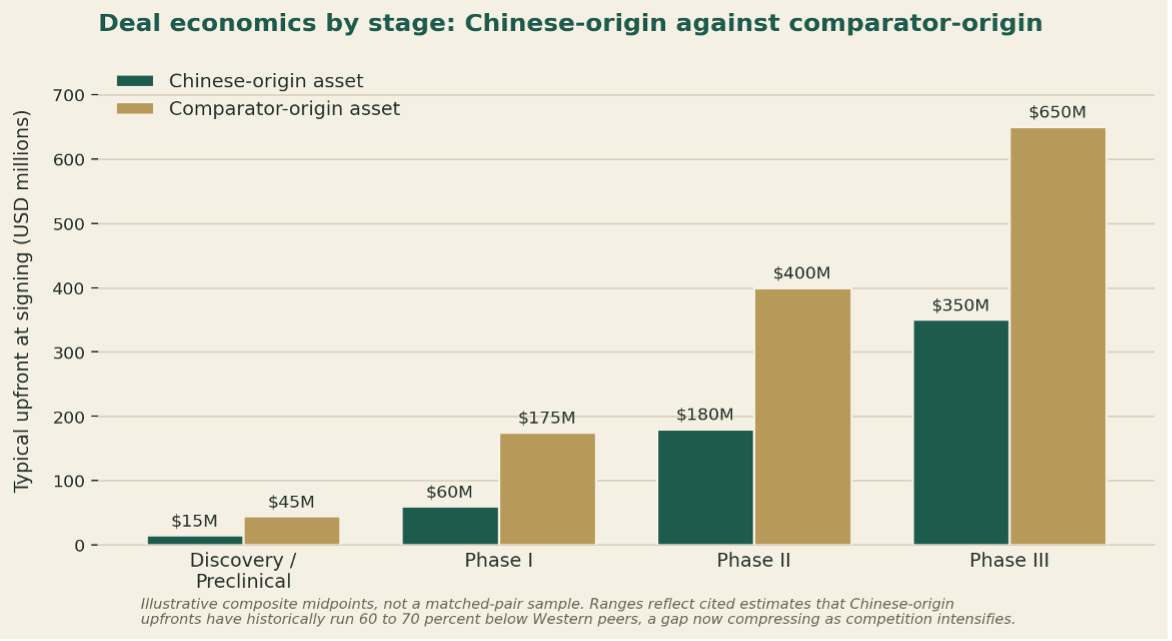 Figure 1. Typical upfront at signing, by development stage. Composite midpoints drawn from cited industry estimates; the origin gap has been compressing as competition intensifies.
The honest reading of a chart like this is that the gap is real, sizeable, and shrinking. The 230 percent climb in average upfronts is the sound of the discount being competed away in plain view. When multiple buyers chase the same class, as they did across the PD-1 by VEGF bispecifics, the origin haircut narrows toward zero, because a buyer who insists on the old discount simply loses the asset to one who will not. That dynamic is hard to reconcile with a pure-prejudice explanation. It is also hard to reconcile with a pure-risk one, because the risk profile of the underlying science did not improve 230 percent in four years. Something in between is going on, and the something is repricing: the market is discovering that it had the risk wrong.
Why a clean comparison is so hard to draw is itself part of the story. No two clinical-stage assets are alike: target, modality, competitive density, patent life, and dataset quality all move the price independently of origin. Headline biobucks make it worse, since a Chinese deal and a Western deal with identical press-release numbers can transfer wildly different cash. Only about 40 of the roughly 92 deals recorded in 2025 disclosed an upfront at all, so every average rests on a self-selected slice. Anyone who tells you the origin discount is exactly some number is overstating what the data can bear. The defensible claim is narrower and still damaging to a pure-risk reading: at matched stage and comparable class, Chinese-origin upfronts have sat materially below Western ones, and no single risk factor cleanly accounts for the gap.
Analysts tracking the category have reached broadly that conclusion in public. Mark Lansdell of Evaluate, whose firm produced the 230 percent figure, has argued that China can no longer be described as the bargain basement of biopharma licensing, and that dealmaking will continue even as prices rise because affordability was never the only reason the assets were attractive. Jefferies’ Cui Cui has tracked the share of global out-licensing value originating in China from single digits, to 21 percent across 2023 and 2024, to 32 percent by the first half of 2025. Neither trajectory is what a market discovering new risk looks like. Both are what a market looks like when it is unwinding an old assumption.
The community is more divided on what the headline numbers are worth. The consistent criticism is that milestone-heavy packages inflate perceived value while transferring little cash, and that the only honest comparison is upfront plus a hard-discounted slice of contingency. On that basis the gap is narrower than the raw comparison suggests in some deals and wider in others, because Western sellers load contingency too. What survives the adjustment is the direction, not a tidy multiple. Anyone quoting a single percentage for the China discount is quoting an artefact of whichever disclosed deals they happened to average.
Testing the stated reason: does the data actually underperform?
The discount’s official justification is data quality, so it deserves to be tested against outcomes rather than reputation. The record is genuinely mixed, and that mixedness is the point.
The cautionary case has a name: sintilimab. The PD-1 inhibitor was approved in China but rejected by the FDA in 2022, because its pivotal evidence rested on a trial run exclusively in China and did not, in the agency’s view, reflect the diversity of the US population or benchmark against a US-approved comparator on the endpoint that mattered. That decision hardened into a doctrine. The FDA has since made clear it prefers multiregional trials for global registration, and that single-country data is generally inadequate for “me-too” drugs entering crowded classes. For a buyer, that is not prejudice. It is a documented regulatory risk with a real price attached.
The validation case is that Chinese sponsors read the sintilimab signal and changed their behaviour. China joined ICH in 2017 and adopted the E17 multiregional-trial framework, and by 2024 the majority of pivotal trials in the country were multiregional. One published analysis of multiregional trials involving Chinese populations found that every one of the programs that reached the application stage went on to approval, a downstream success rate that does not look like a data-quality crisis. NMPA has moved to compress its clinical-trial review clock toward the FDA’s 30-day standard, and Chinese companies have accumulated a real tally of FDA and EMA oncology approvals. The molecules that Western buyers are paying up for are, increasingly, ones designed from the start to clear a Western regulator.
So the data-quality question does not resolve to a clean yes or no. It resolves to a moving line. On assets whose evidence is single-geography and whose class is crowded, the discount is defensible and the regulatory risk is priced in fact, not folklore. On assets built to ICH E17 with multiregional data, the same discount is increasingly a lag: a reputational tax collected on the basis of a problem the specific asset has already solved. The uncomfortable truth for both camps is that the label “Chinese-origin” has stopped predicting data quality with any reliability, which means using it as a pricing shortcut is now a bet, not a fact.
There is a practical wrinkle that keeps the discount alive even for good assets, and it is neither prejudice nor pure science. Diligence on a China-origin asset is harder and more expensive for a buyer without people on the ground in Shanghai or Suzhou. Verifying trial conduct, source data integrity, and manufacturing readiness across a language and regulatory barrier costs real money and time. Some of what looks like an origin discount is a diligence-cost discount: the buyer prices in the expense of proving to its own satisfaction that the data is what it appears to be, a cost the seller effectively subsidises through a lower upfront. It is a real economic factor, and it is not the same thing as distrust of the science, even though the two are easy to confuse from outside.
The market has responded to that cost in a telling way. Rather than abandoning China-origin sourcing, buyers have industrialised the verification of it, leaning on local advisory networks, specialist cross-border diligence practices, and increasingly on machine-assisted screening of trial records and publication histories to keep pace with deal flow. Firms without a permanent presence in the major Chinese biotech clusters have found diligence to be the binding constraint on how many opportunities they can even evaluate. That is a capacity problem, not a quality verdict, and it distributes the discount unevenly: the largest buyers, who can afford to verify, have been able to pay closer to full value and win the contested assets, while smaller buyers price in their own uncertainty and lose them.
The seller’s side of the table
If the discount cannot be fully explained by data, the forced-seller thesis is the next candidate. The intuitive version goes like this: a brutal funding winter left Chinese biotechs starved of capital, an upfront from a Western partner became the only cash available, and desperate sellers accepted whatever terms were offered. On that account, the discount is real and its source is weakness at the table.
The intuitive version has aged badly. Through 2022 and 2023 it was largely accurate: a global biotech selloff, rising rates, and geopolitical friction shut the financing window, Hong Kong’s Chapter 18A listings dried up, and licensing out was often the only door open. But by 2025 the door had swung back. Hong Kong ranked first among global exchanges for IPO proceeds, with full-year totals around 37 billion dollars, and biotech was a leading driver. Fourteen healthcare firms used the 18A pathway in 2025, past the full-year 2024 count, and by late December thirteen biotechs had raised a combined 6.4 billion dollars under 18A. The Hang Seng innovative-drug index climbed roughly 70 percent over the year. Mainland asset managers, noticing the gap between depressed public valuations and rich transaction values, began building positions in innovative developers.
That recovery cuts against the simple story. Analysts have argued the licensing wave itself helped reopen the funding window, because every marquee tie-up with a Western giant read as validation and pulled investor confidence higher. If out-licensing now feeds the capital markets rather than substituting for them, a Chinese seller in 2026 is not obviously the weaker party. A pending or completed 18A listing gives a biotech a public valuation, a tradable currency, and a comparable that strengthens its hand in the next negotiation. That is the opposite of a distressed seller.
The honest position holds both facts at once. The market is bifurcated. A well-capitalised, 18A-listed developer with a multiregional dataset negotiates from strength, keeps equity through a NewCo, and helps compress the origin discount toward nothing. A smaller, pre-revenue company staring at a lapsed prospectus and a cash crunch, of which there are still many, takes the upfront because it must, and the discount it accepts is at least partly the price of survival. Both companies are “Chinese-origin sellers.” They are not selling from the same position, and treating them as one bloc is precisely the error that lets each camp cite the half of the market that flatters its argument.
The public record of individual companies illustrates the split better than any generalisation. At one end sit developers whose licensing deals arrived alongside strong listings and rising share prices, for whom an upfront was growth capital and a validation event rather than a lifeline. At the other sit companies like Mingyu Pharmaceutical, founded by a former Hengrui executive, which filed for a Hong Kong listing in November 2025, watched the prospectus lapse, and re-filed within two months against zero revenue and substantial liabilities, with a successful float understood to be the thing that would give it real bargaining power in out-licensing. A company in that position does not negotiate the same deal as one with a fresh 18A balance sheet. The forced-seller dynamic has not disappeared, it has concentrated in the tail.
Following the assets forward
The cleanest test of whether the early prices were discounts is what the assets did next. Here the evidence increasingly embarrasses the buyers who paid least. The PD-1 by VEGF bispecific class, sourced largely from China, has moved from speculative to central in a matter of quarters, and each positive readout has raised the price of the next deal in the class. That is why AbbVie was willing, fourteen months after Merck’s LaNova deal, to pay more and to load additional value into royalties and milestones for a comparable asset. The market repriced upward because the science delivered, which is close to a definition of an original discount.
The counterpoint, and it is a fair one, is survivorship. The deals that read out well are the ones everyone cites; milestone stacks that quietly lapse generate no headlines, and a structure paying four percent at signing exists precisely so the buyer can walk away cheaply when an asset fails. A buyer underwriting a portfolio of China-origin bets at low upfronts and heavy contingency is not necessarily discounting Chinese science. It may be pricing a book of high-variance options correctly, winning big on the few that hit and losing little on the many that do not. From inside that model, the low upfront is not an insult. It is the shape of the instrument.
Which is why the pricing debate stays unresolved even with hindsight. The winners look underpriced in retrospect and the losers look fairly priced, and you only learn which was which after the readout that the price was supposed to anticipate. The most defensible summary is that the era of a blanket bargain is ending. Analysts who tracked the 230 percent climb now say plainly that China is no longer the bargain basement of biopharma licensing. The discount that was once a reflex is now contested asset by asset, which is exactly what you would expect as a market corrects a mispricing it inherited from an earlier, less credible era of Chinese drug development.
So: discount, or validation?
The answer the reporting keeps pointing to is that it was both, and that the mix is shifting. There was a discount, and part of it was rational: single-geography data carried a real, sintilimab-shaped regulatory risk, and pricing that risk was not prejudice. Part of it was reputational: a haircut applied to origin that outlived the fast-follow reality it was built on, and that competition is now stripping out in real time. And part of it came from the seller’s side of the table, from a funding environment that in 2022 and 2023 genuinely forced hands, and that by 2026 does so only for the weaker half of a bifurcated market.
What makes the story worth running is that all three forces are still in play at once, and the balance between them is the live question in every current negotiation. A buyer arguing “rational risk” and a founder arguing “origin discount” can both point at real deals and be right about those deals. The category has simply outgrown a single answer. The useful thing a reader can carry away is the discipline to ask, of any given transaction, which of the three forces is actually setting the price: the data, the reputation, or the seller’s bank balance. On the best assets, the first is now the only one that survives scrutiny. On the rest, the argument is still open, and the money riding on it is getting larger every quarter.
arcilla.fran@biopharmaapac.com
Sources and method
Deal terms, aggregate deal-value and upfront figures, and the 60-to-70-percent origin-gap estimates are drawn from Evaluate, SynBioBeta, Dealforma/Stifel, Jefferies, and industry deal-trackers as reported by Fierce Biotech, PharmaVoice, and specialist licensing trackers over 2025 and the first half of 2026. Regulatory findings on single-country versus multiregional data draw on the FDA’s sintilimab/ORIENT-11 decision, ICH E17, NMPA reform announcements, and peer-reviewed analysis of multiregional-trial success rates. Hong Kong Chapter 18A and funding-environment figures draw on HKEX data and reporting from PharmaBoardroom, China Briefing, and financial press. Figure 1 is an illustrative composite of published stage-level ranges, not a matched-pair dataset. All monetary values are in US dollars and reflect disclosed terms; a large share of deals in this category do not disclose upfronts, so aggregate figures understate true activity. This article is reported from documentary and public sources rather than from confidential interviews. Positions attributed to named analysts reflect their publicly reported statements, paraphrased; where the text characterises buyer or seller reasoning without attribution, it is inferring from deal structures and disclosed terms and says so in the text.
Disclaimer
Editorial independence. This article is an independent work of journalism produced by BioPharma APAC. It was not sponsored, commissioned, reviewed, or approved by any company, investor, or other party named or referenced in the text, and no such party had sight of it prior to publication.
No investment or financial advice. Nothing in this article constitutes investment, financial, legal, tax, or business advice, or a recommendation, offer, or solicitation to buy, sell, license, or hold any security or asset. Readers should obtain independent professional advice before acting on any information contained here.
Most Read
- Can APAC Biomanufacturing Decarbonise Without Pricing Itself Out?
- The Algorithm on the GMP Floor: AI Promises a Smarter Plant. Regulators Demand the Audit Trail.
- APAC's Peptide-Capacity Gamble
- After the Rush: APAC's mRNA and Vaccine Capacity Hangover
- The Biosimilar Race: Factory to the World — or Stuck in the Copycat Economy?
- The Vein-to-Vein Problem: Can APAC's Cold Chain Carry Advanced Therapies?
- Vectors, Plasmids and the CGT Trap: APAC's Cell and Gene Therapy Ambitions Face an Upstream Bottleneck
- Can APAC Build Radioligand Therapy Before the Atoms Decay?
- The Great Biopharma Reset: 50 Developments That Changed Everything in H1 2026
- Beyond the Trial: Can Real-World Evidence Earn Regulatory Trust in APAC?
- Beyond the Obvious Giant: Where APAC's Clinical Trials Go Next
- The Frontier That Won’t Quite Arrive
Bio Jobs
- Sanofi Turns The Page As Belén Garijo Steps In And Paul Hudson Steps Out
- Global Survey Reveals Nearly 40% of Employees Facing Fertility Challenges Consider Leaving Their Jobs
- BioMed X and AbbVie Begin Global Search for Bold Neuroscience Talent To Decode the Biology of Anhedonia
- Thermo Fisher Expands Bengaluru R&D Centre to Advance Antibody Innovation and Strengthen India’s Life Sciences Ecosystem
- Accord Plasma (Intas Group) Acquires Prothya Biosolutions to Expand Global Plasma Capabilities
- ACG Announces $200 Million Investment to Establish First U.S. Capsule Manufacturing Facility in Atlanta
- AstraZeneca Invests $4.5 Billion to Build Advanced Manufacturing Facility in Virginia, Expanding U.S. Medicine Production
News