Why 10,000 Koreans a Year Still Fly Abroad for Stem Cell Treatment
21 September 2026 | Monday | Analysis
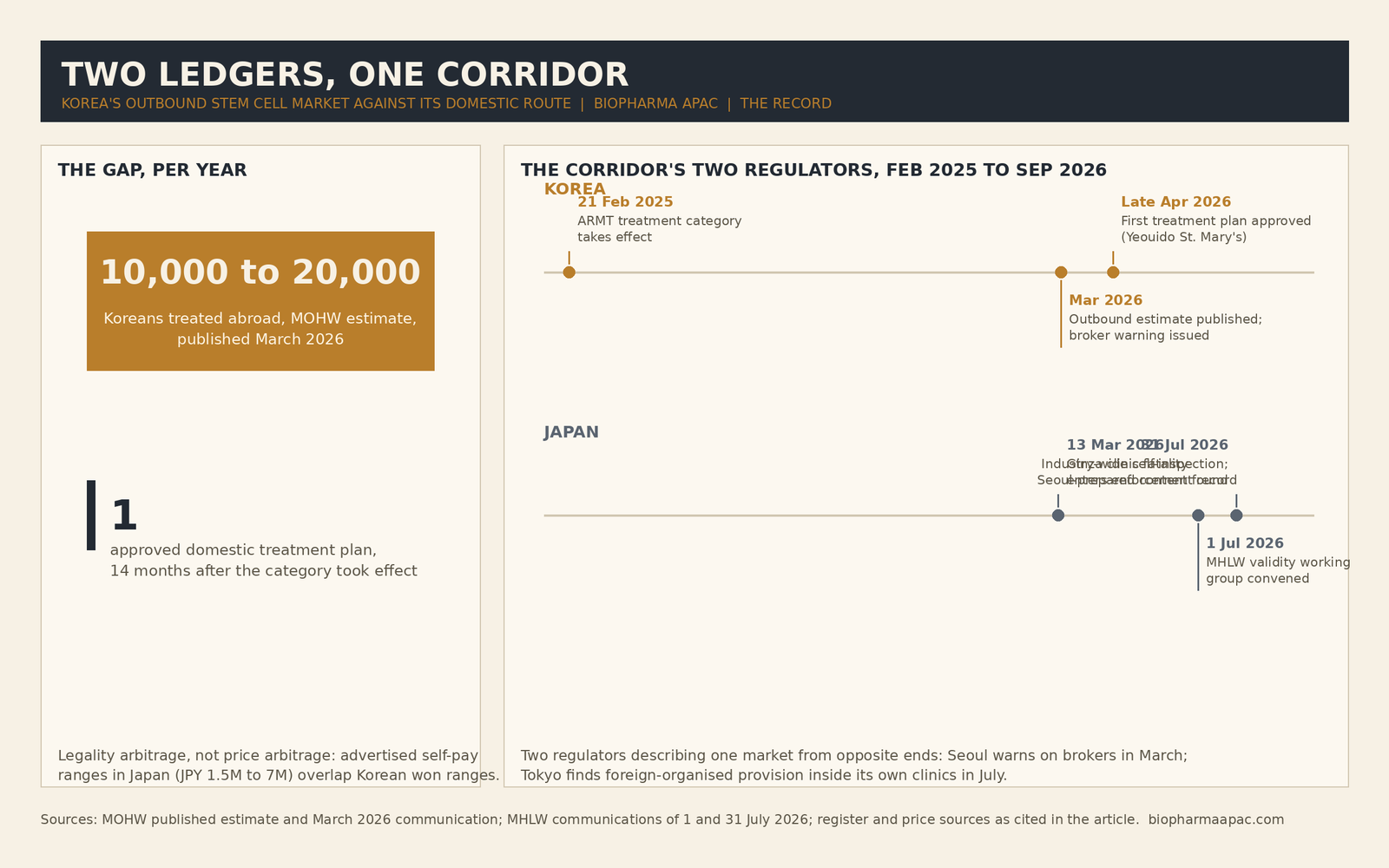
Figure 1. Two ledgers, one corridor: the outbound estimate against the domestic route, and the corridor's two regulators, Feb 2025 to Sep 2026.
METHOD IN BRIEF This feature expands entry 21 of our year-end count, 2026 in 26 Numbers. Every figure is cited to a regulator publication, official communication, register record, peer-reviewed paper or dated advertised price, with the date attached; no patient case is described and no quotation is invented. Figures were verified to 18 September 2026 except where a different date is stated, with a re-verification pass at publication. Our September feature The Arbitrage Triangle owns the three-corner regional analysis of these flows and our August feature Reading the Register owns the Japanese register data; this piece reads the Korean outbound ledger, and cites both rather than re-arguing them.
A NUMBER THE MINISTRY PUBLISHED ABOUT ITSELF
Governments count many things. They rarely publish a number that measures the limits of their own regulation, which is what makes the figure at the centre of this feature so unusual. In March 2026, Korea's Ministry of Health and Welfare put its estimate of citizens travelling abroad each year for stem cell treatment at 10,000 to 20,000 people, and it published that estimate alongside a warning: brokering such treatment in Japan may be illegal. The number and the warning belong together, because together they describe a market. Five figures of annual outbound patients, an intermediary industry organised enough to earn a ministerial caution, and a destination one short flight away.
What gives the estimate its edge is the number that sits beside it in our year-end count. Korea's advanced regenerative medicine treatment category, the legal route created precisely so that patients like these could be treated at home, took effect on 21 February 2025. The first treatment plan under it was approved in late April 2026, at Yeouido St. Mary's Hospital, for autologous EBV-specific T cells in a rare lymphoma. Fourteen months, one approval. Set one approved domestic plan against 10,000 to 20,000 annual departures and you have, in two numbers, the most precise description available of how regenerative medicine actually works in Northeast Asia: the law changed what Korea permits, and it has not yet changed what Koreans do.
A word on the number itself, because its shape is part of the story. It is a band, not a count, produced in the course of ministry audit work rather than from any registry, for the simple reason that no registry exists: patients who buy treatment abroad appear in no Korean clinical record until something goes wrong. A government estimating its own outbound patients to within a factor of two is a government admitting it can see the phenomenon only in outline, through visa patterns, broker marketing and the complications that come home. That opacity is not incidental. It is a property of the market, and every number in this feature should be read with it in mind.
This feature walks through why. The answer is not a scandal and not a failure of drafting. It is the predictable result of three systems interacting: a Korean regime built to be careful, a Japanese regime built to be open, and a broker economy built to connect the demand the first cannot yet serve to the supply the second cannot yet police.
WHAT THE LAW NOW PERMITS
Korea's regenerative medicine framework was, for its first years, a research statute. Treatment with advanced regenerative therapies outside an approved product or a clinical study was simply not a lawful category, which is one reason the outbound channel grew: the demand existed, and the domestic supply could not legally meet it. The amendment that took effect on 21 February 2025 changed the architecture. It created a treatment category under which hospitals can provide advanced regenerative therapies outside clinical research, subject to a treatment plan reviewed and approved before any patient is treated.
The design is deliberately conservative, and the first fourteen months showed exactly what conservative implementation of a permissive law looks like. Institutions had to be designated. Plans had to be assembled to an evidentiary standard, reviewed by committee, and approved individually. The first plan to clear that machinery, the Yeouido St. Mary's programme approved in late April 2026, is a textbook choice for a cautious system: an autologous cell therapy, a defined rare cancer, a national tertiary hospital, a population for whom the risk-benefit argument is strongest and the alternative options fewest.
It is worth being precise about how much work that machinery demands, because the contrast with the destination country is the entire subject of this feature. Under the Korean category, the institution must be designated for the purpose, the therapy must arrive with a dossier a review committee can defend, the plan is approved before the first patient rather than audited after the fact, and the burden of demonstrating that the science supports the treatment sits with the applicant. Japan's clinic channel, as the next section sets out, inverts almost every one of those defaults: notification rather than approval, committee review of a filing rather than adjudication of evidence, and a burden that in practice has fallen on regulators to prove harm rather than on providers to prove benefit. Two frameworks, nominally governing the same medicine, allocate the benefit of the doubt to opposite parties.
None of that is a criticism. A regulator opening a new legal category for unapproved therapies has every reason to move slowly, and fourteen months from commencement to first approval is not unusual by the standards of new frameworks anywhere. Our series closer this September set the honest benchmark in falsifiable form: five or more approved treatment plans by 31 December 2027, marked in public next March. The point of this feature is different. It is that the pace and shape of the domestic route, however defensible, bear almost no relationship to the demand that is leaving the country, and the ministry's own outbound estimate is the proof.
WHERE THE PATIENTS ACTUALLY GO
The destination architecture matters, because the outbound market is not travelling toward better evidence. It is travelling toward a different legal category. Japan's regenerative medicine framework, in force since 2014, allows clinics to provide cell-based interventions outside the pharmaceutical approval system by filing a provision plan, reviewed by a certified committee, into a national register. The register's earliest published snapshot, in November 2015, already recorded 1,831 Class III plans, 1,794 of them filed by private practice, and a 2022 analysis in Cell Stem Cell coded 3,467 plans in total. Our August feature, Reading the Register, took that record apart line by line; the single sentence that matters here is its spine finding, which Japanese regulators themselves have now effectively endorsed: the register is a filing record, not an approval list.
For a Korean patient, that distinction is the product. What Japan offers is not a therapy Korea lacks but a legal setting Korea does not provide: lawful, clinic-delivered, self-pay administration of cell interventions for indications, including degenerative and aging-adjacent ones, that no conservative treatment-plan committee in Seoul would currently touch. The advertised self-pay prices we documented in September ranged from JPY 1.5 million to 7 million per administration, and the striking fact about those prices is that they do not undercut Korea. The won and yen ranges overlap. Nobody flies to Tokyo to save money.
The register's composition tells you what the corridor actually carries. From its first snapshot, the overwhelming majority of filings sat in the lowest risk class and came from private practice rather than academic medicine, and our August reading of the record found the stated purposes of a large share of plans ambiguous enough that no honest coder could assign them to a disease at all. That is not a register of experimental oncology. It is, in substantial part, a register of clinic commerce in degenerative, orthopaedic and aging-adjacent indications, exactly the demand profile a conservative treatment-plan committee cannot serve, because the evidence that would let it say yes has never been generated. The corridor exists because one country asks for that evidence and the other, until now, has asked only for a filing.
That is why we described this market in September as legality arbitrage rather than price arbitrage, and the description carries the whole economics of the flow. Where medical travel runs on price, it is self-limiting: the destination's costs rise, the differential closes, the flow slows. Where it runs on legal difference, it persists for exactly as long as the difference does, and it is insulated from every intervention except regulatory change at one end or the other. In 2026, for the first time, both ends moved at once.
THE YEAR THE DESTINATION SHOOK
Japan spent 2026 discovering, in public, the costs of being the region's open jurisdiction. The enforcement record that our register feature traced from late 2024 accelerated sharply. In March 2026, a patient death following treatment at a Ginza clinic entered the record, the framework's most serious publicly reported harm. On 1 July 2026, MHLW convened a working group to build a scientific validity assessment mechanism for self-pay regenerative medicine, together with a scope decision on exosomes and culture supernatant, thirteen months after a May 2025 amendment that was supposed to have supplied exactly that mechanism by relocating validity review onto certified committees.
Then came the document that connects Japan's problem to Korea's. On 31 July 2026, MHLW issued a self-inspection request to every provider, certified committee and cell manufacturer operating under the framework. The trigger, stated in the ministry's own communication, was an investigation that found a Tokyo clinic delivering treatment following content prepared by a South Korean group, in what the ministry described as provision under the influence of a third party and in a form the Act does not contemplate. Read that finding against the outbound estimate and the broker warning published in Seoul four months earlier, and the two regulators are describing the same market from opposite ends. Korea warned in March that intermediaries were organising its patients toward Japan. Japan confirmed in July that the organising had reached inside its own clinics.
This is the figure our September analysis called the multi-corner operator: a commercial actor whose business is not medicine in any one jurisdiction but the differential between jurisdictions, assembling Korean demand, Japanese legal settings and, increasingly, Southeast Asian alternatives into a single product. Thailand's ministerial decree of May 2026, bringing expanded cells under advanced therapy registration with the Thai FDA, is best read in this light: the region's southern corner beginning to close the same gap Japan is now policing. The operators these systems are converging on do not appear in any register as what they are. They appear, when they appear at all, the way this one did: as an anomaly in someone else's inspection file.
For the outbound market, the consequence of Japan's 2026 is genuine uncertainty for the first time in a decade. A destination whose regulator is auditing its entire industry, building a validity gate it conspicuously lacked, and naming foreign-organised provision as a specific concern is a destination whose legal openness, the very product the market sells, is being repriced. The arbitrage has not closed. But 2026 is the first year in which a rational broker would have to model the possibility that it might.
THE BROKER IN THE MIDDLE
The ministry's March warning was aimed not at patients but at the industry between them and the airport, and that aim is telling. Brokerage is where this market's real economics live. The intermediary packages what an individual patient cannot easily assemble: clinic selection in a foreign language, scheduling compressed into a travel window, translation in the consultation room, payment handling across currencies, and the reassuring appearance of a system. The clinic sells an administration. The broker sells the entire journey, and prices it accordingly.
What the broker does not sell is what happens afterwards, and this is the gap our September analysis identified as the market's least defensible feature. A patient who returns to Seoul after cell administration in Tokyo returns to a health system that did not treat them, holds no record of what they received, and owes them care anyway when complications arrive. The treating clinic is in another jurisdiction; the intermediary's obligations, to the extent they exist at all, are contractual rather than clinical; and the follow-up burden lands on Korean clinicians and the Korean insurance system, which absorbed none of the fee. The liability gap is not an accident of the model. It is the model: the revenue is collected where the treatment is lawful, and the risk is repatriated with the patient.
The March warning also marks the limit of what Seoul can reach. Korean law stops at the border; the clinic in Tokyo is beyond its jurisdiction, the treatment is lawful where it is given, and the patient is exercising a freedom no ministry proposes to remove. The only domestically reachable actor in the chain is the intermediary who organises, advertises and profits from the flow while sitting in Seoul, which is precisely why the ministry aimed its language there. Enforcement against brokers is the one lever a demand-side government holds over a supply it cannot regulate, and the fact that Korea reached for it in 2026, after years of leaving the channel undisturbed, is itself information about how the ministry now reads the risk.
The legal status of the brokerage itself is precisely what the ministry put in question in March, and the word it chose matters. May be illegal is not a prohibition; it is a signal that enforcement theory is being assembled. Between the Seoul warning and the Tokyo self-inspection request, 2026 produced, for the first time, the outline of a coordinated squeeze on the intermediary layer from both ends of the corridor. Whether either government follows through is one of the questions this publication will mark next year.
WHY THE DEMAND HAS NOT COME HOME
It is tempting to read the fourteen-months-one-approval record as the whole explanation for the outbound flow, and it is not. Even a fast, generous domestic approval machine would not repatriate most of these patients, because the domestic category and the outbound market are, in large part, different products aimed at different demand.
The treatment category Korea built is disease-scoped and evidence-gated. Its natural early population looks like the first approval: defined serious illness, strong biological rationale, institutional delivery, a committee able to satisfy itself on risk and benefit. The outbound market, on the record Japan's own register composition suggests and our register analysis documents, is weighted heavily toward private-practice provision for degenerative, orthopaedic and aging-adjacent indications, the demand categories least likely to clear any committee anywhere, because the evidence to clear them does not exist. A Korean patient seeking cell therapy for knee osteoarthritis or for aging itself was not waiting for the February 2025 amendment, and no plausible pace of treatment-plan approvals will change that. The law built a corridor for the sickest. The market is made of the worried well and the chronically degenerating, which is to say, of demand medicine has not yet earned.
There is also the plain arithmetic of throughput. One approved plan treats a defined cohort at one institution. Ten thousand departures a year is a volume that, even under aggressive assumptions about plan approvals through 2027, the domestic category cannot absorb this decade. And there is price. The domestic route, where it exists, runs through hospitals, committees and documentation; the outbound route runs through a broker and a booking. For the patient whose indication would never qualify domestically, the comparison is not between two prices for the same thing. It is between something available and something that does not exist, and no reform short of a change in the evidence base alters that comparison.
Set the two systems side by side and the throughput problem becomes vivid. Japan's clinic channel scaled to thousands of filed plans within a year of opening because filing is cheap; Korea's channel produced one approval in fourteen months because approval is expensive. Those are not different speeds of the same machine. They are different machines, and the expensive one is expensive on purpose. Any proposal to close the gap by making Korean approval cheaper is really a proposal to import the Japanese model, and 2026, the year Japan audited that model's entire industry after a fatality and a foreign-influence finding, is the worst year in a decade to make that argument.
Which is why the honest conclusion is uncomfortable for everyone in this story. Korea's regulator has built a defensible system that does not address most of the departing demand. Japan's regulator is policing a system whose openness created the destination. The brokers connect the two and carry the liability of neither. And the patients are responding rationally to the incentives all three have constructed. The 10,000 to 20,000 are not a failure of information. They are a verdict on the region's collective decision, so far, to let legal geography stand in for evidence.
WHAT WOULD COUNT AS CHANGE
A market defined by numbers should be judged by them, so here is what movement would actually look like, stated in advance in the way this publication now prefers. First, the domestic route: five or more approved Korean treatment plans by 31 December 2027, the falsifiable marker our series closer set in September, which would demonstrate that the category can scale beyond its first, carefully chosen case. Second, the outbound ledger itself: a revised ministry estimate materially below the 10,000 to 20,000 band, published with method, which is the only number that would show demand actually returning home rather than regulation merely tightening around it.
Third, the intermediary layer: an enforcement action in either jurisdiction that treats the broker, rather than the clinic or the patient, as the regulated party, converting March's may be illegal into a tested legal position. Fourth, the destination: the output of MHLW's July working group, because a functioning validity gate on Japanese self-pay provision would reprice the arbitrage at its source, and its absence after a second year would confirm that the openness is structural. And fifth, the southern corner: implementation of Thailand's May 2026 decree on a published timetable, which would tell us whether closing one corridor merely redirects it.
None of these is exotic. All of them are checkable in public documents, which is the standard everything in this series is written to. The two numbers this feature began with will both be different by the time our count runs again next November: the approvals figure because the machinery is finally moving, the outbound estimate because someone will eventually re-measure it. Whether they move toward each other is the actual question, and it is the one we will put to the record, in public, with dates. The law changed what Korea permits. The year the numbers show it changing what Koreans do will be a different year than this one.
Sources and method. Figures in this feature are cited in the text to their sources: the Ministry of Health and Welfare's published outbound estimate and March 2026 communication on brokered treatment in Japan; the commencement date of Korea's advanced regenerative medicine treatment category (21 February 2025) and the first approved treatment plan (late April 2026, Yeouido St. Mary's Hospital); MHLW communications of 1 July 2026 (working group on a validity assessment mechanism and the exosome scope decision) and 31 July 2026 (self-inspection request, including the ministry's stated findings on third-party influenced provision); the Japanese register's published November 2015 composition and the coding analysis of 3,467 provision plans published in Cell Stem Cell in September 2022; Thailand's ministerial decree of May 2026; and dated advertised self-pay prices documented in this publication's September 2026 feature The Arbitrage Triangle, which also carries the fuller three-corner analysis and liability discussion referenced here. Reading the Register (August 2026) carries the full analysis of the Japanese register record. Figures verified to 18 September 2026 except where dated otherwise; items to re-verify at publication: whether a second Korean treatment plan has been approved, the status of MHLW's working group output, and implementing timelines under the Thai decree.
Most Read
- Can APAC Biomanufacturing Decarbonise Without Pricing Itself Out?
- The Algorithm on the GMP Floor: AI Promises a Smarter Plant. Regulators Demand the Audit Trail.
- APAC's Peptide-Capacity Gamble
- After the Rush: APAC's mRNA and Vaccine Capacity Hangover
- The Biosimilar Race: Factory to the World — or Stuck in the Copycat Economy?
- The Vein-to-Vein Problem: Can APAC's Cold Chain Carry Advanced Therapies?
- Vectors, Plasmids and the CGT Trap: APAC's Cell and Gene Therapy Ambitions Face an Upstream Bottleneck
- Can APAC Build Radioligand Therapy Before the Atoms Decay?
- The Great Biopharma Reset: 50 Developments That Changed Everything in H1 2026
- Beyond the Trial: Can Real-World Evidence Earn Regulatory Trust in APAC?
- Beyond the Obvious Giant: Where APAC's Clinical Trials Go Next
- The Frontier That Won’t Quite Arrive
Bio Jobs
- Sanofi Turns The Page As Belén Garijo Steps In And Paul Hudson Steps Out
- Global Survey Reveals Nearly 40% of Employees Facing Fertility Challenges Consider Leaving Their Jobs
- BioMed X and AbbVie Begin Global Search for Bold Neuroscience Talent To Decode the Biology of Anhedonia
- Thermo Fisher Expands Bengaluru R&D Centre to Advance Antibody Innovation and Strengthen India’s Life Sciences Ecosystem
- Accord Plasma (Intas Group) Acquires Prothya Biosolutions to Expand Global Plasma Capabilities
- ACG Announces $200 Million Investment to Establish First U.S. Capsule Manufacturing Facility in Atlanta
- AstraZeneca Invests $4.5 Billion to Build Advanced Manufacturing Facility in Virginia, Expanding U.S. Medicine Production
News