
Patent Rulings That Decided Who Could Launch What in APAC in 2026
19 November 2026 | Thursday | Analysis
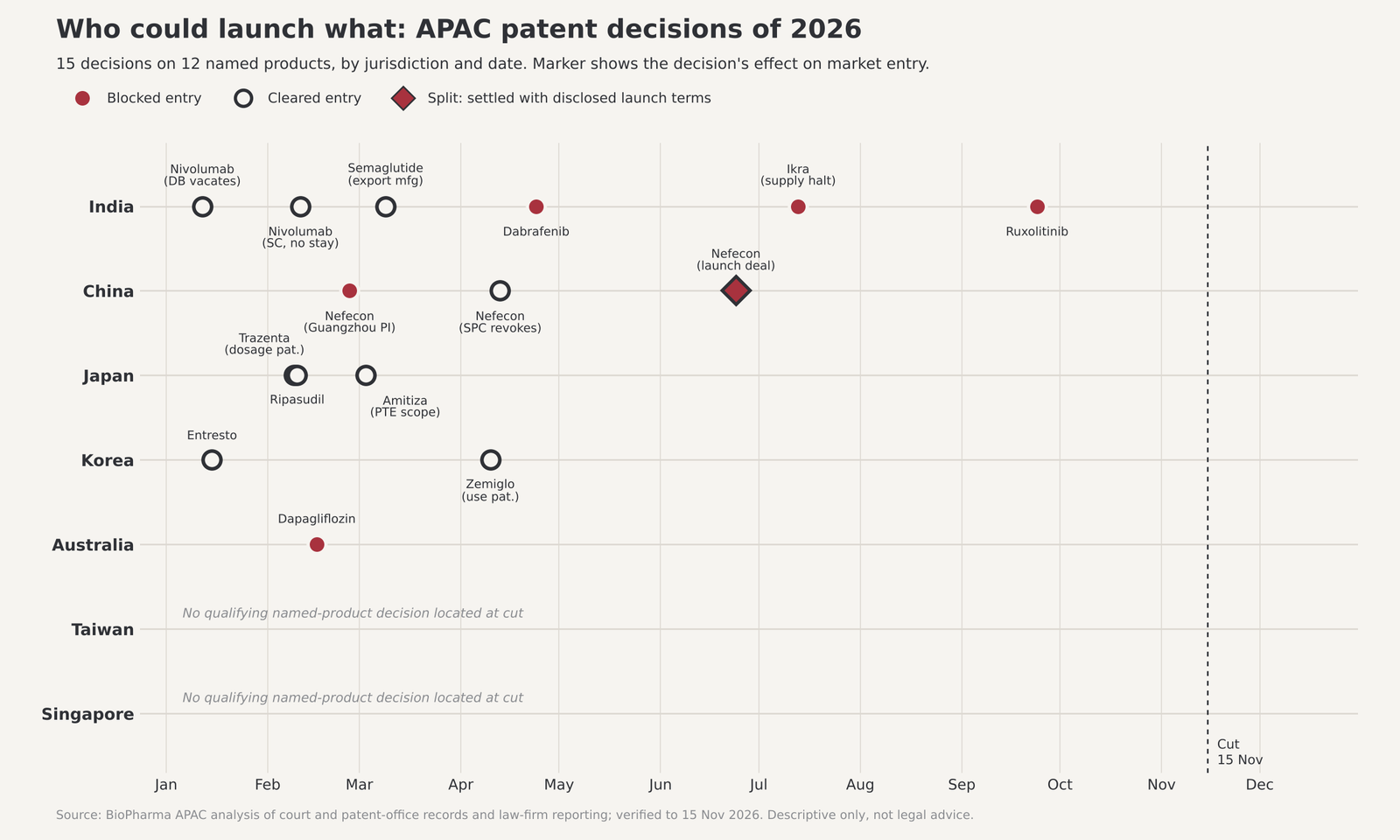
Figure 1. Jurisdiction lanes on a 2026 timeline. Filled crimson markers blocked entry, open charcoal markers cleared it, the diamond marks a settlement with disclosed launch terms.
Every December, generic and biosimilar teams across Asia Pacific sit down to fix their launch calendars for the coming year. The regulatory side of that exercise is well rehearsed: dossiers, review clocks, reference product availability. The patent side is usually treated as a list of expiry dates. 2026 showed why that is not enough. In five APAC jurisdictions this year, courts and patent offices decided, product by product, who could ship and who had to wait, and several of those decisions moved launch dates by months or years in either direction.
This piece records those decisions. It is a ledger of rulings, not of expiries: the 2027 expiry calendar belongs to our Patent Cliff 2027 franchise, and nothing here should be read as a forecast of when a patent runs out. What follows is narrower and, for launch planning, arguably more useful. It is the set of 2026 judgments, injunction rulings, invalidation outcomes and linkage decisions that named a product, named the parties, carried a public reference, and changed whether that product could reach the market.
How this list was built
Inclusion. A court judgment, interim injunction ruling, patent-office invalidation outcome or patent-linkage decision dated between 1 January and 15 November 2026, issued in India, China, Japan, Korea, Australia, Taiwan or Singapore, naming the product and the parties, with a public case or decision reference. Settlements count only where their launch terms are disclosed.
Coding. Each decision is coded by its effect on market entry at the time it was made: blocked, cleared, or split (where an outcome let the product launch on negotiated terms). A product can carry several decisions; the timeline in Figure 1 shows each one.
Sources. Court and patent-office records where published, company disclosures, and specialist law-firm and trade reporting. Where a docket number has not been published in public reporting, the entry says so.
Boundaries. Expiry dates appear only where they define a decision's effect. The India semaglutide launch market is covered in our semaglutide generics ledger and is cited once here. The policy argument over Section 3(d) and compulsory licensing is left to Fault Lines. This is a descriptive record and not legal advice.
Revisions. The list updates in place to a 31 December cut. Every change carries a dated revision note at the foot of the page.
The count at the cut: 15 decisions on 12 named products. Five decisions blocked entry, nine cleared it, and one ended in a settlement with disclosed launch terms. By where each product stood at the cut, four remain blocked, seven are cleared, and one is split. India supplied five products, Japan three, Korea two, China and Australia one each. Taiwan and Singapore produced no decision that met the inclusion test, which is itself a finding we return to below.
India: five products, two directions
India was the busiest venue of the year and also the most instructive, because the Delhi High Court moved in both directions within months. It cleared two high-profile products early in the year on reasoning about claim mapping and public interest, then granted three fast interim restraints in the second and third quarters against products that had not yet launched. Read together, the five entries show that the court is not leaning one way. It is asking for different things at different stages.
1. Nivolumab biosimilar (ZRC-3276): cleared
|
Product |
Zydus Lifesciences' nivolumab biosimilar ZRC-3276, referencing Opdivo |
|
Parties |
Zydus Lifesciences Ltd v E.R. Squibb and Sons LLC (Bristol Myers Squibb) and others |
|
Court and reference |
Delhi High Court, Division Bench (C. Hari Shankar and Om Prakash Shukla JJ), 2026:DHC:178-DB; Supreme Court of India on the follow-up petition |
|
Decision date |
12 January 2026 (Division Bench); Supreme Court declined to stay in February 2026 |
|
What was decided |
The bench vacated the single judge's July 2025 injunction. It found the patentee had not mapped Zydus's product to the claims of IN 340060, as Rule 3(A)(ix) of the Delhi High Court Patent Suits Rules, 2022 requires, and weighed the public interest in access to a life-saving drug. |
|
Market effect |
Zydus was cleared to manufacture and market roughly four months before IN 340060 expired on 2 May 2026. |
|
Appeal status at cut |
The Supreme Court refused to halt the launch and told BMS to carry out claim mapping and seek any interim relief in the High Court. The patent has since expired. |
The nivolumab ruling became the year's most cited Indian decision because of the procedural point at its centre. The bench did not say the patent was weak. It said the patentee had compared product to product rather than product to claim, and that this was not enough to keep a cancer biologic off the market in the closing months of the term. For biosimilar teams, the practical lesson is about the evidentiary record an originator must build, not about the strength of any particular patent.
2. Semaglutide: cleared for export manufacture
|
Product |
Dr Reddy's Laboratories' semaglutide, made for export |
|
Parties |
Novo Nordisk A/S v Dr Reddy's Laboratories Ltd and OneSource Specialty Pharma |
|
Court and reference |
Delhi High Court, Division Bench, on appeal from CS(COMM) 565/2025 |
|
Decision date |
9 March 2026 |
|
What was decided |
The bench dismissed Novo Nordisk's appeal and upheld the December 2025 refusal of an interim injunction, which had found a credible challenge to the validity of the species patent. |
|
Market effect |
Dr Reddy's kept manufacturing for export in the final weeks before the Indian patent term ended in March 2026, putting it in position for day-one supply. |
|
Appeal status at cut |
Overtaken by expiry. The domestic launch market that followed is tracked in our semaglutide generics ledger. |
3. Dabrafenib: blocked
|
Product |
Intas Pharmaceuticals' dabrafenib-based products |
|
Parties |
Novartis AG and another v Intas Pharmaceuticals Ltd |
|
Court and reference |
Delhi High Court, CS(COMM) 433/2026 |
|
Decision date |
24 April 2026 |
|
What was decided |
An ex parte ad interim injunction in a quia timet action. The court accepted that the threat of infringement was real rather than speculative and restrained Intas from dealing in dabrafenib-based products before any launch. |
|
Market effect |
Intas's entry, for the domestic market and for export, is on hold while the injunction runs. |
|
Appeal status at cut |
Interim order. No later ruling located at the cut. |
4. Ikra: blocked pending hearing
|
Product |
Ikra, a cancer product supplied to Zydus Lifesciences (active ingredient not named in public reporting of the order) |
|
Parties |
AbbVie Manufacturing Management Unlimited Company v Zydus Lifesciences Ltd and another |
|
Court and reference |
Delhi High Court, Jyoti Singh J; commercial suit registered 10 July 2026 |
|
Decision date |
13 July 2026 |
|
What was decided |
A status-quo order. The manufacturing defendant could keep making Ikra, but no supplies could go to Zydus or any third party from 14 July 2026 until the interim injunction application was heard on 24 July. |
|
Market effect |
Supply into the market stopped from 14 July. |
|
Appeal status at cut |
The outcome of the 24 July hearing has not been located in public reporting and is on the pre-publication check list. |
5. Ruxolitinib: blocked to expiry
|
Product |
Melody Healthcare's generic ruxolitinib phosphate |
|
Parties |
Incyte Holdings Corporation v Melody Healthcare Pvt Ltd |
|
Court and reference |
Delhi High Court, Vikas Mahajan J, ex parte ad interim order on IN 269841 |
|
Decision date |
24 September 2026 |
|
What was decided |
Melody, which held a state manufacturing licence for the API and had listed it for sale, was restrained from manufacturing, selling or exporting any ruxolitinib product. The order reaches directors, group companies, licensees and distributors. |
|
Market effect |
No pre-expiry manufacture or stockpiling. IN 269841 runs to 12 December 2026. |
|
Appeal status at cut |
Before the Joint Registrar on 17 November 2026; listed before the court on 20 January 2027, after the patent will have expired. |
Set the five side by side and a pattern appears. The clearing decisions came from appellate benches looking at a full record: what the claims cover, what the patentee told the Patent Office, and what an injunction would cost patients. The blocking decisions were fast, early-stage orders against products that had not launched, granted on the strength of an apparent compound-level overlap. A generic team reading this record should expect the court to act quickly when an originator arrives early with a clean infringement case, and to look much harder when the originator arrives late, relies on a secondary patent, or cannot map the product to its claims.
China: when a declaration is not a wall
China contributed one product, but it carried three decisions and the year's most consequential linkage ruling. The case turned on a question every generic filer in China now has to think about: what a Category 3 declaration actually binds a company to.
6. Nefecon generic (budesonide enteric capsules): split
|
Product |
Hainan Herui Pharmaceutical's budesonide enteric capsules, the first generic of Nefecon |
|
Parties |
Everest Medicines (China rights holder) and the patentees v Hainan Herui Pharmaceutical |
|
Court and reference |
Guangzhou Intellectual Property Court, (2026) Yue 73 Xing Bao No. 1; Supreme People's Court IP Tribunal, (2026) Zui Gao Fa Zhi Min Fu No. 1; patent CN 200980127272.5 |
|
Decision date |
26 February 2026 (preservation order); 13 April 2026 (SPC reconsideration); 24 June 2026 (commercial agreement announced) |
|
What was decided |
Herui won NMPA approval on 16 December 2025 under a Category 3 declaration not to launch before the patent expires in May 2029, then sought procurement listings. Guangzhou granted a pre-suit injunction. On reconsideration, the SPC revoked it: a Category 3 declaration is preliminary evidence of infringement, but not decisive once rebutted, and breaching it does not automatically justify an order to stop. The SPC criticised Herui's conduct as a breach of good faith that could weigh at trial. |
|
Market effect |
Under the June agreement, Herui's capsules may be launched in mainland China, with Everest responsible for commercialisation and quality oversight, subject to closing conditions. |
|
Appeal status at cut |
No merits judgment reported. The collaboration was subject to customary closing conditions when announced. |
The sequence matters more than any single step. A generic secured approval on a promise not to launch, began to act as if it would launch, was stopped, and then had the stop lifted by the country's top IP court because the patentee had not met the evidential threshold on infringement. The two companies then settled into a structure where the generic reaches patients under the originator's commercial control. For planners, the SPC ruling removes an assumption many had made: a Category 3 declaration is an administrative commitment, not a self-executing bar in civil litigation.
China's other headline patent outcome of the cycle sits just outside our window. The Supreme People's Court upheld Novo Nordisk's semaglutide compound patent on 31 December 2025, a date that falls before our 1 January start. It is worth noting only because it explains an absence: in 2026, the barrier facing at least ten Chinese semaglutide applicants after the patent's March expiry was regulatory data protection, reported to run to April 2027, rather than any patent ruling.
Japan: secondary patents under pressure
Japan has no statutory linkage court process, so its patent decisions arrive through invalidation appeals and ordinary infringement suits. All three 2026 entries cleared the way for generics, and all three involved patents that sit around a molecule rather than on it: a dosage regimen, a container, and the scope of a term extension.
7. Linagliptin (Trazenta and Tradiance dosage patent): cleared
|
Product |
Generic routes to Trazenta tablets and Tradiance combination tablets (linagliptin) |
|
Parties |
Patentee as plaintiff against the Japan Patent Office invalidation decision; demandant generic parties (Trazenta is Boehringer Ingelheim's brand) |
|
Court and reference |
Intellectual Property High Court, 2025 (Gyo-ke) 10054 |
|
Decision date |
9 February 2026 |
|
What was decided |
The court upheld the invalidation of the dosage-and-administration patent. A 5 mg dose, once-daily administration, and combination with other antidiabetic drugs were each found easily conceivable. |
|
Market effect |
The dosage patent no longer stands in front of linagliptin generics. Other patents on the product were not before the court. |
|
Appeal status at cut |
Any petition to the Supreme Court not confirmed in public reporting at the cut. |
8. Ripasudil (container patent): cleared
|
Product |
Ripasudil ophthalmic solution, generic route opened by TOA Pharmaceuticals |
|
Parties |
Kowa Company, Ltd v TOA Pharmaceuticals Co., Ltd |
|
Court and reference |
Intellectual Property High Court, 2025 (Gyo-ke) 10073; Japan Patent No. 6244038 |
|
Decision date |
10 February 2026 |
|
What was decided |
The court dismissed Kowa's suit against the invalidation of claims to the drug stored in a container that blocks certain wavelengths of light, finding no inventive step. |
|
Market effect |
The packaging patent is removed as a barrier to TOA's generic. |
|
Appeal status at cut |
Further appeal not confirmed in public reporting at the cut. |
9. Lubiprostone (Amitiza): cleared at first instance
|
Product |
Sawai Pharmaceutical's 24 microgram lubiprostone generic |
|
Parties |
Viatris Pharmaceuticals (exclusive licensee), with patentee Sucampo Pharma intervening, v Sawai Pharmaceutical |
|
Court and reference |
Osaka District Court (filed 10 October 2025); appeal at the Intellectual Property High Court, 2026 (Ne) 10041 |
|
Decision date |
3 March 2026 |
|
What was decided |
The court dismissed the injunction claim. The extended term was granted on the 12 microgram product, and Sawai's 24 microgram product was held not substantially identical to it. |
|
Market effect |
Sawai's generic stays on the market while the appeal runs. |
|
Appeal status at cut |
Pending. On 29 June 2026 the IP High Court's First Division invited amicus briefs on the scope of extended patents, with a 30 September deadline. |
The Amitiza appeal is the Japanese decision to watch in 2027. The amicus call is unusual and signals that the court intends to set a general rule on how far a patent term extension reaches beyond the exact approved product. That rule will matter well beyond lubiprostone, because strength and formulation changes are a standard lifecycle tool. It also sits alongside the 2025 Remitch judgment, where the same court went the other way on substantial identity and awarded record damages, so the law here is genuinely in motion.
Korea: final answers on two cardiometabolic franchises
Korea's 2026 entries came at the end of long Supreme Court roads. Both went to the generic challengers, and both concerned patents layered on top of the core compound.
10. Sacubitril/valsartan (Entresto): cleared
|
Product |
Generic sacubitril/valsartan |
|
Parties |
Novartis v ten generic companies including Chong Kun Dang and Erisson Pharmaceutical (crystalline-form patent); Novartis v Hanmi Pharm (salt and hydrate patent) |
|
Court and reference |
Supreme Court of Korea; one 15 January judgment on the heart-failure patent is reported as 2024Hu10658 (docket match to be confirmed against court records before publication) |
|
Decision date |
15 January 2026 |
|
What was decided |
Novartis's appeals were dismissed on both the crystalline-form and the salt and hydrate patents. The use patent had already fallen in April 2024. |
|
Market effect |
Most patent risk to early generic launch in a market Korean trade press sizes at around KRW 80 billion a year was removed. |
|
Appeal status at cut |
Final. Parallel salt and hydrate cases against other challengers were still pending in January. |
11. Gemigliptin (Zemiglo use patent): cleared
|
Product |
Generic gemigliptin |
|
Parties |
LG Chem v Celltrion Pharm, Dongkoo Bio and Pharma, Daehwa Pharmaceutical, Jeil Pharmaceutical and Boryung |
|
Court and reference |
Supreme Court of Korea, dismissal without full hearing of LG Chem's appeal in the invalidation case (docket not published in public reporting at the cut) |
|
Decision date |
Reported 10 April 2026 |
|
What was decided |
The use patent covering gemigliptin with insulin, which ran to October 2039, is finally invalid for lack of inventive step. That also brings the parallel scope-confirmation case to a close. |
|
Market effect |
Generic entry moves to the compound patent's expiry in January 2030, about nine years earlier than the use patent would have allowed. The Zemiglo family generated KRW 159.1 billion in prescriptions in 2025. |
|
Appeal status at cut |
Final. |
Australia: the injunction comes back
Australia supplied only one qualifying entry, but it may be the decision with the widest commercial consequence, because it changed expectations about what an originator can win before trial.
12. Dapagliflozin: blocked
|
Product |
Pharmacor's generic dapagliflozin tablets (ARTG 322440 to 322443) |
|
Parties |
AstraZeneca AB v Pharmacor Pty Ltd |
|
Court and reference |
Federal Court of Australia, Downes J, [2026] FCA 88, NSD 2359 of 2025; patent AU 2003237886 |
|
Decision date |
16 February 2026 |
|
What was decided |
An interlocutory injunction restraining Pharmacor from listing and launching before trial. Infringement was not disputed; the court found the invalidity attack did not displace AstraZeneca's prima facie case and declined to treat selection patent principles as part of current Australian law. |
|
Market effect |
The planned 1 April 2026 PBS listing, and the 25 percent statutory price cut it would have triggered for Forxiga, did not happen. The patent runs to 22 October 2027. |
|
Appeal status at cut |
Trial set to begin 31 August 2026. No trial judgment located at the cut. |
The speed was as notable as the outcome: judgment came ten days after the hearing, driven by an 18 February deadline for withdrawing the PBS application. Coming two months after Janssen's December 2025 injunction on paliperidone palmitate, it ended what some practitioners had called a seven-year drought of pharmaceutical interim injunctions, though others argue the court's test never changed. Either way, the practical reading for 2027 is that an Australian launch timed to a PBS listing date now carries a live risk of being stopped weeks before it happens, and that the price-cut mechanics of the PBS are exactly what persuades the court that damages would not be enough.
A ruling outside our count shows how far those mechanics reach. In Gilead Sciences v Minister for Health and Ageing [2026] FCA 232, decided on 12 March, the court held that listing Alphapharm's generic of Descovy would also trigger price reductions for Odefsey, Biktarvy and Genvoya. Gilead then obtained a consent injunction in July against the Alphapharm product. That consent order is excluded here only because no public case reference could be located at the cut.
Taiwan and Singapore: the quiet lanes
Two of the seven jurisdictions in scope produced no qualifying entry. In Taiwan, the Supreme Court did issue a relevant ruling on 25 March 2026, 2023 Tai Shang Zi No. 7, holding that a generic maker that has carved an indication off its label cannot seek a declaration of non-infringement about a future relisting, because that dispute is prospective. It is useful law for skinny-label planning, but the published decision anonymises the product and the parties, so it fails the naming test. In Singapore, where linkage runs through the HSA approval process and patentees can sue on notice of a generic application, we located no 2026 judgment that named a product and decided its entry. An empty lane is a result, not a gap in the work, and both will be rechecked at the 31 December cut.
What the record says about the year
Pull the twelve entries together and three observations hold across jurisdictions.
The first is that core patents mostly held and the layers around them mostly fell. Every product that was still blocked at the cut, dapagliflozin, dabrafenib, ruxolitinib and the Ikra supply order, was blocked by an early, fast order against a product that had not yet launched. Every invalidation or non-infringement outcome in Japan and Korea concerned a secondary patent: a dosage regimen, a container, a crystalline form, a salt, a combination use, or the reach of an extension. That is a description of 2026 rather than a rule, but it is a consistent one.
The second is that procedure decided as much as validity. The nivolumab bench cleared a biosimilar because claim mapping was missing. The Australian injunction turned partly on a PBS withdrawal deadline. The Chinese reversal turned on an evidentiary threshold and on what a linkage declaration does and does not do. In each case, the record a party built, and when it built it, shaped the outcome as much as the patent itself.
The third is that commercial settlement is becoming part of the litigation map. The Nefecon outcome, a generic launched under the originator's commercial control after a lost injunction, is the clearest disclosed example in the region this year. Whether it becomes a template depends on deals whose terms are rarely published, which is why our inclusion rule counts settlements only when launch terms are disclosed.
For teams fixing 2027 calendars, the list is a reminder that a patent register and an expiry table describe only part of the risk. The other part is a docket: interim hearings still listed for January, an IP High Court rule on extension scope expected after the amicus round, an Australian trial judgment, and a Chinese merits case that may never be heard now that the parties have a deal.
On the desk for the 31 December update
- The 24 July 2026 interim hearing outcome in AbbVie v Zydus (Ikra), and confirmation of the active ingredient from the court record.
- The trial judgment in AstraZeneca v Pharmacor, if delivered before the cut.
- Docket confirmation for the Korean Entresto and Zemiglo Supreme Court rulings against court records.
- The final judgment in the baloxavir marboxil (Xofluza) prodrug invalidation case, which the Beijing Intellectual Property Court highlighted in November among nine typical cases marking five years of China's linkage system. Its date, parties and outcome are being verified before any entry is added.
- Any December 2026 linkage decision published by CNIPA or the Beijing Intellectual Property Court that names a product.
- A recheck of Taiwan and Singapore for a qualifying named-product decision.
Revision notes will appear below this line, dated, as the list moves to its 31 December cut.
This article is a descriptive record of public decisions and does not constitute legal advice.
Most Read
- Can APAC Biomanufacturing Decarbonise Without Pricing Itself Out?
- The Algorithm on the GMP Floor: AI Promises a Smarter Plant. Regulators Demand the Audit Trail.
- APAC's Peptide-Capacity Gamble
- After the Rush: APAC's mRNA and Vaccine Capacity Hangover
- The Biosimilar Race: Factory to the World — or Stuck in the Copycat Economy?
- The Vein-to-Vein Problem: Can APAC's Cold Chain Carry Advanced Therapies?
- Vectors, Plasmids and the CGT Trap: APAC's Cell and Gene Therapy Ambitions Face an Upstream Bottleneck
- Can APAC Build Radioligand Therapy Before the Atoms Decay?
- The Great Biopharma Reset: 50 Developments That Changed Everything in H1 2026
- Beyond the Trial: Can Real-World Evidence Earn Regulatory Trust in APAC?
- Beyond the Obvious Giant: Where APAC's Clinical Trials Go Next
- The Frontier That Won’t Quite Arrive
Bio Jobs
- Sanofi Turns The Page As Belén Garijo Steps In And Paul Hudson Steps Out
- Global Survey Reveals Nearly 40% of Employees Facing Fertility Challenges Consider Leaving Their Jobs
- BioMed X and AbbVie Begin Global Search for Bold Neuroscience Talent To Decode the Biology of Anhedonia
- Thermo Fisher Expands Bengaluru R&D Centre to Advance Antibody Innovation and Strengthen India’s Life Sciences Ecosystem
- Accord Plasma (Intas Group) Acquires Prothya Biosolutions to Expand Global Plasma Capabilities
- ACG Announces $200 Million Investment to Establish First U.S. Capsule Manufacturing Facility in Atlanta
- AstraZeneca Invests $4.5 Billion to Build Advanced Manufacturing Facility in Virginia, Expanding U.S. Medicine Production
News


