
APAC Antibody-Drug Conjugates Past Phase 2, and Who Owns Them Now
04 November 2026 | Wednesday | Analysis
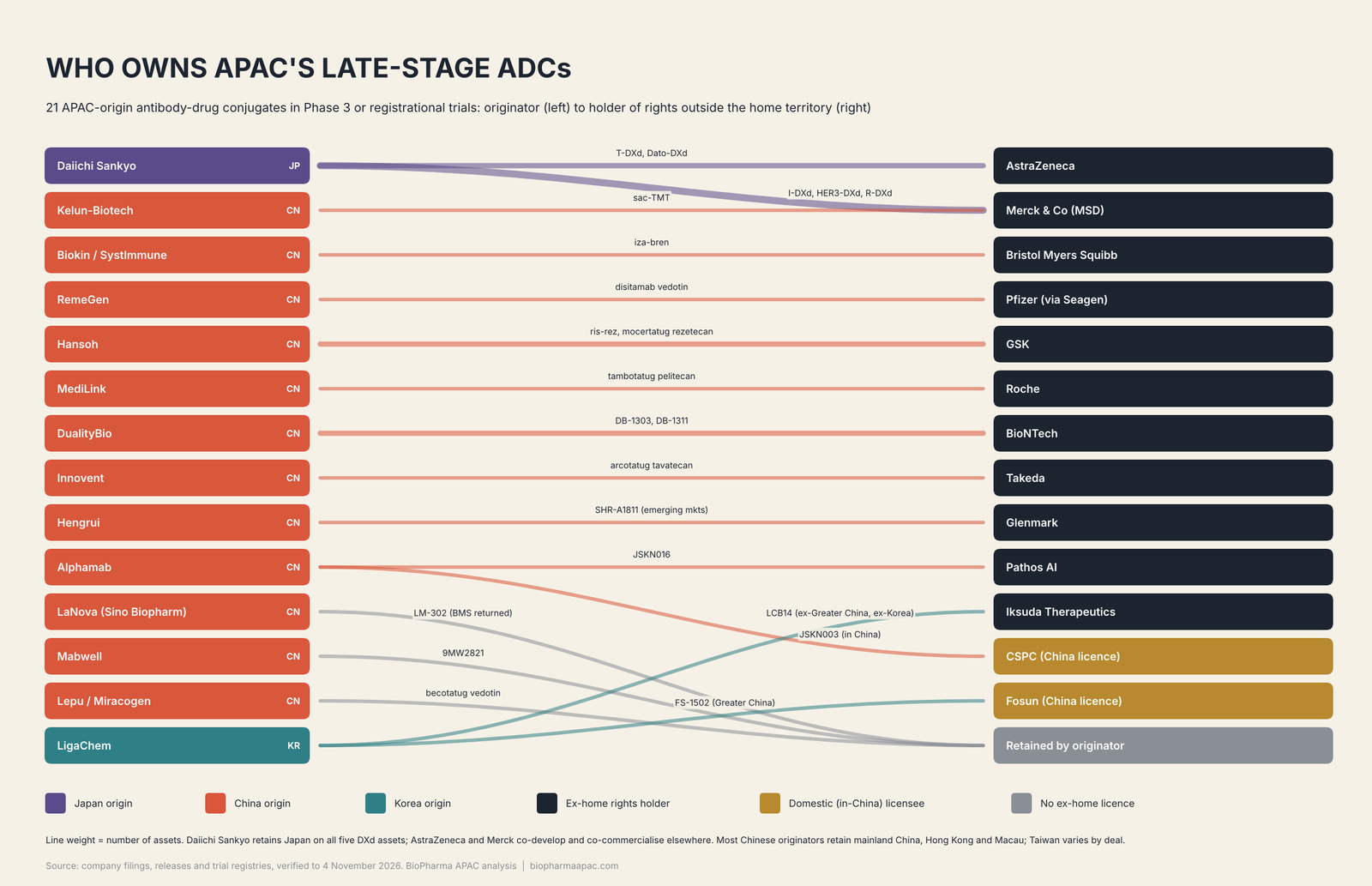
Figure 1. Ownership flow for the 21 APAC-origin ADCs in Phase 3 or registrational trials. Left: originator. Right: holder of rights outside the home territory, or a domestic licensee, or the originator itself where no ex-home licence exists. Line weight reflects the number of assets. Source: company filings, releases and trial registries, verified to 4 November 2026.
Seventeen of them have already been licensed outside their home market, and the companies that will sell most of them in the US and Europe are Merck, AstraZeneca, GSK, BioNTech, Roche, BMS, Pfizer and Takeda. This is the map, asset by asset, territory by territory.
|
HOW THIS MAP WAS BUILT Inclusion. An antibody-drug conjugate (ADC) qualifies if it was discovered by a company headquartered in the Asia-Pacific region and has at least one trial registered as Phase 3, Phase 2/3, or a Phase 2 the sponsor describes as registrational, that is active at our cut. Products already approved somewhere stay in the map if a registrational trial for a new indication is still running. Ownership chain. Rights holders by territory are taken from company filings, licensing announcements and stock-exchange disclosures, not from secondary deal databases. Where a filing does not state a territory precisely, we say so rather than infer it. Trial IDs. Each entry carries one pivotal trial identifier from ClinicalTrials.gov or, where no NCT record was located, the sponsor's own study code from China's trial registry, flagged as such. Cut. Verified to 4 November 2026. This page is updated in place; every change after publication carries a dated revision note at the foot of the article. Boundaries. Deal economics (upfronts, milestones, royalties) belong to our out-licensing roster and are not repeated here. Production and conjugation capacity belong to the Next-Generation Manufacturing ADC story. This piece answers one question: who holds the right to sell each drug, and where. |
Why ownership is the question that matters now
For most of the past decade the ADC story in Asia was told as a science story. Daiichi Sankyo's deruxtecan platform showed that a cleavable linker and a potent topoisomerase I payload could rescue targets the field had written off, and Chinese biotechs took that template and ran it across every antigen with a plausible expression gap. A month before oncologists gather at the Suntec convention centre in Singapore for ESMO Asia on 4 to 6 December, that phase of the story is over. The science has been validated in Phase 3, repeatedly, and the more useful question for anyone planning a launch, a partnership or a competitive response is a commercial one.
Who actually owns these drugs? Not who discovered them, which is well documented, but who holds the right to file, price and sell them in the United States, in Europe, in Japan, and in the originator's own home market. The answer has shifted quietly over the past three years, one licence at a time, and nobody has laid it out in one place. So we built the map.
The method was deliberately narrow. We took every APAC-origin ADC we could find in a registrational trial, traced the rights chain from the originator's own disclosures, and recorded who sits at the end of it in each territory. Twenty-one assets cleared the bar at our cut. Five are Japanese, fifteen are Chinese and one is Korean. The figure below shows where each of them now flows.
The map in five findings
First, the home market almost never leaves. Every Chinese originator on the list that has licensed an asset abroad kept mainland China, and usually Hong Kong and Macau, for itself. Daiichi Sankyo kept Japan on all five of its DXd assets. The one structural exception is a domestic licence: Alphamab handed mainland Chinese commercial rights for JSKN003 to CSPC while keeping supply, which tells you that even inside China, the originator is not always the seller.
Second, the rest of the world has mostly been sold. Seventeen of the twenty-one assets carry some form of licence outside the home territory, and sixteen of those place the US rights with a company other than the originator or in a shared structure. Only four assets, JSKN003, LaNova's LM-302, Mabwell's 9MW2821 and Lepu's becotatug vedotin, have no ex-home licence at all.
Third, Merck & Co is the largest single landlord. It holds rights outside Japan to three Daiichi Sankyo ADCs and rights outside Greater China to Kelun-Biotech's sac-TMT, which makes it the commercial owner of four of the twenty-one. AstraZeneca, GSK and BioNTech hold two each.
Fourth, B7-H3 has become an APAC-origin target with four Western owners. Daiichi Sankyo's ifinatamab deruxtecan sits with Merck, Hansoh's risvutatug rezetecan with GSK, MediLink's tambotatug pelitecan with Roche and DualityBio's DB-1311 with BioNTech. Every late-stage B7-H3 ADC on the map was discovered in Asia, and none of them will be sold in the US by the company that discovered it.
Fifth, Taiwan is the swing territory. Hansoh and Alphamab kept Taiwan when they licensed; MediLink did not, so Roche holds Taiwanese rights to tambotatug pelitecan. For anyone mapping access in the region, Greater China is not a single unit, and the deal language decides it.
The map, entry by entry
Each entry answers its question in the first sentence, then gives the fixed template: target, payload and linker class, originator, rights holder by territory, pivotal trial ID and status. A short note on why the entry matters follows.
Japan: the deruxtecan family
Daiichi Sankyo is the region's original ADC exporter and still its most prolific. Its structure is the template the rest of the region has varied: a global co-development and co-commercialisation partnership with one big pharma per asset, and Japan held back in full.
- Trastuzumab deruxtecan (Enhertu)
AstraZeneca co-develops and co-commercialises Enhertu worldwide with Daiichi Sankyo, which retains exclusive rights in Japan.
HER2 | DXd (exatecan-derived topoisomerase I inhibitor), tetrapeptide cleavable linker | Originator: Daiichi Sankyo | Japan: Daiichi Sankyo; rest of world: Daiichi Sankyo and AstraZeneca jointly | Pivotal trial: DESTINY-Breast05, NCT04622319 | Approved; registrational programme continuing
Enhertu is on this map because its Phase 3 programme is still running in new settings, including post-neoadjuvant HER2-positive early breast cancer. It is the reference point every other HER2 ADC below is measured against.
- Datopotamab deruxtecan (Datroway)
Datroway follows the same split: AstraZeneca and Daiichi Sankyo share it globally, and Japan stays with Daiichi Sankyo.
TROP2 | DXd, tetrapeptide cleavable linker | Originator: Daiichi Sankyo | Japan: Daiichi Sankyo; rest of world: Daiichi Sankyo and AstraZeneca jointly | Pivotal trial: TROPION-Lung07, NCT05555732 | Approved; Phase 3 programme continuing
First-line lung combinations with pembrolizumab are where Datroway's next label will be won or lost, and where it meets Kelun's sac-TMT head on.
- Ifinatamab deruxtecan (I-DXd)
Merck & Co co-develops and co-commercialises I-DXd outside Japan; Daiichi Sankyo keeps Japan.
B7-H3 | DXd, tetrapeptide cleavable linker | Originator: Daiichi Sankyo | Japan: Daiichi Sankyo; rest of world: Daiichi Sankyo and Merck jointly | Pivotal trial: IDeate-Lung02, NCT06203210 | US accelerated filing withdrawn 25 September 2026; Phase 3 enrolling
The withdrawal followed FDA feedback that single-arm Phase 2 data did not meet the bar for accelerated approval. The rights did not move, but the timeline did, and the gap matters for the B7-H3 race described below.
- Patritumab deruxtecan (HER3-DXd)
Merck holds co-development and co-commercialisation rights to HER3-DXd outside Japan, alongside Daiichi Sankyo.
HER3 | DXd, tetrapeptide cleavable linker | Originator: Daiichi Sankyo | Japan: Daiichi Sankyo; rest of world: Daiichi Sankyo and Merck jointly | Pivotal trial: HERTHENA-Breast04, NCT07060807 | Phase 3
After the lung filing was withdrawn in 2025, the asset moved to HR-positive, HER2-negative breast cancer in a roughly 1,000-patient trial. It remains the only late-stage HER3 ADC on the map.
- Raludotatug deruxtecan (R-DXd)
Merck shares R-DXd outside Japan with Daiichi Sankyo, having made the continuation payment that kept it in the deal.
CDH6 | DXd, tetrapeptide cleavable linker | Originator: Daiichi Sankyo | Japan: Daiichi Sankyo; rest of world: Daiichi Sankyo and Merck jointly | Pivotal trial: REJOICE-Ovarian01, NCT06161025 | Phase 2/3
A Phase 2/3 design in platinum-resistant ovarian cancer qualifies it under our method. It is the least crowded target on the list.
China: licensed outside the home market
This is the bulk of the map. The common structure is an exclusive licence outside Greater China, or outside mainland China, Hong Kong and Macau, with the Chinese originator running domestic development and often generating the first Phase 3 data in its own patients.
- Sacituzumab tirumotecan (sac-TMT)
Merck holds exclusive rights to sac-TMT outside Greater China; Kelun-Biotech keeps Greater China, where the drug is already approved.
TROP2 | Belotecan-derived topoisomerase I inhibitor, bifunctional linker | Originator: Kelun-Biotech | Greater China: Kelun-Biotech; rest of world: Merck | Pivotal trial: TroFuse-005, NCT06132958 | Approved in China; US filing under priority review, decision date 15 June 2027
Merck runs 18 global Phase 3 trials on this asset, ten of them in women's cancers. TroFuse-005 met both survival endpoints in pretreated endometrial cancer and was presented in the ESMO 2026 Presidential Symposium. If it is approved next June, it would, on our reading of the record, be the first China-discovered ADC to win US approval.
- Izalontamab brengitecan (iza-bren)
Bristol Myers Squibb holds rights to iza-bren outside mainland China under a joint development deal with SystImmune; Biokin keeps mainland China.
EGFR x HER3 bispecific | Ed-04 topoisomerase I inhibitor, cleavable linker, DAR 8 | Originator: Sichuan Biokin (via US subsidiary SystImmune) | Mainland China: Biokin; outside mainland China: SystImmune and BMS under the collaboration | Pivotal trial: PANKU-Lung01, NCT06382116 | Approved in China (nasopharyngeal carcinoma, June 2026; oesophageal squamous cell carcinoma); multiple positive Phase 3s
No asset on the map has moved faster this year. It became the world's first approved bispecific ADC in June, then posted positive Phase 3 data in triple-negative breast cancer, oesophageal cancer, HR-positive breast cancer and, in late October, EGFR-mutated lung cancer, where median progression-free survival roughly doubled against platinum chemotherapy.
- Disitamab vedotin
Pfizer, through its Seagen acquisition, holds disitamab vedotin everywhere outside RemeGen's territory, which is Asia excluding Japan and Singapore.
HER2 | MMAE, protease-cleavable mc-vc linker | Originator: RemeGen | Asia excluding Japan and Singapore: RemeGen; rest of world including Japan and Singapore: Pfizer | Pivotal trial: DV-001, NCT05911295 | Approved in China; Pfizer Phase 3 past its primary completion date
This is the oldest licence on the map, signed in 2021, and the only one that hands Japan to the licensee. RemeGen's own first-line bladder cancer Phase 3 with toripalimab was positive on both survival endpoints. Pfizer's DV-001, with pembrolizumab, reached its estimated primary completion at the end of June 2026; no topline result had been disclosed in the sources we reviewed at our cut.
- Risvutatug rezetecan (ris-rez, HS-20093, GSK'227)
GSK holds ris-rez outside mainland China, Hong Kong, Macau and Taiwan; Hansoh keeps those four territories.
B7-H3 | Topoisomerase I inhibitor payload | Originator: Hansoh Pharma | Greater China including Taiwan: Hansoh; rest of world: GSK | Pivotal trial: EMBOLD SCLC-301, NCT07099898 (global); ARTEMIS-008, NCT06498479 (China, positive) | Phase 3
ARTEMIS-008 was the first Phase 3 to show an overall survival benefit for any B7-H3 ADC, cutting the risk of death by about half against topotecan in 461 Chinese patients with relapsed small-cell lung cancer. GSK's own global trial reads out in 2027.
- Mocertatug rezetecan (HS-20089, GSK'584)
GSK holds the ex-Greater China licence to this B7-H4 ADC; Hansoh runs the Chinese Phase 3.
B7-H4 | Topoisomerase I inhibitor, protease-cleavable linker, DAR about 6 | Originator: Hansoh Pharma | Greater China: Hansoh; rest of world: GSK | Pivotal trial: NCT06855069 (China, platinum-resistant ovarian cancer) | Phase 3 in China; GSK has said it plans five Phase 3 studies in gynaecological cancers
Two Hansoh assets with one licensee make GSK the most concentrated bet on a single Chinese originator in the map.
- Tambotatug pelitecan (YL201)
Roche holds YL201 worldwide outside mainland China, Hong Kong and Macau, which means Roche, not MediLink, owns Taiwan.
B7-H3 | Topoisomerase I inhibitor on the TMALIN tumour-microenvironment-activatable linker platform | Originator: MediLink Therapeutics | Mainland China, Hong Kong, Macau: MediLink; rest of world including Taiwan: Roche | Pivotal trial: TAISHAN-302, NCT06612151 | Two positive Phase 3s in China; Chinese NDA accepted
Licensed in January 2026, this is the newest big-pharma entry on the map. TAISHAN-302 showed a survival benefit over topotecan in relapsed small-cell lung cancer with a confirmed response rate near 59%, and Roche has said it will begin its own global Phase 3.
- Trastuzumab pamirtecan (DB-1303, BNT323)
BioNTech holds trastuzumab pamirtecan outside the Chinese territories DualityBio retains, and the two co-develop it globally.
HER2 | Topoisomerase I inhibitor on the DITAC platform | Originator: DualityBio | China: DualityBio; rest of world: BioNTech | Pivotal trial: DYNASTY-Breast02, NCT06018337 | Chinese BLA accepted April 2026; US filing planned
The companies have said they will choose the US regulatory path from the combined endometrial and breast data, which is a polite way of saying the HER2-low breast readout will decide how this asset is positioned against Enhertu.
- DB-1311 (BNT324, elfetabart drozuntecan)
BioNTech holds DB-1311 outside China, but DualityBio exercised an option in May 2026 to share US development costs and US profits.
B7-H3 | Topoisomerase I inhibitor payload | Originator: DualityBio | China: DualityBio; rest of world: BioNTech, with DualityBio sharing US costs and profits | Pivotal trial: NCT07365995 (metastatic castration-resistant prostate cancer, versus docetaxel) | Phase 3, first patient dosed May 2026
This is the clearest example on the map of an originator buying back part of the US upside after signing. It is also the only B7-H3 ADC whose first registrational trial is in prostate cancer rather than small-cell lung cancer.
- Arcotatug tavatecan (IBI343, TAK-921)
Takeda holds arcotatug tavatecan worldwide outside Greater China, making it the only asset on the map licensed by one APAC company to another.
Claudin 18.2 | Exatecan (topoisomerase I inhibitor) | Originator: Innovent Biologics | Greater China: Innovent; rest of world including Japan: Takeda | Pivotal trial: G-HOPE-001, NCT06238843 | Met primary endpoint; Chinese NDA under priority review; ESMO 2026 late-breaker
G-HOPE-001 enrolled patients in China and Japan, so the Japanese data that will support a Takeda filing at home came from a trial run by a Chinese originator. It is the first Claudin 18.2 ADC to enter regulatory review anywhere.
- Trastuzumab rezetecan (SHR-A1811)
Hengrui keeps trastuzumab rezetecan in China, the US, Europe and Japan; Glenmark holds a regional licence covering emerging markets outside those territories.
HER2 | Topoisomerase I inhibitor payload | Originator: Jiangsu Hengrui | China, US, Canada, Europe, Japan, Russia and CIS: Hengrui; remaining markets including India: Glenmark | Pivotal trial: Glenmark multi-country Phase 3 in platinum-resistant ovarian cancer (NCT number not located at cut; registered in India) | Approved in China for HER2-mutant lung cancer (2025) and HER2-positive breast cancer (March 2026)
This is the one entry where the originator kept the big Western markets and licensed the rest, the reverse of the dominant pattern. Whether Hengrui intends to take the US and Europe itself, or is holding them for a later and larger deal, is one of the open questions on the map.
- JSKN016
Pathos AI, a US company, holds JSKN016 outside the Chinese mainland, Hong Kong, Macau and Taiwan; Alphamab keeps all four.
TROP2 x HER3 bispecific | Topoisomerase I inhibitor, site-specific glycan conjugation, DAR 4 | Originator: Alphamab Oncology | Greater China including Taiwan: Alphamab; rest of world: Pathos AI | Pivotal trial: Chinese Phase 3 in triple-negative breast cancer (NCT number not located at cut) | Phase 3 in China; licensed August 2026
The licensee is the unusual part. Pathos is a venture-backed, AI-led developer rather than a big pharma, which makes this the only Phase 3 Chinese ADC whose Western future depends on a company that does not yet sell a drug.
China: home rights licensed, or nothing licensed at all
Four Chinese assets have no licence outside their home market. One of them has been licensed inside China instead.
- JSKN003
CSPC, through its subsidiary JMT-Bio, holds mainland Chinese commercial rights to JSKN003 and is the marketing authorisation holder there; Alphamab keeps supply and all rights outside mainland China.
HER2 biparatopic | Topoisomerase I inhibitor, glycan-specific conjugation | Originator: Alphamab Oncology | Mainland China (tumour indications): CSPC; Hong Kong, Macau, Taiwan and rest of world: Alphamab, unlicensed | Pivotal trial: JSKN003-306 (China registry study code) | Three Phase 3s in China
A Chinese originator licensing its home market to a larger Chinese company is still rare at this stage, and it shows that commercial scale inside China can be worth more to a biotech than keeping the sales force.
- Tecotabart vedotin (LM-302)
LaNova, now owned by Sino Biopharmaceutical, holds LM-302 worldwide after Bristol Myers Squibb terminated the ex-China licence it inherited from Turning Point Therapeutics.
Claudin 18.2 | MMAE, cathepsin-cleavable linker | Originator: LaNova Medicines | All territories: LaNova (Sino Biopharm); global rights available | Pivotal trial: LM302-03-101 (China registry study code) | Phase 3 enrolment complete
LM-302 is the map's cautionary tale and its best-value orphan. It is the first Claudin 18.2 ADC to finish enrolling a registrational Phase 3, yet it is back on the shelf for Western buyers, while Innovent's competitor has already been licensed to Takeda.
- Bulumtatug fuvedotin (9MW2821)
Mabwell holds 9MW2821 worldwide; no licence outside China has been disclosed.
Nectin-4 | MMAE via interchain-disulfide conjugation | Originator: Mabwell | All territories: Mabwell | Pivotal trial: NCT06196736 (urothelial carcinoma) | Four Phase 3s in China; US Phase 1b in progress
With registrational trials in urothelial, cervical and ADC-pretreated triple-negative breast cancer, and interim analyses due, this is the most advanced unpartnered asset on the map.
- Becotatug vedotin (MRG003)
Lepu Biopharma holds becotatug vedotin worldwide; no ex-China licence has been disclosed.
EGFR | MMAE | Originator: Lepu Biopharma (Miracogen) | All territories: Lepu | Pivotal trial: Chinese Phase 3 in head and neck squamous cell carcinoma (NCT number not located at cut) | Conditionally approved in China for nasopharyngeal carcinoma, October 2025
The first approved EGFR ADC anywhere is still entirely Chinese-owned, which says as much about the auristatin payload's commercial appeal in 2026 as it does about the target.
Korea: the three-way split
Korea contributes one asset, and it has the most fragmented ownership on the map.
- Caxmotabart entudotin (LCB14, FS-1502, IKS014)
Fosun holds Greater China, Iksuda Therapeutics holds the rest of the world outside Greater China and Korea, and LigaChem Biosciences keeps Korea.
HER2 | MMAF, site-specific ConjuAll linker, DAR 2 | Originator: LigaChem Biosciences | Greater China: Fosun Pharma; Korea: LigaChem; rest of world: Iksuda | Pivotal trial: NCT05755048 (Fosun, China, versus T-DM1) | Phase 3 in China; Phase 1 in the US
Three companies, three territories, one molecule. The registrational data are being generated by the Chinese licensee, which makes this the region's clearest case of a Korean platform being validated in China before anyone sees it in the West.
What the map says about who has the leverage
Read the right-hand side of the figure and a pattern jumps out. Eight Western or Japanese pharmaceutical companies hold the commercial future of most of Asia's late-stage ADCs, and almost all of them got there by licensing rather than discovery. Merck alone controls four. If sac-TMT and HER3-DXd succeed, a meaningful share of the next decade of TROP2 and HER3 revenue in the US will be booked by a company with no ADC chemistry of its own in either molecule.
Read the left-hand side and a different pattern appears. Chinese originators have become very good at keeping the one territory where they have structural advantages: faster enrolment, lower trial costs, a regulator that now accepts conditional approval on strong Phase 2 data, and the national reimbursement list. Ris-rez, tambotatug pelitecan, iza-bren and arcotatug tavatecan all produced positive Phase 3 data in China before their licensees produced any in their own territories. The originator is, in effect, generating the first pivotal evidence for an asset it has already sold abroad.
That creates a quiet tension worth watching. The licensee owns the global label, but the originator owns the first dataset, the first approval and often the manufacturing know-how. When a global trial disagrees with a Chinese one, as could happen in B7-H3 small-cell lung cancer next year, the two owners will be reading the same molecule's evidence from opposite sides of the table.
Japan is the inverse case
Daiichi Sankyo kept Japan on every asset. Chinese originators mostly gave Japan away. Disitamab vedotin's Japanese rights sit with Pfizer, arcotatug tavatecan's with Takeda, ris-rez's with GSK, and tambotatug pelitecan's with Roche. Only Hengrui explicitly carved Japan back out of its Glenmark deal. For Japanese oncologists, that means the Chinese ADCs they are most likely to prescribe in the late 2020s will arrive through Western or domestic pharma channels, priced and positioned by companies that did not discover them. For Japanese pharma, the Takeda deal shows the alternative: buy the asset and own Japan outright.
The unlicensed four, and what keeps them that way
Three of the four assets with no ex-home licence carry an auristatin payload: LM-302, 9MW2821 and becotatug vedotin all use MMAE. The licensed majority are overwhelmingly topoisomerase I conjugates. That is not proof of cause, but it is a consistent signal of where Western buyers have placed their bets since deruxtecan reset expectations. JSKN003, the fourth, is a topoisomerase I conjugate whose home market is already licensed to CSPC, which may make the remaining global rights harder to package.
The more interesting test is LM-302. A Claudin 18.2 ADC with a completed Phase 3 enrolment and no Western partner is either an overlooked bargain or a signal the field has priced in. The first readout from LM302-03-101 will settle which.
What to watch through 2027
Five events will redraw lines on this map before the next edition. The FDA decision on sac-TMT, due 15 June 2027, determines whether a Chinese-origin ADC reaches US patients under a big-pharma label. GSK's EMBOLD SCLC-301 readout, expected in 2027, will be the first global test of whether Chinese B7-H3 survival data travel. The DV-001 result will decide whether Pfizer keeps investing in disitamab vedotin outside Asia, after the US$200 million impairment Pfizer reported against it for the fourth quarter of 2024. Any Western licence for 9MW2821 or LM-302 would close two of the four gaps. And Hengrui's choice on trastuzumab rezetecan in the US and Europe, partner or launch alone, will tell the region whether a Chinese originator can still hold the largest markets once it has a Phase 3 asset in hand.
We will update this map in place as each of those happens, refresh it in the week of ESMO Asia 2026 for any deals or data announced in Singapore, and rebuild it in full each year. On the evidence of the past twelve months, the right-hand column will be longer.
The ledger: all 21 entries in the fixed template
RoW = rest of world. Topo-I = topoisomerase I inhibitor. Verified to 4 November 2026; updated in place with dated revision notes.
|
ADC |
Target |
Payload and linker class |
Originator |
Rights holder by territory |
Pivotal trial ID |
Status at cut |
|
Trastuzumab deruxtecan |
HER2 |
DXd topo-I; tetrapeptide cleavable |
Daiichi Sankyo (JP) |
JP: Daiichi; RoW: Daiichi + AstraZeneca |
NCT04622319 |
Approved; Ph3 ongoing |
|
Datopotamab deruxtecan |
TROP2 |
DXd topo-I; tetrapeptide cleavable |
Daiichi Sankyo (JP) |
JP: Daiichi; RoW: Daiichi + AstraZeneca |
NCT05555732 |
Approved; Ph3 ongoing |
|
Ifinatamab deruxtecan |
B7-H3 |
DXd topo-I; tetrapeptide cleavable |
Daiichi Sankyo (JP) |
JP: Daiichi; RoW: Daiichi + Merck |
NCT06203210 |
US filing withdrawn Sep 2026; Ph3 |
|
Patritumab deruxtecan |
HER3 |
DXd topo-I; tetrapeptide cleavable |
Daiichi Sankyo (JP) |
JP: Daiichi; RoW: Daiichi + Merck |
NCT07060807 |
Ph3 |
|
Raludotatug deruxtecan |
CDH6 |
DXd topo-I; tetrapeptide cleavable |
Daiichi Sankyo (JP) |
JP: Daiichi; RoW: Daiichi + Merck |
NCT06161025 |
Ph2/3 |
|
Sacituzumab tirumotecan |
TROP2 |
Belotecan-derived topo-I; bifunctional |
Kelun-Biotech (CN) |
Greater China: Kelun; RoW: Merck |
NCT06132958 |
China approved; US PDUFA 15 Jun 2027 |
|
Izalontamab brengitecan |
EGFR x HER3 |
Ed-04 topo-I; cleavable; DAR 8 |
Biokin / SystImmune (CN) |
Mainland China: Biokin; ex-China: SystImmune + BMS |
NCT06382116 |
China approved; multiple Ph3 wins |
|
Disitamab vedotin |
HER2 |
MMAE; mc-vc protease-cleavable |
RemeGen (CN) |
Asia ex-JP/SG: RemeGen; RoW incl. JP, SG: Pfizer |
NCT05911295 |
China approved; Pfizer Ph3 |
|
Risvutatug rezetecan |
B7-H3 |
Topo-I |
Hansoh (CN) |
Greater China incl. TW: Hansoh; RoW: GSK |
NCT07099898 |
China Ph3 positive; global Ph3 |
|
Mocertatug rezetecan |
B7-H4 |
Topo-I; protease-cleavable; DAR ~6 |
Hansoh (CN) |
Greater China: Hansoh; RoW: GSK |
NCT06855069 |
Ph3 (China) |
|
Tambotatug pelitecan |
B7-H3 |
Topo-I; TMALIN |
MediLink (CN) |
CN, HK, MO: MediLink; RoW incl. TW: Roche |
NCT06612151 |
Two China Ph3 positive; NDA accepted |
|
Trastuzumab pamirtecan |
HER2 |
Topo-I; DITAC |
DualityBio (CN) |
China: DualityBio; RoW: BioNTech |
NCT06018337 |
China BLA accepted; Ph3 |
|
DB-1311 (BNT324) |
B7-H3 |
Topo-I |
DualityBio (CN) |
China: DualityBio; RoW: BioNTech (US cost/profit share with DualityBio) |
NCT07365995 |
Ph3 |
|
Arcotatug tavatecan |
CLDN18.2 |
Exatecan topo-I |
Innovent (CN) |
Greater China: Innovent; RoW incl. JP: Takeda |
NCT06238843 |
Ph3 met; China NDA priority review |
|
Trastuzumab rezetecan |
HER2 |
Topo-I |
Hengrui (CN) |
CN, US, EU, JP and others: Hengrui; emerging mkts: Glenmark |
Not located (India-registered) |
China approved; Ph3 |
|
JSKN016 |
TROP2 x HER3 |
Topo-I; glycan site-specific; DAR 4 |
Alphamab (CN) |
Greater China incl. TW: Alphamab; RoW: Pathos AI |
Not located (China Ph3) |
Ph3 (China) |
|
JSKN003 |
HER2 biparatopic |
Topo-I; glycan-specific |
Alphamab (CN) |
Mainland China: CSPC; elsewhere: Alphamab (unlicensed) |
JSKN003-306 |
Ph3 (China) |
|
Tecotabart vedotin (LM-302) |
CLDN18.2 |
MMAE; cathepsin-cleavable |
LaNova / Sino Biopharm (CN) |
Worldwide: LaNova (BMS licence terminated) |
LM302-03-101 |
Ph3 enrolment complete |
|
Bulumtatug fuvedotin (9MW2821) |
Nectin-4 |
MMAE; interchain disulfide |
Mabwell (CN) |
Worldwide: Mabwell |
NCT06196736 |
Four Ph3s (China) |
|
Becotatug vedotin (MRG003) |
EGFR |
MMAE |
Lepu / Miracogen (CN) |
Worldwide: Lepu |
Not located (China Ph3) |
China approved (NPC); Ph3 HNSCC |
|
Caxmotabart entudotin (LCB14) |
HER2 |
MMAF; site-specific; DAR 2 |
LigaChem (KR) |
Greater China: Fosun; KR: LigaChem; RoW: Iksuda |
NCT05755048 |
Ph3 (China) |
Most Read
- Can APAC Biomanufacturing Decarbonise Without Pricing Itself Out?
- The Algorithm on the GMP Floor: AI Promises a Smarter Plant. Regulators Demand the Audit Trail.
- APAC's Peptide-Capacity Gamble
- After the Rush: APAC's mRNA and Vaccine Capacity Hangover
- The Biosimilar Race: Factory to the World — or Stuck in the Copycat Economy?
- The Vein-to-Vein Problem: Can APAC's Cold Chain Carry Advanced Therapies?
- Vectors, Plasmids and the CGT Trap: APAC's Cell and Gene Therapy Ambitions Face an Upstream Bottleneck
- Can APAC Build Radioligand Therapy Before the Atoms Decay?
- The Great Biopharma Reset: 50 Developments That Changed Everything in H1 2026
- Beyond the Trial: Can Real-World Evidence Earn Regulatory Trust in APAC?
- Beyond the Obvious Giant: Where APAC's Clinical Trials Go Next
- The Frontier That Won’t Quite Arrive
Bio Jobs
- Sanofi Turns The Page As Belén Garijo Steps In And Paul Hudson Steps Out
- Global Survey Reveals Nearly 40% of Employees Facing Fertility Challenges Consider Leaving Their Jobs
- BioMed X and AbbVie Begin Global Search for Bold Neuroscience Talent To Decode the Biology of Anhedonia
- Thermo Fisher Expands Bengaluru R&D Centre to Advance Antibody Innovation and Strengthen India’s Life Sciences Ecosystem
- Accord Plasma (Intas Group) Acquires Prothya Biosolutions to Expand Global Plasma Capabilities
- ACG Announces $200 Million Investment to Establish First U.S. Capsule Manufacturing Facility in Atlanta
- AstraZeneca Invests $4.5 Billion to Build Advanced Manufacturing Facility in Virginia, Expanding U.S. Medicine Production
News


