The 10 Deals That Defined APAC Biopharma in 2026
25 September 2026 | Friday | Analysis
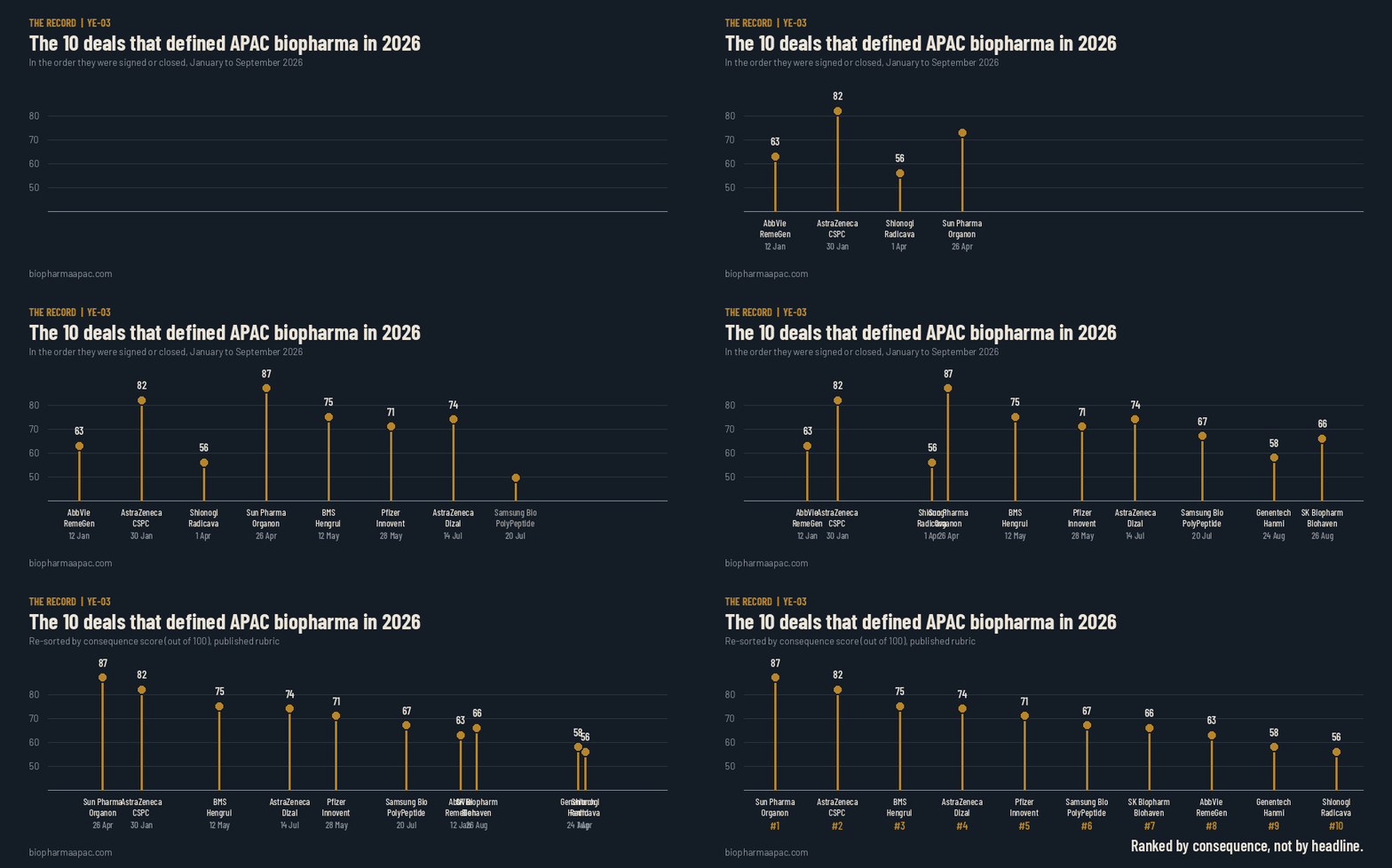
The biggest pharma deals of 2026 with an Asia-Pacific principal are easy to list and hard to rank. The ten on this page carry more than US$70 billion in headline value between them. Less than a third of that is money anyone is obliged to pay, and three acquisitions account for most of the part that is.
That is not a criticism of anyone's dealmaking. It is how the modern licensing contract is built: a committed cheque, a long ladder of milestones that pay only if the science and the market cooperate, and a total printed in the headline because it is the largest defensible number in the release. Rank a year by that total and you are ranking optimism.
So this list ranks by consequence. Each deal was scored against a rubric published below, before the ranking was read off. The result puts an Indian generics company buying an American women's health business at the top, has a Korean epilepsy company buying a US asset outrank a US$5.6 billion oncology licence, and leaves the year's largest Korean headline off the list entirely, because nobody will say what was paid for it.
|
HOW THIS LIST WAS BUILT The window. Agreements signed, or closed, between 1 January 2026 and the cut of 23 September 2026. The list updates in place to a 31 December cut in the first week of January, with dated revision notes. Nothing changes silently. Who qualifies. M&A, licensing and structured partnerships in which at least one principal is headquartered in Asia-Pacific. Venture rounds are excluded; they belong to the funding tracker (YE-10). Commercial distribution rights on already-marketed products are excluded. Where the numbers come from. Every term is cited to a company announcement, an exchange filing or an SEC filing, with its date. Where the release and the filing differ, both are shown. How headlines are decomposed. Committed means cash or equity the buyer is obliged to pay: upfronts, fixed anniversary payments, all-cash acquisition consideration. Contingent means anything that depends on an option, a milestone or a condition. Royalties are noted, never valued. Unvalued deals. A deal without disclosed consideration can enter on consequence, flagged as unvalued, with its capital score capped at 5 out of 25. Boundaries. Structure analysis of the licensing class belongs to our roster “8 APAC Assets That Went Global”; entries that overlap it cite it and add only the full-year frame. |
The rubric
Ranked means scored. The desk scored each deal out of 100 on four criteria worth 25 points each, against these definitions.
Strategic reach (25). How much of a company's position, or the region's, the deal changes. A deal that doubles a company outscores one that adds a programme.
Precedent set (25). Whether the deal creates a structure, a price point or a direction of travel that later deals will be measured against.
Capital committed versus contingent (25). Full marks go to all-cash consideration that has closed. Points come off for the contingent share of the headline, for closings still pending at the cut, and for deferred payments.
What moved because of it (25). Observable consequences by the cut: closings, follow-on deals, market reaction, competitor response. A deal awaiting clearance scores low here by construction and should rise in January if it closes.
Ties are broken on precedent. Other contenders were scored and fell short; the closest are listed after the ten.
THE SCOREBOARD
|
# |
Deal |
Date |
Committed |
Headline |
Reach |
Prec. |
Cap. |
Moved |
Total |
|
1 |
Sun Pharma / Organon |
26 Apr 2026 |
US$11.75B (all cash, EV) |
US$11.75B |
25 |
22 |
22 |
18 |
87 |
|
2 |
AstraZeneca / CSPC |
30 Jan 2026 |
US$1.2B |
US$18.5B |
20 |
22 |
18 |
22 |
82 |
|
3 |
BMS / Hengrui |
12 May 2026 |
US$775M |
US$15.2B |
19 |
24 |
15 |
17 |
75 |
|
4 |
AstraZeneca / Dizal |
14 Jul 2026 |
US$600M |
US$1.5B |
17 |
22 |
21 |
14 |
74 |
|
5 |
Pfizer / Innovent |
28 May 2026 |
US$650M |
US$10.5B |
18 |
21 |
15 |
17 |
71 |
|
6 |
Samsung Biologics / PolyPeptide |
20 Jul 2026 |
CHF 1.46B (~US$1.8B) |
CHF 1.46B |
18 |
18 |
20 |
11 |
67 |
|
7 |
SK Biopharm / Biohaven |
26 Aug 2026 |
US$400M |
US$795M |
17 |
21 |
18 |
10 |
66 |
|
8 |
AbbVie / RemeGen |
12 Jan 2026 |
US$650M |
US$5.6B |
15 |
16 |
17 |
15 |
63 |
|
9 |
Genentech / Hanmi |
24 Aug 2026 |
US$190M |
US$2.3B |
15 |
18 |
12 |
13 |
58 |
|
10 |
Shionogi / Radicava |
1 Apr 2026 (close) |
US$2.5B (lump sum) |
US$2.5B |
15 |
10 |
23 |
8 |
56 |
Committed and headline values as disclosed; Sun Pharma / Organon is enterprise value and includes debt assumed. Samsung Biologics / PolyPeptide: CHF 1.46 billion, reported as about US$1.8 billion.
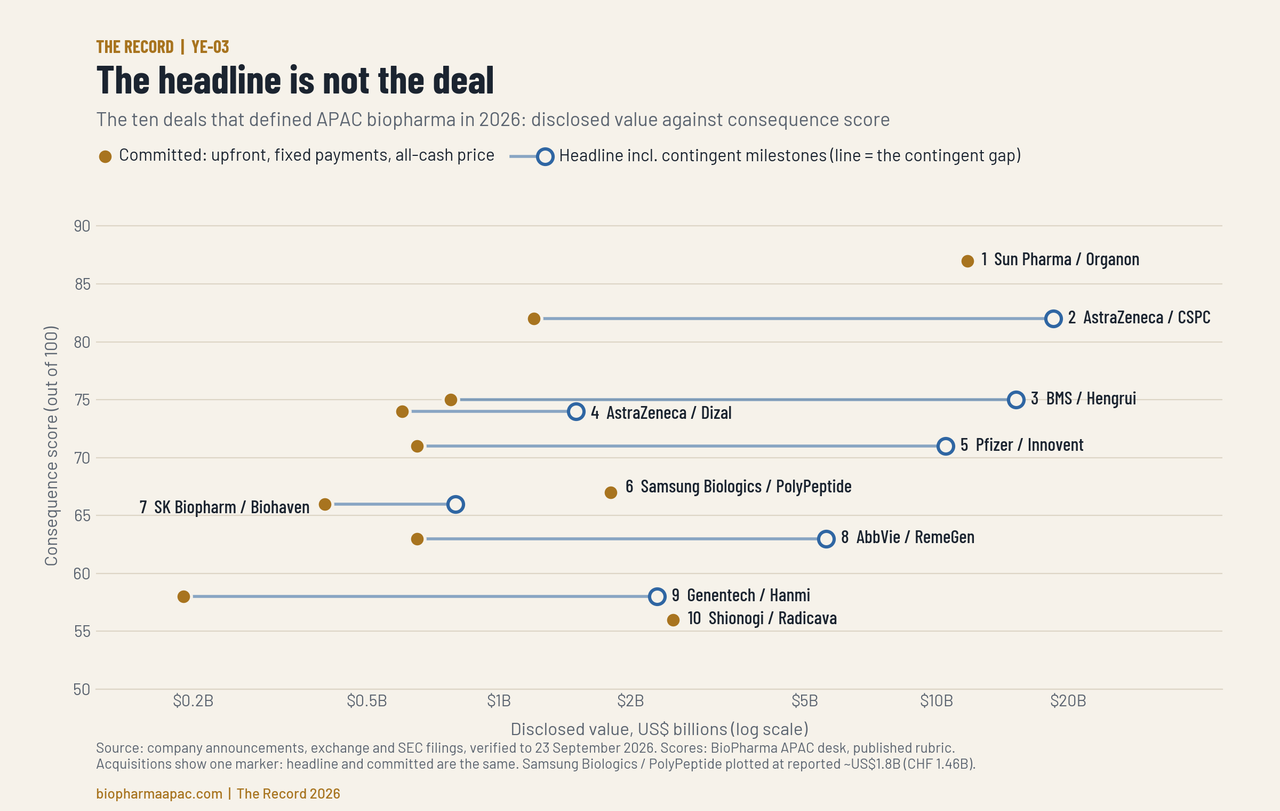
Figure 1. Disclosed value against consequence score. The filled marker is committed money; the open ring is the headline; the line between them is the contingent share. The two largest headlines sit far from the top of the ranking.
The ten
1. Sun Pharma and Organon: the year's defining deal is an acquisition
The most consequential APAC biopharma deal of 2026 is Sun Pharma's all-cash agreement to buy Organon, which Sun describes as the largest acquisition ever made by an Indian drugmaker.
|
Parties |
Sun Pharmaceutical Industries (India), acquirer; Organon & Co. (US), target. |
|
Structure |
Acquisition of all outstanding shares for cash at US$14.00 per share. |
|
Date |
Announced 26 April 2026 (27 April in Mumbai). Close expected early 2027. |
|
Disclosed economics |
Enterprise value US$11.75 billion, all committed at signing. The release states no equity value. On its own year-end figures Organon carried US$8.6 billion of debt against US$574 million of cash, so most of the enterprise value is liabilities assumed rather than cash to stockholders; published broker estimates of the equity cheque run from about US$3.2 billion to US$4.0 billion. Funded from internal cash and committed bank financing, with post-deal net debt to EBITDA guided at 2.3x. |
|
Score |
Reach 25 | Precedent 22 | Capital 22 | Moved 18 | Total 87 |
Consequence. This is the deal that changes what an Asian pharma company is allowed to be. Sun doubles itself in one move: Organon's US$6.2 billion of 2025 revenue matched Sun's own, and the combined company, guided at about US$12.4 billion in revenue, enters the global top 25 and becomes the seventh-largest seller of biosimilars. The price is the precedent. At US$11.75 billion against US$1.9 billion of adjusted EBITDA, Sun is paying about 6.2 times, low for a large pharma control transaction, and a buyer valued on Indian market multiples re-rates every dollar of acquired earnings the moment it consolidates them. Sun's shares rose 7% and Organon's 17% on announcement. It gives up points only because it has not closed: the capital is committed, but the integration and the deleveraging are still ahead.
2. AstraZeneca and CSPC: the partnership that became a relationship
The largest partnership of the year by headline, and the one whose consequences spread furthest, is AstraZeneca's US$18.5 billion obesity alliance with CSPC Pharmaceutical.
|
Parties |
AstraZeneca (UK), licensee; CSPC Pharmaceutical Group (China), licensor. |
|
Structure |
Exclusive ex-China licence to eight weight-management programmes, led by SYH2082, a long-acting GLP-1R/GIPR agonist entering Phase 1, with access to CSPC's AI peptide design and LiquidGel once-monthly dosing platform. CSPC keeps mainland China, Hong Kong, Macau and Taiwan, where AstraZeneca holds a co-commercialisation option. |
|
Date |
Announced 30 January 2026; closed April 2026, per AstraZeneca's Q1 2026 report. |
|
Disclosed economics |
US$1.2 billion upfront (committed, paid on close). Up to US$3.5 billion in development and regulatory milestones, and up to US$13.8 billion in sales milestones, the latter disclosed in CSPC's Hong Kong filing rather than AstraZeneca's release. Committed share of headline: 6.5%. |
|
Score |
Reach 20 | Precedent 22 | Capital 18 | Moved 22 | Total 82 |
Consequence. Read AstraZeneca's release alone and this is a US$4.7 billion deal; read CSPC's exchange filing and it is US$18.5 billion. The difference is sales milestones, which is exactly why the house rule insists on both documents. What earns the ranking is what followed. The agreement came a day after AstraZeneca pledged US$15 billion for its China operations through 2030, and it turned a buyer relationship into an operating one. In July AstraZeneca came back for a kidney siRNA collaboration (US$30 million upfront, up to US$1.77 billion); in August the two formed a 51:49 biologics manufacturing joint venture in Shijiazhuang in which CSPC holds the majority. No other deal this year produced a second and a third transaction between the same parties inside seven months. It also set the ceiling: US$1.2 billion is the largest licensing upfront on public 2026 trackers.
3. Bristol Myers Squibb and Hengrui: the template that runs both ways
The 2026 deal most likely to be copied is Bristol Myers Squibb's 13-programme alliance with Hengrui, because it moves assets in both directions.
|
Parties |
Bristol Myers Squibb (US); Jiangsu Hengrui Pharmaceuticals (China). |
|
Structure |
Global collaboration and licence. BMS takes rights outside mainland China, Hong Kong and Macau to four Hengrui oncology and haematology assets; Hengrui takes rights inside that territory to four BMS immunology assets; five programmes are discovered jointly. Hengrui runs early clinical development through proof of concept. |
|
Date |
Announced 12 May 2026; closed July 2026, per BMS's Q2 2026 Form 10-Q. |
|
Disclosed economics |
US$600 million upfront payable in Q3 2026, plus a US$175 million first-anniversary payment in 2027: US$775 million committed. A second US$175 million in 2028 depends on BMS not terminating first, and up to US$14.3 billion depends on development, regulatory and sales milestones. Headline about US$15.2 billion; committed share 5.1%. |
|
Score |
Reach 19 | Precedent 24 | Capital 15 | Moved 17 | Total 75 |
Consequence. Until May the China licensing template ran one way: Western capital buys ex-China rights and the originator keeps its home market. BMS broke that symmetry by paying partly in assets, handing Hengrui four immunology programmes for its territory alongside the cash. The anniversary payment is the other structural idea worth watching. It converts part of what would once have been a milestone into a fixed obligation, which is what Chinese originators have been bargaining for all year; Evaluate data put the average royalty floor on China deals down from 7.1% to 5.5% in the first four months of 2026, while average upfronts rose 36%. The deal also benchmarks Hengrui against itself: GSK paid US$500 million upfront for its 2025 Hengrui alliance, BMS US$600 million plus fixed anniversaries a year later. Pfizer's Innovent agreement arrived sixteen days afterwards, with an even more elaborate rights architecture.
4. AstraZeneca and Dizal: worldwide rights, China included
The most unusual licence of 2026 is AstraZeneca's purchase of worldwide rights, China included, to Dizal's approved lung cancer drug Zegfrovy.
|
Parties |
AstraZeneca (UK), licensee; Dizal Pharmaceutical (China), licensor. |
|
Structure |
Exclusive global licence to sunvozertinib (Zegfrovy), an oral irreversible EGFR inhibitor approved in the US and China for previously treated non-small cell lung cancer with EGFR exon 20 insertions. |
|
Date |
Announced 14 July 2026; AstraZeneca has since reported the licence completed. |
|
Disclosed economics |
US$600 million upfront (committed). Up to US$900 million in milestones, which Dizal's Shanghai filing splits into up to US$400 million for clinical development and up to US$500 million sales-related. Tiered royalties. Headline US$1.5 billion; committed share 40%, the highest of any licence on this list. |
|
Score |
Reach 17 | Precedent 22 | Capital 21 | Moved 14 | Total 74 |
Consequence. Nearly every China out-licence of the past three years left the originator its home market. This one does not: AstraZeneca takes the world, China included, for a drug already on the market in both jurisdictions that matter most. That makes it closer to a product acquisition than a pipeline bet, and the economics say so, with 40% of the headline committed against single digits for the portfolio deals ranked above it. The history adds a twist. Dizal was founded in 2017 as a joint venture between AstraZeneca and a China Investment Corporation unit, and an AstraZeneca affiliate still holds 23.4%, so this is a pharma licensing back, at a market price, a drug that grew out of its own former China research operation. There is a live catalyst attached: on Phase 3 WU-KONG28 data (median progression-free survival 10.3 months against 7.5 on chemotherapy), first-line filings are with the FDA and China's CDE. Dizal's shares hit their 20% daily limit on the news.
5. Pfizer and Innovent: an originator with a share of Western profits
Pfizer's up to US$10.5 billion oncology alliance with Innovent is the year's clearest sign that Chinese originators now negotiate for a share of Western profits, not only milestones.
|
Parties |
Pfizer (US); Innovent Biologics (China). |
|
Structure |
Licence and collaboration over 12 early-stage and de novo cancer programmes (eight Innovent-originated, four Pfizer-proposed) spanning antibody-drug conjugates with novel payloads and multispecific antibodies, in three tiers: four global licences to Pfizer, four ex-Greater China licences, and four programmes co-developed and co-commercialised with profits shared in the US, the UK and the EU. Innovent leads through Phase 1 and keeps Greater China. |
|
Date |
Announced 28 May 2026; closed 10 July 2026, per Pfizer's Q2 2026 Form 10-Q. |
|
Disclosed economics |
US$650 million upfront (committed); up to US$9.85 billion in milestones (contingent); up to double-digit royalties. Committed share 6.2%. |
|
Score |
Reach 18 | Precedent 21 | Capital 15 | Moved 17 | Total 71 |
Consequence. The co-commercialisation tier is the story. A profit share in the US and Europe gives Innovent what no milestone ladder can: exposure to Western net sales on its partner's terms, and a reason to build commercial capability outside China. It also makes Innovent the year's most bought originator. Four months earlier Lilly signed its seventh collaboration with Innovent (US$350 million upfront, up to about US$8.5 billion in milestones, with Innovent leading programmes through Phase 2), which sits just outside this ten because Pfizer's agreement went further on the same idea. Between them, the two committed US$1 billion in upfront cash to one Suzhou company in one year. Innovent's Hong Kong shares rose about 10% on the Pfizer announcement.
6. Samsung Biologics and PolyPeptide: buying the obesity supply chain
Samsung Biologics' tender offer for Swiss peptide manufacturer PolyPeptide is what Korean press has called the largest acquisition in the history of the country's pharmaceutical and biotechnology industry, and the year's most direct bet on obesity supply.
|
Parties |
Samsung Biologics (Korea), acquirer through Samsung Peptide AG; PolyPeptide Group (Switzerland), target. |
|
Structure |
All-cash public tender offer for 100% of PolyPeptide, to be followed by squeeze-out and delisting from SIX. |
|
Date |
Pre-announced 20 July 2026; main offer period 15 September to 12 October 2026; completion expected towards the end of 2026. |
|
Disclosed economics |
CHF 44.31 per share, implied equity value about CHF 1.46 billion (reported as about US$1.8 billion), all cash and fully committed; a 40% premium to the unaffected price of CHF 31.65 on 10 April. The largest shareholder, with about 55.65%, has irrevocably undertaken to tender; the minimum acceptance threshold is two-thirds. |
|
Score |
Reach 18 | Precedent 18 | Capital 20 | Moved 11 | Total 67 |
Consequence. Every obesity licence on this list assumes someone can make the peptide. Samsung has decided to be that someone, and to buy rather than build: PolyPeptide's first-half 2026 revenue rose 41.6% to EUR 236.6 million, with metabolic therapeutics about 68% of it. The precedent is directional. An APAC contract manufacturer is buying European capacity and a network across the US, Europe and India, the reverse of the offshoring story that defined the last decade, and it gains a modality it did not have in a supply chain its customers are short of. The score for what moved is low only because the offer was still open at the cut; if it settles, this entry rises in January.
7. SK Biopharmaceuticals and Biohaven: Korea writes the cheque
SK Biopharmaceuticals' licence of Biohaven's Kv7 epilepsy platform is the year's clearest case of an APAC company buying Western science rather than selling its own.
|
Parties |
SK Biopharmaceuticals (Korea), licensee; Biohaven (US), licensor through Biohaven Bioscience Ireland. |
|
Structure |
Exclusive worldwide licence to Biohaven's Kv7 ion channel platform, led by opakalim (BHV-7000), a selective Kv7.2/7.3 activator in Phase 2/3 for focal epilepsy. |
|
Date |
Signed 26 August 2026; closing subject to US antitrust clearance. |
|
Disclosed economics |
US$400 million non-refundable upfront fee: US$350 million at closing and US$50 million one year later. Up to US$150 million in development and regulatory milestones. SK also assumes up to US$245 million of Biohaven's future obligations to Knopp Biosciences, the platform's originator. Headline “up to US$795 million”; committed share about 50%. |
|
Score |
Reach 17 | Precedent 21 | Capital 18 | Moved 10 | Total 66 |
Consequence. Here the gap between headline and filing runs in an unusual direction. Of the US$795 million, US$245 million never reaches Biohaven: it is SK taking over Biohaven's milestone debts to Knopp, as Biohaven's Form 8-K makes plain. Strip that out and the deal is US$550 million to Biohaven, of which US$400 million is fixed, one of the highest committed ratios of any licence this year. That is the precedent: a Korean company writing a Western-sized upfront for a US asset ahead of its pivotal readout. The logic is commercial rather than scientific. SK already sells Xcopri to US neurologists through SK Life Science, and chief executive Lee Dong-hoon framed opakalim as the growth backbone for the post-cenobamate era. The RISE3 readout, due in the second half of 2026, will decide whether this looks prescient or expensive. Until it closes and reads out, little has moved.
8. AbbVie and RemeGen: the price that opened the year
AbbVie's RC148 licence from RemeGen opened the year's dealmaking and remains the cleanest price signal for the PD-1/VEGF bispecific class.
|
Parties |
AbbVie (US), licensee; RemeGen (China), licensor. |
|
Structure |
Exclusive licence outside Greater China to RC148 (ABBV-1480), a PD-1/VEGF bispecific antibody in Phase 1/2. |
|
Date |
Announced 12 January 2026; completed March 2026. |
|
Disclosed economics |
US$650 million upfront, recorded as acquired in-process R&D in AbbVie's Q1 2026 Form 10-Q and confirmed as received by RemeGen. Up to US$4.95 billion in milestones in the joint release, rounded to “up to US$5.0 billion” in the 10-Q; tiered double-digit royalties. Headline US$5.6 billion; committed share 11.6%. |
|
Score |
Reach 15 | Precedent 16 | Capital 17 | Moved 15 | Total 63 |
Consequence. Our out-licensing roster carries the structural analysis of this deal, and the finding that RC148 and 3SBio's SSGJ-707 form the class's only like-for-like pair; this entry adds only the full-year frame. In that frame RemeGen's deal did two things. Signed in the second week of January, it confirmed that the premium on China-origin assets would hold into 2026, and it set the upfront bar that the licences which followed were measured against. By autumn the scarcity that priced it had eased: the class is crowded, and the year's larger upfronts went to portfolios and platforms rather than single assets. It ranks eighth because it was a strong price for a strong asset, which is not the same thing as changing the market.
9. Genentech and Hanmi: the price of keeping muscle
Hanmi's licence of HM17321 to Genentech is the year's defining Korean out-licence and the clearest price yet for the next question in obesity: muscle.
|
Parties |
Genentech, a member of the Roche Group (US), licensee; Hanmi Pharmaceutical (Korea), licensor. |
|
Structure |
Exclusive worldwide licence, excluding South Korea, to HM17321, a urocortin-2 analogue that selectively activates CRFR2, designed to reduce fat while preserving muscle through a non-incretin mechanism. Hanmi completes the ongoing Phase 1; Genentech leads from Phase 2. |
|
Date |
Announced 24 August 2026. |
|
Disclosed economics |
US$190 million upfront (committed). Development, regulatory and commercial milestones take the total to about US$2.3 billion; tiered royalties. Committed share about 8%. |
|
Score |
Reach 15 | Precedent 18 | Capital 12 | Moved 13 | Total 58 |
Consequence. Every incretin franchise carries the same overhang, that a meaningful share of the weight lost is lean mass, and the industry spent 2026 buying answers rather than building them. Hanmi's deal prices one of those answers at Phase 1 with US$190 million of hard cash, the company's largest licence for a single candidate, and gives Roche a muscle-preservation asset to sit beside its incretin programmes. For Korea it confirms that domestic metabolic science can clear a nine-figure upfront on Phase 1 data, in the same week that SK wrote a US$400 million cheque in the opposite direction. It places ninth because the asset is early and the committed share modest.
10. Shionogi and Radicava: ranked on money, not novelty
Shionogi's US$2.5 billion purchase of Tanabe Pharma's Radicava business takes tenth place on committed capital: it is the only deal on this list paid in full, in one sum, and already integrated.
|
Parties |
Shionogi & Co. (Japan), acquirer; Tanabe Pharma Corporation (Japan, a Bain Capital portfolio company), seller. |
|
Structure |
Acquisition of 100% of a newly established subsidiary holding global rights to Radicava ORS and IV Radicava (edaravone) for ALS, including intellectual property, sales rights in major countries and regions, and the US commercial organisation. |
|
Date |
Signed 22 December 2025; closed 1 April 2026. Eligible on its closing date. |
|
Disclosed economics |
US$2.5 billion lump sum, paid at closing, plus possible royalties on future sales subject to conditions. Committed share: effectively 100%. Shionogi guided about US$700 million of annual global revenue and immediate accretion in fiscal 2026. |
|
Score |
Reach 15 | Precedent 10 | Capital 23 | Moved 8 | Total 56 |
Consequence. This deal ranks on money, not novelty. Japanese companies buying US commercial footprints is an established pattern, and a private-equity-owned Japanese seller passing a Japanese-discovered drug to another Japanese company is no new template, hence the low precedent score. What it does is turn Shionogi, historically an infectious disease company, into a commercially active US rare disease business from day one, with more than 100 Tanabe staff joining and a platform for planned launches in Fragile X syndrome, Jordan's syndrome and Pompe disease. It is the one deal on the list where headline and committed money are the same number, and that is what edges the year's largest Korean headline out of tenth place.
|
THE DEAL THAT DID NOT MAKE IT, AND WHY Novartis's option and licence agreement with Alteogen (2 September 2026) carries the year's largest Korean headline, up to US$3.223 billion in option exercise fees and development and commercial milestones for subcutaneous versions of several Novartis products built on Alteogen's ALT-B4 hyaluronidase, plus royalties. It is Alteogen's fourth ALT-B4 licence of 2026, after GSK's Tesaro unit, Biogen and an unnamed global company, and it confirms that subcutaneous conversion has become defensive infrastructure for biologics facing intravenous biosimilar erosion. It scored 45. No upfront was disclosed, so under the unvalued rule its capital score is capped, and a ceiling assembled from options on unnamed products cannot tell a reader what Novartis has committed. If a filing discloses the upfront before the 31 December cut, the deal will be re-scored with a dated note. The next closest: Lilly and Innovent (8 February; US$350 million upfront, up to about US$8.5 billion in milestones) scored 55, held back by the lowest committed share of any large deal this year at about 4%. GSK and HUTCHMED (3 September; US$110 million upfront for a preclinical KRAS-EGFR conjugate, up to US$1.295 billion) scored 49. Haisco and Sentivera (25 August; about US$40 million in cash plus a 17.5% equity stake in a purpose-built US company, up to about US$1.5 billion) scored 48. AstraZeneca and Sino Biopharmaceutical's TQC3721 respiratory licence (8 July; US$200 million upfront, up to US$1.9 billion in milestones) scored 47. |
What the ranking says about the year
Three things stand out once the headlines are decomposed.
The committed money is in acquisitions; the headlines are in licences. The seven licences on this list carry US$54.4 billion of headline value and US$4.5 billion of committed money, about eight cents on the dollar. The three acquisitions carry about US$16 billion, all of it committed. A year-end wrap that sums headlines is mostly summing milestones that will never be paid, and the deals that actually moved balance sheets were the ones with the least exciting release language.
APAC is now a buyer as well as a source. Four of the ten have an Asia-Pacific company writing the cheque rather than receiving it: Sun, Samsung Biologics, SK Biopharmaceuticals and Shionogi. Three of those four bought American or European companies or assets. The flow the out-licensing roster documented, Western capital buying Asian science, is still the larger stream, but it is no longer the only one.
China's originators now negotiate structure, not just price. Assets moving both ways (BMS and Hengrui), a profit share in Western markets (Pfizer and Innovent), fixed anniversary payments in place of milestones, and worldwide rights sold with China included (AstraZeneca and Dizal) are all 2026 firsts at this scale. Upfronts rose and royalty floors fell, which is what a seller trading future upside for certainty looks like.
The absences are part of the record. No Chinese company appears as an acquirer or a target in an outright acquisition. No principal from Australia or Southeast Asia cleared the rubric. Japan appears as a buyer and a seller of businesses, not as an out-licensing originator.
Three of the ten were still pending at the cut: Sun and Organon, Samsung Biologics and PolyPeptide, and SK Biopharmaceuticals and Biohaven. They will be re-scored on what moved in the January update, alongside anything signed after 23 September. The revision notes will say what changed, and why.
(arcilla.fran@biopharmaapac.com )
Most Read
- Can APAC Biomanufacturing Decarbonise Without Pricing Itself Out?
- The Algorithm on the GMP Floor: AI Promises a Smarter Plant. Regulators Demand the Audit Trail.
- APAC's Peptide-Capacity Gamble
- After the Rush: APAC's mRNA and Vaccine Capacity Hangover
- The Biosimilar Race: Factory to the World — or Stuck in the Copycat Economy?
- The Vein-to-Vein Problem: Can APAC's Cold Chain Carry Advanced Therapies?
- Vectors, Plasmids and the CGT Trap: APAC's Cell and Gene Therapy Ambitions Face an Upstream Bottleneck
- Can APAC Build Radioligand Therapy Before the Atoms Decay?
- The Great Biopharma Reset: 50 Developments That Changed Everything in H1 2026
- Beyond the Trial: Can Real-World Evidence Earn Regulatory Trust in APAC?
- Beyond the Obvious Giant: Where APAC's Clinical Trials Go Next
- The Frontier That Won’t Quite Arrive
Bio Jobs
- Sanofi Turns The Page As Belén Garijo Steps In And Paul Hudson Steps Out
- Global Survey Reveals Nearly 40% of Employees Facing Fertility Challenges Consider Leaving Their Jobs
- BioMed X and AbbVie Begin Global Search for Bold Neuroscience Talent To Decode the Biology of Anhedonia
- Thermo Fisher Expands Bengaluru R&D Centre to Advance Antibody Innovation and Strengthen India’s Life Sciences Ecosystem
- Accord Plasma (Intas Group) Acquires Prothya Biosolutions to Expand Global Plasma Capabilities
- ACG Announces $200 Million Investment to Establish First U.S. Capsule Manufacturing Facility in Atlanta
- AstraZeneca Invests $4.5 Billion to Build Advanced Manufacturing Facility in Virginia, Expanding U.S. Medicine Production
News