The Biological Age Business
27 August 2026 | Thursday | Analysis
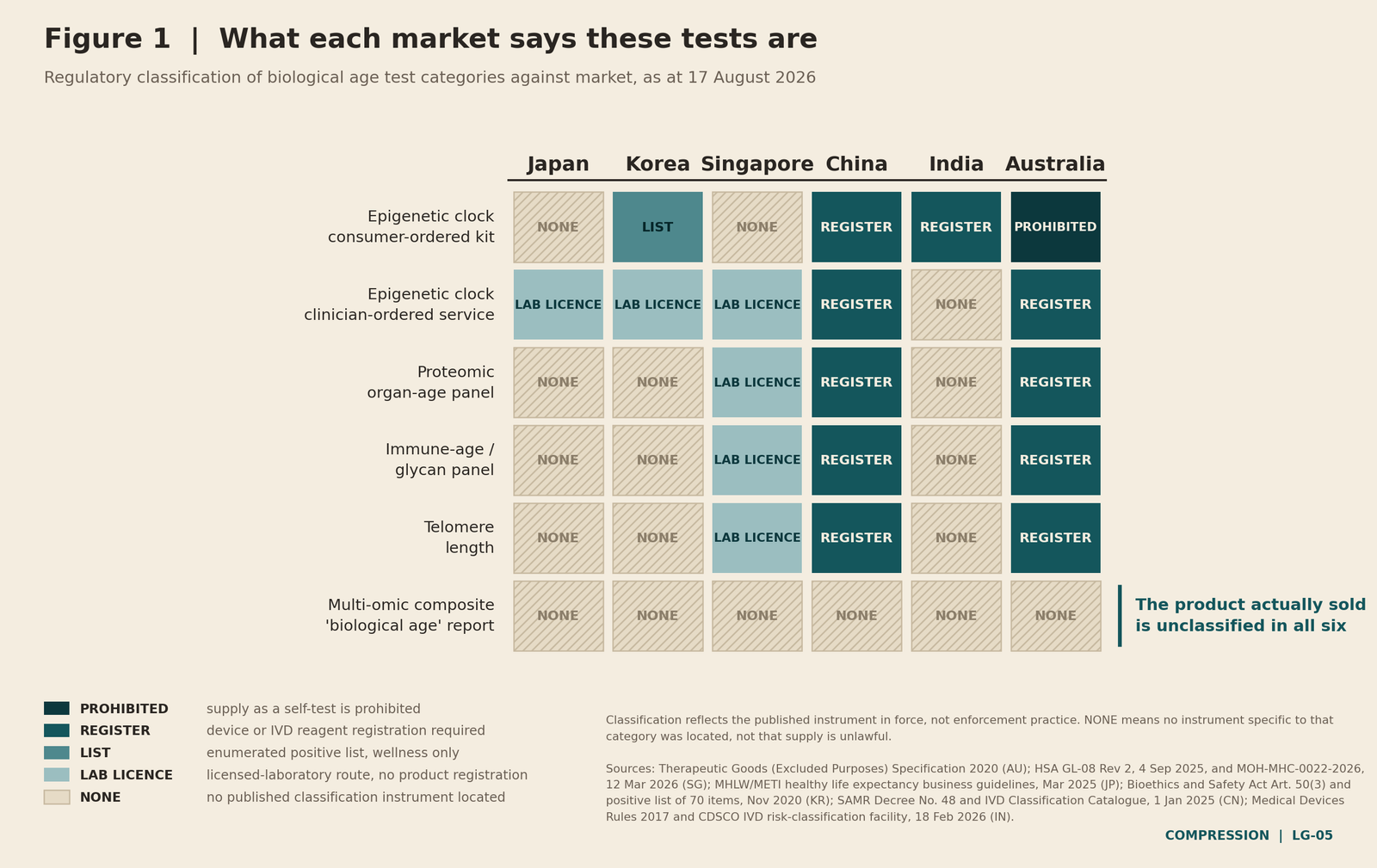
Figure 1. Regulatory classification of biological age test categories against market, as at 17 August 2026. Cells record the published instrument in force, not enforcement practice.
On coming 4th September at six in the evening Singapore time, a public consultation will close. It opened on 7 August, it is still open as this is published, and it is not, on its face, about biological age testing at all. The Ministry of Health is gathering views on a proposed Bill governing the use of genetic information in insurance and employment, with the Bill expected to be tabled in Parliament in 2027. It builds on the MOH and Life Insurance Association moratorium introduced in 2021, which already restrains insurers from requesting or using predictive genetic test results in underwriting.
Anyone with a view has until that Friday evening to put it on the record. MOH treats submissions as confidential, so there will be no public register of who did and who did not, and we make no claim either way about who has filed. We have asked the organisations named in this article whether they intend to respond.
The Ministry's announcement of 7 August sets out the intended scope in one sentence that does a great deal of work. The protections are to extend beyond genetic information obtained under national programmes, to cover all genetic information, including information derived from commercially available genetic tests.
Whether that sentence reaches a biological age panel is a question this article has to put on the table before it does anything else, because a good deal rests on it. Methylation is not sequence variation. An epigenetic clock reads how genes are being regulated, not what they say. If the Bill's operative definition of genetic information is drafted around sequence, the epigenetic panel sold in a shopping mall clinic on Orchard Road sits outside the perimeter after all. We were unable to obtain the consultation paper itself before publication, and the announcement does not resolve the point, so we cannot tell you which way it falls.
Both answers are the same story from opposite ends. If methylation is inside the definition, then a regulator in Asia-Pacific has for the first time drawn a legal line that encloses this category, sideways, for a purpose with nothing to do with whether the tests work, and the question of what else these products are becomes considerably harder to leave open. If methylation is outside it, then even Singapore's genetic information Bill misses the fastest-growing consumer diagnostics category in the region, and no authority anywhere in Asia-Pacific is regulating it under any heading at all.
This is a story about that gap. Biological age testing has scaled across the region faster than any authority has moved to classify it. Epigenetic clocks, proteomic organ-age panels, immune-aging and glycan assays and multi-omic composite reports are sold to consumers and, more often, to clinics that sell them onward. None of the underlying biomarkers has been qualified as a surrogate endpoint by any regulator on earth. In most of the six markets examined here, no authority has said in a published instrument what class of product these tests belong to.
The finding of this piece is not that the tests are invalid. That would be a different article and a much weaker one. The finding is narrower and, we think, more useful: there is a persistent and commercially significant gap between what these assays have been shown to do at the level of a population and what a result is being used to justify at the level of one person sitting in a consulting room. The distinction between those two things is load-bearing throughout.
What is actually being sold
Four product families dominate the regional shelf, and they are not equivalent.
The largest by volume is the DNA methylation clock. A saliva or blood sample is assayed for methylation at a set of CpG sites, and an algorithm trained on a reference cohort converts those values into an age estimate or a rate. First-generation clocks were trained to predict chronological age. Second and third-generation models, including PhenoAge, GrimAge and the rate-based DunedinPACE, were trained instead against mortality, morbidity and longitudinal biomarker change, which is why they carry more health-relevant signal and why they behave differently under repeat measurement.
Second are proteomic panels, which measure circulating protein abundance and report organ-specific or system-specific age estimates. These are the newest entrant to the regional consumer shelf and carry a particular interpretive hazard, because an organ-level result reads to a client as though a specific organ has been examined. It has not been. A statistical association between a plasma protein signature and outcomes in a reference cohort has been mapped onto an anatomical label.
Third are immune-aging and glycan panels, which index inflammatory and immunosenescence markers such as CD8+ subset ratios, IgG glycosylation patterns and composite inflammatory scores. These sit closest to established clinical chemistry, which cuts both ways: the individual analytes are often well characterised, and that familiarity transfers unearned credibility to the aggregate aging score built on top of them.
Fourth, and increasingly the commercial product rather than a component of it, is the composite report: a multi-omic dashboard, often with an AI-generated narrative, that fuses several of the above with routine bloods and wearable data into a single headline number. The composite is the hardest object for any regulator to classify, because it is not a test at all in the sense the instruments contemplate. It is an interpretation layer sitting above several tests, and in most of these markets the interpretation layer is the part nobody has written a rule about.
Two separate questions attach to each of these, and the whole regulatory argument turns on keeping them apart.
The first is analytical validity. Does the assay measure what it claims to measure, reproducibly, on the same sample, in the same laboratory, on a different day? This is a question about the instrument. It is answerable, and for the better laboratories it has largely been answered.
The second is clinical validity. Does the number the instrument produces correspond to a health state in a way that supports an inference about this individual? That is a question about meaning, not measurement, and it is answered by outcome data, not by a coefficient of variation.
Vendors across the region routinely present the first as though it settled the second. That is the central move this story is documenting, and it is worth being precise about why it works. A laboratory can hold ISO 15189 accreditation, run a College of American Pathologists proficiency programme, and report a coefficient of variation that would satisfy any clinical chemist, and none of that tells you whether a client whose result improved by two years should change anything they are doing.
The classification map
We mapped the product families against the diagnostic classification framework in six markets. The picture is not one of uniform absence. It is one of six different kinds of gap.
Australia is the strictest and the clearest. Under the Therapeutic Goods (Excluded Purposes) Specification 2020, in force from 1 October 2020, self-tests for serious diseases including genetic self-tests remain prohibited from supply. Most nutrigenetic tests are Class 3 IVDs requiring inclusion in the Australian Register of Therapeutic Goods, with the manufacturer holding evidence of conformity with the Essential Principles. The TGA has said it is exploring closer alignment with the EU IVD Regulation and will consider approaches to genetic tests within that work. The gap in Australia is therefore not classificatory but jurisdictional: regulation 7.1 and Schedule 4 of the Therapeutic Goods Regulations permit personal importation, so an Australian consumer may lawfully buy from an offshore provider that Australian authorities cannot reach. The rule is firm and the border is porous.
Singapore regulates the laboratory rather than the product. Under HSA guidance GL-08, laboratory developed tests are not subject to product evaluation and registration; instead the licensed laboratory notifies the test through the Ministry of Health's licensing portal and maintains an objective checklist recording, among other things, its analytical validity, clinical validity and clinical utility. Two recent moves matter commercially. Revision 2 of GL-08, issued on 4 September 2025, added a prohibition on the advertisement of LDTs, restricting promotion to publications intended for healthcare professionals and confirming that access runs through professional supervision. MOH circulated the revised guidelines to licensees under circular MOH-MHC-0022-2026 on 12 March 2026. Separately, MOH's own published guidance treats non-clinical direct-to-consumer genetic testing as a wellness and recreational category outside the clinical framework, and identifies unreliability of results as one of its stated risks. So Singapore has, in the space of eighteen months, tightened who may advertise a test while continuing to hold the wellness category outside product regulation. Which side of that line a biological age panel falls on is decided by how the vendor describes it.
Japan has the most developed scientific base and the least statutory clarity. There is no specific law regulating non-clinical direct-to-consumer testing services. Clinical laboratories are registered under the Act on Clinical Laboratory Technicians, but that registration attaches to premises performing examinations on human specimens, not to the interpretive claim attached to a result. The operative constraint is Article 17 of the Medical Practitioners' Act, which reserves medical practice to licensed physicians and carries criminal penalties, and whose scope the Supreme Court has held must be determined by purpose, circumstance and social norms rather than by technique alone. In March 2025 MHLW and METI published revised guidelines on new business activities related to extending healthy life expectancy, which clarify the regulatory position of non-clinical DTC testing services. Guidelines are not classification. Japan has told the industry where the edges probably are without saying what the product is.
Korea runs a positive list. Direct-to-consumer genetic testing was permitted under Article 50(3) of the Bioethics and Safety Act from 2016, with 12 test items covering 46 genes initially approved and the list expanded to 70 items in November 2020, alongside a certification system for service providers introduced from 2019. The list is confined to wellness traits. Anything touching disease risk must run through a medical institution. Korea is the only market in our set where a regulator has drawn an explicit enumerated boundary around what may be sold outside clinical settings, which makes it the most legible market and also the one where the classification question for a biological age composite is sharpest: an aggregate aging score is not obviously any of the enumerated items, and it is not obviously a disease risk estimate either.
China classifies the reagent, not the service. In vitro diagnostic reagents are registered or filed under SAMR Decree No. 48, in force from 1 October 2021, within the framework of State Council Order 739, and the revised IVD Classification Catalogue took effect on 1 January 2025 with structured 6840 coding assigned by intended use and diagnostic function. A test performed as a service by a domestic laboratory, reported as a wellness index rather than a diagnostic result, does not straightforwardly engage that catalogue. Layered on top is the human genetic resources regime, which constrains the export of Chinese biological samples and genotype data and is, in practice, a firmer operational limit on foreign vendors than the device rules are.
India has the largest classification vacuum relative to market activity. IVDs are regulated under the Medical Devices Rules 2017, administered by CDSCO with the Drugs Controller General of India as central licensing authority, and genetic and molecular diagnostics including PCR and NGS assays sit within that framework. CDSCO opened a facility for applicants to apply for a risk classification determination for IVDs with effect from 18 February 2026, which tells you the perimeter is being actively drawn. But India has no laboratory developed test framework of the kind Singapore operates, no statutory instrument specific to direct-to-consumer genetic testing, and no binding constraint on the claims a wellness laboratory may attach to a methylation score.
The clock versus the outcome
Between December 2025 and March 2026 the field produced its strongest validation and its sharpest conceptual challenge in the same quarter, which is worth dwelling on because both are true at once.
On the validation side, a head-to-head comparison of 14 clocks against 174 incident disease outcomes and all-cause mortality in 18,859 adults from the Generation Scotland cohort gave the most substantial empirical support to date for second and third-generation models, with respiratory and liver outcomes emerging as the strongest predictive domains. A longitudinal analysis of 699 adults in the InCHIANTI cohort followed for up to 24 years then showed that the trajectory of a clock over time carries information that a single baseline reading does not.
Note what both of those establish. They are population-level associations between a measured value and an outcome distribution. That is genuinely important, and it is the reason this category deserves serious rather than dismissive coverage.
Now the individual level, which is where the product is sold. Technical noise in methylation arrays has been shown to produce deviations of up to nine years between replicates for six prominent clocks, a problem substantially but not completely addressed by principal component reconstructions that bring most replicate pairs within about 1.5 years. Epigenetic age has been shown to oscillate across the course of a single day. Reliability drops measurably with differences in slide position and DNA extraction protocol. Test-retest reliability of the older clocks remains imperfect even after the principal component refinements and the GrimAge revisions.
Put those two paragraphs beside each other and the commercial problem states itself. A clinic that retests a client at three or six months is operating inside the interval where measurement noise, diurnal variation, batch effects and regression to the mean can each produce a change of the magnitude being reported as progress. The population finding does not license the individual inference, and no amount of laboratory accreditation closes that distance, because the distance is not an analytical one.
None of this means a result is meaningless. It means a specific thing: a biological age result is a laboratory output, not a clinical fact, and the difference between those two is exactly what a classification decision would have to settle.
Testing is the funnel
The economics explain why the category has grown the way it has, and they are visible in the vendors' own published material rather than requiring any inference.
Singapore's private longevity sector illustrates the structure cleanly. Helix Prive, a Singapore longevity concierge, sets out a four-stage protocol on its website: an epigenetic baseline before any programme begins, personalisation of NAD+, peptide and nutritional protocols against the pathways the result flags, repeat testing at three to six month intervals, and longitudinal profile building across years. The stated purpose of the repeat testing is to measure “whether your interventions are actually reversing biological age” (captured via search index, 17 August 2026). Hisential, operating from Mandarin Gallery on Orchard Road, describes its epigenetic testing as showing “whether your current habits are accelerating or slowing down the aging process” (captured via search index, 17 August 2026). Reporting on the Singapore market has recorded saliva-based methylation testing offered from S$180 by Asia Medical Group, a figure we have not yet confirmed against the vendor's own current price page.
The test is not the business. The test is the qualifying event for the business. A panel priced in the low hundreds of Singapore dollars establishes a baseline, identifies a deficit, and creates the clinical rationale for interventions priced an order of magnitude higher, most of which are themselves outside any approved indication for aging. Then the retest closes the loop by producing a number that can be read as validation of the protocol.
This is not, in itself, an accusation. Longitudinal biomarker tracking is a defensible clinical practice in many contexts, and the more scientifically serious operators in the region are explicit about uncertainty. Chi Longevity in Singapore, founded by the geriatrician and precision geromedicine researcher Andrea Maier, integrates epigenetic and genomic clocks into a multi-system assessment rather than presenting a clock as the finding. The point is structural rather than moral: in a market where the diagnostic is a loss leader for the intervention, the commercial incentive runs toward interpreting an ambiguous number generously, and there is presently no regulatory instrument in five of these six markets that constrains how generously.
What qualification would require, and why nobody has filed
If a vendor wanted to convert clinical validity from a marketing position into a regulatory one, the pathway exists. It is simply almost never used, and the arithmetic explains why.
The FDA's Biomarker Qualification Program has been running since 2007. As of 1 July 2025, 61 projects had been accepted into it. Eight biomarkers have been qualified through the programme in its entire history, most of them before the 21st Century Cures Act came into force in December 2016, and the most recent qualification was in 2018. Only five of the 61 accepted projects concerned surrogate endpoint biomarkers. Half of accepted projects remained at the initial letter of intent stage. For those that progressed, qualification plan development took a median of 32 months, rising to 47 months where a surrogate endpoint was the object. Agency review of letters of intent and qualification plans routinely exceeded the FDA's own targets.
No aging biomarker of any kind has been qualified through that programme or its European equivalent. No epigenetic clock has achieved formal regulatory validation as a surrogate endpoint for aging interventions anywhere.
Now consider the filing decision from a vendor's side. Qualification is expensive, takes the better part of a decade in practice, requires a defined context of use narrow enough to be evidentiable, and, critically, produces a result that binds. A qualified biomarker comes with stated limits on what may be claimed. An unqualified one, sold as wellness, comes with no limits at all beyond general consumer protection law. The current regulatory position across most of Asia-Pacific therefore prices qualification as a pure cost with a negative commercial return: the vendor would spend years and a great deal of money to acquire a narrower permission than it already enjoys.
That is the honest answer to why nobody has filed. It is not scientific timidity. It is a rational response to a regulatory structure that rewards ambiguity.
What changes when one authority moves
Which brings us back to Friday 4 September. Singapore's proposed Bill is about insurance and employment, not about diagnostic classification, and it would be wrong to overstate what it does. On its stated scope it would establish that information derived from commercially available genetic tests is genetic information for at least one regulatory purpose, subject to the definitional question set out at the top of this article. Combine even the narrow reading with a September 2025 advertising prohibition on laboratory developed tests, a March 2026 circular pushing it to licensees, and a published MOH position that non-clinical genetic testing carries a risk of unreliable results, and Singapore has assembled most of the components of a classification decision without yet having made one.
There is a reason MOH is legislating rather than leaving the moratorium to do the work. Of those referred for testing under the national familial hypercholesterolaemia programme launched in June 2025, only around 40 per cent proceeded, with insurance, employment and stigma concerns cited among the reasons. That is a government discovering that the credibility of a test category is a policy problem and not only a clinical one. The same logic, applied one category across, is what would eventually bring biological age testing into view.
Once it does, the pressure is directional. Regional regulators watch HSA closely, and Singapore's LDT framework has already been cited in industry analysis as one of the few APAC markets with a defined process, where most apply no risk-based classification to laboratory developed tests at all. The question the other five authorities would then face is not whether these tests work. It is the one this article has tried to hold steady throughout: what does a result entitle a clinician to do, and who decided?
Nobody in the region has answered that in a published instrument. The category has grown to its present size in the space where the answer should be.
arcilla.fran@biopharmaapac.com
Most Read
- Can APAC Biomanufacturing Decarbonise Without Pricing Itself Out?
- The Algorithm on the GMP Floor: AI Promises a Smarter Plant. Regulators Demand the Audit Trail.
- APAC's Peptide-Capacity Gamble
- After the Rush: APAC's mRNA and Vaccine Capacity Hangover
- The Biosimilar Race: Factory to the World — or Stuck in the Copycat Economy?
- The Vein-to-Vein Problem: Can APAC's Cold Chain Carry Advanced Therapies?
- Vectors, Plasmids and the CGT Trap: APAC's Cell and Gene Therapy Ambitions Face an Upstream Bottleneck
- Can APAC Build Radioligand Therapy Before the Atoms Decay?
- The Great Biopharma Reset: 50 Developments That Changed Everything in H1 2026
- Beyond the Trial: Can Real-World Evidence Earn Regulatory Trust in APAC?
- Beyond the Obvious Giant: Where APAC's Clinical Trials Go Next
- The Frontier That Won’t Quite Arrive
Bio Jobs
- Sanofi Turns The Page As Belén Garijo Steps In And Paul Hudson Steps Out
- Global Survey Reveals Nearly 40% of Employees Facing Fertility Challenges Consider Leaving Their Jobs
- BioMed X and AbbVie Begin Global Search for Bold Neuroscience Talent To Decode the Biology of Anhedonia
- Thermo Fisher Expands Bengaluru R&D Centre to Advance Antibody Innovation and Strengthen India’s Life Sciences Ecosystem
- Accord Plasma (Intas Group) Acquires Prothya Biosolutions to Expand Global Plasma Capabilities
- ACG Announces $200 Million Investment to Establish First U.S. Capsule Manufacturing Facility in Atlanta
- AstraZeneca Invests $4.5 Billion to Build Advanced Manufacturing Facility in Virginia, Expanding U.S. Medicine Production
News