The Sarcopenia Definition Race: The Endpoint Is the Asset
12 August 2026 | Wednesday | Analysis
In a category with no approvable indication anywhere in the world, whoever writes the endpoint definition controls who is eligible for a trial, what counts as a response, and what the next agent has to beat. Asia-Pacific wrote the sarcopenia criteria most of the region actually uses. It holds four of twenty-two seats on the committee drafting the global replacement, and on a stricter count, three. For sponsors enrolling in Asian populations, that is a commercial exposure, not a diplomatic one.
The asset nobody books
Sarcopenia has an ICD-10 code. It has had one since 2016. What it does not have, in any jurisdiction, is an approved therapy or a settled regulatory endpoint, which means the category sits in an unusual position: the science is mature enough to generate trials, and the framework is loose enough that the trials do not agree on who they are studying.
That gap is where the money is. In a licensed indication, the endpoint is a constraint, something a sponsor works around. In an unlicensed one, the endpoint is an asset. Whoever writes the operative definition decides three things that no amount of clinical execution can undo afterwards. They decide the denominator, meaning how many people in a given population are eligible to be enrolled at all. They decide what a responder looks like, which fixes the effect size a trial has to detect and therefore its sample size and its cost. And they decide the comparator bar, because once one definition is embedded in a pivotal study, every subsequent agent is measured against a population selected the same way.
There is precedent for how valuable this position is. Bone density thresholds, osteoarthritis structural criteria and the various operational definitions of frailty all began as academic instruments and ended as gatekeepers on billion-dollar development programmes. In each case the working group that fixed the threshold was not the party that captured the value, but it did determine which parties could compete for it. Definitions are infrastructure. They are built once, cheaply, by people who are not paid for them, and then everybody else builds on top.
None of this is hypothetical. The commercial pull on sarcopenia endpoints is no longer coming from geriatrics at all. It is coming from obesity. Incretin therapies produce weight loss with a substantial lean-mass component, and a category of muscle-preservation adjuncts has grown up alongside them. Scholar Rock's apitegromab, tested in the EMBRAZE Phase 2 study alongside tirzepatide, reported at week 24 a least-squares mean of 1.9 kg less lean-mass loss than placebo, representing 54.9 per cent retention of lean mass relative to placebo, on similar total weight loss between the arms. The result was published in Nature Medicine in 2026.
The interesting part is not the number. It is what happened to the category around it. In September 2025 Eli Lilly terminated one of its bimagrumab studies, and the reporting at the time noted that the US regulator appeared to be signalling that composition improvement alone might not be sufficient. If lean mass on its own does not carry a filing, then whichever definition of muscle health becomes operative determines what else a sponsor is obliged to show. That is not a scientific detail. That is the difference between a trial that reads out on a body-composition scan and a trial that has to demonstrate a functional consequence in a population that, by construction, was not selected for functional impairment.
What AWGS 2025 actually changed
On 1 December 2025 the Asian Working Group for Sarcopenia launched its 2025 consensus update, published in Nature Aging, volume 5, pages 2,164 to 2,175, led by Liang-Kung Chen of National Yang Ming Chiao Tung University with co-authors from Japan, Thailand, Singapore, Korea, Malaysia, Taiwan and Hong Kong. The 2019 predecessor had already achieved something rare for a regional guideline: by 2 December 2025 it had accumulated 5,465 citations in Web of Science, according to an editorial in the Annals of Geriatric Medicine and Research. Whatever the 2025 update says will propagate through the regional literature on the same trajectory.
Four changes matter to anybody designing a trial.
The first is age. AWGS 2025 extends diagnosis to adults aged 50 to 64 with validated cut-offs for that band, on the evidence that muscle decline accelerates from around age 50 rather than 65. As the AGMR editorial notes, this is the first sarcopenia guideline anywhere to offer recommendations for that age group. A whole cohort that was previously undiagnosable has become classifiable.
The second is the denominator used for muscle mass. Alongside appendicular skeletal muscle mass indexed to height squared, AWGS 2025 introduces ASM indexed to BMI as an official diagnostic option. The stated reason is body-size variation across Asian populations, which height-adjustment alone handles poorly. Vendor documentation circulating since November 2025 reports the BIA cut-offs as ASM/height below 7.6 for men and 5.7 for women aged 50 to 64, below 7.0 and 5.7 at 65 and over, with ASM/BMI thresholds of 0.90 and 0.63 for the younger band and 0.83 and 0.57 for the older. These figures come from device-maker summaries rather than from the primary table, and should be checked against the Nature Aging paper before any protocol is written against them.
The third change is the algorithm. Diagnosis now requires low muscle strength and low muscle mass concurrently. The either-or structure is gone.
The fourth is the one with the sharpest commercial edge. Physical performance, meaning gait speed, chair stand and SPPB, has been removed from the diagnostic algorithm entirely and repositioned as an outcome measure, used for monitoring and for tracking intervention response. Severity staging has been dropped. "Possible sarcopenia" survives, for community screening and primary care.
Read those four together and a shape emerges. AWGS 2025 has made the diagnosis earlier, wider, more specific about muscle pathology, and deliberately silent about function at the point of diagnosis.
Why body composition forces the divergence
It is tempting to read regional criteria as a political artifact, a working group asserting itself. The measurement problem is more boring and more real than that.
Cut-offs for muscle mass are population-derived. They are typically set at a fixed number of standard deviations below the mean of a young reference population, which means that the reference population determines the threshold. Asian reference populations differ from the European and North American cohorts underpinning the original criteria in body size, in limb-to-trunk proportion, and in the relationship between BMI and appendicular lean mass. Apply a threshold derived from one to the other and you do not get a slightly noisier estimate. You get a systematically shifted one, in a direction that depends on which index you use.
That is why the ASM/BMI addition is more consequential than it looks. Height-squared indexing and BMI indexing do not rank the same people. In a population with a high prevalence of normal-BMI, low-muscle phenotypes, the two indices disagree on a meaningful fraction of cases, and which one a protocol specifies determines who screens in.
The same logic runs through the strength thresholds. A grip-strength cut-off is only meaningful relative to the distribution it was derived from, and dynamometer model, hand position, number of trials and whether the maximum or the mean is recorded all move the number. AWGS 2025 specifies the maximum of two trials with both hands. A protocol that specifies otherwise is not measuring the same variable, whatever the case report form says.
None of this is unique to sarcopenia. It is the ordinary problem of any criterion built on a continuous measure with no biological discontinuity. What is unusual is that the field is attempting global harmonisation while the underlying reference distributions genuinely differ, and while the largest research output in the field is being produced in the populations whose distributions differ most.
The price of the difference, in one cohort
The abstract argument becomes concrete in a Chinese multicentre study that set out to operationalise the global framework and test it against the regional one.
The Global Leadership Initiative in Sarcopenia, convened from 2021 under the umbrella of participating international societies, published its conceptual definition in Age and Ageing in March 2024. The Delphi process, run across 2022 and 2023, accepted muscle mass at 89.4 per cent agreement, muscle strength at 93.1 per cent and muscle-specific strength at 80.8 per cent as components of sarcopenia. Impaired physical performance was accepted at 97.9 per cent agreement as an outcome, not a component. That last distinction is the structural decision at the heart of everything that follows, and AWGS 2025 aligns with it.
But a conceptual definition is not a protocol. The operational definition, the one with instruments and numbers in it, is still being drafted by working groups on muscle mass, muscle function and outcomes. Until it lands, GLIS can be instantiated more than one way.
The Chinese study did exactly that. Working from a national survey, with 12,116 participants for cut-off development and 11,241 for outcome analysis, plus 504 chronic kidney disease patients for validation, the authors proposed a lower-limb muscle mass to five-time chair stand ratio as a muscle-specific strength measure, then built six defensible diagnostic combinations from handgrip strength, appendicular skeletal muscle mass index and muscle-specific strength.
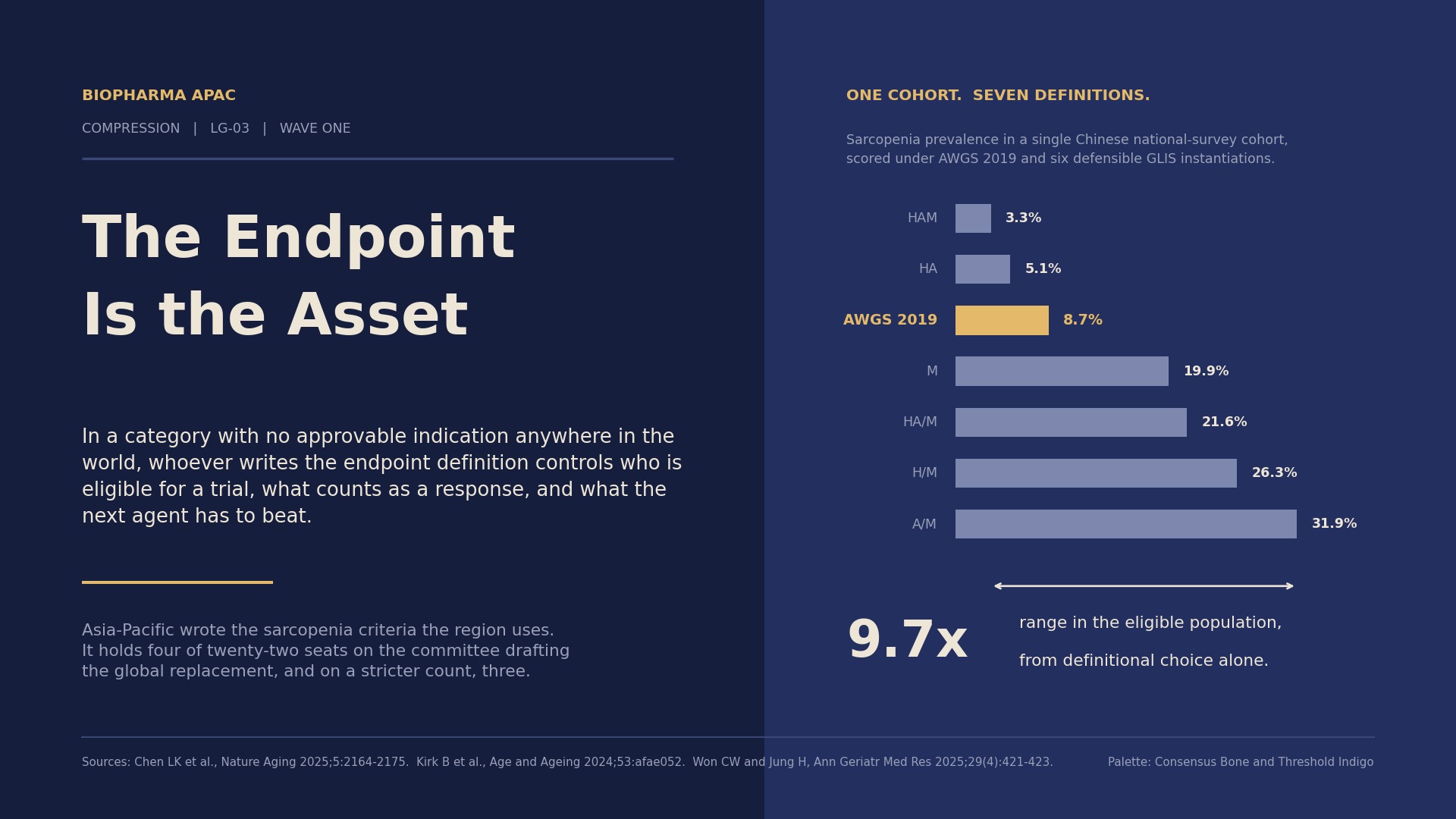
The prevalence results are the number this article exists to report. Under AWGS 2019, 8.7 per cent of the cohort had sarcopenia. Under the six GLIS instantiations, prevalence ran from 3.3 per cent when all three criteria were required, to 5.1 per cent for low grip plus low mass, to 19.9 per cent for low muscle-specific strength alone, to 21.6, 26.3 and 31.9 per cent for the various or-combinations.
That is a range of roughly ten to one, in a single cohort, from one country, generated entirely by definitional choice. Nothing about the participants changed between the low figure and the high one.
Translate that into a development plan. A sponsor sizing a trial against a 3.3 per cent prevalence and a sponsor sizing against 31.9 per cent are not running the same study, are not costing the same screening burden, and will not produce comparable effect sizes. A screen-failure rate modelled on one definition and executed under another can move a recruitment timeline by quarters. And a sponsor that locks a definition into a Phase 2, then finds the operational GLIS definition lands elsewhere, is carrying a bridging problem into Phase 3 that no amount of statistical adjustment fully closes.
The representation question, stated as arithmetic
Here the story usually turns into a grievance. It should not. It is a counting exercise, and the count is checkable.
The GLIS steering committee has twenty-two members, each nominated by a participating scientific society. The AGMR editorial, published 26 December 2025 by Chang Won Won and Heeeun Jung of Kyung Hee University, counts four of those twenty-two as being from Asia, naming Japan, Taiwan, Hong Kong and Saudi Arabia. Saudi Arabia sits outside Asia-Pacific on any definition this publication uses. On the published author list of the 2024 Delphi paper, the members at Asia-Pacific institutions are Hidenori Arai in Japan, Liang-Kung Chen in Taiwan and Jean Woo in Hong Kong. Three of twenty-two, or roughly fourteen per cent, if the Australia and New Zealand society seat is counted separately from Asia, as the editorial does.
Now set that against output. Analysing Web of Science publications with sarcopenia in the title between 2015 and 2025, the same editorial found China first at 20.2 per cent of 13,065 papers, the United States second at 12.7, Japan third at 10.7, South Korea fourth at 7.3 and Italy fifth at 6.9. Taiwan was twelfth at 3.0 per cent and India seventeenth at 1.7. Among the 167 highly cited papers, defined as the top one per cent by citations for field and year, China took 25.7 per cent, ahead of the United States at 24.0 and Italy at 20.4, with Japan at 11.4, South Korea at 7.2, Taiwan at 5.4 and Singapore at 3.6.
So the arithmetic is this. China produces the largest share of the world's sarcopenia literature and the largest share of its most-cited literature, and has no dedicated seat on the steering committee. South Korea produces more titled output than every European country except Italy, and has no seat, notwithstanding that the Korean Working Group on Sarcopenia has published its own national guideline. India, at 1.7 per cent of output and with a population structure that will make it one of the largest sarcopenia markets on earth within two decades, has no seat.
The editorial's own explanation is worth reporting because it is unflattering to the region rather than to the committee. Seats went to societies, and outside AWGS there are few internationally recognised societies in this field in Asia to send a representative. The KWGS guideline, the editorial notes, is bounded within a national scope. The authors' conclusion is a call for Asian researchers to convene more and organise better, not an accusation of exclusion.
That is the honest structural reading, and it is the one this article adopts. A society-nomination model allocates influence by institutional density, not by evidence production. Where those two diverge, as they now sharply do in this field, the resulting committee is unrepresentative of the evidence base without anybody having done anything improper. Nobody needs to be blamed for the arithmetic to be a commercial problem for the sponsors who will enrol in those populations.
The remedy implied by that reading is unglamorous and entirely within the region's control. Society seats are awarded to societies, so the region acquires seats by building societies that meet the nomination criteria, and by federating the national working groups that already exist. AWGS itself is the proof that this works: it is a regional body, it produced a guideline, and that guideline became the operative standard across a continent. What it has not yet produced is a second body of comparable standing, which is why the region's committee footprint has not grown in step with its output. The gap is one of institutional formation, not of capability, and it is measured in years rather than in decades.
Intrinsic capacity, the construct nobody is fighting over
There is a second framework in play, and it is quietly the more useful one.
The World Health Organization's Integrated Care for Older People guidance, first issued in 2017, is built on intrinsic capacity: the composite of an individual's physical and mental capacities across domains including locomotion, cognition, vitality, vision and hearing. It is not a disease definition. It is a case-finding and care-pathway construct, designed for community and primary-care deployment, and it is already implemented in health systems across the region.
AWGS 2025 hooks into it deliberately, framing muscle health promotion within ICOPE and using the overlap between muscle health and ICOPE's intrinsic capacity domains for enhanced case-finding. The locomotion domain screen is, in practice, an early filter for the same population sarcopenia criteria are trying to reach.
For a sponsor, this matters in a specific way. Intrinsic capacity is less contested than sarcopenia because it does not carry the same definitional stakes. Nobody is trying to make it an indication, so nobody is fighting over its thresholds, and its instruments are already deployed at population scale in exactly the countries where recruitment is hardest. A trial that records ICOPE domain screens alongside whichever sarcopenia criteria it has specified acquires a second classification axis at very low incremental cost, one that is stable across the definitional argument and legible to health systems and payers who will never care which working group's cut-off was used.
It also has a limitation worth stating plainly. Intrinsic capacity is broader than muscle, which makes it a poor primary endpoint for a muscle-directed agent. It is a case-finding rail and a contextual outcome, not a substitute for the thing being argued about.
What to do while this is unresolved
The operational GLIS definition is not published. The AWGS 2025 update is, and is aligned to the GLIS concept but not to an operational instrument set that does not yet exist. That leaves a window, and windows close.
Five things follow for anybody with an asset in this space and sites in Asia-Pacific.
Classify twice, prospectively. Collect enough to score participants under both AWGS 2025 and the plausible GLIS instantiations. In practice this means capturing appendicular skeletal muscle mass with the instrument and method recorded, both height-squared and BMI denominators, grip strength to the AWGS specification, and at least one chair-stand-derived muscle-specific strength measure. The marginal cost at enrolment is small. The cost of not having it, when the operational definition lands somewhere other than where the protocol guessed, is a bridging exercise.
Pre-specify a definitional sensitivity analysis. If prevalence in a comparable cohort can swing tenfold on definitional choice, an analysis plan that reports the primary result under one classification and nothing else is leaving the most obvious reviewer question unanswered. Pre-specifying the alternatives is cheap and forecloses the accusation that they were chosen after the fact.
Treat performance measures as outcomes, and collect them anyway. Both frameworks now place physical performance outside the diagnostic gate. That is a reason to stop using it to select patients. It is not a reason to stop measuring it, particularly given the signal that composition change alone may not satisfy a regulator.
Do not build the commercial case on a single definition. Any market-sizing model built on one prevalence figure should carry the range. A forecast that quotes 8.7 per cent without noting that defensible alternatives in the same cohort run from 3.3 to 31.9 per cent is not a forecast.
Engage the process while it is still open. The operational definition is being drafted now, by working groups that accept applications from qualified researchers and that explicitly seek geographic diversity. Sponsors running trials in Asian populations have data on those populations. Contributing it to the reference distributions under discussion is a legitimate and low-cost route to influence, and it is available for as long as the drafting continues and not after.
The last point is the whole argument in miniature. The endpoint is an asset. It is currently unowned, it is being written by a group whose composition does not track where the evidence is being produced, and the drafting is not finished. That combination will not recur in this category. Sponsors who treat definition-setting as somebody else's committee work will discover, at the point of a pivotal readout, that it was the most consequential commercial decision in the programme, and that it was taken without them.
(arcilla.fran@biopharmaapac.com)
Most Read
- Can APAC Biomanufacturing Decarbonise Without Pricing Itself Out?
- The Algorithm on the GMP Floor: AI Promises a Smarter Plant. Regulators Demand the Audit Trail.
- APAC's Peptide-Capacity Gamble
- After the Rush: APAC's mRNA and Vaccine Capacity Hangover
- The Biosimilar Race: Factory to the World — or Stuck in the Copycat Economy?
- The Vein-to-Vein Problem: Can APAC's Cold Chain Carry Advanced Therapies?
- Vectors, Plasmids and the CGT Trap: APAC's Cell and Gene Therapy Ambitions Face an Upstream Bottleneck
- Can APAC Build Radioligand Therapy Before the Atoms Decay?
- The Great Biopharma Reset: 50 Developments That Changed Everything in H1 2026
- Beyond the Trial: Can Real-World Evidence Earn Regulatory Trust in APAC?
- Beyond the Obvious Giant: Where APAC's Clinical Trials Go Next
- The Frontier That Won’t Quite Arrive
Bio Jobs
- Sanofi Turns The Page As Belén Garijo Steps In And Paul Hudson Steps Out
- Global Survey Reveals Nearly 40% of Employees Facing Fertility Challenges Consider Leaving Their Jobs
- BioMed X and AbbVie Begin Global Search for Bold Neuroscience Talent To Decode the Biology of Anhedonia
- Thermo Fisher Expands Bengaluru R&D Centre to Advance Antibody Innovation and Strengthen India’s Life Sciences Ecosystem
- Accord Plasma (Intas Group) Acquires Prothya Biosolutions to Expand Global Plasma Capabilities
- ACG Announces $200 Million Investment to Establish First U.S. Capsule Manufacturing Facility in Atlanta
- AstraZeneca Invests $4.5 Billion to Build Advanced Manufacturing Facility in Virginia, Expanding U.S. Medicine Production
News