
Purity Is Not Content: What Research Buyers Check on a Peptide Certificate of Analysis
11 November 2026 | Wednesday | Analysis
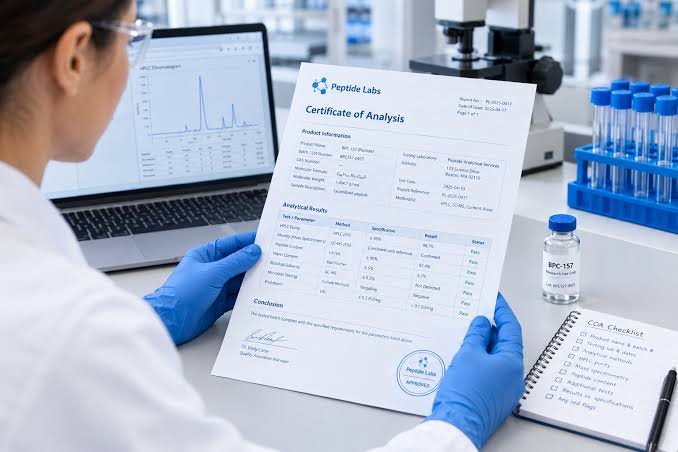
This analysis comes from the distributor's side of that transaction. BulkGLP is a US supplier of research peptides that publishes its lot reports online. Below are five things a downstream buyer needs from a manufacturer's certificate, and what goes wrong when one is missing.
1. Purity describes the peaks, not the powder
Most certificates lead with HPLC purity. Measured by ultraviolet absorbance at 210 to 220 nanometres, it reports how much of the peptide-related material in a sample is the intended compound. It does not say how much of the lyophilised cake is peptide.
That second quantity is net peptide content. The quality-control guide published by Bachem defines it as the percentage of peptide relative to non-peptide material, mostly counterions and moisture, and states that net peptide content and purity are not equivalent. A certificate that reports 99% purity and nothing else leaves the buyer unable to say how much peptide is in the vial.
2. State the basis of every milligram
A fill weight can mean gross lyophilisate or net peptide. The certificate should say which, and give the figures that connect the two:
-
the counterion, trifluoroacetate or acetate, and its amount, typically by ion chromatography
-
the water content, by Karl Fischer titration
-
the peptide content itself. Bachem's guide describes nitrogen content from elemental analysis as a measure of it.
The arithmetic shows why this matters. Take a hypothetical 10 mg cake of retatrutide with a net peptide content of 80%. It holds 8 mg of peptide. PubChem lists the molecular weight as 4,731 grams per mole, so 8 mg made up to 2 mL is about 0.845 millimolar. A researcher who calculates from the 10 mg on the label records about 1.057 millimolar. Every dilution that follows is a fifth lower than the record says, and the certificate gave no warning.
3. Tie the document to the lot
The lot number on the vial, on the certificate and in the laboratory's sample record should be the same number. The certificate should name the laboratory and give the test date.
Third-party reports need one more line. A contract laboratory reports on the sample it received. The certificate should say how that sample relates to the lot that shipped: who drew it, from which batch, and when. Without that, a clean report on a similarly named product proves little about the material in the box.
4. Name the methods
A result is only as useful as the description of how it was obtained. For chromatography, that means the method reference and the detection wavelength. For mass spectrometry, it means saying whether a stated mass is an average or a monoisotopic value. For retatrutide, PubChem gives 4,731 grams per mole as the molecular weight and about 4,728.47 daltons as the monoisotopic mass, and a reader comparing a spectrum with the wrong one will see a mismatch that is not there.
When a method changes between lots, say so on the certificate. A one-line revision note keeps a buyer from reading a change of method as a change in quality.
5. Make it verifiable
A report that the issuing laboratory will confirm from its report number carries more weight than a PDF alone. Reissued certificates should carry a revision number and a reason. Distributors are asked for both by their own customers, and they pass the question upstream.
Why the extra lines are worth it
For a manufacturer that already measures content, counterion and water for release, printing them costs nothing. For one that does not, these are the tests that distributors now commission from third-party laboratories before they list a lot.
The practical effect shows up at listing. A distributor can publish a complete certificate as it stands. An incomplete one has to be supplemented by re-testing first, which adds cost and delay to every lot from that source. Once a certificate is public, it sits beside those of other suppliers and is compared line by line.
Purity sells the lot. Content decides whether an experiment built on it can be repeated.
BulkGLP supplies research peptides for laboratory research use only and has a commercial interest in this subject. This article was prepared for BulkGLP with AI assistance. BulkGLP also maintains an open-source molarity calculator at github.com/BulkGLP/retatrutide-ly3437943-molarity-calculator.
Sources: Bachem, "Quality Control of Amino Acids & Peptides: A Guide". PubChem compound record CID 171390338.
Most Read
- Can APAC Biomanufacturing Decarbonise Without Pricing Itself Out?
- The Algorithm on the GMP Floor: AI Promises a Smarter Plant. Regulators Demand the Audit Trail.
- APAC's Peptide-Capacity Gamble
- After the Rush: APAC's mRNA and Vaccine Capacity Hangover
- The Biosimilar Race: Factory to the World — or Stuck in the Copycat Economy?
- The Vein-to-Vein Problem: Can APAC's Cold Chain Carry Advanced Therapies?
- Vectors, Plasmids and the CGT Trap: APAC's Cell and Gene Therapy Ambitions Face an Upstream Bottleneck
- Can APAC Build Radioligand Therapy Before the Atoms Decay?
- The Great Biopharma Reset: 50 Developments That Changed Everything in H1 2026
- Beyond the Trial: Can Real-World Evidence Earn Regulatory Trust in APAC?
- Beyond the Obvious Giant: Where APAC's Clinical Trials Go Next
- The Frontier That Won’t Quite Arrive
Bio Jobs
- Sanofi Turns The Page As Belén Garijo Steps In And Paul Hudson Steps Out
- Global Survey Reveals Nearly 40% of Employees Facing Fertility Challenges Consider Leaving Their Jobs
- BioMed X and AbbVie Begin Global Search for Bold Neuroscience Talent To Decode the Biology of Anhedonia
- Thermo Fisher Expands Bengaluru R&D Centre to Advance Antibody Innovation and Strengthen India’s Life Sciences Ecosystem
- Accord Plasma (Intas Group) Acquires Prothya Biosolutions to Expand Global Plasma Capabilities
- ACG Announces $200 Million Investment to Establish First U.S. Capsule Manufacturing Facility in Atlanta
- AstraZeneca Invests $4.5 Billion to Build Advanced Manufacturing Facility in Virginia, Expanding U.S. Medicine Production
News


