
Orphan Drug Incentives in 9 APAC Markets, Compared
26 October 2026 | Monday | Analysis
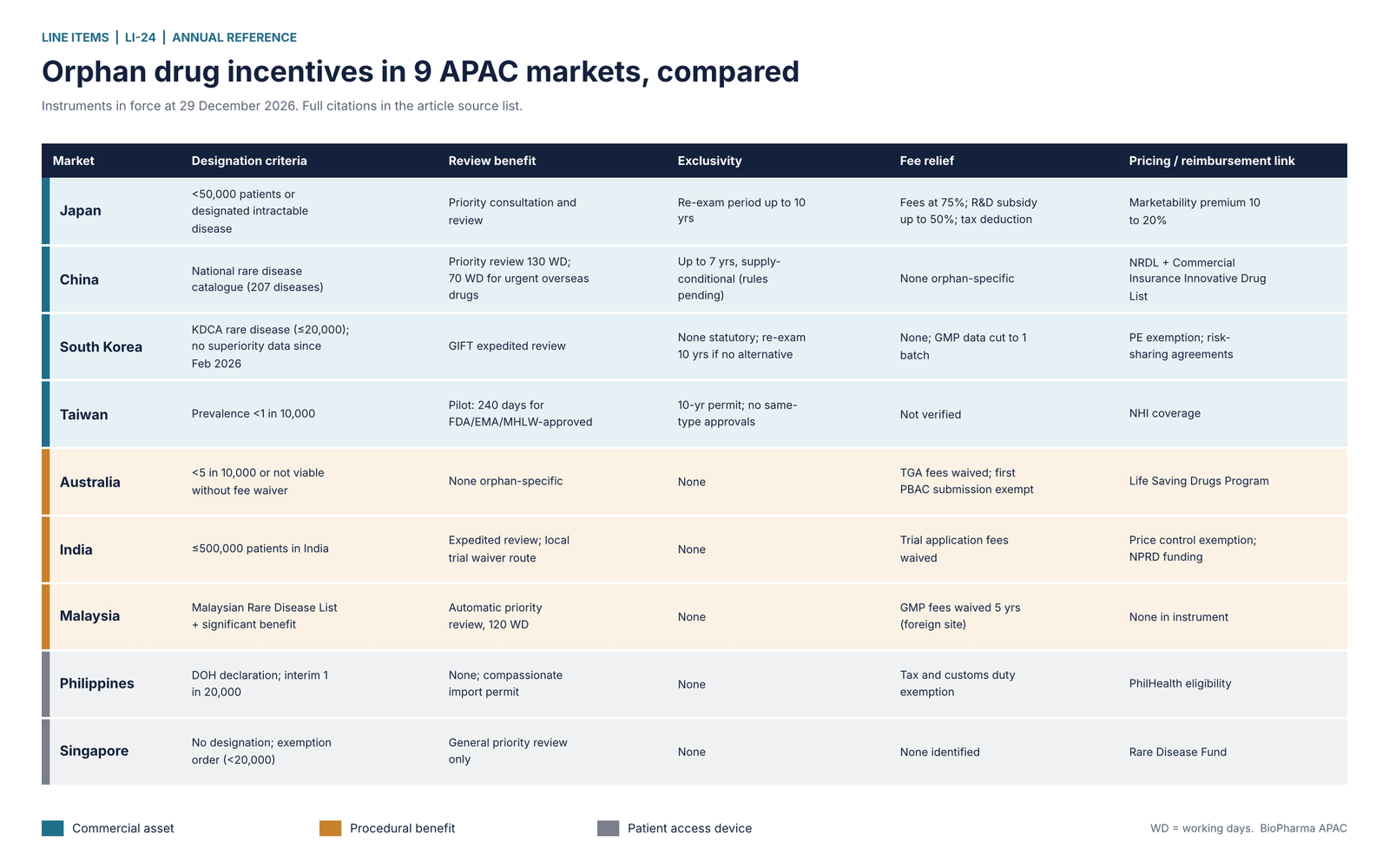
Every January, regulatory affairs teams across Asia-Pacific rebuild the same spreadsheet. Which markets will designate this asset as an orphan? Which will review it faster, protect it longer, waive the fee, or treat it differently at the pricing table because it serves so few patients? The answers sit in statutes, ministerial notifications, guidance appendices and reimbursement circulars, written in half a dozen languages and revised on no shared timetable.
This is our attempt to put that spreadsheet on a single page. LI-24 compares orphan drug incentives in nine markets: Japan, China, South Korea, Taiwan, Australia, India, Malaysia, the Philippines and Singapore. For each, we ask the same six questions. What qualifies? What review benefit follows? Is there exclusivity? Which fees are relieved? Does the designation reach price or reimbursement? And which instrument, dated and referenced, says so?
2026 was an unusually busy year, which is exactly why the reference is needed now. China wrote orphan market exclusivity into administrative regulation for the first time. South Korea dropped the requirement that a rare disease drug prove it beats existing therapy before it can be designated. Malaysia refreshed its orphan appendix in July. Japan is still harvesting the effects of its 2024 loosening, which more than doubled designations in a single fiscal year. And yet three of the nine markets offer nothing a Western developer would recognise as orphan exclusivity, and one has no development-stage designation at all.
The headline finding is simple to state and easy to forget: orphan status in APAC is not one thing. In some markets it is a commercial asset with a price premium attached. In others it is a procedural courtesy that shortens a queue or trims a dossier. In a few it is mainly a patient access device that lets a hospital import an unregistered medicine. Knowing which is which, market by market, should change how you sequence filings in 2027.
How we built the matrix
The inclusion rules were strict. Only instruments in force on the publication date count in the main matrix, and each is cited to the issuing authority's own text wherever we could reach it, with a reference and a date. Where we relied on a law firm alert, journal article or trade press summary, that source is named in the list at the end. Proposed, consultation-stage and pilot measures are pulled out into their own section further down, so nothing speculative contaminates the grid.
Two definitions matter. "Exclusivity" here means a period during which the regulator will not approve the same or a comparable product for the same use; where a re-examination or licence-validity period does that job in practice, we say so. "Pricing or reimbursement link" means a benefit that attaches because of orphan or rare disease status, not a general innovation premium that an orphan product might also earn. Incentives that apply to every new drug are mentioned only where they are the practical substitute for an orphan-specific benefit.
One boundary. Our forthcoming franchise, 12 Regulatory Changes Every APAC Biopharma Executive Should Have on the 2027 Calendar, owns the changes that bite in 2027. Where one of those touches an orphan incentive, we flag it here and leave the detail to that piece.
The matrix at a glance
The grid below is the at-a-glance version. Bracketed numbers point to the numbered source list at the end of the article. The full entries that follow give the reasoning and the caveats.
Figure: The LI-24 incentive matrix. A pinnable A3 version accompanies this article. The fully cited version of the grid follows on the next page.
The cited matrix
Bracketed numbers refer to the source list at the end of the article.
|
Market |
Designation criteria |
Review benefit |
Exclusivity |
Fee relief |
Pricing or reimbursement link |
|
Japan |
Under 50,000 patients in Japan, or a designated intractable disease (nanbyo); high medical need [1][2][3] |
Priority consultation and priority review [2] |
Re-examination period up to 10 years (8 for a standard NME) [2] |
Application and pre-NDA consultation fees at 75% of standard; designation consultation free [2][4] |
Marketability premium of 10 to 20% at NHI listing [2][5] |
|
China |
Disease on the national rare disease catalogue (207 diseases) [11][14] |
Priority review, 130 working days; 70 for urgently needed rare disease drugs marketed overseas [7] |
Up to 7 years, conditional on supply commitment; implementing measures pending [8][9][10] |
No orphan-specific fee relief identified |
NRDL and the Commercial Health Insurance Innovative Drug List, both from 1 Jan 2026 [12][13] |
|
South Korea |
Rare disease per KDCA (20,000 or fewer, or unknown prevalence); since 2 Feb 2026 no superiority data needed [15][16][17] |
GIFT expedited review; 84% of GIFT approvals are orphans [19] |
No statutory exclusivity; re-examination 10 years where no alternative exists [18] |
No fee waiver identified; GMP batch data cut from 3 to 1 [18] |
Pharmacoeconomic evaluation exemption and risk-sharing agreements [20][21] |
|
Taiwan |
Prevalence below 1 in 10,000, or recognised by the Review Committee [22][25] |
Expedited pilot: 300 to 240 days for FDA, EMA or MHLW-approved orphans [23][24] |
10-year permit validity; no same-type approvals in that period [22] |
Not verified in current instruments |
NHI coverage of designated orphan drugs [23] |
|
Australia |
Life-threatening or seriously debilitating; under 5 in 10,000, or not viable without a fee waiver [26b][27] |
None orphan-specific; priority review is a separate designation [28] |
None [29] |
TGA application and evaluation fees waived; first PBAC submission exempt [27][30] |
Life Saving Drugs Program for effective but not cost-effective drugs [32] |
|
India |
Condition affecting 500,000 or fewer people in India (NDCT Rules 2019) [33] |
Expedited review; local trial waiver route for orphan drugs approved in named markets [33][34] |
None |
Clinical trial application fees waived [33] |
Price control exemption [35]; NPRD 2021 patient funding and duty exemptions [36] |
|
Malaysia |
Disease on the Malaysian Rare Disease List; no satisfactory alternative or significant benefit [37] |
Automatic priority review, 120 working days; Phase II data may suffice [37] |
None |
GMP processing and inspection fees waived for 5 years (foreign site) [37] |
None in the instrument |
|
Philippines |
Declared by DOH on NIH and expert group advice; interim rare threshold 1 in 20,000 [38][39] |
None set; FDA compassionate special permit for import [38] |
None |
Taxes and customs duties exempted for certified orphan drugs [40] |
PhilHealth benefit package eligibility [38] |
|
Singapore |
No designation scheme; 1991 exemption order for doctor-identified drugs with no substitute, under 20,000 patients [42][43] |
General priority review for life-saving therapies [45] |
None |
None identified |
Rare Disease Fund, government-matched donations [44] |
The nine markets, entry by entry
1. Japan: the deepest toolkit, now easier to reach
Japan legislated for orphan drugs in 1993, a decade after the United States and seven years before Europe, and it still runs the most complete system in the region [2]. The legal basis is Article 77-2 of the PMD Act, with the patient ceiling fixed in Article 251 of its Enforcement Regulation and the detailed criteria set by notification [4]. A product qualifies if fewer than 50,000 patients in Japan could use it, or if the target disease is a designated intractable disease (nanbyo), and it must meet a high medical need [1][2]. Designation attaches to the combination of drug, indication and applicant [4].
The important change is recent. In January 2024 MHLW replaced the old criteria with PSB/PED Notification No. 0116-1 [3], loosening a regime that sponsors had long found too strict; one reported effect is that a gene-defined subset under 50,000 patients can now qualify [41]. The result showed up immediately. PMDA counts 86 designations in FY2024, against 36 the year before [6].
What follows designation is generous. Sponsors get priority scientific consultation and priority review [2]. The re-examination period stretches to 10 years for an orphan with a new molecular entity or orphan indication, against eight for a standard NME [2], and PMDA itself labels that period as the market exclusivity period [4b]. The marketing application fee for an orphan NME is set at 75% of the non-orphan fee, as is the pre-NDA consultation fee [2], and designation consultation is free [4]. Through the national institute NIBN, sponsors can receive subsidies of up to 50% of development expenses for up to three years between designation and filing, plus a tax deduction during the subsidy period [2]. At listing, orphan drugs are eligible for a marketability premium of 10 to 20% on the NHI price [2][5].
|
Designation criteria |
Under 50,000 patients or designated intractable disease; high medical need [1][2][3] |
|
Review benefit |
Priority consultation and priority review [2] |
|
Exclusivity |
Re-examination period up to 10 years [2] |
|
Fee relief |
Application and consultation fees at 75%; free designation consultation; R&D subsidy up to 50%; tax deduction [2][4] |
|
Pricing link |
Marketability premium 10 to 20% [5] |
|
Instrument reference |
PMD Act Art. 77-2; Enforcement Regulation Art. 251; PSB/PED Notification No. 0116-1, 16 January 2024 [3][4] |
2. China: list-based eligibility, and exclusivity on paper
China does not use a prevalence threshold. Eligibility follows the national rare disease catalogue, which now covers 207 diseases across batches published in 2018 and 2023 [14], and the new exclusivity provision keys off that catalogue [11]. If the disease is not listed, the orphan incentives below do not apply, whatever its prevalence.
Review benefits are already well established. Under the Provisions for Drug Registration, the standard marketing authorisation review runs 200 working days, priority review runs 130, and priority review for rare disease drugs with urgent clinical need that are marketed overseas but not yet in China runs 70 [7].
The 2026 story is exclusivity. The State Council issued the revised Implementing Regulations of the Drug Administration Law on 27 January 2026, effective 15 May 2026 [8]. Article 21 grants up to seven years of market exclusivity to qualifying rare disease drugs, provided the marketing authorisation holder commits to ensuring supply, and the protection can end if supply is not maintained [8][9]. The regulations also let certain pre-approval commercial batches of rare disease drugs be sold after approval if they pass GMP checks [8]. The catch is that NMPA has not yet published the detailed measures explaining how sponsors apply for, or obtain, the exclusivity [10]. On paper it exists; in practice nobody can yet claim it.
On price, the route runs through two lists. The 2025 National Reimbursement Drug List and the first Commercial Health Insurance Innovative Drug List both took effect on 1 January 2026 [12]. Six of the 19 therapies on the commercial list also appear in China's rare disease catalogue, about a third of the total [13], which suggests the commercial channel was built with high-cost orphan products in mind.
|
Designation criteria |
Disease on the national rare disease catalogue [11][14] |
|
Review benefit |
Priority review 130 working days; 70 for urgent overseas-marketed rare disease drugs [7] |
|
Exclusivity |
Up to 7 years, supply-conditional; implementing measures pending [8][9][10] |
|
Fee relief |
No orphan-specific fee relief identified |
|
Pricing link |
NRDL and Commercial Health Insurance Innovative Drug List [12][13] |
|
Instrument reference |
Implementing Regulations of the Drug Administration Law (2026), Art. 21, effective 15 May 2026; Provisions for Drug Registration, Art. 96 [7][8] |
3. South Korea: designation opened up, reimbursement next
Korea defines a rare disease as one with a prevalence of 20,000 people or fewer, or one whose prevalence cannot be established because it is hard to diagnose, as designated and announced by the Korea Disease Control and Prevention Agency [15]. Until this year, an orphan designation also required data showing a significant safety or efficacy improvement over substitute drugs, a hurdle companies said was hard to clear in practice [15b].
That changed on 2 February 2026, when MFDS promulgated its revised Regulation on Orphan Drug Designation, effective from the date of notice [16]. The criteria now run on two tracks. Track one covers a drug for treating or diagnosing a rare disease under the Rare Disease Management Act, with no comparative data required. Track two keeps the old route: a population of 20,000 or fewer plus proof of marked improvement over alternatives [17].
Korea offers no statutory exclusivity, but the re-examination system does similar work. Since the 2016 reforms, all orphan drugs fall under re-examination, with 10 years for orphans that have no alternative and four or six years where they improve on one, and licence validity runs 10 years rather than five [18]. The same reforms cut GMP evaluation data from three manufacturing batches to one [18]. On review speed, the GIFT expedited pathway has designated 62 ingredients and approved 50 products since September 2022, and 84% of those approvals were orphans [19].
The pricing link is where Korea is most distinctive. HIRA has long used risk-sharing agreements, pharmacoeconomic evaluation exemptions and flexible ICER thresholds to bring oncology and rare disease drugs into coverage [20], and a dedicated evaluation exemption for paediatric rare disease drugs has existed since 2023 [21]. A flexible contract system for confidential net pricing was implemented in June 2026 [20b].
|
Designation criteria |
KDCA rare disease (20,000 or fewer, or unknown); track 1 needs no superiority data [15][16][17] |
|
Review benefit |
GIFT expedited review [19] |
|
Exclusivity |
None statutory; re-examination 10 years where no alternative [18] |
|
Fee relief |
No fee waiver identified; GMP data reduced to one batch [18] |
|
Pricing link |
PE exemption, risk-sharing agreements, flexible contracts [20][20b][21] |
|
Instrument reference |
Regulation on Orphan Drug Designation (MFDS Notice), revised 2 February 2026; Rare Disease Management Act [16][17] |
4. Taiwan: the strictest threshold, a decade of protection
Taiwan's Rare Disease and Orphan Drug Act dates from 2000, which made Taiwan the fifth country in the world to legislate specifically for rare diseases [25b]. A rare disease is one with a prevalence below the standard announced by the Ministry of Health and Welfare, or one recognised by the statutory Review Committee [22], and that standard sits at 1 in 10,000 [25]. That is half the EU's 5 in 10,000 ceiling, which makes Taiwan the tightest prevalence-based gate in this comparison.
The reward for clearing it is strong. Article 17 gives drug permits for registered orphan drugs a 10-year validity period, during which the authority will not approve the same type of drug [22]. That is the closest thing in APAC to the classic pre-reform European model, and it predates China's version by a quarter of a century.
Review speed has improved through reliance. TFDA's Orphan Drug Recognition and Expedited Registration Pilot cuts approval time from 300 to 240 days for orphan drugs already authorised by the US FDA, EMA or Japan's MHLW, and lets sponsors seek orphan recognition and registration together [23]. TFDA describes it as a three-year pilot running from 1 January 2024 [24]. On reimbursement, designated orphan drugs are covered under National Health Insurance [23], and the Health Promotion Administration subsidises care for rare diseases outside NHI cover [26]. We could not verify an orphan-specific fee schedule in a current instrument, so that cell is left open rather than filled from older secondary sources.
|
Designation criteria |
Prevalence below 1 in 10,000, or Review Committee recognition [22][25] |
|
Review benefit |
Expedited pilot, 240 days for FDA, EMA or MHLW-approved orphans [23][24] |
|
Exclusivity |
10-year permit validity, no same-type approvals [22] |
|
Fee relief |
Not verified in current instruments |
|
Pricing link |
NHI coverage; HPA subsidies outside NHI [23][26] |
|
Instrument reference |
Rare Disease and Orphan Drug Act (2000, as amended), Art. 17; TFDA pilot from 1 January 2024 [22][24] |
5. Australia: a fee waiver, not a monopoly
Australia designates orphan drugs under regulation 16J of the Therapeutic Goods Regulations 1990 [26b]. The current criteria, revised in August 2018 after the old fixed cap of 2,000 patients encouraged indication "salami slicing", require a life-threatening or seriously debilitating condition and either a prevalence under 5 in 10,000 or a showing that the medicine would not be financially viable without a fee waiver [27][29]. Designation lapses after six months unless extended in certain circumstances [28], so it is a tool to time with the registration dossier, not a badge to collect early.
There is no orphan-specific review clock; priority review is a separate designation with its own criteria [28]. Nor is there explicit market exclusivity: the TGA simply will not designate another treatment for the same indication as an orphan unless it is clinically superior or the first cannot be supplied [29].
The core benefit is money saved at the door. Designated orphans receive a waiver of TGA application and evaluation fees [27]. On the reimbursement side, a designated orphan drug is exempt from PBS cost recovery fees for submission services if PBAC has not previously considered it [30], though Medicines Australia continues to press for the exemption to cover every cost recovery element, not just the first submission [31]. For ultra-rare conditions, the Life Saving Drugs Program funds drugs that PBAC accepts as clinically necessary and effective but cannot recommend for the PBS on cost-effectiveness grounds [32].
|
Designation criteria |
Serious condition; under 5 in 10,000 or not viable without fee waiver [27][29] |
|
Review benefit |
None orphan-specific [28] |
|
Exclusivity |
None [29] |
|
Fee relief |
TGA fees waived; first PBAC submission exempt [27][30] |
|
Pricing link |
Life Saving Drugs Program [32] |
|
Instrument reference |
Therapeutic Goods Regulations 1990, reg. 16J; TGA eligibility criteria v1.2, April 2021; PBS cost recovery fee exemptions [26b][27][30] |
6. India: a definition, a fee waiver and a patient fund
India had no legal definition of an orphan drug until the New Drugs and Clinical Trials Rules, 2019. They define it as a drug intended to treat a condition affecting not more than five lakh (500,000) people in India, waive fees on clinical trial applications for orphan drugs, and allow sponsors to seek an expedited review [33]. Given India's population, that ceiling is generous, which means many indications that would not qualify elsewhere qualify here.
The practical review benefit arrived in August 2024, when CDSCO waived local clinical trials for new drugs already approved in specified reference markets in several categories, orphan drugs among them, while keeping Phase 4 obligations in place [34]. There is no orphan market exclusivity of any kind.
Where India does more is on the demand side. Orphan drugs can be exempted from price control, irrespective of patent status, on application, under the January 2019 changes to the Drugs (Prices Control) Order [35]. The National Policy for Rare Diseases, 2021, provides up to Rs 50 lakh per patient for treatment at notified Centres of Excellence, and imports of drugs and food for special medical purposes for listed rare diseases are exempt from basic customs duty and IGST under Department of Revenue notifications dated 29 March 2023 and 26 July 2023 [36]. These measures help patients and payers more than developers, but they do lower the effective price barrier at launch.
|
Designation criteria |
Condition affecting 500,000 or fewer in India [33] |
|
Review benefit |
Expedited review; local trial waiver route [33][34] |
|
Exclusivity |
None |
|
Fee relief |
Clinical trial application fees waived [33] |
|
Pricing link |
DPCO price control exemption; NPRD funding; BCD and IGST exemption [35][36] |
|
Instrument reference |
NDCT Rules, 2019; DPCO 2013 as amended January 2019; NPRD 2021; Revenue notifications 29.03.2023 and 26.07.2023 [33][35][36] |
7. Malaysia: the newest rulebook in the set
Malaysia's orphan rules live in Appendix 13 of the Drug Registration Guidance Document, refreshed in the Third Edition, 12th Revision of July 2026 [37]. Eligibility is list-based, like China's: the product must treat, prevent or diagnose a disease on the latest Malaysian Rare Disease List, and either no satisfactory alternative exists or the product offers significant benefit, a test borrowed explicitly from EMA [37]. NPRA decides through its Drug Evaluation Committee within 45 working days [37]. Importantly for multinational sponsors, a foreign designation does not carry over automatically [37].
The review benefits are the most concrete in Southeast Asia. Designated products are granted priority review automatically, with a 120 working day evaluation timeline for new chemical entities and biologics [37]. The dossier can be lighter: Phase II data may be accepted with justification and post-approval obligations, Zone IVb stability data is not mandatory, and analytical documentation for a single batch can suffice [37]. Non-PIC/S manufacturing sites can receive two-year conditional registration while GMP evidence is completed [37].
Fee relief is narrow but real. For a foreign manufacturer making only the registered orphan medicine, the RM5,000 GMP processing fee and RM20,000 inspection fee are waived for five years, though travel costs still apply; local manufacturers get a one-off waiver on their next inspection [37]. Registration fees themselves follow the standard schedule [37]. There is no exclusivity and no pricing link in the instrument.
|
Designation criteria |
Malaysian Rare Disease List; no alternative or significant benefit [37] |
|
Review benefit |
Automatic priority review, 120 working days; lighter dossier [37] |
|
Exclusivity |
None |
|
Fee relief |
GMP processing and inspection fees waived for 5 years (foreign) [37] |
|
Pricing link |
None in the instrument |
|
Instrument reference |
DRGD Third Edition, 12th Revision, July 2026, Appendix 13 [37] |
8. The Philippines: incentives in statute, thin in practice
The Rare Diseases Act of the Philippines, Republic Act No. 10747, was signed on 3 March 2016 [38]. It gives the Department of Health the power to declare orphan drugs and products on the recommendation of the National Institutes of Health and a Rare Diseases Technical Working Group [38]. Pending a final definition, a disease is treated as rare when it affects one in every 20,000 people [39].
The incentives are fiscal and access-oriented rather than developmental. Orphan drugs and products used solely by rare disease patients, as certified by the FDA, are exempt from all taxes and customs duties [40]. Anyone may import an orphan drug for compassionate use by obtaining a compassionate special permit from the FDA, and patients can draw on the PhilHealth benefit package and medical assistance funded by sin tax revenues [38].
What the law does not provide is a review clock, a fee schedule or exclusivity. A bill in the 20th Congress acknowledges that implementation has been limited nearly a decade on and proposes a National Rare Disease Council with stronger governance [46]; we list it with the proposals below.
|
Designation criteria |
Declared by DOH on NIH and RDTWG advice; interim threshold 1 in 20,000 [38][39] |
|
Review benefit |
None set; compassionate special permit for import [38] |
|
Exclusivity |
None |
|
Fee relief |
Tax and customs duty exemption for certified orphan drugs [40] |
|
Pricing link |
PhilHealth benefit package eligibility [38] |
|
Instrument reference |
Republic Act No. 10747, 3 March 2016 [38] |
9. Singapore: access without designation
Singapore has the distinction of being first and, today, the least incentive-driven. Its 1991 Medicines (Orphan Drug) Exemption Order was the first legislation anywhere to follow the US Orphan Drug Act [43]. But the model it chose was access, not development. An orphan drug is one a doctor or dentist identifies as an appropriate remedy with no effective substitute for a life-threatening or severely debilitating disease affecting fewer than 20,000 people, and the licensing authority may allow it to be imported or supplied without a product licence [42].
There is no designation that triggers fee relief, a review clock or exclusivity. The nearest regulatory benefit is general: HSA offers priority review to life-saving innovative therapies that address critical public health needs, regardless of where they were developed [45]. Funding comes through the Rare Disease Fund, set up in 2019, where donations attract three-for-one government matching [44]. MOH has been candid that the fund is small: it had supported nine patients by early 2023 and focuses on life-threatening conditions where treatment extends lifespan [44].
A practical note: the 1991 order was made under the Medicines Act, and therapeutic products have since moved under the Health Products Act framework. Sponsors should confirm with HSA how the orphan exemption operates today before building a launch plan around it.
|
Designation criteria |
No designation scheme; doctor-identified drug, no substitute, under 20,000 patients [42] |
|
Review benefit |
General priority review for life-saving therapies [45] |
|
Exclusivity |
None |
|
Fee relief |
None identified |
|
Pricing link |
Rare Disease Fund [44] |
|
Instrument reference |
Medicines (Orphan Drug) Exemption Order, 1991 (Medicines Act); Rare Disease Fund, 2019 [42][43][44] |
Proposed, pending and pilot measures
These items are not in the matrix because they are not yet operative, or because they are pilots with an end date. Several will land on the 2027 calendar, which our 12 Regulatory Changes franchise covers in full.
- China: exclusivity rules of the road. NMPA has said it will issue detailed requirements for rolling out market and data exclusivity [8], and as of September 2026 the measures governing how rare disease drugs apply for exclusivity had not been published [10]. Until they are, the seven-year figure is a ceiling, not a plan.
- South Korea: reimburse first, evaluate later. A new pathway targeting reimbursement of rare disease treatments within 100 days is scheduled as a pilot in the second half of 2026, with implementation in 2027 and expansion to selected innovative medicines from 2028 [20b]. This is a 2027-dated change; see 12 Regulatory Changes.
- Taiwan: the expedited pilot reaches the end of its term. TFDA framed its orphan recognition and expedited registration scheme as a three-year pilot starting 1 January 2024 [24], which puts the continuation decision on the 2027 agenda.
- The Philippines: a stronger Rare Diseases Act. House Bill 7331 in the 20th Congress would amend RA 10747, create a National Rare Disease Council and regional councils, and broaden governance [46].
- Australia: wider fee relief, as an industry ask. Medicines Australia's 2025 to 2026 cost recovery submission seeks full exemption for orphan-designated medicines across every PBS cost recovery element [31]. This is an industry position, not a government proposal.
What the matrix tells you
Read the grid across rather than down and three groups emerge.
The first group treats orphan status as a commercial asset. Japan is the clearest case: designation brings faster review, a decade of de facto protection, subsidies, a tax deduction and a price premium, all in one package. Taiwan matches the protection with its 10-year permit rule but guards the gate with the tightest threshold in the region. China has now joined this group in law, if not yet in practice, and its new commercial insurance list gives high-cost rare disease products a second route to payment. South Korea sits at the edge of the group: no formal exclusivity, but a re-examination period that behaves like one, an easier designation since February and the most developed rare disease reimbursement toolkit outside Japan.
The second group treats orphan status as a procedural benefit. Australia saves sponsors close to AUD 0.5 million in TGA and PBS fees on a new molecule [29] and gives ultra-rare products a funding safety net, but offers no clock and no monopoly. Malaysia trims the dossier and guarantees priority review. India waives trial fees, opens a reliance route around local trials and loosens price control. In all three, orphan status lowers the cost and friction of entry; it does not change the long-term economics of the asset.
The third group treats orphan status as a patient access device. The Philippines and Singapore both put rare disease medicines within reach of patients through import permits, tax relief and funds, while offering little a developer would plan a filing around.
Three practical lessons follow for 2027 planning. First, designation is rarely portable: Malaysia says so explicitly [37], China and Malaysia determine eligibility by list rather than prevalence, and Taiwan's threshold will exclude indications that qualify in Japan or India. Map eligibility market by market before assuming a regional orphan strategy. Second, where formal exclusivity is absent, look for its substitutes, re-examination in Japan and Korea, permit validity in Taiwan and general data protection elsewhere, and value them honestly. Third, the pricing link, not the regulatory one, is where the money is. Only Japan builds a premium into the list price, and only Korea, China and Australia have dedicated reimbursement mechanisms that reliably catch orphan products. If a launch sequence is driven by commercial return, those four markets should anchor it.
Reference
This is the first annual edition of the LI-24 matrix. We will republish it each December with a revision note, rather than starting again, so that changes are visible year on year. If your organisation tracks an instrument we missed, or holds a more recent version of one we cited, write to the BioPharma APAC desk and we will reflect it in the next refresh.
Sources
[1] MHLW, Overview of Orphan Drug/Medical Device Designation System. https://www.mhlw.go.jp/english/policy/health-medical/pharmaceuticals/orphan_drug.html
[2] PMDA, Orphan drug designation and incentives in Japan (DIA presentation, 2025). https://www.pmda.go.jp/files/000277956.pdf
[3] MHLW, PSB/PED Notification No. 0116-1, 16 January 2024 (PMDA provisional translation). https://www.pmda.go.jp/files/000268408.pdf
[4] PMDA, Legal basis of orphan drug designation (PMD Act Art. 77-2; Enforcement Regulation Art. 251). https://www.pmda.go.jp/files/000280806.pdf
[4b] PMDA, Orphan drug designation in Japan (DIA presentation, 2023). https://www.pmda.go.jp/files/000269524.pdf
[5] MHLW, New drug price determination process (marketability premium). https://www.mhlw.go.jp/file/04-Houdouhappyou-11123000-Iyakushokuhinkyoku-Shinsakanrika/price.pdf
[6] PMDA, Orphan drug designation trends, FY2014 to FY2024 (DIA presentation, 2026). https://www.pmda.go.jp/files/000280804.pdf
[7] NMPA, Provisions for Drug Registration, Chapter VII, Article 96. https://english.nmpa.gov.cn/2022-06/30/c_785628_8.htm
[8] Ropes & Gray, China Announces the Implementing Regulation of the Drug Administration Law (January 2026). https://www.ropesgray.com/en/insights/alerts/2026/01/china-announces-the-implementing-regulation-of-the-drug-administration-law
[9] Lexology, China Releases Comprehensively Revised Implementing Provisions of Drug Administration Law (May 2026). https://www.lexology.com/library/detail.aspx?g=4670c37f-34ed-478b-90f3-32a4e846a28f
[10] National Law Review, China's 2026 drug data-protection regime reshapes exclusivity (September 2026). https://natlawreview.com/article/china-move-china-reprices-clinical-data-part-one-new-exclusivity-architecture-takes
[11] Frontiers in Medicine, orphan drug market exclusivity under Article 21 (2026). https://www.frontiersin.org/journals/medicine/articles/10.3389/fmed.2026.1896433/full
[12] CMS, China has renewed the NRDL and released the first commercial reimbursement list (9 January 2026). https://cms.law/en/chn/news-information/china-has-renewed-the-national-reimbursement-drug-list-and-released-the-first-commercial-reimbursement-list-for-innovative-drugs
[13] Avalere Health, Early learnings from China's Commercial Health Insurance Innovative Drug Catalogue. https://advisory.avalerehealth.com/?p=35860
[14] Frontiers in Pharmacology, Drug lag of US-approved orphan drugs in China (2025). https://www.frontiersin.org/journals/pharmacology/articles/10.3389/fphar.2025.1595497/epub
[15] Korea Policy Briefing, MFDS administrative notice on orphan designation criteria (December 2025). https://www.korea.kr/news/policyNewsView.do?newsId=148955977
[15b] Dailypharm, MFDS to ease orphan designation requirements (5 November 2025). https://www.dailypharm.com/Users/News/NewsView.html?ID=328428
[16] Korean Pharmaceutical Association News, revised Regulation on Orphan Drug Designation promulgated 2 February 2026. https://www.kpanews.co.kr/news/articleView.html?idxno=529113
[17] Korea Medical and Pharmaceutical News, two-track designation criteria. https://www.kmpnews.co.kr/news/articleView.html?idxno=68428
[18] Medigate News, MFDS orphan drug reforms: licence validity, re-examination, GMP data (February 2016). https://medigatenews.com/news/2905230082
[19] HIT News, MFDS on GIFT expedited review and designation changes (2026). https://www.hitnews.co.kr/news/articleView.html?idxno=74107
[20] ISPOR Europe 2026, Two decades of the positive list system in South Korea (HIRA). https://www.ispor.org/heor-resources/presentations-database/presentation-cti/ispor-europe-2026/poster-session-2-5/two-decades-of-the-positive-list-system-in-south-korea-balancing-access-and-sustainability-through-evidence-based-hta
[20b] Simon-Kucher, Korea pharma market access: inside the 2026 drug pricing policy reforms. https://www.simon-kucher.com/index%2ephp/fr/node/9572
[21] ISPOR Asia Pacific 2026, Age criteria under Korea's pharmacoeconomic evaluation exemption pathway. https://www.ispor.org/heor-resources/presentations-database/presentation-cti/ap-summit-2026/poster-session-3-5/age-criteria-for-pediatric-rare-disease-reimbursement-under-korea-s-pharmacoeconomic-evaluation-exemption-pathway-a-comparative-analysis-with-overseas-hta-agencies
[22] MOHW Taiwan, Rare Disease and Orphan Drug Act (English text). https://mohw.gov.tw/dl-92374-1b7d1838-4317-49b4-9ab0-bcb0d584063e.html
[23] MOHW and TFDA, TFDA Strengthens Orphan Drug Access with Policy Reforms (11 March 2025). https://www.mohw.gov.tw/cp-7198-81823-2.html
[24] TFDA, TFDA is dedicated to improving the regulation of new drug applications (18 March 2024). https://www.fda.gov.tw/eng/newsContent.aspx?id=30435
[25] National Development Council, Rare disease legislation in Taiwan (2014). https://report.ndc.gov.tw/ReportFront/PageSystem/reportFileDownload/C10303332/006
[25b] NHIA Taiwan, Orphan drug reimbursement in Taiwan (presentation hosted by PMDA). https://www.pmda.go.jp/files/000152152.pdf
[26] Journal article on Taiwan's Rare Disease and Orphan Drug Act implementation (PMC). https://pmc.ncbi.nlm.nih.gov/articles/PMC9931014
[26b] TGA, Orphan drug designation eligibility criteria, Version 1.2 (April 2021). https://www.tga.gov.au/sites/default/files/orphan-drug-designation-eligibility-criteria.pdf
[27] Spruson & Ferguson, Australia: Regulatory considerations for orphan drugs (2025). https://www.spruson.com/australia-regulatory-considerations-for-orphan-drugs-part-2/
[28] BioWorld, TGA priority review and expanded orphan criteria. https://www.bioworld.com/articles/437145
[29] PharmaLex, Can your medicine benefit from incentives for treating rare disorders?. https://www.pharmalex.com/thought-leadership/blogs/thats-odd-can-your-medicine-benefit-from-incentives-for-treating-rare-disorders
[30] PBS, Cost Recovery Fees and Charges: fee exemptions. https://www.pbs.gov.au/pbs/industry/listing/elements/fees-and-charges
[31] Medicines Australia, Response to CRIS 2025 to 26 (13 February 2025). https://www.medicinesaustralia.com.au/wp-content/uploads/sites/65/2025/05/20250213_sub_Medicines-Australia-Response-to-CRIS-2025-26_FINAL.pdf
[32] PBS, Independent review of PBS cost recovery: Life Saving Drugs Program definition. https://www.pbs.gov.au/publication/factsheets/independent-review-PBS-cost-recovery.doc
[33] Mondaq, Changes to the regulatory framework for clinical trials in India (NDCT Rules, 2019). https://www.mondaq.com/india/healthcare/925344/changes-to-the-regulatory-framework-for-clinical-trials-in-india
[34] Vision IAS, CDSCO waives local clinical trials for new drugs approved in developed countries (August 2024). https://visionias.in/current-affairs/news-today/2024-08-09/polity-and-governance/cdsco-waives-local-clinical-trials-for-new-drugs-approved-in-developed-countries
[35] Pharmaceutical Technology, India implements new clinical trial rules (price control exemption for orphan drugs). https://www.pharmaceutical-technology.com/?p=141611
[36] Lok Sabha unstarred question AU701: NPRD 2021 funding and BCD/IGST notifications. https://eparlib.sansad.in/bitstream/123456789/2983511/1/AU701_nbdruV.pdf
[37] NPRA, DRGD Third Edition, 12th Revision (July 2026), Appendix 13: Designation and Registration of Orphan Medicines. https://www.npra.gov.my/easyarticles/images/users/1153/drgd_appendices/APPENDIX-13-Designation-and-Registration-of-Orphan-Medicines.pdf
[38] Republic Act No. 10747, Rare Diseases Act of the Philippines (3 March 2016). https://ncda.gov.ph/disability-laws/republic-acts/ra-10747-an-act-promulgating-a-comprehensive-policy-in-addressing-the-needs-of-persons-with-rare-disease/
[39] Philippine Society for Orphan Disorders, Key provisions of RA 10747 and its IRR. https://psod.org.ph/?p=1982
[40] Senate of the Philippines, press release on RA 10747 (9 March 2016). https://legacy.senate.gov.ph/press_release/2016/0309_guingona1.asp
[41] RAPS, Japan expands its orphan drug designation system (2024). https://connect.raps.org:443/discussion/japan-expands-its-orphan-drug-designation-system?hlmlt=VT
[42] The Pharma Letter, Singapore Government Orphan Drug Act (3 February 1992). https://www.thepharmaletter.com/singapore-govt-orphan-drug-act
[43] The Pharma Letter, Orphan drugs in Asia-Pacific (2010). https://www.thepharmaletter.com/pharma-news/orphan-drugs-in-asia-pacific-from-designation-to-pricing-funding-and-market-access
[44] MOH Singapore, Singaporeans diagnosed with rare diseases and coverage by Rare Disease Fund (22 March 2023). https://www.moh.gov.sg/news-highlights/details/singaporeans-diagnosed-with-rare-diseases-and-coverage-by-rare-disease-fund
[45] MOH Singapore, HSA's regulatory pathways for NMPA-approved medicines (7 July 2026). https://www.moh.gov.sg/newsroom/hsa-s-regulatory-pathways-for-nmpa-approved-medicines/
[46] House of Representatives of the Philippines, House Bill No. 7331 (20th Congress). https://docs.congress.hrep.online/legisdocs/basic_20/HB07331.pdf
Most Read
- Can APAC Biomanufacturing Decarbonise Without Pricing Itself Out?
- The Algorithm on the GMP Floor: AI Promises a Smarter Plant. Regulators Demand the Audit Trail.
- APAC's Peptide-Capacity Gamble
- After the Rush: APAC's mRNA and Vaccine Capacity Hangover
- The Biosimilar Race: Factory to the World — or Stuck in the Copycat Economy?
- The Vein-to-Vein Problem: Can APAC's Cold Chain Carry Advanced Therapies?
- Vectors, Plasmids and the CGT Trap: APAC's Cell and Gene Therapy Ambitions Face an Upstream Bottleneck
- Can APAC Build Radioligand Therapy Before the Atoms Decay?
- The Great Biopharma Reset: 50 Developments That Changed Everything in H1 2026
- Beyond the Trial: Can Real-World Evidence Earn Regulatory Trust in APAC?
- Beyond the Obvious Giant: Where APAC's Clinical Trials Go Next
- The Frontier That Won’t Quite Arrive
Bio Jobs
- Sanofi Turns The Page As Belén Garijo Steps In And Paul Hudson Steps Out
- Global Survey Reveals Nearly 40% of Employees Facing Fertility Challenges Consider Leaving Their Jobs
- BioMed X and AbbVie Begin Global Search for Bold Neuroscience Talent To Decode the Biology of Anhedonia
- Thermo Fisher Expands Bengaluru R&D Centre to Advance Antibody Innovation and Strengthen India’s Life Sciences Ecosystem
- Accord Plasma (Intas Group) Acquires Prothya Biosolutions to Expand Global Plasma Capabilities
- ACG Announces $200 Million Investment to Establish First U.S. Capsule Manufacturing Facility in Atlanta
- AstraZeneca Invests $4.5 Billion to Build Advanced Manufacturing Facility in Virginia, Expanding U.S. Medicine Production
News


