The PD-(L)1 x VEGF Bispecific Race: Every APAC Programme in the Clinic, Counted
16 October 2026 | Friday | Analysis
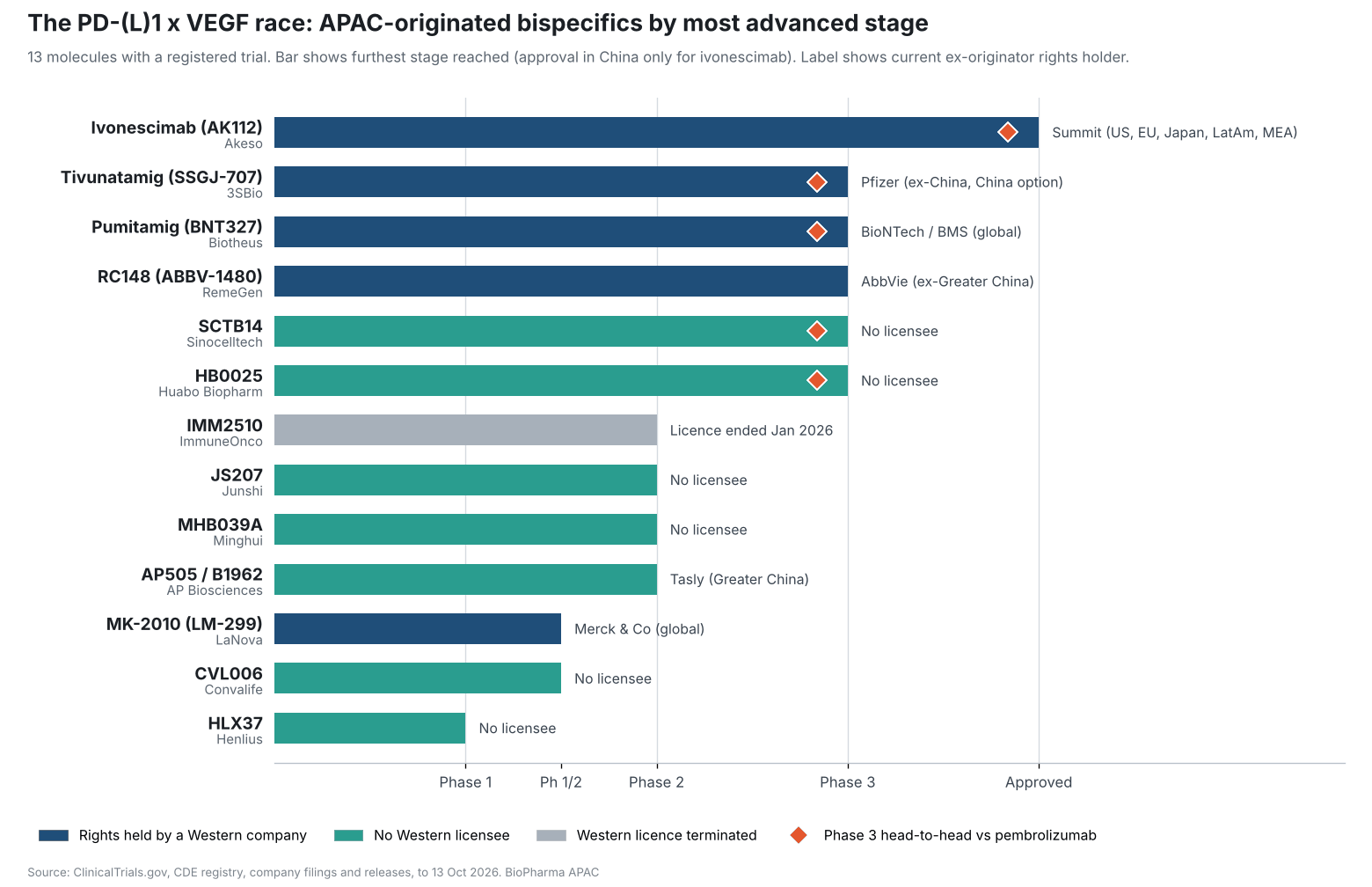
The race chart: furthest registered stage per molecule. Orange diamonds mark a Phase 3 run directly against pembrolizumab.
When the ESMO Congress opens in Madrid on 23 October, one drug class will be hard to miss. Two days in, on the evening of Sunday 25 October, the Presidential Symposium will hear HARMONi-GI1, Akeso's Phase 3 trial of ivonescimab plus chemotherapy against durvalumab plus chemotherapy in first-line biliary tract cancer. Akeso has already said the trial met its overall survival endpoint at a prespecified interim analysis. The next morning, Pfizer and 3SBio will post updated Phase 2 lung cancer data for tivunatamig, the molecule Pfizer paid US$1.25 billion to license. Three weeks after that, on 14 November, the US Food and Drug Administration is due to rule on Summit Therapeutics' application for ivonescimab in EGFR-mutant lung cancer.
Those three dates sit inside a larger story. Bispecific antibodies that block PD-1 or PD-L1 with one arm and the blood-vessel growth factor VEGF with the other are the most heavily licensed drug class to come out of Asia-Pacific in this cycle. Almost every clinical-stage molecule in the class traces back to China. Pfizer, Bristol Myers Squibb, AbbVie and Merck & Co now hold rights to APAC-born molecules, and AstraZeneca bought its way in on 28 September with a US$2.0 billion equity investment in Summit.
So we counted. This tracker lists every APAC-originated PD-1 or PD-L1 x VEGF bispecific with a registered clinical trial, who holds which territories, which have reached Phase 3, and which have chosen to fight the world's best-selling cancer drug, pembrolizumab (Keytruda), head-on. We intend to rerun it every year.
|
13 APAC molecules with a registered trial |
6 with a Phase 3 under way or completed |
5 in Phase 3 head-to-head vs pembrolizumab |
14 Nov FDA action date for ivonescimab |
|
How we counted Inclusion: a bispecific antibody (including antibody fusion formats) that binds PD-1 or PD-L1 and VEGF, originated by a company headquartered in Asia-Pacific, with at least one registered interventional trial on ClinicalTrials.gov, China's CDE drug trial registry or ChiCTR, or a company disclosure that dosing has begun. Excluded: trispecifics (such as PD-1 x CTLA-4 x VEGF constructs), antibody-drug conjugates, preclinical assets, and molecules originated outside the region even where an APAC company holds local rights. Stage: the most advanced registered trial. Licence economics are reported only from regulatory filings or company releases; undisclosed terms are marked as such and never estimated. Data cut: 13 October 2026. Identifiers were checked against registry records and company releases; readers should treat trial-status fields as a snapshot. |
The roster at a glance
|
Molecule |
Target pair |
Rights outside originator |
Stage |
Phase 3 comparator(s) |
|
Ivonescimab (AK112) |
PD-1 x VEGF |
Summit: US, Canada, Europe, Japan, Latin America, Middle East, Africa |
Approved (China) |
Pembrolizumab; pembrolizumab + chemo; tislelizumab + chemo; durvalumab + chemo |
|
Tivunatamig (SSGJ-707) |
PD-1 x VEGF |
Pfizer: global ex-China, with China option |
Phase 3 |
Pembrolizumab + chemo; pembrolizumab; bevacizumab + chemo |
|
Pumitamig (BNT327) |
PD-L1 x VEGF |
BioNTech (owner), co-developed with BMS |
Phase 3 |
Pembrolizumab + chemo; pembrolizumab; durvalumab |
|
RC148 (ABBV-1480) |
PD-1 x VEGF |
AbbVie: ex-Greater China |
Phase 3 |
Tislelizumab + chemo |
|
SCTB14 |
PD-1 x VEGF |
None |
Phase 3 |
Pembrolizumab |
|
HB0025 |
PD-L1 x VEGF |
None |
Phase 3 |
Pembrolizumab + chemo |
|
IMM2510 |
PD-L1 x VEGF |
None (Instil/Axion licence ended Jan 2026) |
Phase 2 |
Phase 3 applications reported |
|
JS207 |
PD-1 x VEGF |
None |
Phase 2 |
Phase 2/3 vs nivolumab cleared by FDA |
|
MHB039A |
PD-1 x VEGF |
None |
Phase 2 |
None |
|
AP505 / B1962 |
PD-L1 x VEGF |
Tasly: Greater China |
Phase 2a |
None |
|
MK-2010 (LM-299) |
PD-1 x VEGF |
Merck & Co: global |
Phase 1/2 |
None disclosed |
|
CVL006 |
PD-L1 x VEGF |
None |
Phase 1/2 |
None |
|
HLX37 |
PD-L1 x VEGF |
None |
Phase 1 |
None |
Approved: the benchmark
1. Ivonescimab (AK112 / SMT112)
|
Originator |
Akeso (China) |
|
Licensee and territory |
Summit Therapeutics: US, Canada, Europe and Japan (December 2022: US$500 million upfront, up to US$5.0 billion total), extended to Latin America, the Middle East and Africa in June 2024 (US$15 million upfront, up to US$55 million in milestones). Akeso retains China and the rest of the world. |
|
Most advanced trial |
Approved by China's NMPA in three lung cancer indications (May 2024, April 2025, August 2026). US BLA under review based on HARMONi (NCT06396065). |
|
Comparator |
HARMONi-2 (NCT05499390) vs pembrolizumab; HARMONi-3 (NCT05899608) vs pembrolizumab + chemo; HARMONi-7 (NCT06767514) vs pembrolizumab in PD-L1 high; HARMONi-6 vs tislelizumab + chemo; HARMONi-GI1 (NCT06591520) vs durvalumab + chemo |
|
Next readout |
HARMONi-GI1, ESMO LBA8, 25 October. FDA action date 14 November. HARMONi-3 squamous PFS guided for second half of 2026; non-squamous PFS first half of 2027. |
|
Note |
Five of 16 announced Phase 3s have read out positive, per Summit. |
Every other molecule in this tracker is measured against ivonescimab, and for good reason. It is the only one with a regulatory approval and the only one with a completed Phase 3 against pembrolizumab. In HARMONi-2, ivonescimab monotherapy cut the risk of progression or death by 49% versus pembrolizumab in first-line PD-L1-positive lung cancer (median PFS 11.1 versus 5.8 months), and at WCLC in September Akeso reported a statistically significant overall survival result: hazard ratio 0.73, with median survival of 30.8 months against 22.6. HARMONi-6 added a win over tislelizumab plus chemotherapy in squamous disease, including an interim OS hazard ratio of 0.66.
The caveat is geography. HARMONi-2 and HARMONi-6 were China-only trials, and the global HARMONi study that underpins the US filing hit on progression-free survival (HR 0.52) but missed statistical significance on overall survival (HR 0.79, p = 0.057), although an update in July moved the figure to 0.76. That is why HARMONi-3, the global head-to-head against pembrolizumab plus chemotherapy, is the single most watched readout in the class. Summit says the squamous cohort's PFS events land in the second half of this year.
Phase 3: five challengers
2. Tivunatamig (SSGJ-707 / PF-08634404)
|
Originator |
3SBio, through subsidiary Shenyang Sunshine Pharmaceutical (China) |
|
Licensee and territory |
Pfizer: global ex-China, with an option on China for up to US$150 million. US$1.25 billion upfront, up to US$4.8 billion in milestones, plus a US$100 million equity investment (Pfizer, May and July 2025). |
|
Most advanced trial |
Phase 3 Symbiotic-Lung-01 (NCT07222566), first-line NSCLC, about 1,410 patients; China Phase 3 (NCT06980272), about 420 patients; Symbiotic-GI-03 (NCT07222800), first-line colorectal |
|
Comparator |
Pembrolizumab + chemo (global); pembrolizumab (China); bevacizumab + chemo (colorectal) |
|
Next readout |
ESMO poster 2660P, updated Phase 2 NSCLC data, 26 October. No Phase 3 timing guided. |
|
Note |
3SBio's 2026 interim release refers to a US$1.4 billion upfront received, which matches the base payment plus the full option amount; Pfizer has not separately announced an exercise. |
Pfizer is building the broadest pembrolizumab confrontation outside Akeso. It is running two head-to-head lung studies at once, one global and one in China, and has flagged a further Phase 3 combining tivunatamig with its own ADC, enfortumab vedotin, in urothelial cancer. 3SBio reports nine trials worldwide on the asset.
3. Pumitamig (BNT327 / PM8002)
|
Originator |
Biotheus (China); acquired by BioNTech in a deal announced November 2024 (US$800 million upfront, up to US$150 million in milestones) |
|
Licensee and territory |
BioNTech holds global rights; Bristol Myers Squibb co-develops and co-commercialises with a 50:50 global cost and profit split (June 2025: US$1.5 billion upfront, US$2.0 billion in non-contingent anniversary payments through 2028, up to US$7.6 billion in milestones) |
|
Most advanced trial |
Global ROSETTA Phase 3 programme including Lung-02 (NCT06712316), Lung-202 (NCT07361510), Lung-201 (NCT07361497), Lung-01 (NCT06712355); China Phase 3s in TNBC (NCT06419621) and second-line SCLC (NCT06616532) |
|
Comparator |
Pembrolizumab + chemo (Lung-02); pembrolizumab (Lung-202, PD-L1 at least 50%); durvalumab (Lung-201) |
|
Next readout |
China first-line TNBC Phase 3 in 2026; global Lung-01 in 2028, Lung-02 and Breast-01 in 2029 (BioNTech guidance) |
|
Note |
The only PD-L1-based molecule with a global Phase 3 against pembrolizumab |
Pumitamig is the class's clearest test of whether targeting PD-L1 rather than PD-1 matters. BioNTech's timelines are also the most candid in the class about how far away global proof is: the pivotal lung readouts sit in 2028 and 2029.
4. RC148 (ABBV-1480)
|
Originator |
RemeGen (China) |
|
Licensee and territory |
AbbVie: ex-Greater China; RemeGen retains Greater China. US$650 million upfront, up to US$4.95 billion in milestones, tiered royalties (January 2026; effective 10 March 2026) |
|
Most advanced trial |
China Phase 3 in first-line squamous NSCLC (NCT07416474), first patient dosed May 2026; non-squamous Phase 3 registered (NCT07829549); FDA has cleared INDs for two US Phase 3s in NSCLC |
|
Comparator |
Tislelizumab + chemo (China squamous study); US comparators not yet disclosed |
|
Next readout |
Not guided |
|
Note |
CDE breakthrough therapy designation in NSCLC (August 2025) |
Our out-licensing roster, The Out-Licensing Class of 2025 to 2026, set the SSGJ-707 and RC148 deals side by side as the only like-for-like pair among that year's APAC transactions; that analysis of how the two were structured stands, and we do not rerun it here. What the tracker adds is that RemeGen chose BeOne Medicines' tislelizumab, not pembrolizumab, as its China comparator, a choice that echoes Akeso's HARMONi-6.
5. SCTB14
|
Originator |
Sinocelltech (China) |
|
Licensee and territory |
None disclosed |
|
Most advanced trial |
Phase 3 monotherapy study, CTR20254727 / NCT07362459, first-line driver-negative NSCLC with PD-L1 TPS of at least 10%, about 246 patients |
|
Comparator |
Pembrolizumab (primary endpoint PFS by blinded central review) |
|
Next readout |
Not guided |
|
Note |
Also in Phase 2/3 with chemotherapy in NSCLC (CTR20251153, CTR20250935) |
6. HB0025
|
Originator |
Huabo Biopharm (Shanghai), a Huahai Pharmaceutical subsidiary |
|
Licensee and territory |
None disclosed |
|
Most advanced trial |
Phase 3 DUALIGHT-02, CTR20260016, first-line squamous NSCLC, about 480 patients; first patient dosed 23 January 2026 |
|
Comparator |
Pembrolizumab + chemo |
|
Next readout |
Not guided |
|
Note |
PD-L1 x VEGF format; end-of-Phase 2 package filed in endometrial cancer |
SCTB14 and HB0025 are the quiet story of the count. Neither has a Western partner, yet both have registered Phase 3s that take on pembrolizumab directly. A positive China readout against the global standard of care is precisely the asset that business development teams have been paying for, and both companies have kept their ex-China rights.
Phase 2 and earlier: the second wave
7. IMM2510
|
Originator |
ImmuneOnco Biopharmaceuticals (China) |
|
Licensee and territory |
None. Instil Bio's subsidiary Axion licensed ex-Greater China rights in August 2024 (US$10 million upfront within up to US$50 million in upfront and near-term payments); it discontinued development and rights reverted in January 2026 |
|
Most advanced trial |
Phase 2 in China; Phase 3 applications in IO-resistant NSCLC reported filed with the CDE in October 2025 (registry identifiers not yet confirmed) |
|
Comparator |
Not disclosed |
|
Next readout |
Not guided |
|
Note |
The only Western licence in the class to have been handed back |
8. JS207
|
Originator |
Junshi Biosciences (China) |
|
Licensee and territory |
None; Junshi has said it is in discussions with overseas companies |
|
Most advanced trial |
Eleven Phase 2 studies, including first-line colorectal with XELOX (NCT06885385) and first-line liver cancer with JS007 (NCT06954467); FDA cleared a Phase 2/3 neoadjuvant NSCLC study |
|
Comparator |
Nivolumab (neoadjuvant Phase 2/3) |
|
Next readout |
Phase 3 start planned within 2026 |
|
Note |
AACR 2026: ORR 71.0% in first-line colorectal, 45.5% in first-line liver cancer (Phase 2, early data) |
9. MHB039A
|
Originator |
Minghui Pharmaceutical (China) |
|
Licensee and territory |
None disclosed |
|
Most advanced trial |
Phase 2 in NSCLC combined with Minghui's TROP-2 ADC MHB036C (first patient May 2025); Phase 1 NCT06345482 |
|
Comparator |
None |
|
Next readout |
Not guided |
|
Note |
An in-house bispecific plus ADC pairing, the combination model big pharma is now pursuing |
10. AP505 / B1962
|
Originator |
AP Biosciences (Taiwan) |
|
Licensee and territory |
Tasly Biopharmaceuticals: mainland China, Hong Kong and Macau; a March 2026 amendment sets revenue sharing for ex-China licensing, terms undisclosed |
|
Most advanced trial |
Phase 2a in advanced solid tumours (NCT06724263); Phase 1 NCT05650385 and NCT06723964 |
|
Comparator |
None |
|
Next readout |
Not guided |
|
Note |
The only non-mainland originator in the count |
11. MK-2010 (LM-299)
|
Originator |
LaNova Medicines (China) |
|
Licensee and territory |
Merck & Co: global. US$588 million upfront, up to US$2.7 billion in milestones (November 2024) |
|
Most advanced trial |
Phase 1/2 in China in PD-L1-positive NSCLC; Phase 2 MK-2010-002 (NCT07793942) registered with a planned start of 27 October 2026, and a combination study with sacituzumab tirumotecan (NCT07785609) |
|
Comparator |
None; the new Phase 2 tests MK-2010 alone and with pembrolizumab, chemo or belzutifan |
|
Next readout |
Not guided; no Phase 3 disclosed |
|
Note |
Merck owns Keytruda, so its plan pairs MK-2010 with pembrolizumab rather than testing against it |
12. CVL006
|
Originator |
Convalife (Shanghai) |
|
Licensee and territory |
None disclosed |
|
Most advanced trial |
Phase 1/2 combination study (NCT07157956); Phase 1 NCT06621615 |
|
Comparator |
None |
|
Next readout |
Not guided |
|
Note |
PD-L1 single-domain (VHH) arm fused to an anti-VEGF IgG1 |
13. HLX37
|
Originator |
Shanghai Henlius Biotech (China) |
|
Licensee and territory |
None disclosed |
|
Most advanced trial |
Phase 1 in solid tumours (NCT07274813); NMPA cleared a further study alone or with chemotherapy or Henlius's ADC HLX43 (July 2026) |
|
Comparator |
None |
|
Next readout |
Not guided |
|
Note |
The newest entrant in the count |
What the count tells us
Pembrolizumab is the yardstick, but not everyone's. Five molecules are in, or have completed, a Phase 3 head-to-head against pembrolizumab, across nine trials: three for ivonescimab, two each for tivunatamig and pumitamig, and one each for SCTB14 and HB0025. Running against the world's best-selling cancer drug is the most expensive way to prove a point, and the most persuasive one for Western payers. Inside China, though, the commercial comparator is often tislelizumab, which explains why HARMONi-6 and RemeGen's first Phase 3 picked it.
The rights map is now mostly Western. Of the six molecules at Phase 3 or beyond, four have ex-China rights with a Western company. Only SCTB14 and HB0025 remain wholly held by their originators, and both are fighting pembrolizumab, which makes them the obvious next names on a buyer's list. At the earlier end the picture flips: of the seven molecules at Phase 2 or below, only MK-2010 sits with a Western owner.
The licence that came back. IMM2510 is the class's one reversal. Instil's subsidiary returned the rights in January without giving a reason. It is a reminder that a licence is an option, not a verdict, and that buyers trimming portfolios will drop the follower asset before the leader.
PD-1 or PD-L1 is still an open question. Seven molecules block PD-1 and six block PD-L1. Only one PD-L1 molecule, pumitamig, has a global Phase 3, so the class's clinical answer on which arm matters will come largely from BioNTech and BMS, and not before 2028.
The next fight is combinations. Pfizer is pairing tivunatamig with its ADCs; Summit has collaborations with Pfizer, AstraZeneca and Daiichi Sankyo, GSK and others; Merck is testing MK-2010 with sacituzumab tirumotecan; Minghui and Henlius pair their bispecifics with in-house ADCs. The bispecific is increasingly being positioned as the immunotherapy backbone for the next generation of regimens, rather than a standalone challenger.
The calendar: dates to watch
- 25 October: HARMONi-GI1, ivonescimab vs durvalumab in biliary tract cancer, ESMO Presidential Symposium (LBA8). First full hazard ratios.
- 26 October: Tivunatamig updated Phase 2 NSCLC data with chemotherapy, ESMO poster 2660P.
- 27 October: Planned start of Merck's MK-2010-002 Phase 2.
- 14 November: FDA action date for ivonescimab plus chemotherapy in EGFR-mutant NSCLC after TKI.
- Second half of 2026: HARMONi-3 squamous cohort PFS, the first global head-to-head against pembrolizumab plus chemotherapy; pumitamig China TNBC Phase 3.
- First half of 2027: HARMONi-3 non-squamous PFS and an interim OS look in the squamous cohort.
- 2028 and 2029: ROSETTA Lung-01, then Lung-02 and Breast-01, for pumitamig.
What we left out, and why
Several programmes sit near the boundary. Kelun-Biotech's SKB118 is a PD-1 x VEGF bispecific licensed into Greater China from the US company Crescent Biopharma, so it is not APAC-originated. AI-081, now with US-based OncoC4, came through a merger and we could not verify an APAC origin. Sailong's KH003 appears in a published review but we found no registry entry. An investigator-led Phase 3 at Shanghai Pulmonary Hospital (ChiCTR2600124154) tests an unnamed PD-1 x VEGF bispecific, so it cannot be assigned. Trispecifics, including BeOne Medicines' option on Huahui Health's HH160, are excluded by design. Industry tallies of the class vary widely, from 14 clinical products in a 2025 broker count to more than 30 assets at all stages in a 2026 intelligence tally; our narrower method, requiring a registered trial and an APAC originator, yields 13.
Sources and method notes
Trial identifiers and designs: ClinicalTrials.gov, China CDE drug trial registry and ChiCTR records, cross-checked with company releases. Licence terms: Summit Therapeutics SEC filings and releases (December 2022, June 2024, Q2 2026 10-Q, September 2026 8-K); Pfizer releases (19 May and 24 July 2025, 28 September 2026); BioNTech 6-K filings and releases (November 2024, June 2025, January and June 2026); RemeGen HKEX announcements (12 January and 24 August 2026) and AbbVie release; Merck release and LaNova HKEX notice (November 2024); Instil Bio 8-K (August 2024) and January 2026 release. Clinical results: Akeso HKEX announcements and releases (HARMONi-2 WCLC 2026; HARMONi-6; HARMONi-GI1, August 2026); Junshi AACR 2026 release. ESMO programme details: Summit and Pfizer releases. All data as of 13 October 2026.
This tracker is a class census, not an investment view or a ranking of clinical merit. Cross-trial comparisons are unreliable and none is intended. Trial statuses change frequently; corrections to the BioPharma APAC desk are welcome and will be reflected in dated updates. The tracker will be refreshed annually.
Most Read
- Can APAC Biomanufacturing Decarbonise Without Pricing Itself Out?
- The Algorithm on the GMP Floor: AI Promises a Smarter Plant. Regulators Demand the Audit Trail.
- APAC's Peptide-Capacity Gamble
- After the Rush: APAC's mRNA and Vaccine Capacity Hangover
- The Biosimilar Race: Factory to the World — or Stuck in the Copycat Economy?
- The Vein-to-Vein Problem: Can APAC's Cold Chain Carry Advanced Therapies?
- Vectors, Plasmids and the CGT Trap: APAC's Cell and Gene Therapy Ambitions Face an Upstream Bottleneck
- Can APAC Build Radioligand Therapy Before the Atoms Decay?
- The Great Biopharma Reset: 50 Developments That Changed Everything in H1 2026
- Beyond the Trial: Can Real-World Evidence Earn Regulatory Trust in APAC?
- Beyond the Obvious Giant: Where APAC's Clinical Trials Go Next
- The Frontier That Won’t Quite Arrive
Bio Jobs
- Sanofi Turns The Page As Belén Garijo Steps In And Paul Hudson Steps Out
- Global Survey Reveals Nearly 40% of Employees Facing Fertility Challenges Consider Leaving Their Jobs
- BioMed X and AbbVie Begin Global Search for Bold Neuroscience Talent To Decode the Biology of Anhedonia
- Thermo Fisher Expands Bengaluru R&D Centre to Advance Antibody Innovation and Strengthen India’s Life Sciences Ecosystem
- Accord Plasma (Intas Group) Acquires Prothya Biosolutions to Expand Global Plasma Capabilities
- ACG Announces $200 Million Investment to Establish First U.S. Capsule Manufacturing Facility in Atlanta
- AstraZeneca Invests $4.5 Billion to Build Advanced Manufacturing Facility in Virginia, Expanding U.S. Medicine Production
News