
FDA Warning Letters to APAC Drug Facilities in Fiscal 2026: The Full Ledger, Normalised
20 October 2026 | Tuesday | Analysis
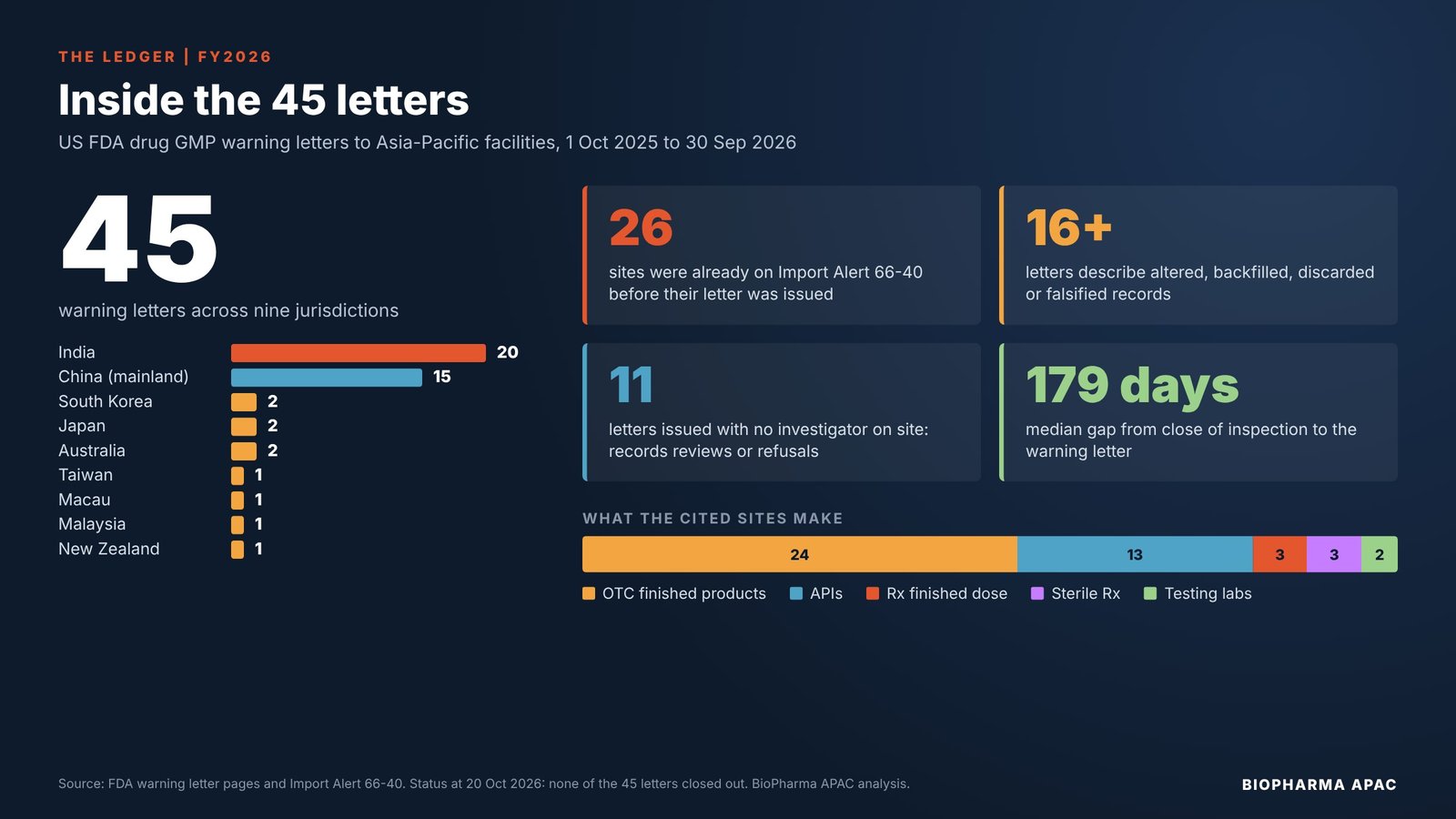
Every October, the same headline writes itself. India leads the count of US FDA warning letters to Asian drug plants, China follows, and the rest of the region barely registers. The headline is accurate. It is also close to useless, because a raw count of letters tells you more about where FDA sends its investigators than about how those plants behave once the investigators arrive.
This ledger is an attempt to fix that. It lists every drug good manufacturing practice (GMP) warning letter that FDA's Center for Drug Evaluation and Research (CDER) issued to a facility in Asia-Pacific between 1 October 2025 and 30 September 2026, the US government's fiscal year 2026. Each entry was read on FDA's own letter page. Then, where the letter came out of an inspection, we set it against the number of drug quality inspections FDA conducted in that country, so that a plant in Gujarat and a plant in Gyeonggi-do are measured on the same scale.
The result is 45 letters across nine jurisdictions. The full table sits at the end of this article, and the method, including its limits, is published alongside it. This is the first edition of an annual franchise, and we intend the second to be better for the corrections the first attracts.
The count everyone will quote
Start with the raw numbers, because they will travel regardless. India drew 20 letters in fiscal 2026, or 44 per cent of the regional total. Mainland China drew 15. Together the two account for 35 of the 45, nearly four letters in every five. The remaining ten were spread thinly: two each to South Korea, Japan and Australia, and one each to Taiwan, Macau, Malaysia and New Zealand. Singapore, Thailand, Vietnam, Indonesia, the Philippines, Pakistan and Bangladesh recorded none that we could find.
The letters did not arrive evenly. Seven landed in the first quarter of the fiscal year, from October to December 2025. The pace then picked up, with 11 in the second quarter, 16 in the third and 11 in the fourth. The third-quarter spike owes a good deal to a single day: on 2 June 2026, FDA issued a cluster of letters over asbestos testing of talc, five of which went to Asia-Pacific sites in India, China and Japan.
The names are a mix that should unsettle anyone who assumes warning letters are a problem for obscure operators only. The ledger includes Zydus Lifesciences, Intas Pharmaceuticals, Aurobindo's sterile injectables arm Eugia Pharma Specialities, Reliance Life Sciences, Dabur India, the Korean injectables maker Huons, Japan's Sato Pharmaceutical and Hubei Gedian Humanwell. Alongside them sit sunscreen contract manufacturers, a cough drop plant in Xiamen, a homeopathic laboratory in New Zealand and two Indian contract testing laboratories. A warning letter is a statement about a site on a date, not a verdict on a company or a country, and the ledger treats each one that way.
Why the raw count misleads
A warning letter is the end of a chain. FDA first decides which plants to look at, sends investigators or requests records, classifies what it finds, and only then, for the most serious outcomes, writes a letter. A country that hosts more FDA-registered plants, and therefore receives more inspections, will generate more letters even if its plants are no worse than anyone else's. India and China host the largest pools of foreign sites supplying the US market, so they will always top a raw count.
The fair question is not how many letters a country received but how many letters it received for every inspection FDA carried out there. That is the number this ledger reports, as letters per 100 inspections.
Two adjustments make the comparison honest. First, only letters that arose from an inspection go into the numerator. Nine of the 45 letters were written after FDA reviewed records it had demanded under section 704(a)(4) of the Food, Drug and Cosmetic Act, without anyone setting foot in the plant, and two more were issued because a firm refused to let FDA in or refused to hand over records. Dividing those letters by an inspection count would inflate the rate for countries where FDA leans on remote tools. We count them separately, and they carry their own lesson, discussed below.
Second, the denominator has to come from the right period. The median gap between the last day of an inspection and the date of the resulting letter in this ledger is 179 days, and the range runs from 123 days to 320. Of the 34 inspection-based letters, 14 stem from inspections that closed before the fiscal year began. A fiscal 2026 letter is, in large part, the product of fiscal 2025 fieldwork.
The normalised view
FDA has not yet published country-level inspection counts for fiscal 2026. The most recent official figures are in CDER's Report on the State of Pharmaceutical Quality for fiscal 2025, released on 29 June 2026, which counts 1,248 drug quality inspections worldwide: 702 in the United States and 546 abroad, including 207 in India and 163 in China. Given the lag described above, that fiscal 2025 cohort is a defensible denominator for this year's letters, and it is the one we use. When FDA's dashboard yields a clean fiscal 2026 count, we will publish the rerun.
On that basis, India received 17 inspection-based letters against 207 inspections, or 8.2 letters per 100 inspections. Mainland China received eight inspection-based letters against 163 inspections, or 4.9 per 100. India's rate is higher, but by a factor of under two, not the gap the raw totals imply.
The more striking result is the rest of the region. FDA's report does not break out Japan, South Korea, Taiwan, Australia or South-East Asia individually; it folds them into a 'rest of world' group that recorded 85 inspections in fiscal 2025, a group that also includes sites outside Asia-Pacific. Nine inspection-based letters went to Asia-Pacific sites outside India and mainland China. Even if every one of those 85 inspections had taken place in Asia-Pacific, which it did not, the rate would be 10.6 letters per 100 inspections. That is a floor, not an estimate, and it sits above both India and China.
Put plainly, the parts of Asia-Pacific that rarely appear in warning letter headlines are not inspected often, but when FDA does go, it finds enough to write a letter at a rate at least as high as anywhere else in the region. Fewer letters reflect fewer visits, not cleaner plants.
FDA's own inspection outcomes point the same way. In fiscal 2025, 17.9 per cent of Indian inspections were classified 'official action indicated', the agency's most serious outcome, against 8.0 per cent in China, 15.3 per cent in the rest of the world group and 21.6 per cent in the United States. The global figure was 18 per cent. Indian plants, in other words, were found wanting at a rate slightly below the global average and well below American plants on FDA's own scoring, even as they collected the largest single share of letters in this region.
Country by country
India's 20 letters were spread across ten states and union territories, which itself is a finding. Maharashtra led with four, from Chemspec Chemicals and Gopaldas Visram in Navi Mumbai to Shimoga Chemicals in Sangli and Reliance Life Sciences in Rabale. Telangana, Gujarat and Karnataka had three each, and the coastal union territory that holds Daman and Silvassa had two. The mix was broad as well: seven API makers, six OTC producers, three prescription finished dose sites, two sterile manufacturers and two contract testing laboratories. The two laboratories matter more than their number suggests, because FDA treats contract labs as extensions of every manufacturer that relies on them, and neither letter names those clients.
China's 15 tell a different story. Nine went to OTC makers and six to API producers; not one went to a prescription finished dose plant. Guangdong accounted for five and Jiangsu for four, largely consumer health manufacturers making sanitisers, wipes, sunscreens and talc products. Nearly half of China's letters came from paperwork or refusal rather than an inspection, which is why its normalised rate is the lowest in the region and also why that rate should be read with care. A plant that refuses an inspection never enters the denominator at all.
The rest of the region produced ten letters, and two of them deserve particular attention from partners. Huons, a listed Korean injectables manufacturer, received a letter describing some of the most detailed data integrity failures in the entire ledger. Sato's letter concerned aseptic filling, an area where Japanese manufacturers are usually assumed to be strong. Australia's two letters both went to Queensland skincare manufacturers making sunscreen-type products, and Malaysia's single letter, to Fulijaya Manufacturing in Kedah, is one of only four outside India in the ledger that centre on data integrity. Taiwan and Macau each recorded one OTC letter, and New Zealand's went to a homeopathic laboratory with a repeat finding on component testing.
Letters without an investigator
The 11 letters that did not come out of an inspection deserve their own attention, because they show where FDA's enforcement is heading.
China accounts for seven of them. Five Chinese firms received letters after FDA reviewed records sent under 704(a)(4): two OTC makers in Guangdong, a talc product maker in Shantou, and two API producers, Hangzhou Yiqi Biotechnology and Tianjin Kilo Pharmaceutical Sci-tech, the latter shipping to US compounding pharmacies. Two more were adulterated by refusal. Kellin Chemicals in Zhangjiagang declined a preannounced inspection in July 2025, and Yangzhou Hongshengding Chemical left two records requests unanswered. India had three records-based letters, all from the talc sweep, to Gopaldas Visram, Umendra Life Sciences and the Baddi site of Zydus Lifesciences. Japan's Asanuma Corporation was the fourth talc recipient in the region on records alone.
For a quality head, the implication is uncomfortable. A records request arrives by email, and the response is judged on paper. Certificates of analysis that have never been verified, identical infrared readings on samples that should differ, and missing asbestos tests on talc were all visible to FDA reviewers who never left Maryland. A site that has prepared for the walk-through but not for the file review is preparing for the wrong exam.
What FDA actually cited
Read the letters themselves and the citations cluster around a small number of failures that recur across borders.
The first is the quality unit. In letter after letter, FDA cites 21 CFR 211.22, the requirement that a site's quality function has the authority and the procedures to stop bad product. For API makers, the equivalent finding is framed under the ICH Q7 guideline. The failure takes many forms: Chemspec Chemicals in Navi Mumbai released APIs without batch records; Harbin Jixianglong Biotech's quality unit allowed relabelling of semaglutide from a source not on FDA's green list; Intas's Dehradun site let a vendor change electronic batch records without an audit trail.
The second is data integrity, and here the region's record is sobering. At least 16 of the 45 letters describe records that were altered, backfilled, discarded, falsified or never generated. Twelve of those are Indian. Tentamus India, a contract testing laboratory in Hyderabad, was found with torn records in garbage bags and was also cited for delaying the inspection. Dabur India's Silvassa plant kept a falsified equipment logbook. Wizcure Pharmaa swapped contaminated environmental monitoring plates. At Huons in Jecheon, FDA describes discarded bioburden plates, altered camera timestamps and 1,897 blank, uncontrolled forms. At Reliance Life Sciences in Navi Mumbai, microbiology samples were logged as collected when they had not been.
The third is testing. A large share of the OTC letters, which account for 24 of the 45, cite the same pair of failures: no identity or strength testing before release under 211.165, and reliance on supplier certificates of analysis without verifying components under 211.84. These are basic obligations, and their frequency says something about how many small consumer product makers in the region supply the US market without fully understanding that a sunscreen or an antiseptic wipe is a drug in American law.
The fourth is sterility. Five of the OTC letters involved products labelled sterile or aseptically filled, and in two Chinese cases FDA found products labelled sterile that had not been sterilised at all. In the prescription space, three letters went to sterile manufacturers: Eugia's Unit 1 in Telangana, where FDA said Units II and III were also classified 'official action indicated'; Reliance Life Sciences; and Huons. Sato's Hachioji plant in Tokyo was cited for six failed media fills between November 2022 and February 2025.
The import alert usually comes first
One pattern in the ledger changes how executives should read the warning letter calendar. In 26 of the 45 cases, FDA had already placed the site on Import Alert 66-40, which allows US border officers to detain its drugs without physical examination, before the warning letter was issued. A 27th, Yangzhou Hongshengding, was placed on the records-refusal alert 66-79 before its letter.
In practice, that means the commercial damage usually lands weeks or months before the public document. Reliance Life Sciences was on the import alert on 9 July 2026, six weeks before its letter. Dabur's Silvassa site was listed on 5 June and received its letter on 24 July. Patcos Cosmetics in Daman has been on the alert since November 2023, and its fiscal 2026 letter is its second. For investors and procurement teams, the warning letter is often the confirmation, not the signal. The import alert list is where the earlier signal sits.
Recalls followed in several cases. Shimoga Chemicals in Sangli recalled clomiphene citrate in May 2026; Reliance recalled all sterile products in June; Dabur and Shoolin Pharma Chem recalled in June and August respectively; Huons committed to a voluntary recall; and Wizcure halted US production.
The compounding supply chain
A smaller thread, but one with policy weight, runs through the API letters. At least six of the 13 API letters went to firms supplying material destined for compounding or for peptide products in high US demand. Harbin Jixianglong made semaglutide and tirzepatide. Tianjin Kilo and Henan Lvyuan Pharmaceutical supplied APIs for compounding. Hangzhou Yiqi supplied APIs used in sterile products and compounding. Almon Healthcare in Ahmedabad was found to have knowingly accepted deliberately mislabelled material, and Shimoga's clomiphene was also for compounding. Shoolin's sildenafil and tadalafil add to the picture.
These are not the large generic exporters that dominate India's US business. They are smaller producers feeding a channel that sits outside the conventional approved-application pathway, and FDA's attention to them in fiscal 2026 tracks the agency's broader concern with compounded GLP-1 products and their inputs.
Nothing has closed
Not one of the 45 letters had been formally closed out by FDA as of 20 October 2026. That is not unusual, since close-out typically requires a follow-up inspection or a thorough file review, and the youngest letters in the ledger are only weeks old. But it does mean that every site in this table remains, in FDA's public record, an open case. FDA may withhold approval of new applications that name these sites as manufacturers until the violations are resolved, which turns an operational problem into a pipeline problem for any partner that relies on them.
Close-outs did happen during the year for older letters. FDA closed out an earlier letter to Global Calcium in July 2026 and a records-refusal letter to Zenzi Pharmaceutical Industries in September, though Zenzi remains on the records import alert. They show the route out exists. They also show it is slow.
Reading the ledger as a buyer or partner
For a sponsor, licensor or procurement head, three practical questions follow from the table. The first is exposure: does any site in the ledger appear in your supplier list, your regulatory filings or your contract testing arrangements? Because FDA can withhold approval of applications that name a cited site, a single API supplier or testing laboratory on this list can stall a filing that has nothing else wrong with it.
The second is timing. Since the import alert preceded the letter in most cases, a supplier that appeared on Import Alert 66-40 during the year without a letter yet may simply be further back in the same queue. Watching the alert list is a better early warning than waiting for the letter to be posted, which, as Kellin Chemicals' eleven-month gap between letter date and publication shows, can take a long time.
The third is the paper trail. Ask suppliers how they would answer a 704(a)(4) request tomorrow, and whether their certificates of analysis rest on testing they actually performed. In fiscal 2026, that question alone would have flagged a large share of the region's letters.
What this ledger does not argue
This is a ledger, not a thesis. It does not argue that Indian or Chinese manufacturing quality is improving or declining, and it should not be read as doing so. One fiscal year of letters is too small and too lagged a sample to carry that argument, and the argument about Indian quality in particular belongs to our Fault Lines series, which can cite this table as its evidence base.
What the ledger does establish is narrower and, we think, more useful. Raw counts overstate India's position relative to its inspection volume. China's normalised rate is lower but its share of letters written without any inspection is far higher. And the smaller markets of the region, from Korea and Japan to Australia and Malaysia, are not quieter because they are better, but because FDA visits them less.
What to watch in fiscal 2027
The new fiscal year is already two days into its own ledger. On 2 October 2026, FDA issued a letter to Hanlim Pharm in Yongin, South Korea, over sterile manufacturing, repeating findings from a 2018 letter. It falls in fiscal 2027 and will open next year's table.
Three things will shape that table. The first is FDA's stated push to expand unannounced foreign inspections, which, if sustained, will raise the inspection count in India and China and test whether the rates reported here hold. The second is the talc sweep, which has not finished, and which falls hardest on OTC makers that never thought of themselves as pharmaceutical manufacturers. The third is the records request. If 704(a)(4) reviews keep growing as a share of enforcement, the denominator for the next edition will need a second column, letters per 100 records requests, and FDA will need to publish the numbers that make it possible.
The ledger at a glance
|
Jurisdiction |
Letters |
From inspection |
Records or refusal |
FDA drug inspections, FY2025 |
Letters per 100 inspections |
|
India |
20 |
17 |
3 |
207 |
8.2 |
|
China (mainland) |
15 |
8 |
7 |
163 |
4.9 |
|
Rest of Asia-Pacific* |
10 |
9 |
1 |
85 or fewer |
10.6 or more |
|
Total |
45 |
34 |
11 |
|
|
*South Korea 2, Japan 2, Australia 2, Taiwan 1, Macau 1, Malaysia 1, New Zealand 1. FDA reports these within a 'rest of world' group of 85 inspections that also includes non-Asia-Pacific sites, so the rate shown is a floor.
Method
Scope. Warning letters issued by CDER (including letters co-signed by CDER's Office of Manufacturing Quality) for violations of drug current good manufacturing practice, dated 1 October 2025 to 30 September 2026 inclusive, addressed to a manufacturing, API or contract testing site in Asia-Pacific. Asia-Pacific here means South Asia, East Asia, South-East Asia, Australia and New Zealand. Letters for compounding pharmacies, devices, food, tobacco, clinical research and marketing claims without GMP findings are excluded. Letters for refusal of inspection or records are included because they adulterate drugs under the same statute; they are flagged.
Sources. Each letter was read on its fda.gov page. Letter date is the date on the letter, not the posting date, which can lag by weeks or months. Kellin Chemicals' letter, dated 6 November 2025, was not posted until 29 September 2026.
Normalisation. Numerator: inspection-based letters only (34 of 45). Denominator: drug quality inspections by country for fiscal 2025 from CDER's Report on the State of Pharmaceutical Quality FY2025 (India 207, China 163, rest of world 85). The fiscal 2025 cohort is used because the median lag from inspection close to letter is 179 days and FDA had not published fiscal 2026 country counts at the time of writing. The rest of Asia-Pacific figure is a lower bound, since FDA's rest of world group also contains non-Asia-Pacific sites. Records-based and refusal letters are reported separately. The regional inspection figures were read from a chart in FDA's report and cross-checked against its stated totals.
Close-out status is as of 20 October 2026 and reflects whether FDA had posted a close-out letter. Henan Lvyuan Pharmaceutical's letter is listed by FDA under its Center for Veterinary Medicine but is co-signed by CDER's Office of Manufacturing Quality and covers APIs for human compounding; it is included and flagged. Removing it changes China's inspection-based rate from 4.9 to 4.3 per 100.
Completeness. FDA's warning letter search is not exhaustive and was rate-limited during compilation. We estimate the ledger captures roughly nine in ten qualifying letters. Corrections and additions are welcome and will be logged openly in the next edition.
Right of reply. Every company named in this ledger is offered a right of reply of seven working days. Responses received are published in full as an addendum to this page, and any factual correction is made in the ledger with a dated note. Editorial independence. Inclusion in this ledger is determined solely by FDA's public record and the method above. No commercial relationship with BioPharma APAC has any bearing on whether, or how, a company appears.
Most Read
- Can APAC Biomanufacturing Decarbonise Without Pricing Itself Out?
- The Algorithm on the GMP Floor: AI Promises a Smarter Plant. Regulators Demand the Audit Trail.
- APAC's Peptide-Capacity Gamble
- After the Rush: APAC's mRNA and Vaccine Capacity Hangover
- The Biosimilar Race: Factory to the World — or Stuck in the Copycat Economy?
- The Vein-to-Vein Problem: Can APAC's Cold Chain Carry Advanced Therapies?
- Vectors, Plasmids and the CGT Trap: APAC's Cell and Gene Therapy Ambitions Face an Upstream Bottleneck
- Can APAC Build Radioligand Therapy Before the Atoms Decay?
- The Great Biopharma Reset: 50 Developments That Changed Everything in H1 2026
- Beyond the Trial: Can Real-World Evidence Earn Regulatory Trust in APAC?
- Beyond the Obvious Giant: Where APAC's Clinical Trials Go Next
- The Frontier That Won’t Quite Arrive
Bio Jobs
- Sanofi Turns The Page As Belén Garijo Steps In And Paul Hudson Steps Out
- Global Survey Reveals Nearly 40% of Employees Facing Fertility Challenges Consider Leaving Their Jobs
- BioMed X and AbbVie Begin Global Search for Bold Neuroscience Talent To Decode the Biology of Anhedonia
- Thermo Fisher Expands Bengaluru R&D Centre to Advance Antibody Innovation and Strengthen India’s Life Sciences Ecosystem
- Accord Plasma (Intas Group) Acquires Prothya Biosolutions to Expand Global Plasma Capabilities
- ACG Announces $200 Million Investment to Establish First U.S. Capsule Manufacturing Facility in Atlanta
- AstraZeneca Invests $4.5 Billion to Build Advanced Manufacturing Facility in Virginia, Expanding U.S. Medicine Production
News


