27 Biopharma Trends to Watch in Asia-Pacific in 2027
23 November 2026 | Monday | Analysis
Asia-Pacific ends 2026 in a stronger position than it has ever held in biopharma. Multinationals paid more for Chinese molecules than in any previous year. An Indian generics company agreed to buy an American one. Hong Kong's biotech listing window reopened. Korea's biologics makers planted flags on US soil. At the same time, Washington spent the year writing tariffs, procurement lists and investment rules aimed squarely at the region's supply chains.
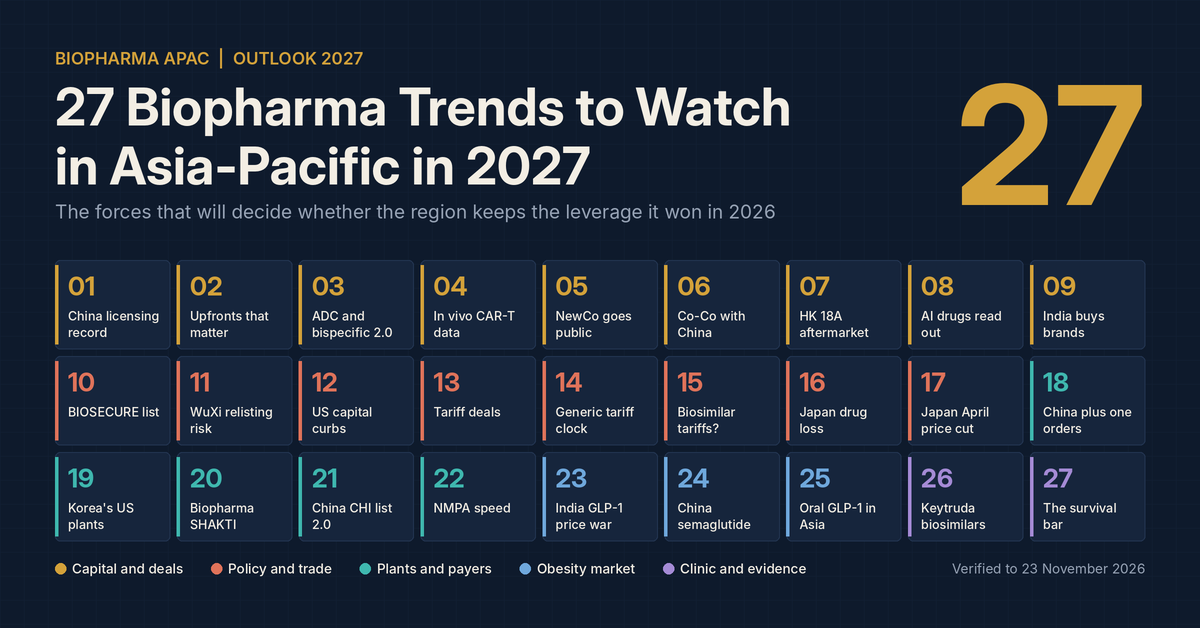
That combination makes 2027 a test year. Leverage is easy to win in a boom and hard to keep when budgets tighten and policy deadlines land. The 27 trends below are the ones we think will decide which way it goes. Each entry opens with the question it answers, then sets out what we already know and the specific signal to watch. Where a date is fixed, we give it. Where it is not, we say so, because in a year like the one ahead, a forecast without a checkpoint is just an opinion.
A word on selection. We did not rank these trends, and we did not pick them for novelty. Each had to meet three tests: it moves money or policy at regional scale, it can be tracked against a primary record or a named data source, and it will produce a visible answer within 2027. Several of them pull against each other. The deal boom and the investment restrictions, the tariff shelter and the onshoring scramble, Japan's price cuts and its drug-loss crisis will all play out at once. That tension is the story of the year ahead, and the companies that plan for both sides of each pairing, rather than betting on one, will be the ones still setting terms in 2028.
Movement one: capital and deals
1. Can China's licensing machine top a record year?
Will China's out-licensing total grow again in 2027? The bar is now very high. By 8 October 2026, overseas licensing deals signed by China-based developers had reached US$139.4 billion on PharmCube's count, already past the full-year 2025 record of US$138.8 billion. Repeating that requires buyers to keep finding assets they cannot source at home, at prices they can defend to their own shareholders. Watch the first-quarter total. In 2026 it passed US$60 billion on preliminary NMPA figures. A first quarter well below that would be the first sign that the cycle is turning from expansion to selection.
2. Upfronts become the only number that matters
How should anyone read a 2027 China deal headline? By its upfront. Evaluate data reported by Fierce Biotech shows the average upfront on China-to-West licensing rising from about US$52 million in 2022 to about US$172 million in 2026. Headline values still bundle milestones that may never be paid, and most of what gets announced remains contingent. In 2027, the meaningful signal is whether average upfronts hold near 2026 levels as volumes normalise. Falling upfronts with steady headline totals would mean buyers are hedging. Steady upfronts on fewer deals would mean they are concentrating on conviction.
3. ADC and bispecific platforms move to their second generation
Which modalities will keep China at the centre of dealmaking? The same two, in more complex forms. Vision Lifesciences estimates that China accounts for close to 90 percent of global ADC licensing activity, and three Chinese bispecific projects drew more than US$8 billion in combined deal value in the first quarter of 2026 alone. The next wave combines the two: bispecific ADCs, novel payloads and multi-specific scaffolds. Watch whether buyers keep licensing families of molecules rather than single assets. That is the clearest indicator that they are buying a platform, and platforms are much harder to replace than products.
4. In vivo CAR-T produces its first serious human data
Will in vivo cell therapy prove itself in 2027? The money has already moved. In November, Pfizer paid US$330 million upfront to Starna Therapeutics for ex-China rights to three pre-IND in vivo CAR-T programmes in autoimmune disease, in a deal worth up to about US$2.6 billion. Kite's arrangement with Pregene, worth up to US$1.64 billion, came before it, and Eli Lilly bought two in vivo CAR-T companies this year. Most of the early human evidence will come from investigator-initiated studies in China, which move faster than almost anywhere else. Watch for durable responses and clean safety in autoimmune patients. Those readouts will decide whether this is a modality or a moment.
5. The NewCo becomes a listing route
What happens to the NewCo structure next? It is turning into a path to public markets. Hansoh created a US company, Avere Therapeutics, and combined it with Nasdaq-listed NextCure in a deal designed mainly to give a China-originated IL-23 asset a listed vehicle for global development. Gilead's acquisition of Ouro Medicines delivered a reported US$257 million upfront to KeyMed from an earlier NewCo. Lawyers spent 2026 warning that the model is more complex than a straight licence, and 2027 may add a further complication: if US investment rules tighten (see entry 12), NewCos with Chinese equity stakes will face new questions from American funds.
6. Co-development with China becomes negotiable
Will more multinationals agree to share control? Some will, where the asset is strong enough. Pfizer's potential US$10.5 billion pact with Innovent in May covered four cancer assets, and reporting at the time noted that Pfizer had initially resisted a co-development and co-commercialisation structure before agreeing terms in under five months. Co-Co structures keep the Chinese originator inside the global value chain rather than paid off at the door. Watch for the next one. If two or three more follow in 2027, the default terms of China dealmaking will have changed.
7. Hong Kong's 18A queue meets its aftermarket test
Will Hong Kong's biotech IPO revival last? That depends on how the 2026 class trades. KPMG called the city's first half its strongest IPO performance in five years, 11 pre-revenue biotechs listed under Chapter 18A between January and early July, cumulative 18A listings reached 94, and dozens of applications sit in the queue. Investors have described a barbell market, in which capital crowds into late-stage assets and proven platforms while mid-stage companies struggle. Watch post-listing performance. If the 2026 cohort holds its offer prices into 2027, the window stays open. If it does not, the queue will shrink quickly.
8. AI-designed drugs have to show clinical results
When does AI drug discovery stop being a valuation story? When its molecules read out. Insilico Medicine listed in Hong Kong as the first AI-driven biotech on the Main Board under Chapter 8.05, raising about US$293 million with Eli Lilly, Tencent and Temasek among its cornerstones. Insiders claim AI tools can cut discovery timelines to as little as 18 months, and buyers have been shopping for AI-designed Chinese assets. In 2027, the market will want proof in later-stage trials, not timelines. Watch for randomised data on AI-originated molecules. That is the only evidence that will move the discount rate investors apply to the whole category.
9. Indian pharma learns to own brands
Will Sun Pharma's Organon deal start a trend? It may. Sun agreed in April to acquire Organon at an enterprise value of US$11.75 billion, which Fierce Pharma described as the largest biopharma deal of 2026, with closing expected in early 2027. The deal gives Sun a top-ten global biosimilars position and an entry into China. Watch the integration, because India's other generics leaders will. Facing US price erosion and a generic tariff clock (entry 14), they have every reason to buy brands, biosimilars and branded generics abroad. If Sun makes it work, others will follow.
Movement two: policy and trade
10. BIOSECURE names its first companies
When does BIOSECURE become real? The first step lands within weeks. The Office of Management and Budget is due to publish its initial list of biotechnology companies of concern by 18 December 2026. After that, implementing guidance follows within 180 days, then a revision of federal procurement rules within a year, and Holland and Knight estimates the actual prohibitions could begin in mid to late 2028, with grandfathering running to roughly 2033. Watch who is on the December list and who is not. Then watch sponsors' second-source qualification through 2027. Most will diversify quietly rather than walk away from existing partners. The long runway means BIOSECURE in 2027 is mainly a test of sentiment: a short, narrow list would calm buyers, while a broad one would push more capacity bookings toward Korea, India and Singapore.
11. WuXi's listing fight is not over
Could WuXi AppTec return to the Pentagon's list? Yes. The US defence department added WuXi AppTec to its Chinese military companies list on 8 June 2026, WuXi sued and won a preliminary injunction on 7 August, and the department's removal was published on 10 November, expressly without prejudice to relisting, with the merits case still pending. Watch the court's ruling on the merits and the department's next annual update. For sponsors, the lesson of 2026 is that designation can be challenged, and the risk does not disappear when it is.
12. US capital rules reach into Chinese biotech
Can American money keep flowing into Chinese biotech? That is now formally in question. On 22 October, the US Treasury proposed adding biotechnology as a sixth sector under its outbound investment regime, which would prohibit covered US investments in Chinese biotech outright. Comments close on 7 December 2026, and the deadline for implementing rules under the underlying statute is 13 March 2027. Separately, the Biotech Investment National Security Act, now introduced in both chambers, would extend coverage to licensing of prohibited technology. Licensing is open for now. Watch BINSA. If it moves, the perimeter reaches the deal room itself.
13. The tariff on patented medicines becomes a bargaining chip
How will the Section 232 tariff shape 2027? Mostly through exemptions, not collections. The April 2026 proclamation set a 100 percent headline rate on imported patented medicines, capped at 15 percent for Japan, Korea, the EU and Switzerland, and offered a zero rate through 20 January 2029 to companies signing most-favoured-nation pricing and onshoring agreements. Commerce is also due to report by around April 2027 on whether action is needed on generic imports. Watch how many Asia-based companies sign agreements, and watch that Commerce report closely. It will tell India how seriously to take entry 14.
14. The generic tariff clock forces plant decisions
Is 2027 too early to worry about the generic tariff? It is the last comfortable year to act. In July 2026 the administration announced tariffs on imported generics of 100 percent from 1 August 2028, rising to 200 percent from 1 August 2029. Analysts expect the burden to fall mainly on India, the leading supplier of finished generics to the US, and on China as the key source of APIs. A sterile injectables plant cannot be built and validated in under two years. Watch Indian capital expenditure announcements for US sites in the first half of 2027. Silence will be a decision too. Companies that choose to absorb the tariff rather than build will need to show investors how their US margins survive it.
15. Biosimilars may enter the tariff conversation
Are biosimilars safe from US tariffs? Not guaranteed. The July generic tariff schedule covers only generics, and whether biosimilars and APIs are included remains unspecified, while the administration said in April it would review tariffs on generics and biosimilars a year later. Korean analysts see limited near-term impact but worry about extension to biosimilars, a core Korean export. Watch that review. A biosimilar tariff would hit Korea, India's new biosimilar champions and the whole Keytruda biosimilar race (entry 26) at once.
16. Japan's drug-loss problem tests Tokyo's response
Will fewer new drugs reach Japan in 2027? Possibly, because of Washington's price policy. Under the US most-favoured-nation approach, American prices can reference the lowest prices in comparable countries, and Japan's launch prices are among the lowest. The count of drugs approved overseas but unavailable in Japan rose from 86 in March 2023 to 114 by April 2026, and in a July industry survey, 38 percent of companies said the policy was already affecting their plans. Japan's pricing panel discussed responses in November. Watch for concrete pricing concessions for new launches. Without them, the count rises.
17. Japan's April 2027 price cut sets the tone
How deep will Japan's next price cut go? The scope is settled in December. The government's June policy draft confirmed the FY2027 off-year revision, which takes effect in April. In FY2025, 53 percent of listed products took a cut. Read against entry 16, the tension is plain: Tokyo wants to end drug loss, and it also wants the annual savings. Watch the share of products cut. A figure above 53 percent means payers won the argument. A lower figure, with protections for innovative drugs, means the drug-loss lobby did.
Movement three: plants and payers
18. China plus one shows up in order books
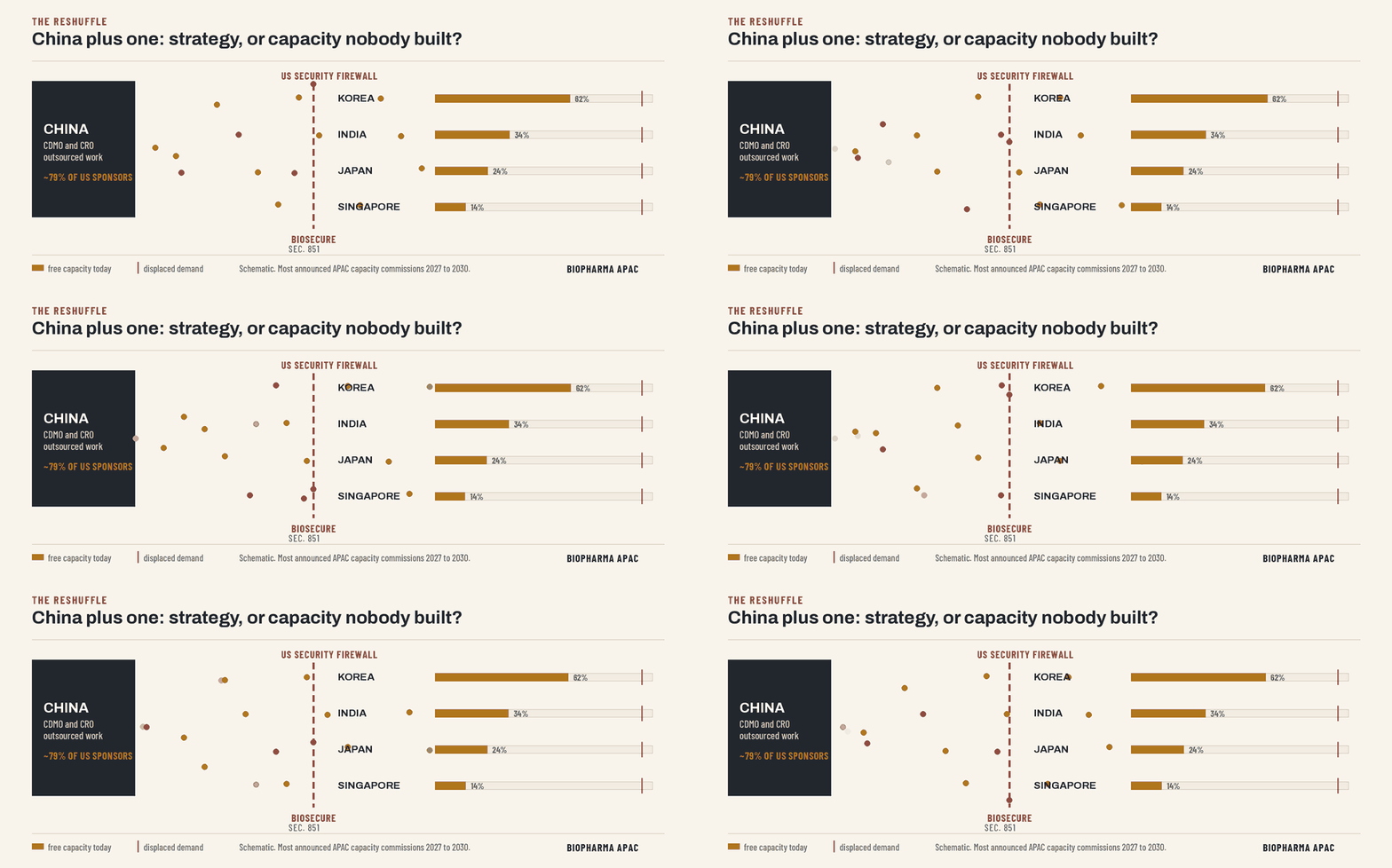
Will diversification away from China accelerate? The order books say it already has. Samsung Biologics reported 845,000 litres of total capacity, cumulative contract orders above US$21.9 billion and raised 2026 growth guidance to 20 percent. Jefferies estimates China plus one adds roughly US$700 million a year in incremental revenue for Indian CRDMOs. Diversification is not replacement, and Chinese CDMOs remain enormous. Watch new capacity bookings after the December BIOSECURE list. That is when cautious sponsors will make the moves they have been planning. India, Korea and, increasingly, Singapore are the main beneficiaries, each competing on a different mix of cost, quality record and proximity to Western regulators.
19. Korea's US plants go into production
Will Korea's US plants change its tariff exposure? That is the plan. Samsung Biologics bought GSK's former Human Genome Sciences facility in Rockville, Maryland, for about US$280 million, its first manufacturing site outside Songdo, while Celltrion moved to acquire a large US drug substance plant and shipped inventory ahead of tariff deadlines. Watch utilisation at these US sites in 2027. A plant bought as tariff insurance only pays off when it is running products that would otherwise be imported.
20. India's biologics bet enters delivery
Will Biopharma SHAKTI deliver anything visible in 2027? It needs to. India's February budget launched the ₹10,000 crore, five-year programme to build domestic biologics and biosimilars production, expand clinical trial capacity and strengthen regulatory science, alongside customs duty relief on 17 critical drugs. Smaller manufacturers have also been racing to meet revised Schedule M quality standards. Watch for the first funded projects, new trial-network sites and regulatory hiring. Year two of a five-year programme is where announcements have to become infrastructure.
21. China's second payer gets its second list
Can commercial insurance pay for China's most expensive new drugs? 2027 will start to show it. China's first Commercial Health Insurance Innovative Drug List took effect on 1 January 2026 with 19 high-cost drugs, including all five domestically developed CAR-T therapies, while the national reimbursement list added 114 medicines. Inclusion does not guarantee coverage, because insurers retain discretion. Watch the second edition and, more importantly, actual uptake by insurers. If real coverage follows, China will have a route to pay for innovation above the basic list's price ceiling. That would matter far beyond China's borders, because it would give multinationals a reason to launch premium-priced therapies there early rather than late.
22. China's regulator keeps setting the pace
Will the NMPA stay one of the world's fastest regulators? Every sign points that way. China approved a record 76 Class 1 innovative drugs in 2025, up from 48 a year earlier, and its 30-working-day review pathway for eligible clinical trial applications is now routine. In June 2026 Chinese authorities approved CARsgen's satricabtagene autoleucel, the world's first CAR-T for a solid tumour. Watch the 2026 approval count when it is published early next year, and watch whether more first-in-world approvals happen in Beijing rather than Washington.
Movement four: the obesity market
23. India's semaglutide price war matures
What happens to India's generic GLP-1 market in its second year? Consolidation and scrutiny. Since the patent expired on 20 March 2026, more than 40 Indian companies have prepared over 50 versions, with Natco launching at about ₹1,290 a month per vial and Dr Reddy's planning 12 million pens aimed at 87 countries. Meanwhile, Eli Lilly's tirzepatide became India's top-selling drug by value. Watch two things: quality enforcement across dozens of brands, and export approvals in the other countries where patents have lapsed. India's real prize is the global market, not the domestic one.
24. China's semaglutide generics arrive
When will Chinese semaglutide copies reach patients? Approvals are the 2027 story. The core China patent expired on 20 March 2026, and at least ten domestic companies, including Jiuyuan Gene, Huadong, Livzon and Qilu, have filed for approval. At the same time, Hengrui and Innovent are pushing next-generation agents with stronger reported weight loss, and L.E.K. Consulting expects China's GLP-1 market to reach US$14 billion by 2030. Watch the first approvals and their prices. A Chinese price floor will reset GLP-1 economics across emerging markets.
25. Oral obesity drugs reach Asian markets
Will the GLP-1 pill matter more in Asia than in the West? It could. The FDA approved Eli Lilly's orforglipron, sold as Foundayo, on 1 April 2026, at US$149 a month for self-pay patients, and Lilly has filed in more than 40 countries, including China. The molecule was discovered by Japan's Chugai, and its pivotal trial enrolled patients in China, India, Japan, Korea and Taiwan. Watch Asian approvals and pricing in 2027. In markets with patchy cold chains and injection reluctance, a daily pill could widen access faster than any generic injectable.
Movement five: the clinic and the evidence bar
26. The Keytruda biosimilar race goes to filing and court
Who will lead the biggest biosimilar opportunity of the decade? Asian companies are near the front. Samsung Bioepis filed for US approval of its Keytruda biosimilar in October 2026, after becoming the first Korean company to file with Korea's regulator, while Celltrion and Alvogen Korea challenged a Keytruda formulation patent. The core US patent expires in 2028, and Merck aims to shift patients to its subcutaneous version before then. Watch FDA review progress and patent rulings through 2027. The winners of 2028 will be decided in courtrooms and review queues next year.
27. Asian data must clear the global survival bar
Can trials led from Asia win US approvals on their own? Only if they are designed to. In November, the FDA declined to approve ivonescimab, the PD-1/VEGF bispecific developed by Akeso and licensed to Summit, in EGFR-mutant lung cancer, because the HARMONi trial showed no statistically significant overall survival benefit despite meeting its progression-free survival endpoint. Yet in September, Akeso's separate HARMONi-2 trial hit statistical significance on overall survival against pembrolizumab. Meanwhile, sponsors are spreading trials across Australia, Korea, India and Singapore to reduce reliance on any single country. Watch whether 2027 global filings from Asian innovators lead with survival data and Western cohorts. A strong Chinese dataset opens the licensing conversation. It does not close the US approval.
The dates that will tell the story
Put the 27 together and three questions remain open going into the year. Will Washington's measures restrict Asian biopharma, or mainly redirect it? Will Asia's pricing systems reward the innovation its labs now produce? And will the deals of 2025 and 2026 turn into approved medicines?
The calendar will answer them in stages. On 7 December, comments close on Treasury's proposed biotech investment rule. On 18 December, the first BIOSECURE list is due, and in the same month Japan settles the scope of its April 2027 price cut. On 13 March 2027 comes the deadline for Treasury's implementing rules. In April, Japan's cuts take effect and Commerce's assessment of generic imports is due. Sun Pharma expects to close its Organon purchase early in the year, and BIOSECURE implementing guidance should follow by mid-year. Throughout, Chinese semaglutide approvals, Keytruda biosimilar reviews and the first in vivo CAR-T readouts will show whether the region's science is keeping pace with its deals.
Asia-Pacific won leverage in 2026 by being faster, cheaper and increasingly better. In 2027 it has to prove it can also be trusted: on quality, on data integrity and on survival curves. The region has shown it can sign deals. Next year will ask whether it can deliver drugs.
Most Read
- Can APAC Biomanufacturing Decarbonise Without Pricing Itself Out?
- The Algorithm on the GMP Floor: AI Promises a Smarter Plant. Regulators Demand the Audit Trail.
- APAC's Peptide-Capacity Gamble
- After the Rush: APAC's mRNA and Vaccine Capacity Hangover
- The Biosimilar Race: Factory to the World — or Stuck in the Copycat Economy?
- The Vein-to-Vein Problem: Can APAC's Cold Chain Carry Advanced Therapies?
- Vectors, Plasmids and the CGT Trap: APAC's Cell and Gene Therapy Ambitions Face an Upstream Bottleneck
- Can APAC Build Radioligand Therapy Before the Atoms Decay?
- The Great Biopharma Reset: 50 Developments That Changed Everything in H1 2026
- Beyond the Trial: Can Real-World Evidence Earn Regulatory Trust in APAC?
- Beyond the Obvious Giant: Where APAC's Clinical Trials Go Next
- The Frontier That Won’t Quite Arrive
Bio Jobs
- Sanofi Turns The Page As Belén Garijo Steps In And Paul Hudson Steps Out
- Global Survey Reveals Nearly 40% of Employees Facing Fertility Challenges Consider Leaving Their Jobs
- BioMed X and AbbVie Begin Global Search for Bold Neuroscience Talent To Decode the Biology of Anhedonia
- Thermo Fisher Expands Bengaluru R&D Centre to Advance Antibody Innovation and Strengthen India’s Life Sciences Ecosystem
- Accord Plasma (Intas Group) Acquires Prothya Biosolutions to Expand Global Plasma Capabilities
- ACG Announces $200 Million Investment to Establish First U.S. Capsule Manufacturing Facility in Atlanta
- AstraZeneca Invests $4.5 Billion to Build Advanced Manufacturing Facility in Virginia, Expanding U.S. Medicine Production
News