
FDA Breakthrough Therapy Designation 2026: Three APAC-Originated Drugs Made the List, and None of Them Came From China
14 November 2026 | Saturday | Analysis
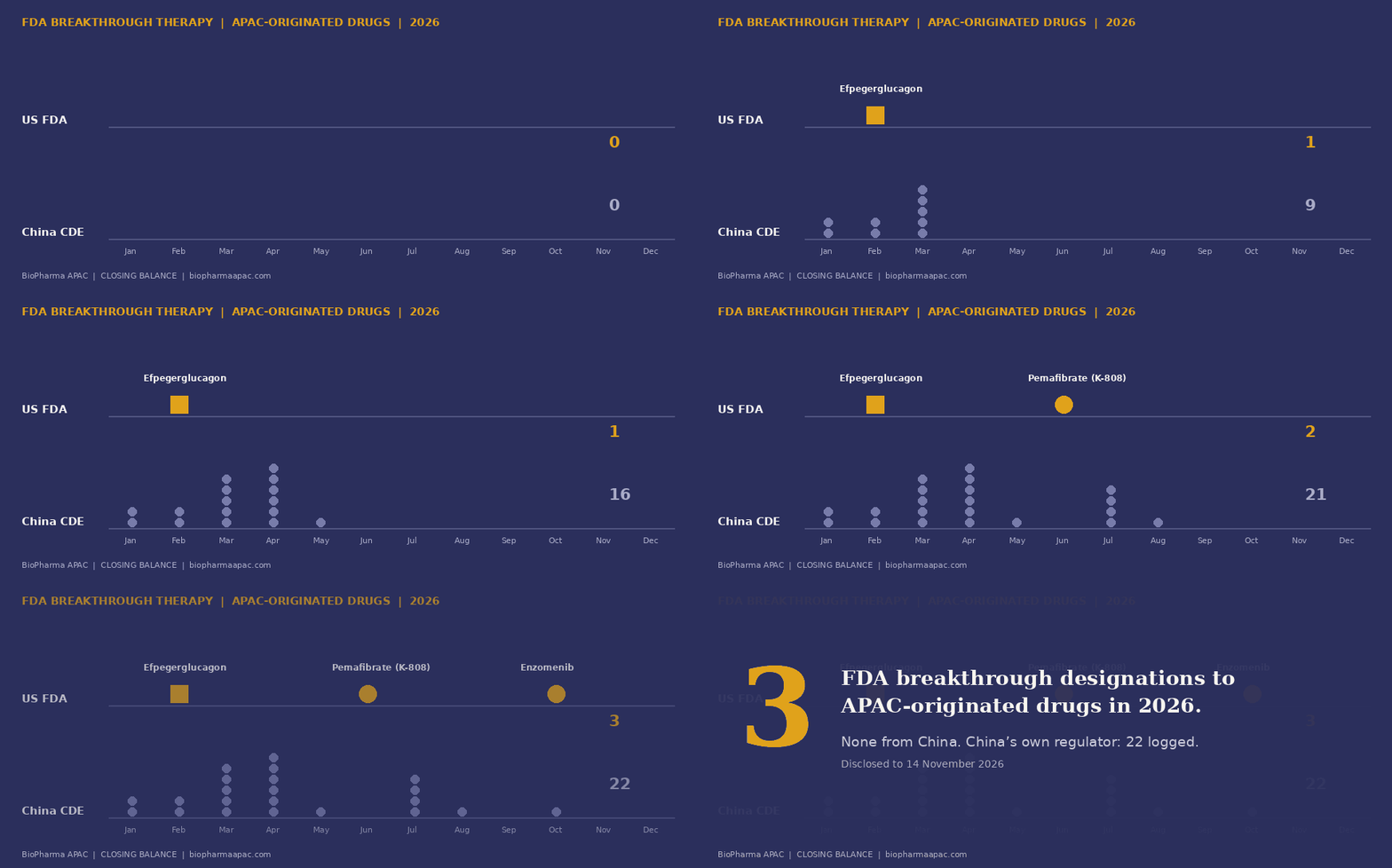
The record, counted to 14 November 2026.
Method
|
What counts |
An FDA Breakthrough Therapy designation disclosed by the sponsor or a licensee in a press release, exchange filing or SEC filing dated 1 January 2026 to the cut. The asset must be of Asia-Pacific scientific origin under the house attribution rule: discovered by a company or institution headquartered in the region. Licensing a drug out does not change where it came from. |
|
Why disclosures |
The FDA publishes how many breakthrough designations it grants. It does not publish which drugs received them. A named roster can only be built from what sponsors choose to announce, so a designation that was granted but never disclosed is invisible to this method. That is the main limit of this list and it is stated, not solved. |
|
How the desk searched |
Sponsor newsrooms; HKEX, SSE, SZSE, KRX, TSE and SEC filings; trade and clinical press in English, Chinese, Korean and Japanese; monthly designation round-ups from data vendors, used only as leads and checked against the sponsor’s own words. |
|
Second indications |
A second designation for the same asset counts as a separate entry and is flagged. None qualified in 2026. |
|
Held out |
Assets whose origin is genuinely shared or unclear are named and held out with the reason, not counted. |
|
Cut and updates |
Verified to 14 November 2026. New disclosures are added in place with a dated revision note until 31 December 2026; the list closes in the first week of January. |
|
Not in the list |
Fast Track, RMAT and Orphan Drug designations appear only as a sidebar count. Approvals belong to YE-02, Every First Approval in APAC 2026. |
Breakthrough Therapy designation is the closest thing the US Food and Drug Administration has to an early opinion. To grant it, the agency has to see preliminary clinical evidence that a drug may beat what patients can already get, by a margin that matters, in a serious disease. It approves nothing. It does put senior FDA staff on the programme, opens the door to rolling review and usually comes before priority review. For anyone reading the region’s pipelines ahead of the 2027 licensing season, it is the cleanest outside signal available.
It is also a signal the FDA keeps unnamed. The agency reports totals; it does not say which drugs were designated. Any list of winners therefore has to be assembled from company announcements, one press release and exchange filing at a time. That is what this roster is: every FDA Breakthrough Therapy designation for an asset of Asia-Pacific scientific origin that a sponsor or licensee disclosed between 1 January and 14 November 2026.
The count is three.
A Korean company’s once-weekly glucagon analogue for a rare paediatric disorder. A Japanese lipid drug, sold at home since 2018, now aimed at a rare liver disease. A Japanese menin inhibitor for an aggressive form of leukaemia. In all three cases the company that discovered the drug still holds its US rights. None is a solid tumour drug. None came from China.
That last point needs care, and the method box above says how far it can be pushed: it is a finding about disclosures, not about the FDA’s files. But it sits beside a second count the desk kept in the same sweep. At least 22 China-originated assets were placed on, or publicly proposed for, the breakthrough list of China’s Center for Drug Evaluation over the same ten and a half months. And it follows a 2025 in which China and Japan-originated cancer drugs collected FDA breakthrough tags at a steady pace. That contrast is the real story of this designation in 2026. The three entries come first; what they add up to comes after.
Figure 1. FDA Breakthrough Therapy designations disclosed for APAC-originated drugs in 2026, against China-originated assets the desk logged on China’s CDE breakthrough list over the same period. The CDE lane is a log, not a census.
How the designation works, and why a roster is hard to build
A sponsor asks for breakthrough status; the FDA does not hand it out unprompted. The request is usually made once a programme has human data that compares favourably with existing treatment, most often around the end of Phase 2, and the agency has 60 days to answer. The bar is specific: a serious condition, and preliminary clinical evidence of substantial improvement over available therapy on at least one clinically significant endpoint. Promising animal data does not qualify. Neither does a good safety profile on its own.
What the sponsor gets is attention rather than speed in the narrow sense. Breakthrough status carries every Fast Track feature, including rolling review, and adds intensive guidance on an efficient development programme and the involvement of senior managers. For a company outside the United States with no long history of FDA meetings, that access can be worth more than the label.
Building a list is harder than it sounds. The FDA counts designations but does not name them, and companies are under no obligation to announce one. Listed companies in Hong Kong, Shanghai, Shenzhen, Seoul and Tokyo often disclose because the news can move a share price; private companies and licensees may not. Vendor round-ups help find leads but mix up agencies, as the HSK31679 case below shows. And where a Western licensee holds US rights, the announcement, if there is one, comes from the licensee under its own code name. Every entry in this roster was therefore traced to the sponsor’s own words, and every assignment of origin was checked against licence terms.
The roster
- Efpegerglucagon (HM15136)
Hanmi Pharmaceutical, Korea | designated 3 February 2026
|
Asset |
Efpegerglucagon (HM15136), a long-acting glucagon analogue dosed once a week |
|
Originator |
Hanmi Pharmaceutical, Seoul |
|
US rights holder |
Hanmi; no US licence disclosed |
|
Indication |
Congenital hyperinsulinism |
|
Designation date and source |
Granted 3 February 2026 (US time); announced by Hanmi on 5 February 2026 |
|
Stage at designation |
Global Phase 2 |
|
What it unlocks next |
Phase 3 design agreed with the FDA; rolling review of the eventual application |
Congenital hyperinsulinism is a rare disease, mostly of children, in which the pancreas releases too much insulin and blood sugar drops dangerously, sometimes repeatedly enough to damage the brain. Hanmi says no drug in the United States is approved specifically for it. The one treatment cleared to control hypoglycaemia from excess insulin works only in some genetic forms of the disease and carries side effects including excess hair growth, fluid retention and heart failure, so families often fall back on off-label drugs or surgery to remove part of the pancreas.
Hanmi’s answer is a glucagon analogue built to last a week. The designation rests on Phase 2 data: at the European Society for Paediatric Endocrinology meeting in 2025, Hanmi reported that the drug was tolerated and cut both hypoglycaemia and severe hypoglycaemia. By September 2026 the company had completed the core dosing period of the global Phase 2 trial and took the study to an oral session at the society’s 2026 meeting in Marseille. Before the breakthrough tag, the programme had already collected orphan status from the FDA, the European Medicines Agency and Korea’s Ministry of Food and Drug Safety, plus the FDA’s rare paediatric disease designation.
Two things make this entry worth reading beyond the disease. First, it is the only designation of the year for a Korean originator. Second, it shows a company that built its name by licensing drugs out keeping one for itself. Hanmi’s best-known US partnership is the opposite model: in 2020 it licensed the GLP-1 and glucagon co-agonist efinopegdutide to MSD for USD 10 million upfront, and MSD has run the programme since. With efpegerglucagon, Hanmi is the sponsor talking to the FDA. Its clinical lead said the company will use the designation to design Phase 3 efficiently and to make use of rolling review.
The size of the market is small by design. The value of the designation is in the time it saves a company of Hanmi’s scale on a programme it intends to run itself.
- K-808 (pemafibrate)
Kowa Company, Japan | designated 11 June 2026
|
Asset |
K-808 (pemafibrate), a selective PPAR-alpha modulator |
|
Originator |
Kowa Company, Nagoya |
|
US rights holder |
Kowa; no US licence disclosed |
|
Indication |
Primary biliary cholangitis, with ursodeoxycholic acid in patients with an inadequate response, or alone in patients who cannot tolerate it |
|
Designation date and source |
Granted 11 June 2026; announced by Kowa on 30 June 2026 |
|
Stage at designation |
Phase 2 (study K-808-2.01) |
|
What it unlocks next |
A development path Kowa says is aimed at approval in the US and Japan |
Pemafibrate is not a new molecule. Kowa has sold it in Japan as Parmodia, for high blood lipids, since June 2018. What is new is the disease. Primary biliary cholangitis is a chronic autoimmune liver disease in which the small bile ducts are slowly destroyed, and which can progress to fibrosis, cirrhosis and liver failure. Kowa says the FDA based the designation on early data from its ongoing Phase 2 study, which showed falls in alkaline phosphatase, the blood marker clinicians use to judge whether the disease is being controlled. Those data were presented at the European liver congress, EASL, in May 2026.
The designation lands in a crowded and fast-moving field. Ipsen’s elafibranor, a dual PPAR-alpha and delta agonist, received US accelerated approval in June 2024, and GSK’s linerixibat was approved in March 2026 for the itch that comes with the disease. Pemafibrate is selective for the alpha receptor, which sets it apart from both elafibranor and the delta-selective seladelpar. The FDA’s judgement that it may still offer substantial improvement in that company is the part of the record that matters to a reader weighing the class.
There is a second APAC thread here. Zydus Lifesciences’ saroglitazar, a PPAR agonist discovered in India, is under priority FDA review for the same disease, with a decision date of 27 November 2026. Two Asia-Pacific PPAR drugs are therefore converging on US primary biliary cholangitis in the same season, one carrying a breakthrough designation and one carrying a priority review. That pairing belongs in any reading of where the region’s science is clearing the US bar: not only in oncology, and not only from new chemistry.
For Kowa, a private company better known at home than abroad, the designation is the first formal US regulatory recognition of pemafibrate in this disease. It is also a reminder that repurposing a domestic drug for a rare indication remains one of the shorter routes from Japan to an FDA conversation.
- Enzomenib (DSP-5336)
Sumitomo Pharma, Japan | designation announced 26 October 2026
|
Asset |
Enzomenib (DSP-5336), an oral inhibitor of the menin and KMT2A interaction |
|
Originator |
Sumitomo Pharma, Osaka |
|
US rights holder |
Sumitomo Pharma America; no US licence disclosed |
|
Indication |
Relapsed or refractory acute leukaemia with a KMT2A rearrangement |
|
Designation date and source |
Announced by Sumitomo Pharma America on 26 October 2026 |
|
Stage at designation |
Phase 1/2 dose escalation and expansion (NCT04988555) plus the registrational Phase 2 Horizen-1 study |
|
What it unlocks next |
Closer FDA engagement ahead of a filing from Horizen-1 |
KMT2A-rearranged acute leukaemia is aggressive, and outcomes remain poor for patients whose disease comes back or never responds, even after chemotherapy and stem cell transplant. Enzomenib blocks the interaction between menin and the KMT2A protein that these leukaemias depend on. The designation covers relapsed or refractory acute leukaemia with a KMT2A rearrangement, which spans both the myeloid and lymphoblastic forms.
The regulatory trail is long. The FDA granted enzomenib orphan status in acute myeloid leukaemia in June 2022 and Fast Track in mid-2024; outlets report that grant as June or July, and the company announced it in July. Japan’s health ministry added orphan status in September 2024. In July 2026 the FDA granted a second orphan designation, in acute lymphoblastic leukaemia. The breakthrough tag in October is the step up from all of these. Sumitomo is running enzomenib alone in Horizen-1, a registrational Phase 2 study in relapsed or refractory leukaemia with either a KMT2A rearrangement or an NPM1 mutation, and in combinations with venetoclax and azacitidine, with gilteritinib, and with intensive chemotherapy.
What makes this designation unusual is the field around it. Menin inhibition is no longer empty space in the United States. Kura’s ziftomenib was approved in November 2025 for relapsed or refractory NPM1-mutated acute myeloid leukaemia, and Johnson & Johnson’s bleximenib holds two breakthrough designations, in KMT2A-rearranged and NPM1-mutated disease. A breakthrough designation is judged against available therapy, so enzomenib’s was granted in a class where the comparison was not with nothing. The record does not say what the FDA weighed. It does show that a Japanese originator cleared the bar after American entrants had already set it.
One piece of Sumitomo’s own science points to how it might compete. At EHA in June 2026 the company presented work on the mutations through which leukaemias escape menin inhibitors, and said its preclinical studies predicted that the main resistance mutation to enzomenib may not affect other drugs in the class. If that holds, the argument for enzomenib becomes partly about sequencing rather than replacement.
Held out: TERN-701, and why it is not counted
On 27 April 2026, Terns Pharmaceuticals announced an FDA breakthrough designation for TERN-701, an allosteric BCR::ABL1 inhibitor, in chronic-phase Philadelphia chromosome-positive chronic myeloid leukaemia without the T315I mutation, after at least two prior tyrosine kinase inhibitors. It is an important designation, and Merck has agreed to acquire Terns. It is held out of this list because its origin cannot be assigned cleanly under the house rule.
The record points both ways. Terns describes TERN-701 as its proprietary inhibitor and holds worldwide rights outside Greater China. Hansoh Pharma, under a 2020 option agreement exercised in November 2021, holds rights in mainland China, Taiwan, Hong Kong and Macau, where it develops the drug as HS-10382. A January 2026 amendment gave Terns an exclusive licence to patents invented by Hansoh and its Shanghai affiliate during work under that agreement, for USD 1.0 million upfront and royalties of 0.75 to 1.25%. Terns’ own 2023 preclinical poster lists Shanghai Hansoh Biomedical scientists among its authors. That is a shared scientific record, not an APAC-originated asset in the sense this list uses. If either company discloses who invented the compound itself, the entry will be revisited with a dated note.
Corrected at source: the designation that was not American
One vendor’s March 2026 round-up listed Haisco’s HSK31679, a THR-beta agonist for MASH, among that month’s FDA breakthrough designations. Haisco’s own Shenzhen exchange announcement says the designation came from China’s Center for Drug Evaluation, which placed the drug on its breakthrough list on 11 March 2026. It is not an FDA designation and is not counted. The case is the reason the method uses vendor round-ups only as leads.
What three entries can say about a year
Three is a small number, and the first discipline is not to read more into it than it carries. But the shape of the three is clear, and it differs sharply from the year before.
Start with geography. Two of the three originators are Japanese and one is Korean. In 2025, the same search turned up at least seven FDA breakthrough designations for Asia-Pacific-originated drugs, and four of those were Chinese: GSK’s risvutatug rezetecan, discovered by Hansoh, for osteosarcoma in January; MediLink’s B7-H3 antibody-drug conjugate YL201 for small cell lung cancer in June; Biokin and SystImmune’s izalontamab brengitecan for EGFR-mutated lung cancer in August; and BeOne’s sonrotoclax for mantle cell lymphoma in October. Daiichi Sankyo added three of its own. That 2025 set is what the desk found in passing, not a census, and it is offered as context rather than as a series.
Then therapeutic area. The 2025 set was almost entirely cancer, and mostly antibody-drug conjugates. The 2026 set is a rare paediatric endocrine disorder, a rare liver disease and a blood cancer. Not one is a solid tumour drug, in the year the region’s solid tumour pipeline drew the most attention it has ever had.
Then control. In all three 2026 cases, the originator holds the US rights and made the announcement. None of the three has a disclosed US licensee. That is a different picture from the deal pages, where the region’s best assets increasingly carry a Western partner’s code name by the time they reach an FDA meeting.
And then the gap. The desk found no 2026 FDA breakthrough designation for a China-originated drug disclosed by the cut. Over the same period it logged at least 22 China-originated assets placed on, or publicly proposed for, the breakthrough list of China’s own Center for Drug Evaluation: antibody-drug conjugates from Hengrui, Hansoh, CSPC and MediLink; Akeso’s ivonescimab in biliary tract cancer; Innovent’s IBI363 in colorectal cancer; GenFleet’s KRAS G12D inhibitor twice; Kelun-Biotech’s sacituzumab tirumotecan with pembrolizumab; Haisco’s two; HUTCHMED’s sovleplenib; Ascentage’s lisaftoclax; InnoCare’s orelabrutinib and mesutoclax combination; and more. Chinese sponsors are plainly generating designation-grade data. In 2026 it has not shown up, in any announced form, as an FDA breakthrough tag.
Several explanations fit the record, and none can be tested from it. Saturation is the first: many of the leading Chinese assets already hold a US breakthrough designation in their lead indication from 2023 to 2025, and a new one needs a new indication’s data. Control is the second: where a Western licensee holds US rights, the licensee decides when to ask and whether to announce. Evidence is the third. Breakthrough requests rest on clinical data, much of the Chinese data is generated in China, and the FDA’s caution about single-country data is long established; this publication’s Fault Lines series has made that argument and it is not repeated here. In April 2026 the House Appropriations Committee advanced report language that would bar the FDA from considering clinical trial data generated in China in support of new trial applications, as Drug Discovery World reported. Nothing in the public record ties that language to any designation decision, and this piece does not suggest it does.
What can be said is narrower and still useful. A licensing team that reads US breakthrough designations as a filter for APAC assets got a very different filter in 2026 than in 2025: smaller, outside oncology, and with Japan and Korea in it rather than China. If the gap is real it will show again in 2027. If it is a disclosure effect it should close as licensees announce. Either way, the next edition of this list will be able to tell.
What a licensing team should take from it
For business development teams, the practical reading is about where to look rather than what to buy. The three 2026 designations all sit in diseases with small, well-defined patient populations, measurable markers and few or no approved options: hypoglycaemia events, alkaline phosphatase, complete remission in a genetically defined leukaemia. Those are the settings where a modest early dataset can show substantial improvement over available therapy, and where an Asia-Pacific originator can make the case to the FDA without a large Western trial behind it.
The second reading is about control. All three designations were won by originators that kept their US rights. A company that holds a breakthrough-designated asset outright negotiates from a different position from one that licensed the asset away before the designation came. That does not make keeping the rights the right choice for every company; it does mean the 2026 designations will strengthen three APAC sponsors’ hands in any partnering conversation that follows.
The third reading is a caution. Breakthrough designations to Chinese-originated assets were a familiar feature of the US licensing story through 2025, and many of those assets are now in Western hands with Phase 3 trials running. A buyer looking for the next wave should not read the 2026 silence as a lack of Chinese science; the Center for Drug Evaluation list says otherwise. It should read it as a reminder that a US designation now has to be earned on data the FDA is prepared to weigh, and that the timing of the request sits with whoever holds the US rights.
|
Sidebar: the other FDA designations the desk logged This is a running log, not a census, and none of these entries count towards the headline number. Fast Track, five: Celltrion’s antibody-drug conjugate CT-P71 in urothelial cancer (9 April) and CT-P73 in cervical cancer (13 August); Zai Lab’s DLL3 antibody-drug conjugate zocilurtatug pelitecan in extrapulmonary neuroendocrine carcinoma (11 May); Aravax’s peanut allergy immunotherapy PVX108 (3 August); and Samsung Bioepis’ first in-house drug, the Nectin-4 antibody-drug conjugate SBE303, in urothelial cancer (21 October). SOTIO’s SOT106, built on LigaChem’s conjugation platform, received Fast Track in soft tissue sarcoma in August and is held out as a shared-origin asset. RMAT, one: Alzignomics’ RZ-001 in hepatocellular carcinoma (May). Orphan Drug, at least six: ABL Bio’s tovecimig in biliary tract cancer (April); Yuhan’s YH35995 in Gaucher disease and an Excelamol pancreatic cancer candidate (both April); enzomenib in acute lymphoblastic leukaemia (July); and HUTCHMED’s sovleplenib, twice, in immune thrombocytopenia (October) and autoimmune haemolytic anaemia (November). |
Between now and 31 December
This list updates in place. Any FDA breakthrough designation for an APAC-originated asset disclosed between 15 November and 31 December 2026 will be added with a dated revision note, and the list closes in the first week of January. Disclosures made after the cut about designations granted earlier in the year will be added the same way, with both dates shown.
Three things are worth watching in the window. The FDA decision on Zydus’ saroglitazar in primary biliary cholangitis, due on 27 November, will set the commercial context for Kowa’s pemafibrate. Hanmi’s full Phase 2 results for efpegerglucagon will show what the FDA saw in February. And the Chinese originators most often tipped for US designations, along with their licensees, will have the American Society of Hematology meeting in December and the J.P. Morgan Healthcare Conference in January to say whether 2026 was a pause or a pattern.
Approvals that follow from any of these designations will be recorded in YE-02. Unpartnered assets that hold a designation sit with the LINE ITEMS BIO-Europe list.
The roster
|
# |
Asset |
Originator |
US rights holder |
Indication |
Designation date and source |
Stage at designation |
What it unlocks next |
|
1 |
Efpegerglucagon (HM15136) |
Hanmi Pharmaceutical (Korea) |
Hanmi |
Congenital hyperinsulinism |
3 Feb 2026; Hanmi release, 5 Feb |
Global Phase 2 |
Phase 3 design; rolling review |
|
2 |
K-808 (pemafibrate) |
Kowa Company (Japan) |
Kowa |
Primary biliary cholangitis |
11 Jun 2026; Kowa release, 30 Jun |
Phase 2 (K-808-2.01) |
US and Japan approval path |
|
3 |
Enzomenib (DSP-5336) |
Sumitomo Pharma (Japan) |
Sumitomo Pharma America |
R/R KMT2A-rearranged acute leukaemia |
Sumitomo Pharma America release, 26 Oct 2026 |
Phase 1/2; registrational Phase 2 Horizen-1 |
Closer FDA engagement ahead of filing |
|
Held out |
TERN-701 |
Terns (US), with Hansoh-invented patents licensed back |
Terns (Merck acquisition agreed) |
Ph+ CP-CML without T315I after 2+ TKIs |
27 Apr 2026; Terns release |
Phase 1/2 (CARDINAL) |
Pivotal trial |
CLOSING BALANCE is BioPharma APAC’s year-end strand of records nobody else keeps for the region. CB-01 was compiled by the BioPharma APAC editorial desk from public disclosures, verified to 14 November 2026. Figure 1 and the tracking sheet are published alongside the article.
© 2026 BioPharma APAC. All rights reserved.
Most Read
- Can APAC Biomanufacturing Decarbonise Without Pricing Itself Out?
- The Algorithm on the GMP Floor: AI Promises a Smarter Plant. Regulators Demand the Audit Trail.
- APAC's Peptide-Capacity Gamble
- After the Rush: APAC's mRNA and Vaccine Capacity Hangover
- The Biosimilar Race: Factory to the World — or Stuck in the Copycat Economy?
- The Vein-to-Vein Problem: Can APAC's Cold Chain Carry Advanced Therapies?
- Vectors, Plasmids and the CGT Trap: APAC's Cell and Gene Therapy Ambitions Face an Upstream Bottleneck
- Can APAC Build Radioligand Therapy Before the Atoms Decay?
- The Great Biopharma Reset: 50 Developments That Changed Everything in H1 2026
- Beyond the Trial: Can Real-World Evidence Earn Regulatory Trust in APAC?
- Beyond the Obvious Giant: Where APAC's Clinical Trials Go Next
- The Frontier That Won’t Quite Arrive
Bio Jobs
- Sanofi Turns The Page As Belén Garijo Steps In And Paul Hudson Steps Out
- Global Survey Reveals Nearly 40% of Employees Facing Fertility Challenges Consider Leaving Their Jobs
- BioMed X and AbbVie Begin Global Search for Bold Neuroscience Talent To Decode the Biology of Anhedonia
- Thermo Fisher Expands Bengaluru R&D Centre to Advance Antibody Innovation and Strengthen India’s Life Sciences Ecosystem
- Accord Plasma (Intas Group) Acquires Prothya Biosolutions to Expand Global Plasma Capabilities
- ACG Announces $200 Million Investment to Establish First U.S. Capsule Manufacturing Facility in Atlanta
- AstraZeneca Invests $4.5 Billion to Build Advanced Manufacturing Facility in Virginia, Expanding U.S. Medicine Production
News


