Every CAR-T Therapy Approved in Asia-Pacific, and What It Costs
07 October 2026 | Wednesday | Analysis
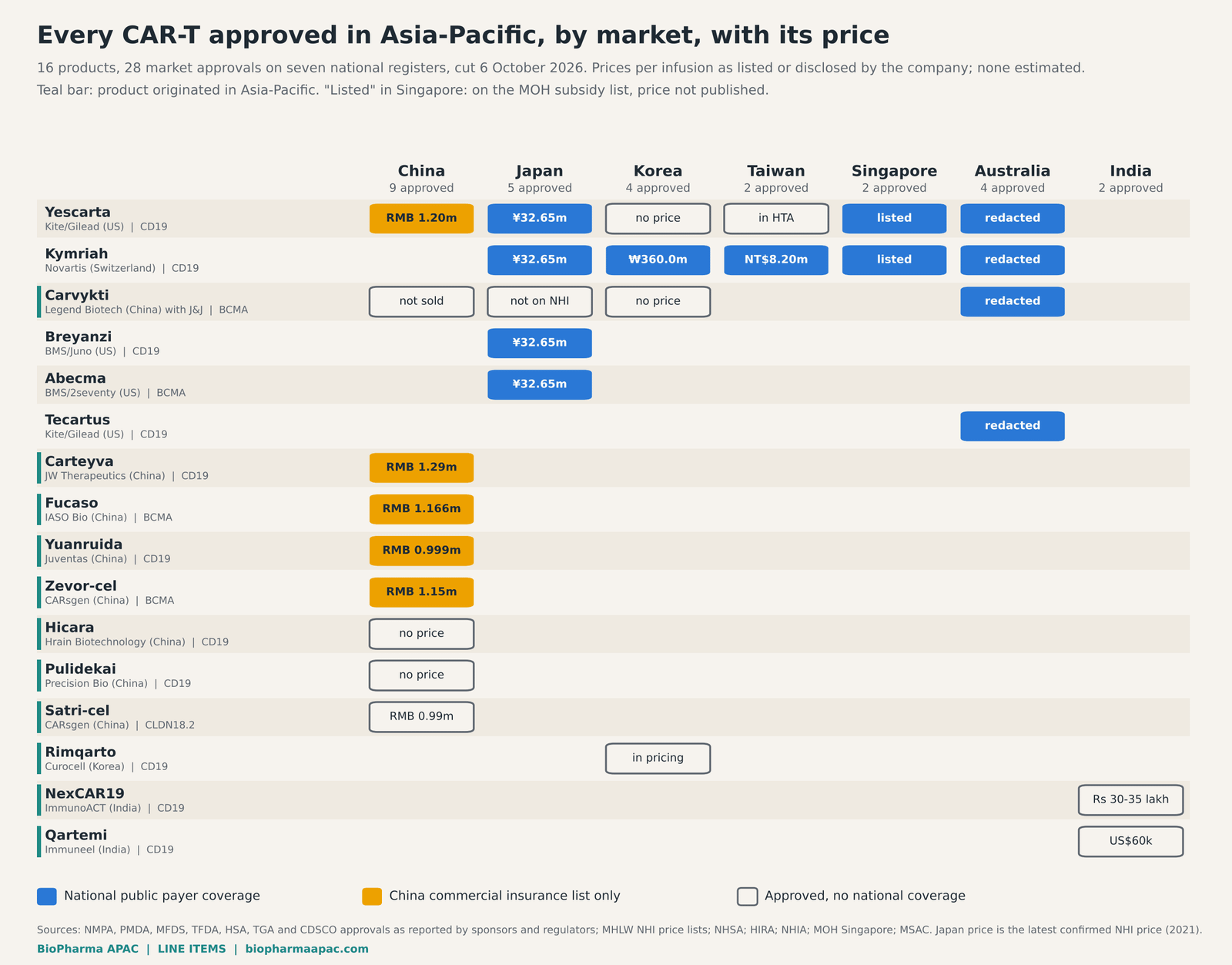
Figure 1. Every CAR-T on the seven registers, by market, with its published price and payer status at 6 October 2026. Blank cells: not approved in that market.
|
Method in brief What counts. A CAR-T cell therapy approved on one of seven national registers: China's NMPA, Japan's PMDA and MHLW, Korea's MFDS, Taiwan's TFDA, Singapore's HSA, Australia's TGA and India's CDSCO. Conditional approvals count. Products that have only been filed, or that are available only in trials, hospital exemptions or named-patient schemes, do not. What a price is. A price appears only if a payer has published it (an NHI price in Japan, a HIRA or NHIA reimbursement price) or the company has stated it, and we give the date. China's prices are launch prices as stated by sponsors and reported at launch. Negotiated discounts that have not been disclosed are described, not estimated. Where no price has been published, the ledger says so. Comparisons. US dollar figures use euro reference rates for 30 September 2026 published by the Banque de France, crossed through the US dollar, and are rounded to the nearest thousand. They are a reading aid; the local price is the record. Our reference source publishes no New Taiwan dollar rate, so Taiwan is shown in local currency only.
|
Search for the price of a CAR-T therapy in Asia and you find a dozen numbers, most of them estimates, many of them out of date and some of them from another country entirely. This ledger keeps only the numbers someone can be held to: a price a payer has published, or one a company has put its name to. Everything else is marked as missing.
Applied across seven registers, that rule yields 16 distinct products and 28 market approvals at our cut date of 6 October 2026. Prices run from the Rs 30 lakh to 35 lakh that ImmunoACT set for India's first home-grown CAR-T, roughly US$31,000 to US$37,000, to the KRW 360 million Korea's national insurer pays for Novartis's Kymriah, roughly US$266,000. Between those poles sit six Chinese list prices between RMB 0.99 million and RMB 1.29 million, and a single figure in Japan that four different products have shared since 2021.
A price on paper is not the same as access. Of the 28 approvals, 12 have national public payer coverage in a form a patient can use. Five more sit on China's new commercial insurance list. The other eleven are approved but unfunded at national level, and in several cases unpriced in public.
|
The ledger in seven numbers
|
How to read a CAR-T price
Three cautions apply to every number below. First, the unit differs. Japan lists its price per patient, China and India quote per infusion, and in practice a CAR-T is a single administration, so the figures are comparable as the price of one course of the product. They are not the cost of treatment. Apheresis, bridging therapy, lymphodepleting chemotherapy, the inpatient stay and the management of cytokine release syndrome and neurotoxicity are billed separately, and in some systems they cost as much again.
Second, the list price is often not the price paid. Korea's reimbursement of Kymriah sits inside a risk-sharing agreement with outcome-based refunds. Australia's funding of Carvykti is conditional on performance. China's commercial-list discounts are confidential. In each case the published figure is the ceiling, not the net.
Third, the payer column matters more than the price column for patients. A product priced at RMB 1.2 million on the commercial list, a product priced at KRW 360 million with a 5% copay, and a product with no public price on Singapore's subsidy list can each be more or less affordable for a given patient than the raw numbers suggest. That is why the ledger records both columns, and dates both.
China: nine approvals, eight of them home-grown, none on the basic list
China approved its first CAR-T in June 2021 and has approved eight more since. Its nine approvals are almost twice Japan's five, the next largest count in the ledger. Only one of the nine is a licensed Western product: axicabtagene ciloleucel (Yescarta, sold in China as 奕凯达), made under licence from Kite by Fosun Kairos, the renamed Fosun Kite. Approved on 22 June 2021 for large B-cell lymphoma after two or more lines, it gained a second-line indication in 2023 and launched at RMB 1.20 million, about US$179,000.
Three months later, in September 2021, came JW Therapeutics' relmacabtagene autoleucel (倍诺达). JW was founded as a joint venture of Juno Therapeutics and WuXi AppTec. Relma-cel, a CD19 product, now carries lymphoma indications in large B-cell, follicular (October 2022) and mantle cell lymphoma (August 2024), at the highest list price in the country, RMB 1.29 million, about US$192,000.
Two BCMA products for multiple myeloma followed. IASO Bio's equecabtagene autoleucel (福可苏) was conditionally approved on 30 June 2023 at RMB 1.166 million. CARsgen's zevorcabtagene autoleucel (赛恺泽) was conditionally approved on 23 February 2024 at RMB 1.15 million. Juventas' inaticabtagene autoleucel (源瑞达) won conditional approval for adult B-cell acute lymphoblastic leukaemia in November 2023 and for large B-cell lymphoma in November 2025, at RMB 0.999 million.
Legend Biotech's ciltacabtagene autoleucel (Carvykti) was approved at home on 27 August 2024, but Yicai reported in January 2026 that it was not being sold commercially in China, and Legend has published no domestic price. Hrain Biotechnology's CD19 product (恒凯莱) was approved in July 2025 for large B-cell lymphoma, with China Resources Double-Crane holding national distribution rights. Precision Bio's CD19 product (普利得凯) was conditionally approved on 7 November 2025 for B-cell acute lymphoblastic leukaemia in patients aged 3 to 21. Neither company has published a price. The ninth is CARsgen's satricabtagene autoleucel (恺力美), approved on 22 June 2026 for CLDN18.2-positive gastric and gastro-oesophageal junction cancer. It is the first CAR-T approved for a solid tumour anywhere, priced on the company's website at RMB 0.99 million. The year's first approvals belong to our year-end record of 2026 approvals; here it takes its place in the cumulative count.
Payment is where China's ledger turns. No CAR-T is on the basic National Reimbursement Drug List. On 7 December 2025 the National Healthcare Security Administration published its first Commercial Health Insurance Innovative Drug List, effective 1 January 2026, and five of its 19 drugs were domestic CAR-Ts: axi-cel, relma-cel, eque-cel, inati-cel and zevor-cel. Negotiated prices were not disclosed. Reports put the discounts across the list between 15% and 50%, while the published hospital prices stayed unchanged. Below the national lists, city Huiminbao supplementary schemes commonly cover CAR-T, with caps typically between RMB 300,000 and RMB 500,000.
The 2026 round moved further. On 6 September, relma-cel and inati-cel became the first CAR-Ts to reach the negotiating table for the basic list, under a new rule allowing commercial-list products to apply. On 9 September, Hrain's product, Precision's product and satri-cel were negotiated for the commercial list. Results are expected around December. Five of China's nine products hold at least one approval that is conditional on confirmatory data, a pattern that matters for payers because the evidence package can still change after a price is agreed. And three of the region's most familiar Western products, Kymriah, Breyanzi and Abecma, have never been approved in mainland China at all.
Japan: five approvals, one price
Japan was the first market in Asia to approve a CAR-T, Kymriah on 26 March 2019, and it has the most orderly price record in the region. Kymriah was listed on the National Health Insurance price list on 22 May 2019 at ¥33,493,407 per patient. After the cost-effectiveness review that Chuikyo decided on 24 March 2021, it was cut by 4.3% to ¥32,647,761 from 1 July 2021. The review found the lymphoma indication above Japan's ¥7.5 million per QALY threshold.
Every CAR-T priced since has landed on exactly the same figure. Yescarta, approved on 22 January 2021 and marketed first by Daiichi Sankyo and now by Gilead, was listed on 21 April 2021 at ¥32,647,761, about US$208,000. BMS's Breyanzi followed on 19 May 2021 and Abecma on 20 April 2022, both at the same price. All three were priced by comparison with Kymriah at its post-review price, so the 2021 cost-effectiveness review set the price for all four. We found no later NHI revision, so ¥32,647,761 is the latest price we can confirm.
The fifth approval breaks the pattern. Janssen's Carvykti was approved on 26 September 2022, and Chuikyo agreed in January 2023 to price it under drug rules. The Japan Society for Transplantation and Cellular Therapy still listed it as not on the NHI price list in May 2025, and we found no listing since, although its use was extended to earlier lines in July 2026. No Japanese-developed CAR-T is approved. Gilead filed Tecartus in August 2026. Indications have nonetheless widened under the fixed price. Kymriah added follicular lymphoma in August 2022, Abecma moved to patients after two prior therapies in December 2023, and Breyanzi added mantle cell and marginal zone lymphoma in April 2026. Each extension broadens the eligible population at a per-patient price that, on the record we could find, has not moved in five years.
Korea: four approvals, one reimbursed
Kymriah was approved in Korea on 5 March 2021, the first product under the Advanced Regenerative Bio Act, and has been reimbursed since 1 April 2022 at about KRW 360.03 million under a risk-sharing agreement. The agreement includes outcome-based refunds in lymphoma and a spending cap. Patients pay 5% coinsurance, capped at KRW 5.98 million. The cap varies by income, from KRW 0.83 million to KRW 5.98 million. Before coverage, the price was reported at about KRW 460 million, so reimbursement came with a reduction of roughly a fifth on top of the refunds. One Dailypharm report gives KRW 363.93 million; we use the figure reported twice.
Nothing else is yet reimbursed. Carvykti was approved in March 2023 and for earlier lines in November 2025; Janssen applied for coverage in June 2026. Yescarta was approved on 13 August 2025 for second-line and later large B-cell lymphoma. The cancer review committee set criteria for its third-line use in January 2026, but Gilead declined the condition attached by the drug evaluation committee in May 2026 and refiled for second-line coverage in July. The most significant entry is Curocell's anbalcabtagene autoleucel (Rimqarto), approved on 29 April 2026 as Korea's first home-grown CAR-T. It cleared HIRA's drug evaluation committee on 3 September on condition it accepts the proposed price, and listing is targeted for this year. No price has been published.
Taiwan, Singapore and Australia: the imported tier
Taiwan reimburses one CAR-T. Kymriah was listed by the National Health Insurance Administration from 1 November 2023 at NT$8,198,096, against an initial asking price reported at NT$15 million. Coverage is limited to patients aged up to 25 with B-cell acute lymphoblastic leukaemia and to adults with large B-cell lymphoma after two or more lines of therapy. By January 2026 more than 90 patients had been treated at a cost to the NHI of about NT$730 million. Yescarta obtained its Taiwan licence in April 2026; a Center for Drug Evaluation assessment dated 15 August 2026 records the price as still to be set. The application covers both second-line use in patients who relapse within a year and third-line use, which would make Yescarta the first CAR-T reimbursed in Taiwan before the third line.
Singapore funds CAR-T through its list of subsidised cell, tissue and gene therapy products rather than the Cancer Drug List. Kymriah, approved by HSA on 9 March 2021, has been subsidised since August 2024. Yescarta was rejected by the Drug Advisory Committee on price in July 2024 and listed after a price reduction, as reported in September 2025. Neither price is published. What is published is the payer's side: from 1 June 2026, MediShield Life pays up to S$141,000 per treatment, and government subsidy reaches up to 75% for citizens, capped at S$150,000. Permanent residents receive 22.5%, capped at S$45,000, and patients may draw up to S$4,680 from MediSave. Claims under the cell and gene therapy list sit outside the annual MediShield Life claim limit. ACE, the national health technology assessment agency, issued guidance on both products in 2024. No other CAR-T appears on the subsidy list, and we could not confirm any further HSA registration.
Australia funds four CAR-Ts through the National Health Reform Agreement's highly specialised therapies route: Kymriah, Yescarta, Tecartus and Carvykti. Every price in the Medical Services Advisory Committee's public summary documents is redacted. The only figure on record is that Yescarta was supported in January 2020 at a price 40% to 45% below the one first requested. Carvykti became available from 5 May 2026 after four prior lines, under pay-for-performance terms. BMS's Breyanzi goes to MSAC on 26 and 27 November 2026. The committee's record also shows how rarely a first application succeeds. Kymriah's paediatric leukaemia application was supported in April 2019 and its lymphoma application in November 2019, but a further application was rejected in November 2020. Yescarta's second-line application was rejected in March 2023 and supported on resubmission in April 2024. Carvykti was rejected in July 2022, deferred in November 2023 and supported in April 2024. Therapies qualify for this joint Commonwealth and state funding when they average more than A$200,000 per patient, which every CAR-T does.
India: the price outlier
India has approved two CAR-Ts, both developed in the country, and no imported product. ImmunoACT's NexCAR19 (actalycabtagene autoleucel), developed with IIT Bombay and Tata Memorial, was approved in October 2023 for relapsed or refractory B-cell lymphoma and leukaemia at Rs 30 lakh to 35 lakh. Immuneel's Qartemi (varnimcabtagene autoleucel) was approved in January 2025 for adult B-cell non-Hodgkin lymphoma; the figure reported at approval was about US$60,000 per dose, and no rupee price has been published by the company.
Neither is covered by a dedicated government package. PM-JAY covers up to Rs 5 lakh per family per year. Both companies have turned instead to financing: Mango Sciences offers interest-free instalments on NexCAR19, and Immuneel launched a zero-cost EMI programme of up to Rs 25 lakh for Qartemi in July 2026. The two rupee prices are not directly comparable: ImmunoACT's range is a company figure from launch, while the Qartemi figure was reported in dollars, and the rupee figures quoted for it since disagree with one another. A humanised CAR-T unveiled in November 2025 is still in clinical trials and is not counted here.
What the ledger shows
Four patterns stand out once the 28 rows sit together.
The first is that the region's CAR-T industry does not yet export. Eleven of the 16 products were developed in Asia-Pacific, eight of them in China, but only Carvykti, partnered with J&J since 2017, is approved outside its home market. No other Chinese CAR-T has an approval elsewhere in this ledger, and neither do Korea's or India's. Western products travel the opposite way: Yescarta holds six of seven markets and Kymriah five, but China has approved neither Kymriah, nor Breyanzi, nor Abecma.
The second is that publication tracks the payer, not the product. Japan, Korea and Taiwan publish exact reimbursement prices because their national insurers list them. Australia funds four products and publishes none of their prices. Singapore publishes what the patient can claim but not what the hospital pays. China publishes launch prices but not the negotiated discounts. A company can therefore have a public price in one market and a confidential one next door, and the ledger reflects that.
The third is the spread itself. On our reference rates, India's NexCAR19 costs between a fifth and a quarter of China's cheapest list price, and between a seventh and an eighth of Korea's Kymriah. Japan's fixed figure sits between China and Korea. Much of that spread comes from where the cells are made and who made the product, which is why the affordability argument has its own home in our Fault Lines series; this ledger supplies its prices.
The fourth is how narrow the biology still is. Eleven of the 16 products target CD19 and four target BCMA, which confines approved CAR-T in the region almost entirely to B-cell lymphoma, B-cell leukaemia and multiple myeloma. The single exception is satri-cel, whose CLDN18.2 target takes it into gastric cancer. Every one of the 28 approvals is for patients who have exhausted or failed earlier therapy, and the race in most markets is to move earlier, as this year's earlier-line extensions in Japan and the second-line filings in Korea and Taiwan show.
What changes before the next update
China, around December. Results of the 2026 negotiations: whether relma-cel and inati-cel become the first CAR-Ts on the basic list, and whether Hrain's product, Precision's product and satri-cel join the commercial list. Fosun Kairos' Tecartus filing, accepted in September 2025, is also pending.
Korea, by year-end. Rimqarto's price talks with the National Health Insurance Service, and coverage decisions on Carvykti and second-line Yescarta.
Australia, 26 and 27 November. MSAC's consideration of Breyanzi for large B-cell lymphoma.
Taiwan. The NHI decision on Yescarta following the August 2026 assessment.
Japan. An NHI listing for Carvykti, and the review of Tecartus, filed in August.
|
Outside the count Hong Kong. Not one of the seven registers in this ledger. The government stated in October 2023 that Kymriah was the only CAR-T registered for clinical use, with a Hospital Authority programme running since 2021. Filed, not approved. Tecartus in China, Japan and Korea; Breyanzi in Australia, where it is not yet on the ARTG; AstraZeneca's AZD0120, which the company says is not yet approved in mainland China. Reported but not confirmed. A November 2025 industry poster listed Abecma as reimbursed in Australia. We found no ARTG or MSAC record and have left it out. |
Most Read
- Can APAC Biomanufacturing Decarbonise Without Pricing Itself Out?
- The Algorithm on the GMP Floor: AI Promises a Smarter Plant. Regulators Demand the Audit Trail.
- APAC's Peptide-Capacity Gamble
- After the Rush: APAC's mRNA and Vaccine Capacity Hangover
- The Biosimilar Race: Factory to the World — or Stuck in the Copycat Economy?
- The Vein-to-Vein Problem: Can APAC's Cold Chain Carry Advanced Therapies?
- Vectors, Plasmids and the CGT Trap: APAC's Cell and Gene Therapy Ambitions Face an Upstream Bottleneck
- Can APAC Build Radioligand Therapy Before the Atoms Decay?
- The Great Biopharma Reset: 50 Developments That Changed Everything in H1 2026
- Beyond the Trial: Can Real-World Evidence Earn Regulatory Trust in APAC?
- Beyond the Obvious Giant: Where APAC's Clinical Trials Go Next
- The Frontier That Won’t Quite Arrive
Bio Jobs
- Sanofi Turns The Page As Belén Garijo Steps In And Paul Hudson Steps Out
- Global Survey Reveals Nearly 40% of Employees Facing Fertility Challenges Consider Leaving Their Jobs
- BioMed X and AbbVie Begin Global Search for Bold Neuroscience Talent To Decode the Biology of Anhedonia
- Thermo Fisher Expands Bengaluru R&D Centre to Advance Antibody Innovation and Strengthen India’s Life Sciences Ecosystem
- Accord Plasma (Intas Group) Acquires Prothya Biosolutions to Expand Global Plasma Capabilities
- ACG Announces $200 Million Investment to Establish First U.S. Capsule Manufacturing Facility in Atlanta
- AstraZeneca Invests $4.5 Billion to Build Advanced Manufacturing Facility in Virginia, Expanding U.S. Medicine Production
News