10 Bioprocessing Bottlenecks and How APAC Plants Are Clearing Them
05 August 2026 | Wednesday | Analysis
|
How this list was built Ten bottlenecks were identified from facility interviews, technical sessions at regional bioprocessing conferences and published case studies. Each entry pairs a constraint with a fix that has been implemented at a named site, or at a site described closely enough for a plant engineer to recognise it, where the operator's disclosure conditions did not allow naming. Two rules govern what follows. Vendor-supplied case studies are usable, but the vendor relationship is disclosed inside the entry rather than in a footnote. And cost figures are indicative ranges assembled from vendor list pricing, published engineering estimates and quoted contractor ranges for the region. They are not site-specific quotations. A skid that costs USD 1.5 million landed in Singapore costs something else again in Hyderabad or Suzhou once duty, local fabrication and commissioning labour are in the number, and the direction of that difference is not always the one you expect. The list is ordered by position on the process line, from vial thaw to batch disposition. It is not ranked. Ranking bottlenecks across facilities is a category error: the constraint that matters is the one your plant has this quarter. |
The constraint always moves
Ask a manufacturing head what their plant's bottleneck is and you will get a confident answer. Ask again eighteen months later and the answer will have changed, because the fix worked. That is the least discussed fact about debottlenecking. It does not remove a constraint. It relocates one.
Titre climbs and the capture column becomes the problem. The column gets cycled harder and the buffer farm becomes the problem. The buffer farm goes in-line and the release laboratory becomes the problem, and in a great many plants the release laboratory was the problem the entire time, sitting patiently behind slower things upstream where nobody had to look at it.
This has a specific consequence for Asia-Pacific plants, and it is worth stating before the list starts. A large share of regional capacity is contract capacity, and a contract plant does not own the process it runs. The most valuable fixes on this list are the ones that leave the licensed process untouched: they change how the plant is scheduled, how buffers arrive, how the seed train is grown, how the batch is tested. The fixes that require reopening the filed control strategy are, for a CDMO, not fixes at all. They are conversations with a client's regulatory affairs group that may take three years and may end in no.
The second regional specificity is arithmetic. Automation business cases written in Basel or Boston assume a labour cost that several APAC sites do not have. A fix that pays back in two years on a European labour base can take six years in a plant where the operator cost is a third of that, which is why some of the most intelligent debottlenecking in the region has been scheduling work and process redesign rather than equipment purchase. That is not a technology gap. It is a correct reading of local economics.
The third is that almost every entry below converts a capital problem into a validation problem. The money is usually findable. The eighteen months of comparability work, the extractables bridging study, the market-by-market acceptance of a new analytical method: that is the part that actually constrains the calendar, and it is the part that vendor case studies compress into a sentence.
With that said, here are the ten.
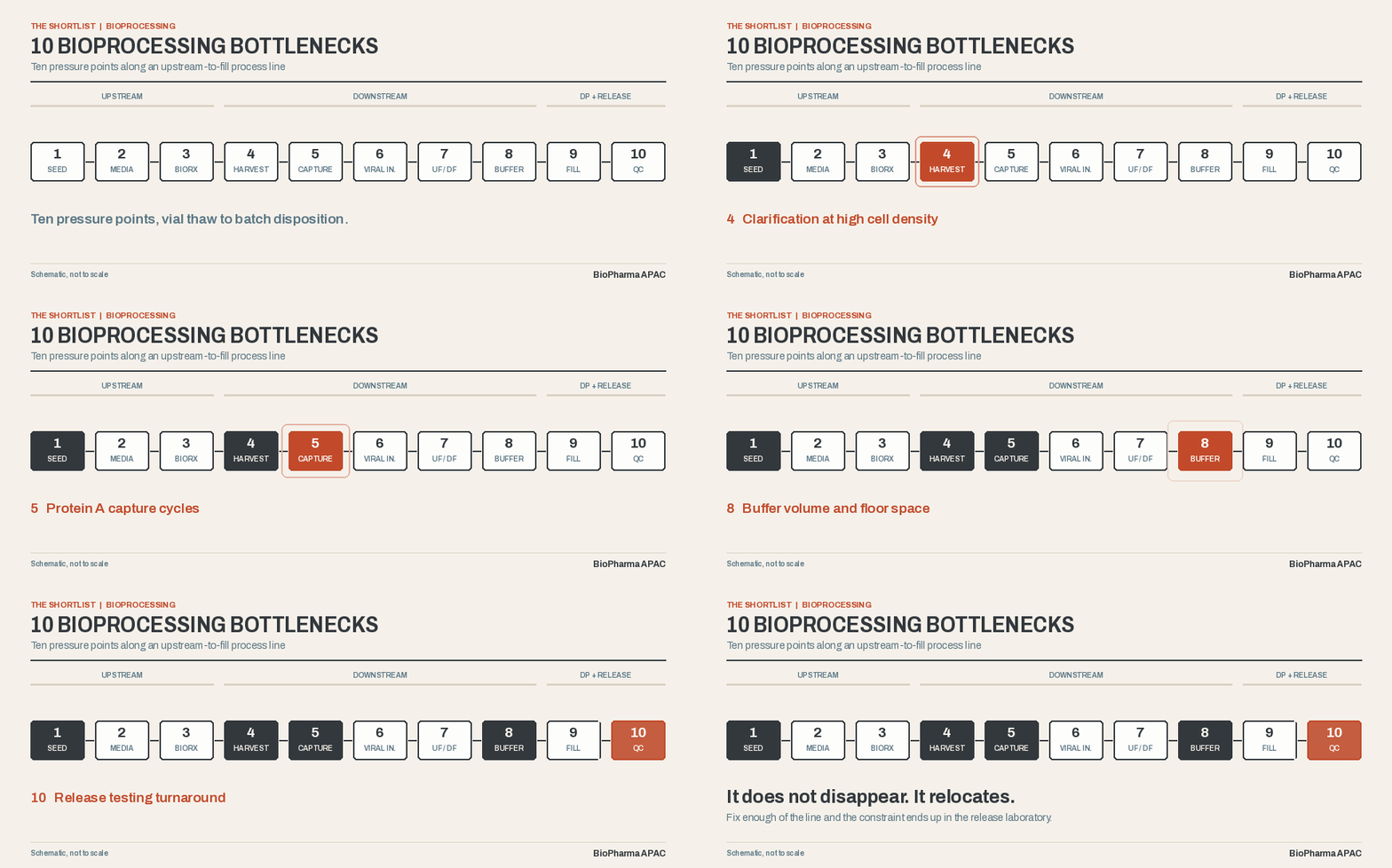
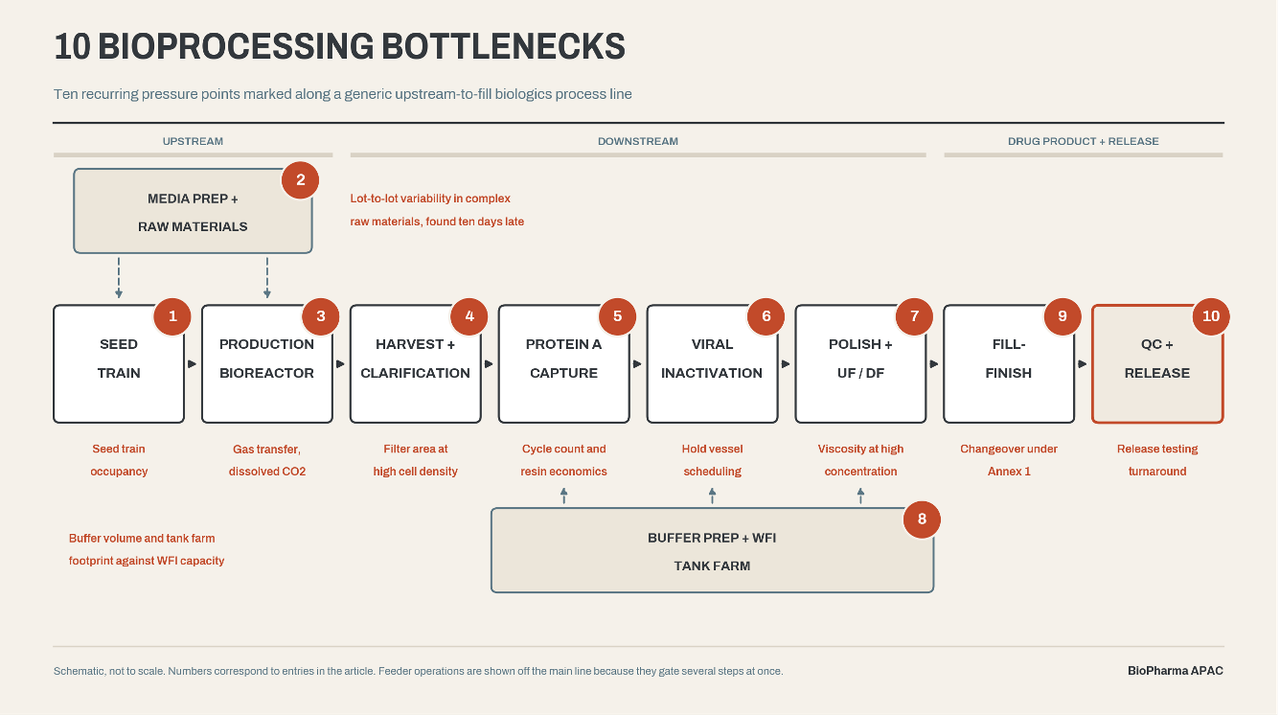
Where the line pinches: ten pressure points along a generic upstream-to-fill process line. Feeder operations sit off the main line because they gate several steps at once.
- The seed train spends three weeks producing nothing
Where it bites. Vial thaw through N-1. A conventional CHO seed train runs seven to eight expansion stages and takes roughly twenty-five to twenty-eight days before the production bioreactor is inoculated. In a plant running 2,000 L single-use trains, that is three weeks of suite time, operator hours and contamination exposure per batch, generating no product. It bites hardest at facilities running fewer than fourteen batches per line per year, where every day of occupancy is visible in the annual output number.
The fix. Run the N-1 stage in perfusion using a cell retention device, grow to 40 to 80 million cells per millilitre, and inoculate the production bioreactor at ten to forty times conventional density. Samsung Biologics has applied N-1 perfusion at 3,000 L stainless steel seed scale, which matters because it demonstrates the approach outside the single-use bench context where most published data sits. Reported outcomes across multiple CHO lines include seed train compression to roughly twelve to sixteen days and substantial titre gains from the shortened lag phase. The production bioreactor itself is not modified.
What the fix cost. Cell retention hardware runs approximately USD 50,000 to 150,000 per position. Add a perfusion-capable N-1 vessel and controller, an N-1 specific expansion medium, and six to twelve months of development and comparability work.
The trade-off. You buy back reactor days and you buy a new failure mode. Perfusion filters foul, retention devices are a sterile barrier with a pressure history, and N-1 media consumption rises sharply. Modelling published by Biopharm Services makes an uncomfortable point that vendor material tends to skip: a shorter upstream batch on its own does not always cover the added N-1 cost. The gain has to come from more batches per year or higher titre, not from the time saving as such.
Who it does not work for. CDMOs running a client's licensed process, unless the client will fund the comparability package. And any plant whose real constraint is downstream, where a faster seed train simply pushes more mass into a column that is already the limit.
- The hydrolysate lot that ruins a batch ten days later
Where it bites. Media preparation, but you find out at harvest. Lot-to-lot variability in complex raw materials, hydrolysates and peptones above all, shows up as titre drift, glycan shift or unexplained growth stalls a week and a half after the material was released on paper. Plants in the region carrying single-source supply for a critical component feel this most, and the exposure is worse where import lead times make a rapid switch impossible.
The fix. Stop qualifying raw material lots on certificate of analysis alone and start screening them functionally at micro scale. A micro-bioreactor system running incoming lots against a retained reference lot, with a defined accept and reject rule, turns a ten-day surprise into a two-week screening step. Several regional contract manufacturers have paired this with a qualified second source and a bridging lot held in reserve.
What the fix cost. A micro-bioreactor screening system runs roughly USD 400,000 to 900,000 installed, plus one to two dedicated analysts. Second-source qualification is its own comparability exercise.
The trade-off. You have added weeks to raw material release and raised inventory carrying cost, in a region where warehouse space and working capital are not free. You have also created a decision you now have to defend: rejecting a lot that met specification requires a documented rationale your quality unit will be asked about.
Who it does not work for. Fully chemically defined processes with a single product and a strong supplier commitment, where the variability is already low enough that the screening cost buys nothing. And small plants with no spare development capacity, which is most of them.
- Dissolved carbon dioxide at the top of the single-use bag
Where it bites. The production bioreactor, above roughly thirty to forty million cells per millilitre in 1,000 to 2,000 L single-use vessels. Single-use bags give you less sparger flexibility and less liquid height for stripping than the stainless vessels the intensified processes were often developed in. Oxygen transfer becomes marginal and dissolved carbon dioxide accumulates, pH control fights it with base addition, osmolality climbs, and the culture stalls in the last three days of a fourteen-day run.
The fix. Dual sparger operation, a microsparger sized for oxygen delivery and a drilled-hole or open-pipe sparger sized for carbon dioxide stripping, run on independent mass flow control with an increased headspace sweep. Where the bag film and port configuration will not support it, the honest fix is capping viable cell density below the point where stripping fails, and accepting a lower intensification target.
What the fix cost. The hardware is modest, typically in the low hundreds of thousands for gas skid and control upgrades. The real cost is a modified bag specification, its extractables and leachables bridging package, and three to six months of engineering runs to find the operating window.
The trade-off. Stripping harder means more foam, more antifoam, and antifoam carries forward into harvest where it fouls depth filters and can appear in clearance discussions. You have moved a gas transfer problem into a filtration problem. That is a good trade only if you have filtration headroom.
Who it does not work for. Plants already on stainless at this scale, which have the sparger flexibility and the liquid height and should be looking elsewhere. And any process locked to a specific bag configuration in the filed dossier.
- Harvest clarification does not scale the way the marketing said
Where it bites. Harvest and clarification. Intensification raises cell density and cell debris load together, and depth filter area requirements scale badly against both. Plants that intensified upstream without touching harvest discover the constraint as an eye-watering consumables line and a clarification step that has quietly become the longest operation in the suite. Floor space for the filter train is usually the hard limit rather than money.
The fix. Three routes are in commercial use in the region. Single-use continuous centrifugation ahead of a much smaller depth filter train; flocculation or precipitation pre-treatment to drop the particle burden before filtration; or continuous harvest through the cell retention device already installed for perfusion, which is why entry one and entry four are often solved by the same purchase.
What the fix cost. A single-use disc-stack centrifugation skid runs roughly USD 1 million to 2.5 million installed. The flocculation route needs almost no capital and instead spends heavily on clearance validation, which is the more expensive currency for a multi-product plant.
The trade-off. Flocculants are new leachables you must demonstrate you have cleared, per product. Centrifugation adds shear and a train to clean. Continuous harvest ties your downstream schedule to your upstream schedule, which removes the buffer that plant managers quietly rely on when something goes wrong.
Who it does not work for. Campaign facilities running many products, where per-product clearance validation multiplies the flocculation route out of contention. And plants harvesting monthly, where the clarification step is not on the critical path at all.
- Protein A is the ceiling, and the resin is the reason
Where it bites. Capture. Titre has gone up, the column has not, and the plant now runs six or eight cycles where it used to run three. Capture becomes the longest downstream operation, resin consumption becomes the largest single consumables line in the plant, and every additional cycle adds cleaning, carryover risk and lifetime pressure. Commercial-grade Protein A resin carries list prices in the region of USD 8,000 to 14,000 per litre, which is what makes the arithmetic unforgiving.
The fix. Two directions, often combined. Move to high-capacity, alkaline-stable resins with dynamic binding capacities above 60 grams per litre, which reduces cycles at constant column volume. Or move to rapid cycling on short bed heights, either through multi-column continuous chromatography or through fibre-based adsorbents that trade capacity for very short residence times and many small cycles. Disclosure: most published head-to-head performance data on this point comes from resin vendors, who are not disinterested parties, and this publication has commercial relationships across that supplier group.
What the fix cost. A multi-column continuous chromatography skid runs roughly USD 1.5 million to 3 million. High-capacity resin costs more per litre and less per gram, so the case rests entirely on your cycles-per-batch and your resin lifetime study.
The trade-off. More cycles means more cleaning cycles, a heavier resin lifetime and carryover validation burden, and in a multi-product plant, a harder argument about resin dedication. Continuous capture goes further and complicates something regulators care about: what constitutes a batch, and how pooling is defined for release.
Who it does not work for. Multi-product contract suites where resin is dedicated per client and utilisation per campaign is low, so cycling economics never arrive. And non-antibody products, where the capture step is a different problem entirely.
- The viral inactivation hold tank is holding the whole suite
Where it bites. Post-capture. Low pH viral inactivation is a short chemical event wrapped in a long logistical one: a tank or bag must be free, filled, adjusted, held, neutralised and emptied, and everything downstream waits. In space-constrained facilities, and much regional capacity is space-constrained by design, the hold vessel and its scheduling gate the suite more tightly than any unit operation's actual duration.
The fix. In-line viral inactivation through a tubular or coiled-flow reactor, with residence time distribution characterised experimentally so that worst-case minimum residence is demonstrated rather than assumed. The tank disappears, the step becomes continuous with capture elution, and hours of suite occupancy come off the schedule.
What the fix cost. A skid in the region of USD 300,000 to 800,000, plus the characterisation package. The characterisation is the expensive half.
The trade-off. You have replaced a tank and a clock, which any inspector understands immediately, with a residence time distribution, which requires you to defend a statistical argument about the fastest-moving fluid element. That demands stronger in-line monitoring and a much clearer deviation position when flow varies. Reviewers who have seen it are comfortable. Reviewers who have not will ask.
Who it does not work for. Products whose inactivation kinetics need long holds. And plants whose filing strategy includes a market where the assessor has not encountered in-line inactivation, unless you are willing to make your submission the teaching case.
- Viscosity at 180 milligrams per millilitre
Where it bites. Final ultrafiltration and diafiltration, on high-concentration subcutaneous formulations. Above roughly 100 to 150 milligrams per millilitre, viscosity rises non-linearly, flux collapses, the step stretches from hours into a shift, and hold-up volume in the cassettes takes a yield bite that is invisible until you weigh the retentate. The step also warms, and warm concentrated protein aggregates.
The fix. Single-pass tangential flow filtration ahead of the final concentration step, so the conventional system starts from a partially concentrated feed and spends less time in the difficult region. Paired with formulation work on viscosity-reducing excipients, and with deliberate temperature control rather than incidental temperature drift.
What the fix cost. Single-pass cassettes and skid modification in the region of USD 200,000 to 600,000. Formulation screening is development spend rather than capital, and it is per molecule.
The trade-off. Single-pass systems add their own hold-up volume, so you can trade processing time for yield if the system is oversized. Excipient changes touch the formulation, which for a filed product is not a process change, it is a regulatory event. Running warmer buys viscosity and spends aggregation margin.
Who it does not work for. Plants filling at 20 to 50 milligrams per millilitre, who do not have this problem. And biosimilar manufacturers locked to an originator formulation, who cannot use the excipient half of the fix at all.
- A third of the floor is buffer
Where it bites. Everywhere downstream, and in the building itself. Conventional buffer preparation puts large hold tanks, water for injection demand, clean-in-place cycles and a preparation crew between you and every chromatography step. In intensified plants running titres of 5 to 10 grams per litre, buffer demand has grown with the process while the tank farm has not, and buffer preparation starts dictating the production schedule rather than following it.
The fix. In-line dilution from buffer concentrates, or in-line conditioning from single-component stock solutions blended in real time. Published vendor data, from Cytiva among others, reports buffer hold tank volume reductions of up to 90 per cent, total stock solution volume reductions of up to 79 per cent, and footprint reductions of around 40 per cent against traditional preparation. Several large regional facilities have used the reclaimed floor for additional process suites, which is the actual return. The alternative fix is outsourcing buffer supply entirely, converting capital into an operating cost and a lead time exposure. Disclosure: the quantified figures above originate with equipment suppliers rather than with independent operators.
What the fix cost. An in-line conditioning skid with its automation runs roughly USD 1 million to 2.5 million. Computer system validation is a meaningful share of that.
The trade-off. Buffer quality now depends on a real-time conductivity and pH control loop rather than a prepared, tested and released tank, which changes what your quality unit is signing. And you have concentrated risk: one skid down stops every step it feeds. Outsourcing has the same shape, with an ocean added.
Who it does not work for. Plants whose constraint is chromatography time rather than buffer supply, who would be buying elegance. And sites without in-house automation and validation capability, who will find the skid is the cheap part.
- Fill-finish is the line, and the line is the plant
Where it bites. Drug product. Fill-finish is where most regional expansion is now aimed and where the constraint is hardest to relieve, because it is a single asset with a fixed hourly rate and a changeover time measured in shifts. Annex 1 has tightened this further: the barrier requirement is now the default assumption for any new line, and decontamination cycles have become part of the throughput calculation rather than an overhead nobody measured.
The fix. Isolator lines running ready-to-use nested components, with format families deliberately restricted, and with the vaporised hydrogen peroxide cycle developed for aeration time rather than only for kill. Aeration, not sterilisation, is usually what sits on the critical path. Restricting the format range is the unglamorous half of the fix and often the larger half.
What the fix cost. An isolator filling line lands somewhere between USD 15 million and 40 million installed, depending on format range and inspection automation. Ready-to-use components cost more per unit than bulk components, permanently.
The trade-off. Format lock. You have bought throughput by giving up the ability to take unusual jobs, which is precisely the business a growing contract manufacturer uses to fill gaps between anchor contracts. Consumable cost per unit rises for the life of the asset.
Who it does not work for. Clinical and advanced-therapy fills with many small formats and unpredictable demand. And any site whose annual unit volume sits below the point where the line pays for its own idle hours, a threshold that a surprising number of regional business cases assume rather than calculate.
- The batch is finished and the batch is not released
Where it bites. After everything. End-to-end release, from sampling to disposition, commonly runs 25 to 40 days against a target of 15 to 20, and the variance is worse than the average. Compendial sterility testing takes 14 days. Culture-based mycoplasma testing takes up to 28. Add analytical queueing, out-of-specification investigations and batch record review, and a plant that has spent USD 3 million debottlenecking upstream can find its cycle time unchanged, because the constraint was never in the suite.
The fix. Two moves, and they are independent. Rapid microbiological methods, automated growth-based systems for bioburden and environmental monitoring, respiration or ATP-based rapid sterility, and PCR-based mycoplasma detection, which compress those tests to days. Samsung Biologics is the most visible regional adopter of automated growth-based microbial quality control at scale. Separately, electronic batch records with review by exception, which attacks the review half of the number rather than the incubation half.
What the fix cost. The instrument is rarely the issue. The validation package is: comparability against the compendial method across the organism panel, limit of detection, specificity, ruggedness, robustness, then acceptance market by market. Twelve to twenty-four months per method per market is a realistic planning assumption.
The trade-off. Acceptance is not uniform across the markets a regional plant exports to, so many sites run the rapid method for release decisions and the compendial method in parallel for years. That is two methods, two sets of consumables and two sets of data to reconcile, and any discordant result becomes an investigation. The compendial method remains the referee.
Who it does not work for. Single-market plants with a conservative assessor and no near-term filing plans elsewhere. And low-batch-count facilities, where the validation spend divided by the batches it accelerates produces a payback measured in decades.
|
Three constraints that are not on the process line The schematic accompanying this piece marks ten pressure points between vial thaw and disposition. Three of the constraints operators raise most often do not appear on it, because they are not unit operations. The process you do not own. A contract facility cannot intensify a licensed process without the licence holder, and the licence holder's regulatory group is measured on approvals, not on your plant utilisation. This is the single largest reason good engineering ideas die in regional contract facilities, and no equipment purchase addresses it. The workaround that does work is scoping intensification into new tech transfers at the point of process fit, before the process is filed, rather than proposing it afterwards. Consumable lead time. Filters, bags, cassettes and resins mostly arrive from somewhere else. A plant that has debottlenecked to sixteen batches a year on an eighteen-week consumable lead time has built a beautiful machine bolted to a slow one, and safety stock is working capital that finance will question in every quarter that nothing goes wrong. The slowest regulator becomes the design authority. A plant exporting to six markets tends to build to the most conservative assessor among them, because a divergent control strategy is more expensive to maintain than a conservative one. This is a rational choice made facility by facility that produces an irrational aggregate: regional capacity designed to a standard nobody actually requires, held there by the market least likely to move. |
What the ten have in common
Read the entries together and four things stand out.
The first is that the fixes cluster into two families: those that leave the filed process untouched and those that do not. N-1 perfusion, in-line buffer preparation, rapid microbiological methods and electronic batch records are, broadly, facility decisions. Sparger redesign, flocculation, continuous capture, in-line inactivation and formulation change reach into the dossier. In a region where contract manufacturing is a large share of installed capacity, that distinction predicts which fixes actually get installed far better than any technical merit does.
The second is that money is rarely the binding constraint. Nine of the ten entries have a capital cost that a mid-size regional operator can fund. What they cannot always fund is eighteen months of a development group's attention and a regulatory affairs argument in four jurisdictions.
The third is that nobody publishes the calendar. Capacity announcements are abundant across the region. Qualification timelines, the interval between purchase order and validated routine use, are almost entirely absent from public disclosure, which leaves every operator planning their own with vendor optimism as the only available benchmark. An operator willing to publish one honest qualification calendar would do more for regional practice than another capacity press release.
The fourth is the cheapest finding here, and the one plant managers confirm most readily. A meaningful share of the throughput recovered in these facilities came from scheduling, campaign sequencing and changeover discipline rather than from anything purchased. It does not photograph well and no vendor will help you build the business case. It is frequently the first thing that should be tried and the last thing that is.
arcilla.fran@biopharmaapac.com
Sources and method
Bottlenecks were selected on recurrence rather than severity: a constraint qualified for the list when it was raised independently by operators at more than one facility, or appeared in more than one published regional case study, and could be paired with a fix that has been implemented rather than proposed. Entries are ordered by position on the process line and are not ranked.
Quantified claims draw on the following, all consulted in the current publication cycle: technical and modelling literature on N-1 perfusion and seed train intensification, including published process modelling by Biopharm Services and vendor implementation material from Repligen and Cytiva; commercial Protein A resin list pricing as reported in market analysis published in May 2026; peer and trade literature on next-generation Protein A media and dynamic binding capacity; buffer management technical literature from Cytiva and coverage in BioPharm International and Separation Science on in-line dilution and in-line conditioning; release testing turnaround data from Element and from published quality control cycle-time practice benchmarks; EU GMP Annex 1, in effect since 25 August 2023; and public disclosure by Samsung Biologics on seed train intensification at stainless scale and on automated growth-based microbial quality control.
Vendor-origin figures are identified as such inside the entries that use them. No interview material is quoted in this version; quotations will be added at the reporting stage and no quotation has been constructed or paraphrased into quotation marks. Where a site could not be named, the entry describes the facility type, scale and configuration instead.
Cost figures are indicative ranges for planning discussion, not quotations. Landed cost in any specific market will differ with duty, local fabrication content, currency and commissioning labour.
Disclaimer
Editorial independence. This article was commissioned, researched and written independently. No party paid for inclusion, review or placement, and no commercial discussion relating to this subject took place before the list was locked.
Indicative costs. All financial figures are order-of-magnitude planning ranges assembled from list pricing, published estimates and contractor ranges. They are not quotations and should not be used as the basis of a capital submission.
Vendor material. Several performance claims originate with equipment and consumable suppliers who have a commercial interest in the outcome. These are identified inside the relevant entries. Readers should treat single-source vendor performance data as a starting point for evaluation rather than as an independent result.
Site attribution. Named sites appear only where the operator has placed the information in the public domain. Other entries describe a facility rather than naming it, at the operator's request. A described site is a real one.
Not engineering or regulatory advice. Nothing here constitutes engineering, quality or regulatory advice for a specific facility. Process changes, control strategy changes and analytical method changes carry filing consequences that are jurisdiction and product specific and must be assessed by qualified personnel.
Corrections and right of reply. Any operator or supplier who believes a statement here is inaccurate may respond and a correction will be published. Corrections are issued in the same channel and at the same prominence as the original.
Copyright 2026 BioPharma APAC. All rights reserved. No part of this article may be reproduced or redistributed without written permission.
Most Read
- Can APAC Biomanufacturing Decarbonise Without Pricing Itself Out?
- The Algorithm on the GMP Floor: AI Promises a Smarter Plant. Regulators Demand the Audit Trail.
- APAC's Peptide-Capacity Gamble
- After the Rush: APAC's mRNA and Vaccine Capacity Hangover
- The Biosimilar Race: Factory to the World — or Stuck in the Copycat Economy?
- The Vein-to-Vein Problem: Can APAC's Cold Chain Carry Advanced Therapies?
- Vectors, Plasmids and the CGT Trap: APAC's Cell and Gene Therapy Ambitions Face an Upstream Bottleneck
- Can APAC Build Radioligand Therapy Before the Atoms Decay?
- The Great Biopharma Reset: 50 Developments That Changed Everything in H1 2026
- Beyond the Trial: Can Real-World Evidence Earn Regulatory Trust in APAC?
- Beyond the Obvious Giant: Where APAC's Clinical Trials Go Next
- The Frontier That Won’t Quite Arrive
Bio Jobs
- Sanofi Turns The Page As Belén Garijo Steps In And Paul Hudson Steps Out
- Global Survey Reveals Nearly 40% of Employees Facing Fertility Challenges Consider Leaving Their Jobs
- BioMed X and AbbVie Begin Global Search for Bold Neuroscience Talent To Decode the Biology of Anhedonia
- Thermo Fisher Expands Bengaluru R&D Centre to Advance Antibody Innovation and Strengthen India’s Life Sciences Ecosystem
- Accord Plasma (Intas Group) Acquires Prothya Biosolutions to Expand Global Plasma Capabilities
- ACG Announces $200 Million Investment to Establish First U.S. Capsule Manufacturing Facility in Atlanta
- AstraZeneca Invests $4.5 Billion to Build Advanced Manufacturing Facility in Virginia, Expanding U.S. Medicine Production
News