ISCT And JSRM Form Five Year Global Partnership To Accelerate Clinical iPSC Therapies
05 March 2026 | Thursday | News
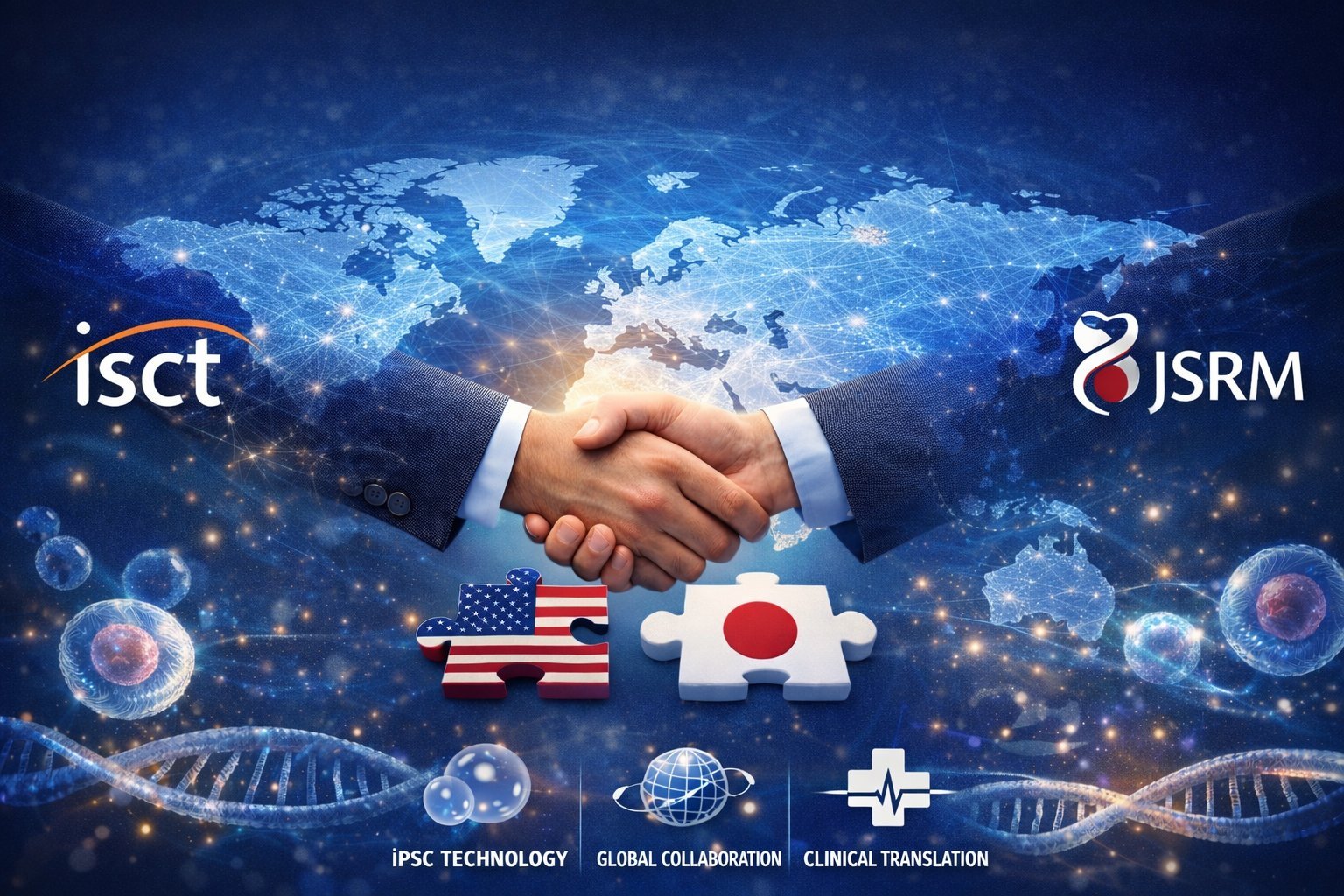
The International Society for Cell & Gene Therapy (ISCT), the translation-focused global community of cell and gene therapy experts and the Japanese Society for Regenerative Medicine (JSRM), advancing iPSC-based therapies, jointly announce a 5-year strategic partnership to advance iPSC-based therapies globally.
The ISCT–JSRM Joint Strategic Collaboration on Clinical iPSCs represents a landmark in the history of international regenerative medicine collaboration. Building on the International Society for Cell & Gene Therapy's (ISCT) three-decade legacy of translating cell and gene therapy research into safe, effective, and accessible therapies worldwide, and the Japanese Society for Regenerative Medicine's (JSRM) pioneering role in translational research, including the world's first clinical application of iPSC-derived cells, the mission of this collaboration is to advance developments towards a global infrastructure that enables access to safe and effective iPSC-based therapies.
"There are big challenges ahead. By leveraging the networks and expertise of both ISCT and JSRM, however, we will create a meaningful global collaboration that will set a standard of knowledge, of approach, and of integration," said Masayo Takahashi, MD, PhD, JSRM Chair for the ISCT-JSRM Joint Collaboration. "Working together, we will accelerate harmonization across key sectors in regulation, medicine, and industry, so that patients not only in Japan, but across the globe, can benefit."
"This is a formative time for iPSCs. The first rigorous clinical trials are beginning to be reported, particularly in Japan. Regulatory structures have been framed but need to be harmonized internationally. Automated platforms for high quality manufacturing for single individuals and large populations are coming online. Our ISCT-JSRM Collaboration is an essential forum for clinicians, scientists, industry, regulators, patients, and payors to share new data and distill opportunities into targeted, safe, effective, and accessible therapies." said George Muschler, MD, ISCT Chair for the ISCT-JSRM Joint Collaboration.
The ISCT–JSRM Joint Collaboration is a continuous, outcomes-focused initiative that will identify emerging bottlenecks, develop and implement solutions, and deliver measurable progress year after year for the sector. By convening expertise from across the globe, this collaboration will construct an infrastructure that fully realizes the social and economic value of clinical iPSCs.
A Strategic Five-Year Vision
Beginning in 2026 at the 25th JSRM Annual Meeting in Kobe, the birthplace of human iPSC transplantation, the Joint Collaboration will host annual events to share insights into key challenges being addressed and provide updates on the Collaboration's activities. These events will alternate annually between JSRM and ISCT annual meetings.
"Alongside ISCT, we see the pathway ahead to fulfilling the promise of iPSCs at a global scale. We are excited to work together on these key events, so that we can both bring our work to the global table, and also learn from others in the CGT space, especially those clinical and regulatory developments that will further shape our success," said Kohji Nishida, MD, PhD, President of JSRM.
The ISCT-JSRM Collaboration will prioritize and advance developments in the following areas:
- Advance clinical translation through shared expertise in trial design, patient recruitment, real-world data integration, and multinational trial networks.
- Drive technological innovation by setting global safety characterization standards, integrating AI and automation, and enabling scalable, cost-effective manufacturing.
- Enable regulatory innovation that reduces approval timelines for iPSC-products without increasing risks for patients.
- Harmonize regulations across jurisdictions to accelerate approval pathways, reduce operational costs, and ensure consistent GMP standards.
- Educate and train across sectors — building capacity from laboratory research to commercial manufacturing, policy, and patient advocacy.
- Promote commercial realization through sustainable reimbursement models and early engagement between developers and payors.
- Strengthen medical affairs to connect clinical evidence with regulators and policymakers
"iPSCs provide a unique opportunity for the CGT field as research begins to mature into therapies. There is no stronger foundation here than a proven clinical application, and JSRM has been a driving force in building that foundation," said Miguel Forte, MD, PhD, President of ISCT. "Together with our partners at JSRM, ISCT will leverage its global network to drive advancement from foundation to ecosystem, from region to globe. Success here will blaze a trail for other CGT platforms that are advancing at an accelerating pace."
ISCT and JSRM acknowledge the leadership and dedication of the Joint Collaboration's Organizing Committee, comprised of leaders from both organizations, in advancing this landmark international initiative.
Most Read
- Can APAC Biomanufacturing Decarbonise Without Pricing Itself Out?
- The Algorithm on the GMP Floor: AI Promises a Smarter Plant. Regulators Demand the Audit Trail.
- APAC's Peptide-Capacity Gamble
- After the Rush: APAC's mRNA and Vaccine Capacity Hangover
- The Biosimilar Race: Factory to the World — or Stuck in the Copycat Economy?
- The Vein-to-Vein Problem: Can APAC's Cold Chain Carry Advanced Therapies?
- Vectors, Plasmids and the CGT Trap: APAC's Cell and Gene Therapy Ambitions Face an Upstream Bottleneck
- Can APAC Build Radioligand Therapy Before the Atoms Decay?
- The Great Biopharma Reset: 50 Developments That Changed Everything in H1 2026
- Beyond the Trial: Can Real-World Evidence Earn Regulatory Trust in APAC?
- Beyond the Obvious Giant: Where APAC's Clinical Trials Go Next
- The Frontier That Won’t Quite Arrive
Bio Jobs
- Sanofi Turns The Page As Belén Garijo Steps In And Paul Hudson Steps Out
- Global Survey Reveals Nearly 40% of Employees Facing Fertility Challenges Consider Leaving Their Jobs
- BioMed X and AbbVie Begin Global Search for Bold Neuroscience Talent To Decode the Biology of Anhedonia
- Thermo Fisher Expands Bengaluru R&D Centre to Advance Antibody Innovation and Strengthen India’s Life Sciences Ecosystem
- Accord Plasma (Intas Group) Acquires Prothya Biosolutions to Expand Global Plasma Capabilities
- ACG Announces $200 Million Investment to Establish First U.S. Capsule Manufacturing Facility in Atlanta
- AstraZeneca Invests $4.5 Billion to Build Advanced Manufacturing Facility in Virginia, Expanding U.S. Medicine Production
News